Scoop: ICE Plans to Descend on Phoenix
Following L.A., Chicago, and Charlotte, DHS now intends to scale up arrests—and its network of detention facilities—in Maricopa County.


ALTHOUGH DONALD TRUMP’S IMMIGRATION AGENDA is becoming less and less popular with voters, the president has shown no interest in slowing it down or scaling it back in the new year.
In fact, the federal crackdown is likely to only grow in scope and intensity, as Reuters reported. And as three former DHS officials in contact with their former colleagues at the agency each described to me, the expectation among current officials is that one Democratic-led city in particular is about to become the next focus of arrests, detentions, and deportations: Phoenix.
A more robust DHS presence in the Phoenix metropolitan area would mark a new phase in the Trump operations—not just because it would take place in one of the country’s most significant swing states (and a border one, at that), but because it would likely involve a greater expenditure of federal resources than prior operations in other cities have required.
ICE is flush with cash following last year’s passage of the president’s signature piece of legislation, the “Big Beautiful Bill.” And the administration is looking to use that money to dramatically expand its detention capabilities. Residents in Arizona have already been fighting plans to turn the former Marana prison outside Tucson into a detention center. And the Washington Post reported recently that ICE is planning to construct seven large-scale industrial holding centers—including a facility in Glendale.
One of the three former senior DHS officials said that adding thousands more beds in the areas surrounding Phoenix would allow the administration to turn the city into a “hub of removal” in the Southwest.
“Right now, if you put 5,000 more beds in Phoenix, you have more expansive throughput,” the former senior DHS official said. An increase on that level would make it possible for federal agents to significantly expand their operations in other Western cities, including Denver, Las Vegas, and L.A.
“Arizona becomes another hub like [the Rio Grande Processing Center],” the official added.
As part of its growing presence in Arizona, DHS is expected to build controversial soft-sided facilities, the former official relayed. The tent-like structures are easier to put up quickly, but they are difficult to manage humanely because of their greater exposure to the elements, which contributes to a variety of serious problems for detainees. Soft-sided facilities have already been controversial during Trump’s second term: Florida opened a detention center in the Everglades, soon nicknamed “Alligator Alcatraz” by the administration, and continues to operate it in spite of horrifying reports about the conditions being faced by the 6,725 men who have been or are currently being held there. (A court case is pending that could result in the closure of the detention camp; it has already survived multiple legal challenges to its continued operations.)
Elsewhere, the use of soft-sided detention centers has expanded. The $1.24 billion facility in Fort Bliss held 1,000 detainees when it opened in August; it is intended to hold up to 5,000 people.
The timeline of increased operations in the Phoenix area is unclear. While it’s a safe bet that the administration plans to use the same playbook it used in other cities, there could be some notable differences.
Andrea Flores, who served as the director of border management on the National Security Council during the Biden administration and oversaw coordination between ICE and CBP, warned that the use of soft-sided facilities as overflow immigration detention space raises significant humanitarian concerns.
“It’s extremely expensive, and these are not spaces people should be in for a long time, frankly—they were very poorly managed even under Biden,” she told me. “The concern is you expand soft-sideds to expand detention space, but just because you do doesn’t mean you can expand removals. Then you’re just going to have a bunch of people detained in the desert.”
Flores added that in its obsessive quest to remake immigration enforcement, the Trump administration has been treating every novel idea as a good one. That fixation on novelty has led to the implementation of some truly bad ideas.
“Alligator Alcatraz was unique and also a failure,” she said. “It didn’t necessarily ramp up deportations, it just put them in intensely inhumane conditions.”
DHS spokesperson Tricia McLaughlin did not respond to a request for comment on the prospect of an enforcement ramp-up in the Phoenix metro area in January.
A History of Opposition: From SB 1070 to a Blue-Hued Arizona
There is another reason that DHS’s Phoenix operations will be different from the ones the department has undertaken in other cities: Arizona’s history of wrenching political fights over immigration and the border.
Arizonans have many scars from these battles. Fifteen years ago, many fought State Sen. Russell Pearce’s show-me-your-papers law, SB 1070. Around that time, a constellation of activists and organizers mobilized against then–Maricopa County sheriff Joe Arpaio. They, alongside Republicans who recoiled at the party’s embrace of Trumpism, turned Arizona from a ruby-red state—one that hadn’t gone blue since 1996—to a state Joe Biden won in 2020. Arizona now boasts two nationally known Democratic figures in Sens. Ruben Gallego and Mark Kelly; it also has a Democratic governor, Katie Hobbs.
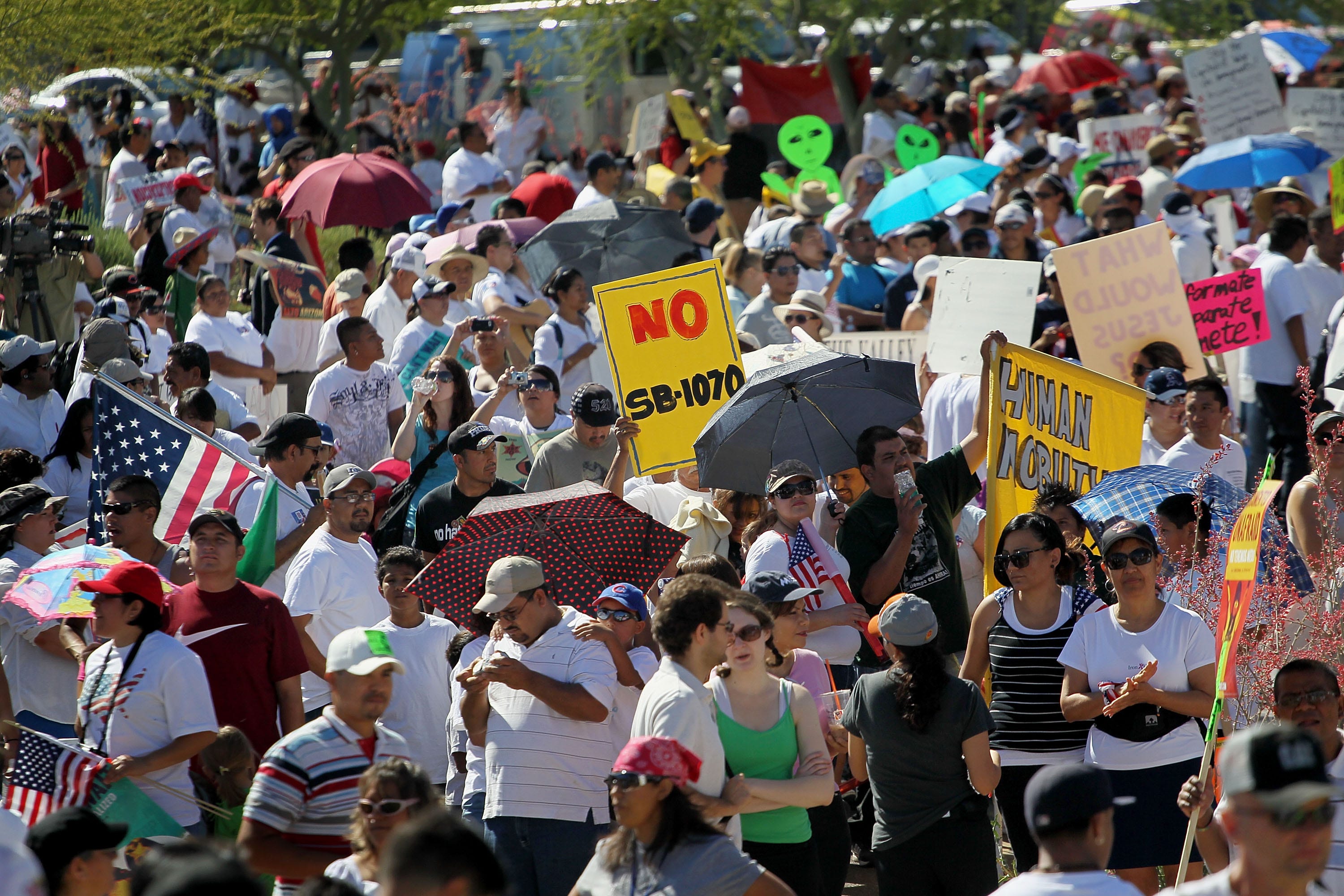
What Arizonans told me is they now see in Trump an Arpaio at the national level—and a threat to immigrants that is that much broader.
“Here, specifically in Southern Arizona, we’ve been anticipating something like this happening,” Rep. Adelita Grijalva (D-Ariz.) told me. “In Tucson, the mayors met with Pima County elected officials and the Tucson police department, who have all taken strong positions that none of our government resources are going to be used to help ICE in any way.”
From the Marana prison in Grijalva’s backyard to the reports of future warehouses stuffed with immigrants, the congresswoman has many vectors of DHS’s operations in view, and she said she’s going to keep pushing back against all of the department’s encroachments in her state.
“I don’t want any kind of detention facility here, people languishing, given no kind of process at all,” she said. “I have not been able to see constituents in Florence and Eloy, so I think I’m just going to start showing up. They have to meet that quota, and the only way to do it is illegally.”
Representatives of grassroots groups preparing for the influx of federal agents say the groups are currently working as a loose network of organizations with no formal leadership structure. The members of the ad-hoc coalition include NDLON; LUCHA AZ, a mainstay in organizing as well as political work activating Latino voters in the state; most of the local labor unions; established groups like Chicanos Por La Causa; and some more radical entities such as the Party for Socialism and Liberation.1 To a person, the activists I spoke with say the state has been in this precarious place before.
“This has been tried before and failed with Joe Arpaio’s tent city and the Arizona experiment with early onset Trumpism changed the state from red to blue,” said Chris Newman, the general counsel of the National Day Laborer Organizing Network (NDLON). Newman noted that even the current backlash to Trump’s immigration crackdown has reminded many Arizonans of what happened in their state during the Arpaio era. “Pretty much all of the activism that you see in the immigrant rights movement right now is emulating the type of response that civil rights leaders demonstrated in Arizona in 2010, which was the seminal year.”
“Linked Fates”
So what will the reaction in the Phoenix area be to more aggressive anti-immigration operations?
Alejandra Gomez, the head of LUCHA AZ, has picked up on several clues. She told me her group conducted a research study during the spring and summer of 2024 that included 1,400 Latino voters, from first generation to fourth, from the most traditional voter to the most skeptical ones. It found that Latinos in Arizona felt a sense of “linked fates” regardless of their immigration status or how long they’d been here.
She also recalled the march of tens of thousands of Arizonans on the state capitol in 2010 to protest SB 1070. More of that kind of resistance will be in order should Trump escalate enforcement in the state, she said.
“There’s a muscle memory that will come together when we begin to see the supercharged version of this,” she predicted. “If there is fear, people are still acting. If there is anger, people are still acting. If there is sadness, people are still acting. What is also true is people are still living and not allowing the intimidation from this administration to stop quinceañeras or weddings.”
Newman agreed.
“If the Trump administration escalates enforcement activities in Arizona, that will be met with an escalation of nonviolent protest,” he said.
But is it possible we live in a different time? Could it be that what worked in 2010 during a nascent anti-immigrant moment won’t succeed now? The state dealt more directly than others with more lax border policies under Joe Biden; could that history have helped prepare it to embrace something more extreme in the opposite philosophical direction?
One of the state’s top pollsters—who worked for one of the state’s more prominent conservatives—doesn’t think so.
Chuck Coughlin served as a campaign manager for former Republican governor Jan Brewer during the battle over SB 1070; today, he is the president of HighGround, a polling operation in Arizona. He told me increased enforcement in Phoenix won’t go over well with voters, and it especially won’t go over well with voters in Maricopa County, which is home to 60 percent of the state’s electorate.
“I don’t look at this as being a positive move in Maricopa county, it’s not going to play well,” Coughlin said. “Everybody believes the border control problem is under control. That was always the issue that created the angst back when I worked for Brewer. Back then it was that people were coming over the border with impunity, that’s not happening at all now, so that sentiment isn’t there.”
I heard something hilarious from a veteran Arizona activist. As opposition to Trump grows, the old guard have had to get used to the growing involvement of younger and more radical activists. She recalled that when longtime Arizona activists told PSL advocates during an early L.A. protest last year that they may not want to wave Mexican flags because of the optics, “the kids were like, ‘Fuck you!’”
I am 72 and have lived in Arizona for 61 years now, and the last 40 years in Phoenix. I am sick of going through this God damn nonsense about immigrants. Immigrants as a group keep us afloat in this state. Picking crops, replacing roofs, landscaping, home building, service industries, housecleaning, and so many more jobs. Any of the jobs I listed that are primarily outdoors in Arizona are not wanted or filled by white Arizonans, and few legal residents of any ethnicity. In Phoenix it routinely hits 110 degrees June through September. And of course often 115 and much higher. Let Barron Trump take any one of these jobs and see if he can even step outdoors into the heat.
Donald Trump is trying to build something really really nasty here using human beings. We cannot allow this. I cannot allow this. I didn't step up and protest SB1070 because I was directing a significant piece of the ACA development in Arizona, which not only was my job, but was also extremely important to me, and my boss reported directly to Republican Governor Jan Brewer. But I retired 11 years ago and I am free to say whatever I want. And I will be out there marching against this and finding other ways to contribute to the fight against ICE and Donald Trump.
Let’s see; failure in LA. Failure in Chicago. Failure in Portland, Oregon. Failure in DC. Failed in San Francisco. Failed in New York City. If this was baseball, that player would be removed permanently. Yet, this administration is going to Phoenix. And the Supreme Court does nothing. The next No Kings March should be 14 million!