There’s Something Weirdly Familiar About This New GOP Argument
Republicans’ latest attempt to win the shutdown fight shows they still don’t get it on Obamacare.

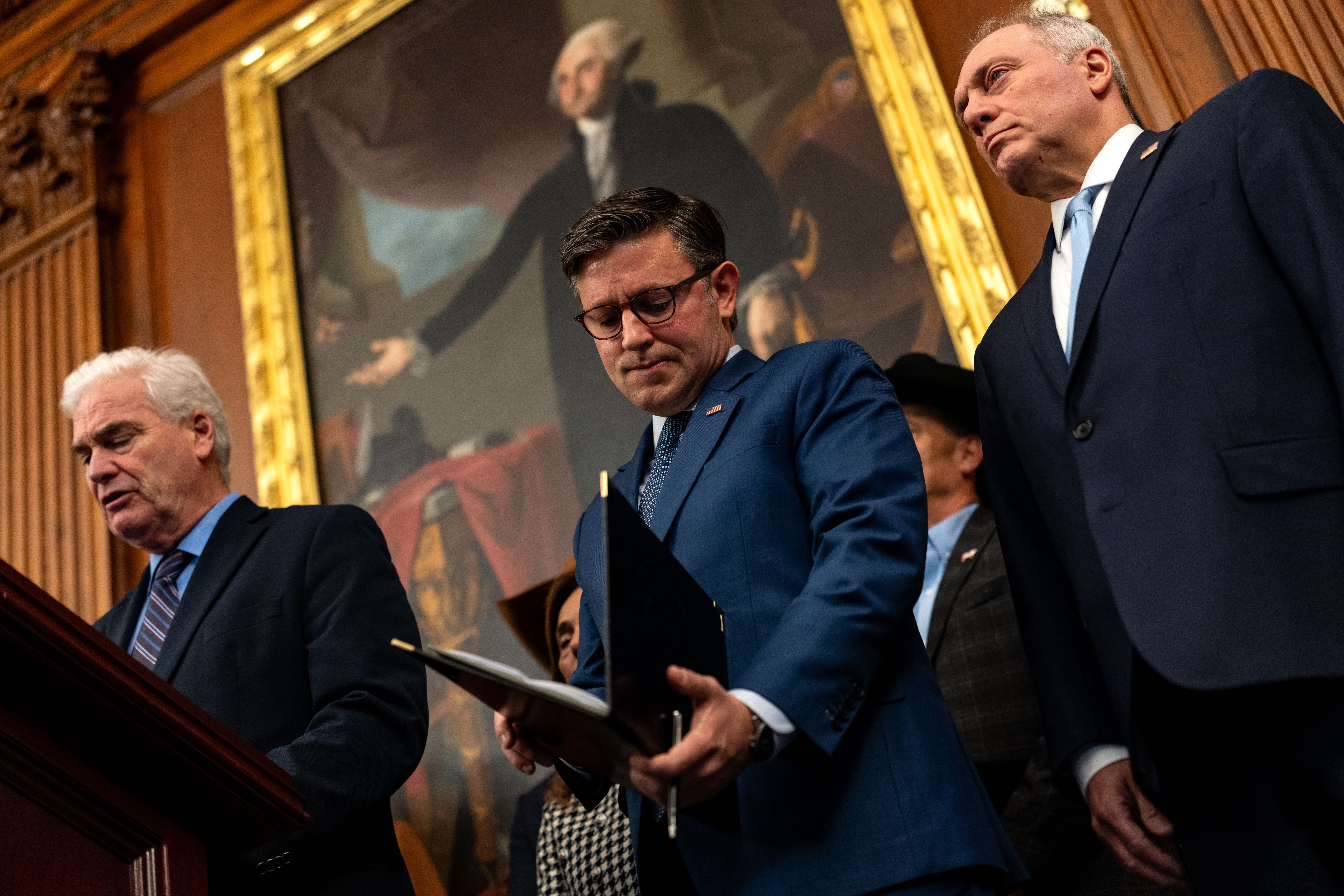
THE LATEST REPUBLICAN TALKING POINT on the government shutdown sounds like one you’ve heard many times before: Obamacare sucks.
It’s their new argument for why a temporary boost to the Affordable Care Act’s subsidies should expire on schedule after December instead of being renewed or made permanent. If the money stops, insurance premiums will double for more than 20 million Americans. But Republicans are insisting that’s okay, because the system itself can’t be saved. Here’s House Majority Leader Steve Scalise on Friday, making the case:
Why would you keep pouring billions more tax dollars into a sinkhole when you can find a better way? We actually are working on better alternatives right now to lower premiums for families. That’s where the focus should be, not propping up a failed product called Obamacare.
The argument sounds familiar because Republicans have been calling the Affordable Care Act a failure ever since President Barack Obama first signed the legislation in 2010. Its reappearance now, going into the third week of the shutdown, feels like an acknowledgment that unfounded claims about giving free insurance to “illegal aliens” and bailing out insurance companies haven’t won the public to the Republican party’s side.
The switch to this latest broadside against Obamacare could, in theory, help Republicans, given that talking about problems in U.S. health care is bound to resonate. Even today, fifteen years after the Affordable Care Act’s enactment, tens of millions of Americans still have no insurance or have coverage yet struggle with medical bills. That’s to say nothing of the byzantine bureaucracies that make life miserable for both patients and providers—or the heavy financial burden that U.S. health care costs, still the world’s highest by far, place on businesses and governments and through them employees and taxpayers.
But there is also a flaw in what Republicans like Scalise are saying: Not even Obama himself ever promised his eponymously nicknamed law would solve all of America’s health care problems. The promise was that it would make things better—primarily, by helping a ton of people to get insurance, moving us closer to the day when health care is a basic right of citizenship like it is in every other developed country.
And if there’s any doubt about whether the Affordable Care Act succeeded in that task, all you have to do is remember all of the problems in American health care before the law took effect; why fixing them was so damn hard; and why even many of the law’s skeptics now have conceded they can’t go back to a time before the law was passed.
LIFE BEFORE THE AFFORDABLE CARE ACT was pretty different, though it’s been long enough that some people seem to have forgotten.
Back in 2008, when Obama first ran for president, 45 million people had no health insurance, accounting for a bit more than 15 percent of the population. They were primarily people who couldn’t afford the insurance that was available, along with people who had pre-existing conditions that insurers would refuse to cover. And when they couldn’t get medical care or pay their bills, bad things happened.
They went into debt. They skipped going to a doctor or rationed their care. They got sick. Sometimes they died.
These were not new problems. Their roots lay in decisions made in the early twentieth century, when medicine was first becoming expensive enough that most people couldn’t afford it. Every other economically advanced country responded by creating some kind of national health system that guaranteed private or public insurance to every citizen, with financing through taxes and some kind of overall government control on prices.
Efforts to create a similar system in the United States fizzled. What emerged instead by the middle of the century—through a combination of private and public-sector action—was a messy patchwork that relied primarily on employers to provide insurance to workers and their families. Although it worked for some people, it left out those who were poor or didn’t have a lot of money—even after the 1965 creation of Medicare, to cover the elderly, and Medicaid, to cover (some of) the poor.
Nobody ever thought this arrangement was ideal. But with every passing year, changing it became more difficult because of everybody with a stake in the status quo. That included the insurance industry, organized medicine, and all sorts of interest groups—as well as those already insured who, whatever their grievances with the way things were, worried the alternatives would be worse. That factor loomed especially large in the minds of Obama and his allies, many of whom had worked on the Clinton health care effort in the 1990s. Going in, they were determined to succeed where past reformers had failed, by filling in the system’s gaps rather than trying to wreck and rebuild it—and by co-opting (or at least not alienating) all of the powerful interest groups that had stymied past reform efforts.
The gambit worked: They were able to pass the single biggest health care reform in more than forty years, causing the number and percentage of Americans without coverage to plummet. And while critics of the law frequently argue the coverage expansion was unhelpful or even counterproductive, a large, still-growing list of studies has backed up what so many people have seen with their own eyes: The law has made a big difference.
“The Affordable Care Act made it easier for people to access medical care, it made them better off financially and it reduced the probability that they died,” Sarah Miller, a University of Michigan economist who has done some of the most groundbreaking work on the subject, told me. “It’s not just my research that says that. It’s this whole body of research behind me.”1
BUT THERE WAS ALWAYS a big asterisk on those gains. The politically grueling effort to pass the Affordable Care Act included compromises that reduced the program’s reach.
Perhaps most significantly, the law had less money for private insurance subsidies than Obama and Democratic leaders had wanted. That was a big deal because the law’s new requirements on private coverage—making sure it was available to anybody, not just healthy people, and always included standard benefits—drove up the premiums. The subsidies were there to offset that increase and with less funding, they couldn’t have the same impact.
The result was “rate shock” for people who had been buying the older, cheaper policies. Explanations that the new coverage was more comprehensive and reliable didn’t do much to mollify them, especially those who remembered—bitterly—Democratic promises that they could keep their old plans.
From the beginning, Obama and his allies said they wanted to keep building off the law, not treat it as the end-all-be-all. They framed it as improving a “starter home” by—among other things—making the subsidies more generous. That is exactly what Joe Biden and Democrats did in 2021 when they included enhanced subsidies as part of their COVID pandemic response legislation, and then renewed them through 2025—noting, correctly, that with the extra money enrollment in the Affordable Care Act marketplaces had more than doubled.
The reason Democrats didn’t extend the subsidy boost even further into the future is that—once again—they didn’t have the votes. And a big reason for that is a very real, very familiar tradeoff for extending the subsidies: It would cost about $35 billion a year, which would add to the deficit unless lawmakers approved offsets in the form of other cuts or new revenue.
There is no shortage of ideas on the latter, starting with a clawback of the (much larger) tax cuts for wealthy Americans that Donald Trump and the Republicans enacted over the summer. But while those ideas would find tons of support on the Democratic side, they would be nonstarters with Republicans. The GOP’s basic posture on health care is that government meddling makes everything more expensive, and hurts the economy too, in ways that ultimately offset whatever gains come from expanded coverage. They also have philosophical objections: Many believe the taxes to finance health care are morally wrong, just as many Democrats believe that guaranteeing health insurance is morally right.
These aren’t really provable or unprovable assertions.2 But they clearly don’t seem to be convincing the voters. Polling consistently finds voters trusting Democrats more on health care, which almost certainly has something to do with the fact that every time Republicans try to scale back health care programs, conversation turns to what they are proposing as an alternative.
And at that point, it always becomes clear the GOP alternative will mean fewer people with insurance.
THAT’S CERTAINLY THE CASE NOW. The big health care cuts Republicans passed over the summer to finance their tax cuts are going to leave 10 million people newly uninsured, according to projections. Failure to renew the extended Affordable Care Act subsidies now would leave another 4 million uninsured. Polls show even Republican voters don’t want that to happen.
In many ways this is a replay of the debate that took place in 2017, when Trump and the Republicans spent most of his first year in office trying to repeal the Affordable Care Act outright—only to see poll numbers for both themselves and their cause plummet as voters realized that the GOP alternative on offer sounded much worse than what existed already.
And that fight was in some ways more politically favorable to Republicans than the one taking place today, in the shutdown fight. The people who would feel the impact of premium hikes if the subsidy boost lapses are disproportionately from red states and congressional districts—and include large numbers of both farmers and small business owners, both of whom are traditionally Republican constituencies.
That probably explains why, according to polling, 57 percent of self-identifying MAGA supporters want Republicans to keep the extra subsidies going. The Affordable Care Act is making a difference in their lives, as it is for so many millions of others—which may or may not qualify as a big success, but certainly doesn’t sound like a failure.
For a fuller discussion of the evidence and its meaning, here is what I wrote back in the summer and here is a rejoinder from the Cato Institute’s Michael Cannon, a principled, influential and unfailingly civil libertarian who thinks I am wrong.
If you do want to get into the merits of the arguments, it’s worth considering evidence that the law slowed growth in both out-of-pocket health care expenses and overall national health spending. That’s not exactly consistent with GOP arguments that the net effect of the law was to make health care costs “explode.”
Jonathan - Thank you for clearly stating what the republican party does not want to acknowledge:
Obamacare helps a ton of people to get insurance and moves us closer to the day when health care is a basic right of citizenship like it is in every other developed country. I know this as a fact as a cancer survivor who would have been denied life saving treatment without it.
Until our healthcare system is about HEALTH, and not for profit, it will never get any better. Having lived abroad in a European country with free healthcare, I am now aware of how we are being lied to in this country by for-profit companies —- and by our government. Money isn’t everything: in fact, it’s the root of all evil, as I recall!