

Take the Masks Off
ICE won’t even match the courage and professionalism of the Iraqi Police.




For his entire second term, Donald Trump has been grousing about Fed Chair Jerome Powell’s resistance to cutting interest rates, but he has always stopped short of actually trying to run Powell out of office—until now. On Sunday, the Federal Reserve released a direct-to-camera video from Powell. In it, he said the Department of Justice has served the Fed with subpoenas and threatened a criminal indictment over alleged cost overruns for renovations at the Fed building. It’s an excuse Trump has been using for going after Powell since last summer.
In his video, Powell—who has gone about his business and ignored Trump’s increasingly ominous rhetoric for a year—dropped all pretense. “This new threat is not about my testimony last June or about the renovation of the Federal Reserve buildings. It is not about Congress’s oversight role; the Fed through testimony and other public disclosures made every effort to keep Congress informed about the renovation project. Those are pretexts,” Powell said. “The threat of criminal charges is a consequence of the Federal Reserve setting interest rates based on our best assessment of what will serve the public, rather than following the preferences of the president.” And here’s the thing: No one is really disputing it. Happy Monday.
Masks, Courage, and Accountability
by Mark Hertling
Between my two tours in Iraq, first in 2003–2004 and then in 2007–2008, one of the more subtle changes I saw in the Iraqi Army and Iraqi Police that U.S. forces were helping organize and train had to do with masks. During my first tour, many of the police recruits and the young soldiers—jundi—wore scarves pulled high across their mouths and noses, sometimes a traditional shemagh or keffiyeh, sometimes whatever cloth they could find. Those face coverings weren’t about intimidation. They wore them due to fear and a lack of courage. Cowardice.
Early on, these men were joining a fragile security force, and they were new to their mission. They understood that insurgents would target anyone cooperating with Americans. They also believed their families would be threatened. Covering their faces, masking their very identity, was a form of survival.
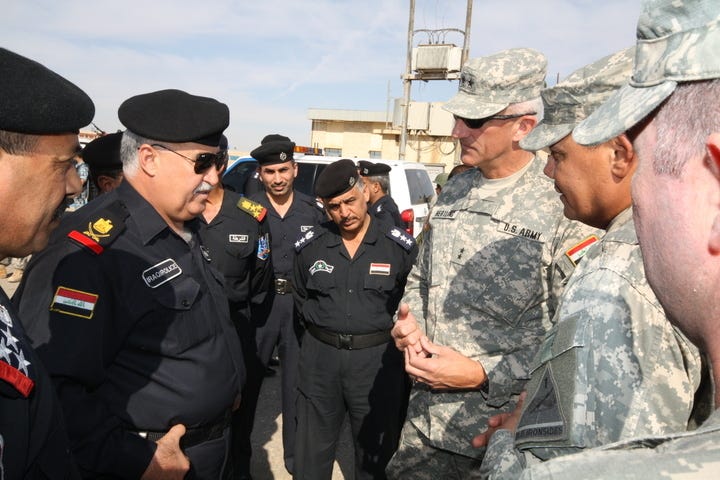
But things changed as security improved and legitimacy began to take hold across the country during the 2007–2008 period. As Iraqi security units gained competence, confidence, and public trust, the Iraqi people came to see the police—not just the men but also the new women police officers—as protectors of the citizenry. Those scarves started to disappear. Soldiers wore their uniforms openly and proudly, and Iraqi commanders didn’t allow faces to be covered. The police began to identify themselves to the people they were protecting as part of the “new Iraq.” There was even a billboard campaign featuring soldiers and police smiling and proclaiming their dedication to a safe, stable environment. Visibility became a marker of courage: This is my job. This is my country. I stand behind what I do.
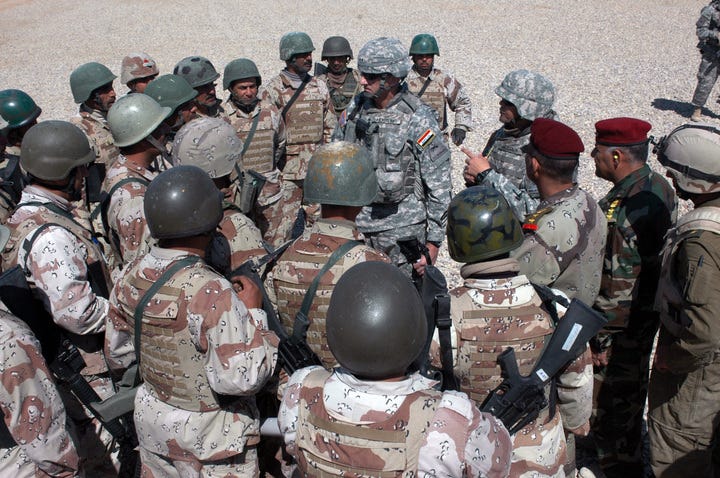
That memory haunts me as I look at the images of ICE officers operating around the country.
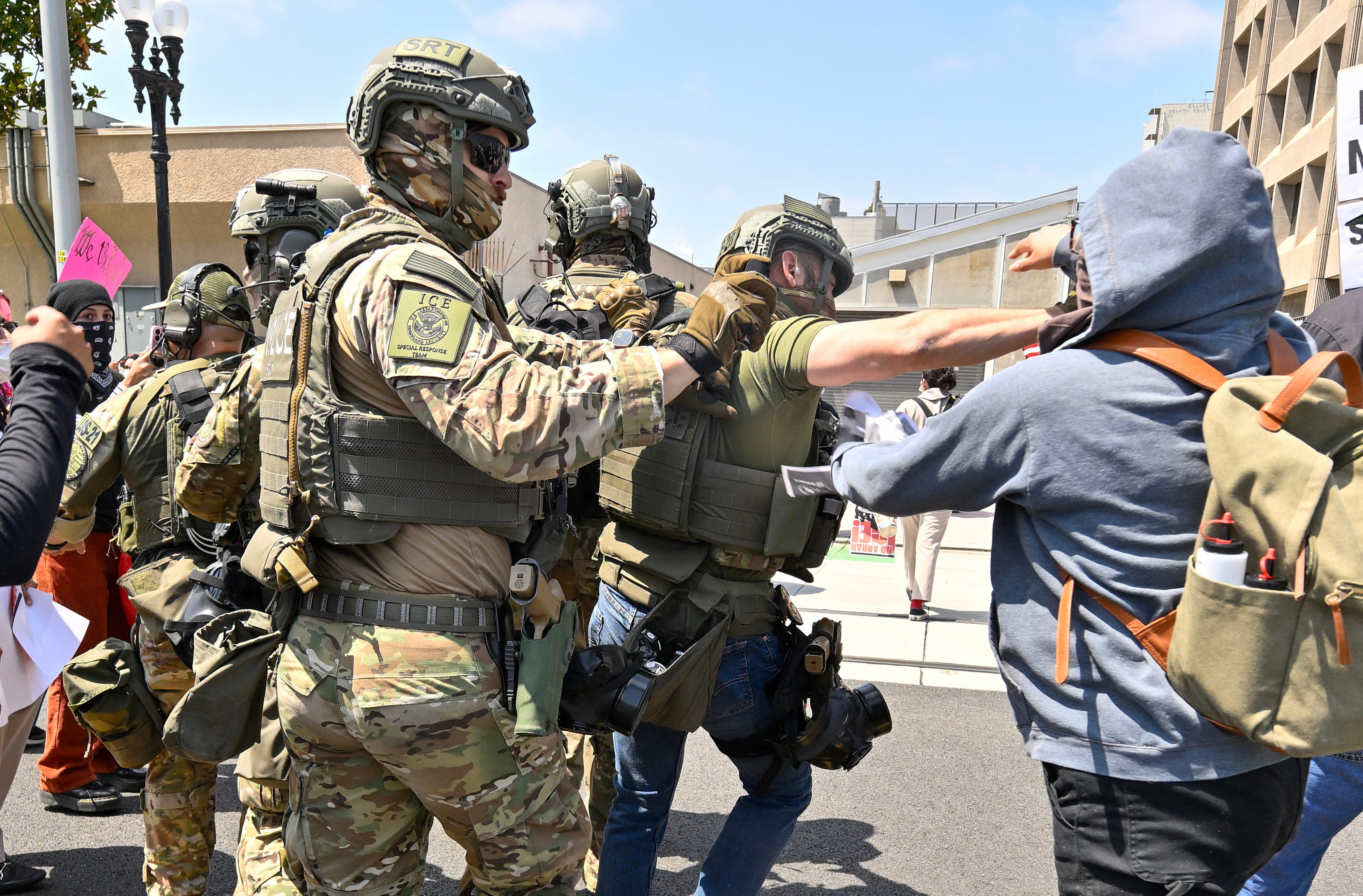
ICE agents now regularly operate masked, heavily militarized, and—most troubling—without any visible identification. ICE officials argue that masks are necessary to prevent doxxing or harassment. But that rationale collapses under scrutiny, especially in a democracy.
In democratic societies, the use of lawful force depends on legitimacy. Legitimacy depends on accountability. And accountability begins with identification.
Police officers, federal agents, soldiers—anyone empowered to detain, arrest, or use force—must be identifiable both to their chain of command, and to the citizens in whose name they act. When officers purposely conceal their faces and perform their duties without name tapes or badge numbers, they sever an essential connection to the public. They turn authority into anonymity. And anonymous power is precisely what democratic systems are designed to prevent.
I’ve commanded soldiers in combat zones where anonymity could mean life or death. Even then, we understood that identity signaled responsibility. It signaled professionalism, discipline, and confidence in the mission. It told the population: We answer for the things we do.
Public scrutiny is not a threat to legitimate law enforcement; it is one of its safeguards. If agents are acting lawfully, ethically, and in accordance with policy guidelines and published standards, identification protects them as much as it protects the public. If they are not identifiable, anonymity enables abuse.
Masks may have a place in specific, tactical circumstances, like special operations. But as a routine posture for domestic law enforcement, especially when combined with military-style gear and no identifying markers, it erodes trust. Once trust is lost, it is not easily rebuilt.
In Iraq, scarves came off as confidence grew. Yet we seem to be moving in the opposite direction. That should concern anyone who believes that power in a democracy must always have a face—and a name.
Resistance Now
by William Kristol
At some point in the last few years, even within much of the anti-Trump coalition, being a “resist lib” became a term of denigration, or belittlement, or at the very least mild disapproval. Being one suggested an unreflective knee-jerkiness to one’s anti-Trumpism, an unmodulated overreaction to every MAGA provocation, an unsophisticated failure to understand the need to set forth a positive alternative.
Some of the disapproval of resist libs may have been warranted. As I’m sure was some of the criticism of the original French Resistance. From 1940 to 1944, La Résistance included dogmatic communists as well as humane liberals, lone wolves as well as capable organizers, and injudicious hotheads as well as canny strategists. And when liberation came, while La Résistance was duly honored, it was the august Gen. Charles de Gaulle, newly returned from Great Britain, who led the victory parade down the Champs-Élysées on August 26, 1944—not some young resisters emerging from hiding after spending years trying to blow up German trains.
This was reasonable, and perhaps, given the way of the world, inevitable. And to be fair, De Gaulle always paid sincere tribute to the resisters. And he would probably have agreed with Albert Camus, who edited the Resistance journal Combat, that during the occupation, “the only moral value is courage.”
After Trump’s first year, and especially after the accelerationist authoritarianism of the last ten days, the primary moral value for our opposition party has to be courage. Democrats now have to embrace resistance without embarrassment. The United States of America is not yet occupied territory. There are many fronts on which the Democratic party in Congress can fight to stop it from becoming so.
For example:
Refuse to support ongoing funding for the Department of Homeland Security, unless various provisions like those outlined by Sen. Chris Murphy—requiring ICE agents to have warrants for arrests, banning them from wearing masks, limiting their use of guns, and restricting the Border Patrol to the border—are incorporated into the funding bill that needs to be passed before January 30. It’s true that Republicans refuse to accept some limitations on ICE, so this could lead to a government shutdown at the end of the month. But the most recent government shutdown began on September 30 amid great trepidation among Democrats about its political effects. Five weeks later, Democrats won resounding electoral victories, by margins far greater than polling a month before suggested. Since then, we’ve also seen Republican defections in Congress on the issue of Obamacare subsidies. A similar dynamic could take effect, this time with a focus on ICE.
Democrats could also refuse to vote to fund the government until Trump’s Justice Department obeys existing law and releases the Epstein files. The bipartisan power of that issue should be obvious by now.
Democrats can work with Republicans on preserving the independence of the Federal Reserve. Republican Sen. Thom Tillis has already said, in light of the Justice Department’s attack on Jerome Powell, that he’ll join Democrats to block any proposed replacement for Powell as chair. In the meantime, Democrats should also work to get Republicans to join them to block any Trump nominee for the Fed, as any such nominee can be expected to help undermine the Fed’s independence.
Democrats could do more. Minority Leader Chuck Schumer could offer Sens. Tillis, Mitch McConnell, Lisa Murkowsky, and Susan Collins substantial incentives to caucus at least temporarily with Senate Democrats in order to reorganize the Senate. A parallel effort could be made in the House. After all, the single best check on the descent into authoritarianism now would be to have a Democrat-led coalition control one or both houses of Congress.
But all of this will require Democrats, and others in the anti-Trump opposition, to overcome their discomfort with a stance of “mere” resistance. That discomfort, if it ever was justified, is no longer. If not resistance now, then when?
AROUND THE BULWARK
Turns Out the Obamacare Subsidy Extension Was Only Mostly Dead… Last week’s House vote sets up a big fight in the Senate over relief for millions, reports JONATHAN COHN in The Breakdown.
ICE Becomes Central to 2026… Democrats debate how best to push back against the rogue agency and its leaders. ADRIAN CARRASQUILLO joins LAUREN EGAN in a jointly reported edition of The Opposition.
Embracing Impeachment… The case against Trump and his cabinet keeps growing—and the argument for waiting is no longer convincing, argues JILL LAWRENCE.
A Dangerous Start to 2026… On Shield of the Republic, ERIC EDELMAN and ELIOT COHEN discuss serious threats that Trump continues to make against Denmark and the possibility that the administration might use military force to seize Greenland.
How Trump Is Harming Federal Childcare Funding… A court shut down his five-state freeze—for now—but his “defend the spend” policy is still a recipe for chaos, writes ELLIOT HASPEL.
Quick Hits
LOOKS LIKE WAR WITH IRAN’S BACK ON THE MENU: The capture of Nicolás Maduro seems not to have satisfied Donald Trump’s appetite for tangling with overseas adversaries; l’appetit vient a mangeant. As anti-regime protests continued to grow across Iran last week, Trump on Friday threatened U.S. intervention if the mullahs crack down:
If Iran shots [sic] and violently kills peaceful protesters, which is their custom, the United States of America will come to their rescue. We are locked and loaded and ready to go. Thank you for your attention to this matter! President DONALD J.TRUMP.
Trump is undeniably correct that Iran has habitually responded to political protests with brutality and murder over the years, and his post doubtless puts additional pressure on the Iranian regime. Following his post, Iranian officials shot back with warlike rhetoric of their own. Mohammad Bagher Ghalibaf, speaker of Iran’s parliament, warned that “all American centers and forces across the entire region will be legitimate targets for us in response to any potential actions.”
Time will tell whether Trump’s saber-rattling here bears good or bad fruit. But it’s just the latest head-spinning development in his recent Bush-on-acid interventionist turn.
NOEM WEIGHS IN, AGAIN: As news of the shooting death of Renee Good began to break online Wednesday, Homeland Security Secretary Kristi Noem was hundreds of miles away, staging a prescheduled press event at the U.S.–Mexico border. This perhaps explained why, when she was asked by a reporter to comment on the breaking news, Noem’s original story was so ludicrously unmoored from reality: ICE officers, she said, had been “stuck in the snow” and “were attempting to push out their vehicle” when a woman “attacked them” and “attempted to run them over and rammed them with her vehicle.”
What defies explanation, however, is why Noem is insisting on sticking to that obviously insane story now. “Everything that I’ve said has been proven to be factual and the truth,” the secretary deadpanned in an interview with CNN’s Jake Tapper yesterday. “It absolutely is what happened.”
In the interview, Tapper pressed Noem further on various of her claims, including that Good had engaged in “domestic terrorism.” How, Tapper asked, does Noem define domestic terrorism? “She weaponized her vehicle to conduct an act of violence against a law enforcement officer and the public,” Noem said.
It’s become pretty obvious that Donald Trump didn’t watch any of the videos of the confrontation in Minneapolis before commenting on it. Maybe that’s administration policy.
TRUMP: RENEE GOOD WAS ‘HIGHLY DISRESPECTFUL’: Speaking of Donald Trump’s comments on the killing of Renee Good: The president was asked yesterday whether, now that he’s viewed the footage, he believes it was necessary for ICE agent Jonathan Ross to use deadly force. “It was highly disrespectful of law enforcement,” Trump replied. “These are professional agitators, and law enforcement should not be in a position where they have to put up with this stuff.”
It’s all right there, isn’t it? Trump is doing everything he can to flood ICE, border patrol, and other federal law enforcement into every American city. He’s doing so while explicitly telling them that they shouldn’t worry too much about being violent, because he’ll have their backs if they are. And, when shocking violence does erupt, he accuses the victim—with zero evidence—of being a “professional agitator.”
And notice: He doesn’t bother tying himself into logical pretzels like so many others in MAGA—for instance, by trying to suggest, against all evidence, that Good was trying to run Ross down and that he therefore acted in justified self-defense. As far as Trump’s concerned, Good signed her own death certificate when she made ICE’s job difficult.
Cheap Shots
The president’s having fun on his social media platform:
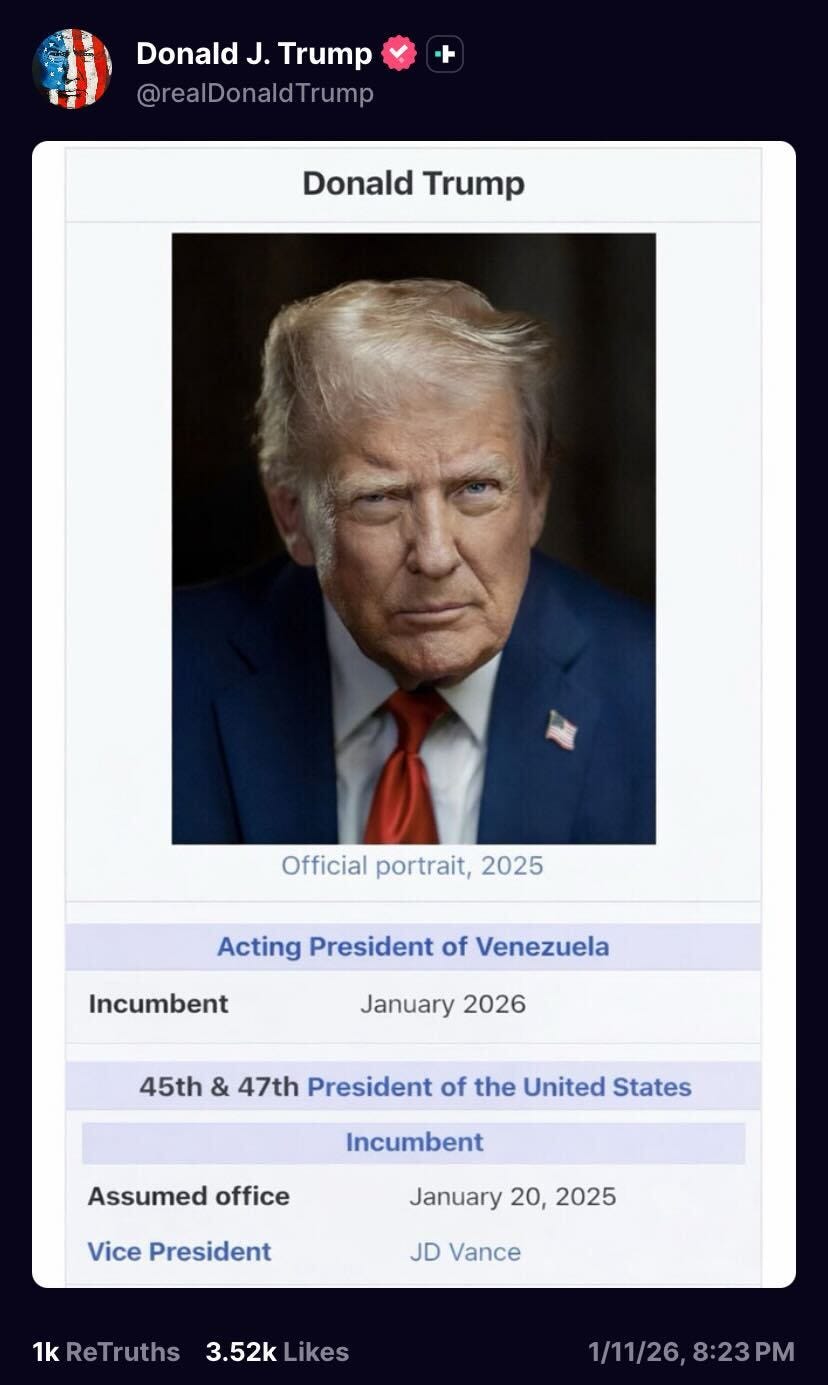
I don't know who said it, but someone described ICE as people who are too chickenshit to join the military and too stupid to be cops.
If we were living inside a functioning democracy, Trump never would have been elevated in the first place. Not because the electorate is virtuous, or wise, or immune to demagoguery, but because democracies are not built on trust in human goodness. They are built on mistrust. On friction. On deliberately engineered resistance. Institutions exist to absorb shock, to filter out pathological actors, to slow the conversion of mass impulse into sovereign power.
If we had a functioning justice system, he would be in prison. Not as a moral spectacle, not as a cathartic act of political revenge, but as the dull, procedural consequence of law encountering evidence and proceeding without fear.
If we had a functioning Supreme Court, he would have been ruled ineligible. The constitutional prohibitions were neither novel nor obscure. They were explicit, historical, and designed for precisely this scenario. The guardrails did not erode through ambiguity; they were dismantled through willful non-enforcement. Law did not fail because it was unclear. It failed because it was inconvenient.
If we had a functioning Congress, he would have been removed. Again and again. Not after solemn speeches or strategic delays, but decisively, without ritualized handwringing. Impeachment did not collapse under the weight of insufficient evidence. It collapsed under the cowardice of legislators who understood the consequences and chose personal survival over institutional survival. What died in those chambers was not procedure, but legitimacy.
In a healthy political system, one individual cannot inflict this much damage, or distort reality this thoroughly. The fact that he could, and did, is the diagnosis. Trump is not the disease. He is the symptom made visible. The real emergency is not the man. It is the hollowed-out architecture that was supposed to stop him, and instead stepped aside.
Against that backdrop, arguing about masks feels almost obscene, and yet the mask controversy is instructive, a kind of moral MRI. The same cohort that howled about personal liberty when asked to wear a mask to protect the vulnerable now insists on anonymity as a prerequisite for inflicting harm. The pivot is flawless. The logic is airtight in its cynicism. It was never about freedom. It was never about safety. It was about insulation. About severing action from consequence. About exercising force without leaving fingerprints.
This is not a debate over fabric. It is a referendum on accountability. Masks here are not protective equipment; they are instruments of moral laundering. They erase the face, and with it the burden of ownership. They convert state power into something feral and deniable, something that can be disowned the moment it becomes inconvenient.
What we are witnessing is not polarization. It is epistemic collapse. The abandonment of any shared, verifiable reality in favor of narrative allegiance. A nation in which vast numbers of people no longer ask whether a thing is true, only whether it sounds good, whether it arrives wrapped in the correct emotional cadence, whether it flatters grievance and sanctifies cruelty. Facts became optional. Truth became factional. Reality itself is demoted to an aesthetic choice, curated to preserve identity rather than describe the world.
This is how democracies don’t fall with tanks in the streets, but with language quietly unmoored from meaning. With accountability rendered optional. With power detached from names, faces, and consequences. When authority wears a mask long enough, it forgets it ever had a face, and when a society stops insisting that power be seen, identified, and answerable, democracy doesn’t collapse in a single, cinematic moment. It hollows out. It becomes a costume. A word we keep using long after the thing itself has slipped the leash.
Masks are incidental. The disappearance underneath them is the point.