The Art of the Yield
Trump says the quiet part out loud: He had to choose between surrender and economic disaster.


The U.S.–Iran Memorandum of Understanding is out, and boy is it as bad as advertised. In exchange for Iran simply agreeing to begin negotiations on its nuclear program and to temporarily reopen the Strait of Hormuz without charging fees for sixty days, America is giving away the farm economically: It will immediately end the blockade, issue waivers to allow Iran to immediately resume selling its oil, and work toward dropping all sanctions on the country—both America’s own and international ones. Not only that: America also agrees to become Iran’s biggest global economic booster, committing to rustle up $300 billion to help Iran rebuild. Art of the deal! Happy Thursday.
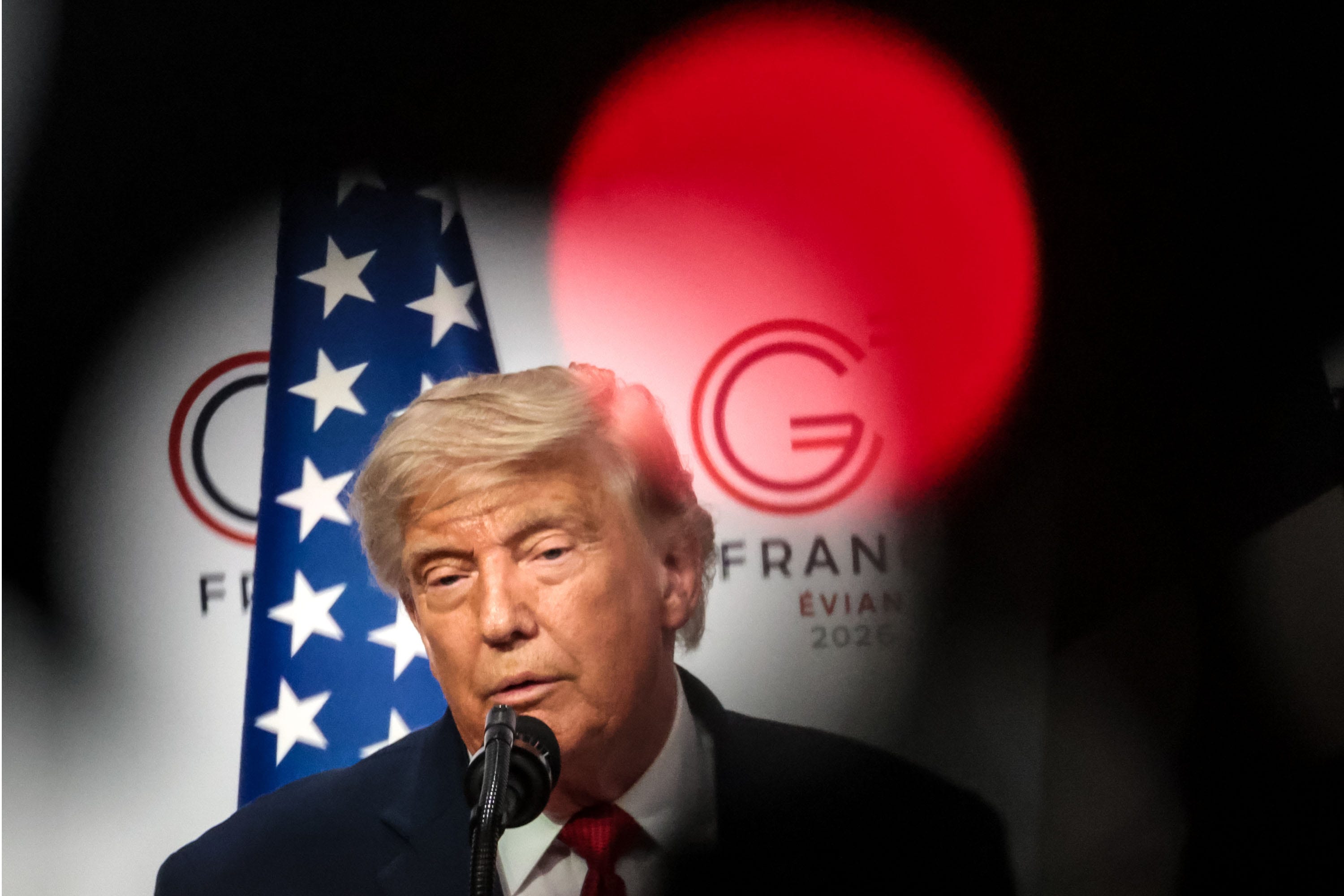
Trump’s G7 Grump-a-Thon
by Andrew Egger
We’ve been writing for months about the no-win bind Donald Trump is in as he struggles to end his misfired war in Iran. But even if you hadn’t read a word of that—even, in fact, if you entered a coma in mid-February and are just returning to your senses now—Trump’s defeated, furious speech at the G7 conference yesterday would have done a lot to bring you up to speed.
Although the president spoke in his usual meandering, free-associating, self-aggrandizing way, the throughline of his argument was unusually straightforward. Its basic thrust: Iran hawks who hate his deal need to shut up and cut him some slack, because failing to strike a deal now would have tipped the economy into global disaster. (Have you even said ‘thank you’ once?)
“The one thing I didn’t want to see was economic catastrophe. If you kept this going, that could have happened,” Trump said. Oil reserves around the world, he suggested, would have been drawn down to critical levels in about four more weeks, and the pain that followed that would have dwarfed what we’ve seen until now. What did you idiots want—for Trump to get blamed for another depression?
“You know, I’ve studied presidents,” Trump said. “The one president I did not want to be was the late great Herbert Hoover. . . . Rather than possibly going into a depression, rather than having your favorite president be Herbert Hoover, we made this deal.”
Even as he tried to focus on selling the supposed pros of the deal, Trump kept getting sidetracked over to what he really wanted to talk about: His grievances with the war hawks in conservative media who have been castigating him as letting Iran off easy. “Some people,” he called them, “some writers that I thought were friends of mine, but I don’t want them as friends anymore, because they’re either stupid or they’re bad people.” At another point, they were “all these so-called geniuses who want to show me how smart they are.” He’s not mad! Don’t put it in the newspaper that he’s mad!
The countries of the G7, he said, are “thrilled that we made a deal, every one of them. There’s not one nation that came to us and said, ‘Please, sir, keep dropping bombs on them.’ Only stupid people say that.”
These people, he suggested, need to know when a negotiating cake is baked: “If we didn’t do this deal, we could have dropped more bombs for another three weeks, two weeks, four weeks, two years. You would never have the Hormuz Strait open. You would never have success.”
It was remarkable to watch Trump, in a fit of pure pique, get up and blab right out the basic realities of America’s terrible negotiating position that nobody in the administration has until now been willing to admit. The world was barreling toward global economic disaster thanks to the closure of the Strait of Hormuz. The aerial bombardment campaign had proven ultimately insufficient to shake any big new concessions out of the Iranian regime. In the end, despite America’s unquestioned military supremacy, it was Iran that held all the cards.
You do have to wonder what the Iran hawks—both in Israel and in America—thought was going to happen. In the opening days of the war, these hawks rapturously convinced themselves that Trump had really been one of them all along: willing to get the bit in his teeth and really get after Iran in a way no other president had been willing to do. As it turns out, Trump was more willing to push the big red “Bomb Iran” button on the Resolute Desk not because he was more fearless than past presidents but because he’d given less thought to the obvious costs that would follow. Now that those costs have presented themselves to him, Trump is chickening out—and if you think that means he’s courting geopolitical disaster, he’s adding you to his “fake friends” list.
Donald J. Hoover
by William Kristol
As Andrew notes, President Trump brought up his long-ago predecessor Herbert Hoover not once but twice in his remarks at the end of the G7 meeting in France yesterday. The references to Hoover were revealing. For all that Trump wanted to pretend his new Iran deal was a good one that he negotiated from a position of strength, Trump was inadvertently acknowledging the opposite: He believed he needed a deal, any deal, because of the possibility of a global economic collapse due to the closure of the Strait of Hormuz. In other words, Iran was winning, and Trump cried “uncle.”
And you know, I’ve studied presidents, some good, some bad, some great, not too many are great, and some really bad. We had one just recently. And the one president I did not want to be was the late great Herbert Hoover. I didn’t want that and who knows what would have happened. But bad things happen. . . . The one I always thought of, Herbert Hoover, and he caused it. . . . And he caused the Great Depression.
Even before he started the war with Iran, Trump feared winding up with a reputation like Jimmy Carter’s. But then he discovered a legacy perhaps even less desirable—Herbert Hoover’s. He thought the Iranian regime had him over a barrel, not because of a hostage crisis but with the threat of global economic disaster. And so he capitulated.
I don’t know if Trump was right that we were on the verge of a global depression. But the fact that Trump thought we might be is notable. It allows the rest of us to bring home this simple fact: We arrived at such a dangerous moment because of a war Trump chose, a war Trump started.
Of course, the peace deal is no guarantee we won’t in fact slide into a recession. Iran’s new control of the strait, along with the demonstration of American weakness before the whole world, increases global uncertainty and risk going forward, and therefore increases the chances of a downturn.
So Democrats need to hammer the message home: The economy is bad. It was already bad due to Trump’s policies. Thanks to his tariffs, the economy was already weak. Under his budget, the federal deficit and the cost of servicing it have risen to an all-time high. Under his policies—enacted by a Republican Congress—the rich have gotten richer, but most Americans have been losing ground. Under his Fed chair, inflation and interest rates are going up. His failed war has made all of this worse. And it could well get worse yet.
Trump fears being a new Hoover. Democrats have no control over whether his economic policies will in fact be as disastrous as Hoover’s. But they can do their best to make Trump as electorally calamitous as Hoover. Republicans lost eight Senate seats and 52 House seats in the 1930 midterm election, and were then crushed in the presidential election of 1932. It’s a good precedent. We should thank Trump for suggesting it.
AROUND THE BULWARK
Is the Trump Administration Slow-Walking DACA to Death? USCIS doesn’t have to deny applications to derail lives—it can just stop deciding in a timely manner, writes DARA LIND.
How to Resist Trump’s Weaponized DOJ… The latest in the crosshairs, Gavin Newsom, shows ways we can stand up to intimidation and defend the rule of law, observes KIM WEHLE.
How to Keep Loving America… Even when it hurts, advises MONA CHAREN.
Stephen Miller and JD Vance Wanted to Suspend Habeas Corpus… On The Illegal News, LEAH LITMAN joins SARAH LONGWELL to talk about the White House’s plan to suspend habeas corpus.
Quick Hits
LOTS OF LEASH FOR WARSH: Donald Trump wants federal interest rates lowered, and he spent years lambasting former Federal Reserve Chair Jerome Powell1 for not bringing them down quickly enough for his satisfaction. But yesterday, Trump sounded a different tune about Powell’s successor, Kevin Warsh—even though Warsh, at his first Fed meeting this week, kept rates steady while signaling hikes will likely follow.
“We have a very good guy over there now,” Trump told reporters of Warsh at the G7 meeting. “So I’m guided by what he wants.”
It’s anyone’s guess how long Trump’s patience with Warsh will last. But for now, it’s a relief for the Fed chair, who, thanks to higher inflation caused by Trump’s war with Iran, would be crazy to cut rates now.
BRUSHING OFF ATROCITIES: Trump did more than just make excuses for losing his shirt to Iran and rage at his hawkish critics in his G7 speech yesterday. He also brushed aside questions about who bore responsibility for the deadly strike on an Iranian girl’s school in the opening salvo of the conflict: “Mistakes are made. War is nasty. . . . Nobody did that on purpose.” Here’s more from the New York Times:
Privately, U.S. military officials have acknowledged American forces carried out the strikes and cast them as an intelligence failure. The school was located near a base used by Iran’s Islamic Revolutionary Guards Corps Navy, and the school’s exact site had originally been part of the base.
Those officials said that an internal investigation found that the military’s personnel in charge of choosing targets were using imagery that had not been updated in seven years. That imagery, they said, did not show a school next to the base. At least two people involved in the military’s assessment of the site, however, had been aware that a building on the base appeared to have been converted into a school.
That assessment did not make it to officials in charge of targeting, and intelligence and military officials continued to classify the site as a legitimate target for bombing. Dozens of students were killed in the first strike on the school. Dozens more were killed after a second strike.
The incident, Trump added, was still under internal investigation. Though it looks like some lawmakers are ready to start forcing the issue. Politico reports that Senators are looking to withhold some of Pete Hegseth’s travel budget unless the defense secretary turns over details about what happened with the school strike in Iran.
Cheap Shots

Or Jerome “Too Late” Powell, in Trumpspeak.
Coming from Iowa and the land of Hoover, I would like to point out that another instructional thing Donald and Herbert have in common is that they were popular businessmen who did not know how to be presidents. They and their voters discovered too late that it is an entirely different skill set, and government can never successfully be run like a business.
I was walking through an arrivals terminal in Bristol (UK) Airport watching screens of Trump giving his speech on Sky News. There was no sound on so I couldn’t hear what he was saying but you could tell from the way his shoulders were hunched and his hands were accordion-ing he was extremely pissed off and defensive. Sad!