The Marquise de #MeToo
What works and what doesn’t in ‘The Seduction,’ HBO’s retelling of ‘Les Liaisons dangereuses.’

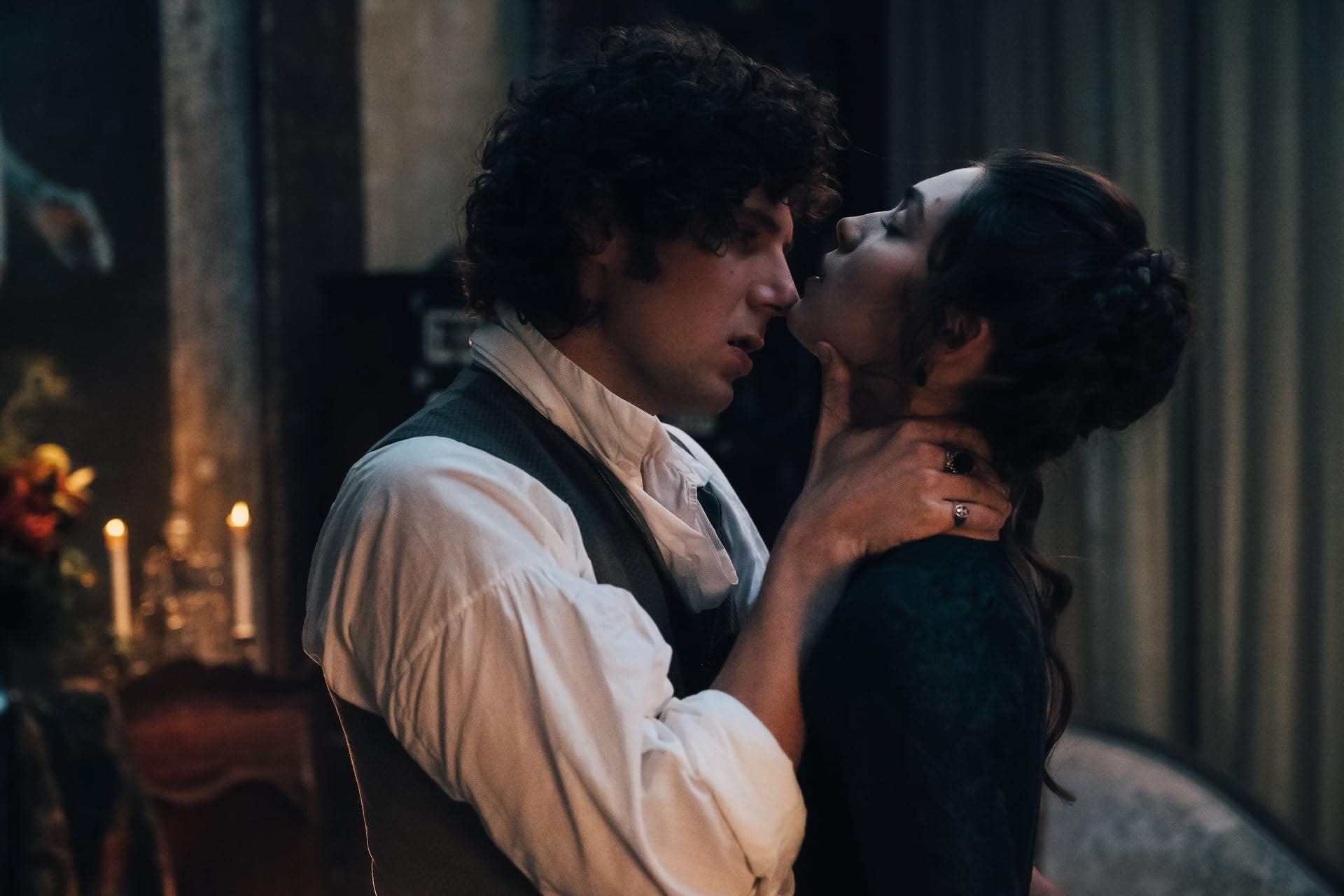
THE MONSTROUS BUT MAGNIFICENT antiheroine of Pierre Choderlos de Laclos’s 1782 classic Les Liaisons dangereuses, the Marquise de Merteuil—sexually autonomous and easily superior to her male partner in crime, the Vicomte de Valmont—was clearly too much for the bourgeois France of the 1830s to handle: She was unceremoniously dropped from the first of the novel’s many dramatizations—a justly forgotten 1834 melodrama—with some of her narrative functions reassigned to made-up male characters. Since then, the marquise has come a long way: The 2025 take on Liaisons, the six-hour, French-produced HBO miniseries The Seduction, is a Merteuil-centric adaptation whose French title is simply Merteuil. But does this revisionist version of Laclos’s still-provocative exploration of sex and power represent progress?
There is certainly nothing wrong with a Merteuil-focused version of Liaisons. Director Jessica Palud, who also cowrote some of the screenplay, probably has a point when she says that the earlier screen versions treated Valmont as the central character, despite Glenn Close’s bravura performance as an elegant, matronly and lethal Merteuil in Stephen Frears’s 1988 cult film Dangerous Liaisons. (Partly, that’s because the movie loses the novel’s far-from-gratuitous subplot in which Merteuil takes on Valmont’s libertine rival and doppelgänger, Prévan, who is plotting to ruin her virtuous reputation.) The problem is what kind of Merteuil story to tell, and how.
The Seduction, starring French-Romanian actress Anamaria Vartolomei, is a very loose adaptation billed as “inspired by” Liaisons. (How loose? Picture an “adaptation” of Les Misérables in which Jean Valjean and Inspector Javert team up as crimefighting buddies and the Thénardiers are warmhearted philanthropists.) Its creators have touted it as an origin story explaining how the marquise became her appalling-but-formidable self. But while the pilot is a kinda-prequel in which young Isabelle Dassonville meets Valmont (Vincent Lacoste) and becomes the Marquise de Merteuil, the show soon catches up with the novel’s storyline—sort of.
As in Laclos’s originating novel, Merteuil schemes, with Valmont’s assistance, to use young Cécile de Volanges (Fantine Harduin) as an instrument against the girl’s fiancé, the Comte de Gercourt (Lucas Bravo); Cécile’s teenage romance with the chevalier Danceny (Samuel Kircher) is both assisted and derailed by the libertine pair’s games; and the Vicomte’s pursuit of the pious Madame de Tourvel (Noée Abita) turns into a bet in which success gets him a night with the marquise. All these events, however, are drastically rewritten—mostly in ways that (1) both flatten and clutter the story and (2) whitewash its antiheroine. Thus, in the novel, Merteuil’s scheme against Gercourt is motivated by a petty grudge against an ex-lover who left her for another woman; the show’s Gercourt not only tried to rape Isabelle during their earlier encounter but seeks her downfall in his own obsessive vendetta, and her plan to humiliate him is intended to neutralize a dangerous enemy and send a message to others.
But an even bigger departure from Liaisons canon—not just in detail but in concept—is the prequel in which Merteuil starts out as Valmont’s victim: A lowly orphan working as a laundress in a convent, young Isabelle is wooed and enticed into a fake marriage by the aristocratic rake in disguise as a common laborer. The wedding night is followed by a rude awakening in an empty cottage. Wandering to a nearby mansion, the distraught Isabelle finds Valmont’s aunt Madame de Rosemonde (Diane Kruger), who assisted in the masquerade as a marriage witness—and who calmly tells the girl that her husband and her marriage are both fictions. (The novel’s Rosemonde is a pious 84-year-old with a weak spot for her bad-boy nephew; the series de-ages her into a glamorous cougar, herself a libertine and apparently a courtesan dependent on wealthy lovers.) After returning to the convent and learning that her “sin” condemns her to cloistered imprisonment, Isabelle storms off to demand help from Rosemonde; apparently impressed by the girl’s spirit, the older woman agrees to bring her to Paris, and the rest is herstory.
Palud, the director, seems to believe she is giving Merteuil a backstory consistent with the book, in which “we understand she experienced some trauma because she was taken advantage of by Valmont.” Pardonnez-moi? Laclos’s novel has plenty of tantalizing ambiguities, but this isn’t one of them. It’s clearly established that Merteuil first met Valmont when she was already a seasoned libertine with a carefully protected virtuous façade. We also know that his libertine “glory” made her want him for her own prize conquest, both as a lover and as an adversary to match and best in sexual combat. (For both of them, sex and love are a battlefield.)
But The Seduction wants to tell a #MeToo story in which the leitmotif is the heroine’s victimization by men—of whom Valmont is only the first and, actually, the nicest. Isabelle’s first social outing in Paris ends in brutal attempted rape by Gercourt (Lucas Bravo), a cipher in the novel here reinvented as a cartoonishly toxic uber-libertine. (Eighteenth-century culture normalized a lot of male sexual aggression under the cover of “she resists/he persists” mating rituals, but this ain’t it: Mildly rebuffed by Isabelle, Gercourt grabs her by the throat, throws her down, and twists her arm behind her back.) By the end of the first episode, Isabelle has married the Marquis de Merteuil, an elderly military officer who seems to adore his gorgeous young wife . . . until he pushes her down on her knees and starts to unbutton. Even the priest from whom she seeks solace at confession after aborting a pregnancy berates her and demands her name, causing her to flee in terror.
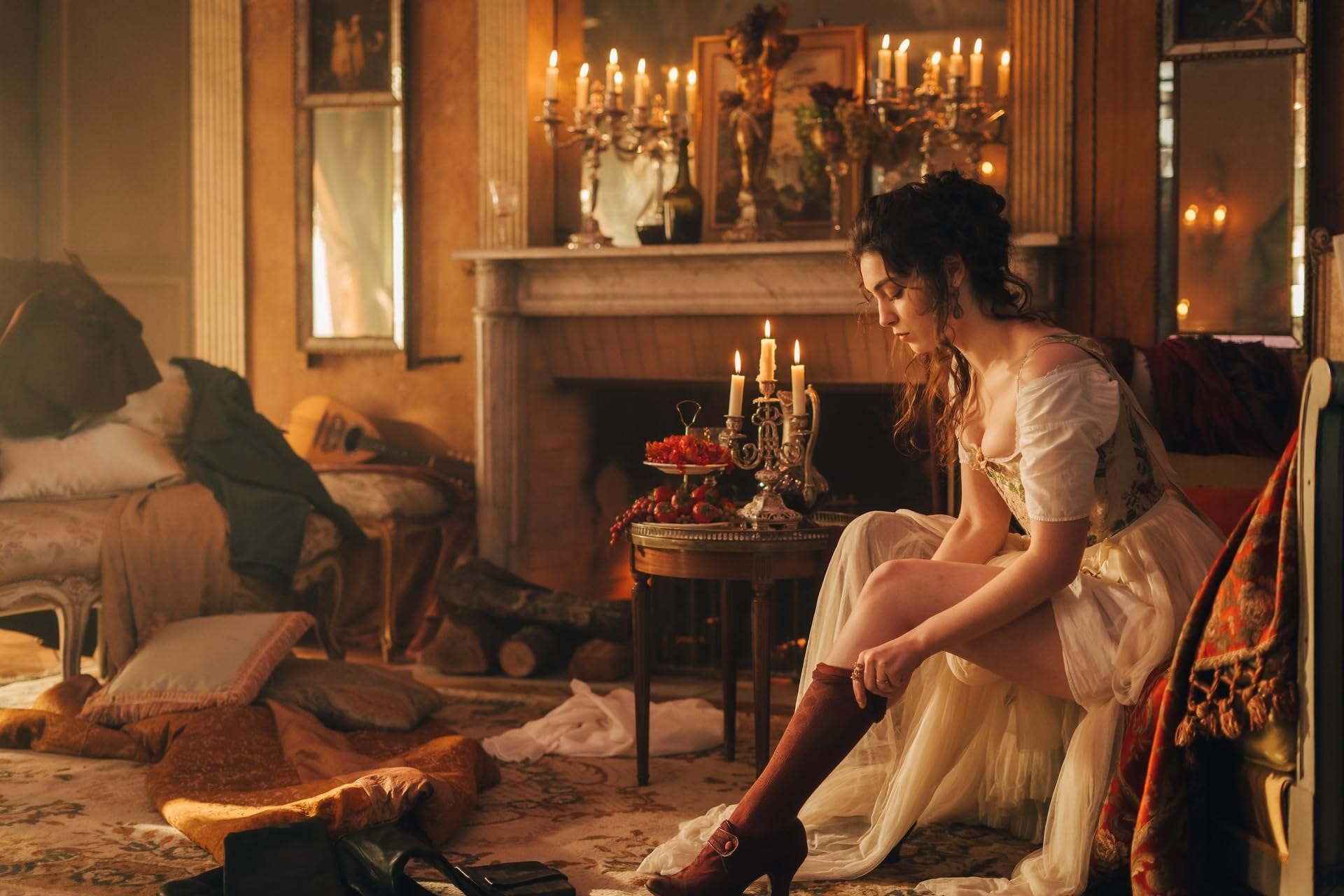
True, the marquise eventually comes into her own as a smart, self-possessed woman who has learned to own and use her sexuality. Her dynamic with Valmont—who quickly regrets his dirty trick and realizes that he passionately loves Isabelle—becomes somewhat similar to the one in the novel: a tense alliance in which Merteuil is clearly dominant. By the end, their storyline has some echoes of the tragic spirit of Les Liaisons dangereuses. Merteuil recognizes that Valmont is the love of her life, but can’t let herself drop her cynical armor or let him feel that he has “won” (which may not be dissimilar to Merteuil’s opaque motivations in the book). Valmont, like his prototype, is a libertine who has found true love—here with Merteuil, not Tourvel—and destroyed it with his own hand. Laclos’s Valmont sends Tourvel a cruel, Merteuil-scripted letter that ultimately kills her; HBO’s Valmont sets Isabelle on the path toward becoming Merteuil (“I’ve turned you into a monster,” he tells her in the final episode). The last five minutes of the series achieve a measure of real pathos.1
It could have been a good or even great variation on the novel. Sadly, no.
FOR ONE THING, the plot is saggy, often incoherent, and at times downright nonsensical. In episode 2, the Marquis de Merteuil feels so mortified by his drunken sexual assault on his wife that he abruptly decamps for war in America to redeem himself. (Given his previous behavior, this sudden extreme contrition feels like a blatant plot device to get the husband out of the way, and then get the marquise widowed.) A subplot in the same episode involves winning the favor of a duke who has a wildly inflated notion of his daughter’s singing talent by featuring the girl in a concert hosted by the marquise—and having her lip-sync on stage while Cécile voices from the wings. (We’re in “I feel dumber just summarizing this” territory here.) Other plot points revolve around Gercourt’s insecurities about having a curved penis, as well as Danceny’s prodigious endowment and problems with premature ejaculation.
The show’s later part is dominated by a storyline in which Isabelle faces ruin because of the resurfaced certificate from her bogus marriage to Valmont, which would supposedly invalidate her marriage to the marquis. It’s not clear why; surely, either the first marriage was valid and she becomes the Vicomtesse de Valmont, or it wasn’t and she remains the Marquise de Merteuil. Nevertheless, a lot of plot happens, including a plan for Valmont to bed Madame de Tourvel, whose magistrate husband is investigating the case. (Judge Tourvel turns out to be yet another male creep who probes Merteuil with freaky prurient questions about her desire for Valmont.) Along the way, the plot also requires two “Merteuil and two hot men” threesomes within one episode—for strategic reasons, natch.
Historical plausibility, even at bare minimum, fares as poorly as logic. Of course one doesn’t nitpick a show like this for accuracy or verisimilitude; we can let slide the notion that an upper-class libertine would invest a lot of effort into seducing a laundry girl, or that a lower-class provincial could easily blend into the Parisian nobility and marry a wealthy aristocrat without a massive scandal. But The Seduction asks for a little too much suspension of our critical faculties. We’re told that by marrying Cécile, here the Marquis de Merteuil’s niece, Gercourt will somehow become “head of the family” for the marquise in her husband’s absence. The well-bred, virginal Cécile readily takes to heavy petting with Danceny and gamely plunges her hand into his culottes. Rosemonde, a courtesan, is universally treated as an esteemed lady. Oh, and that French war in America? It’s happening in 1745—nine years too early. (For some reason, the writers gave the series a specific time frame by dating the fake marriage certificate.)2 Nitpick away.
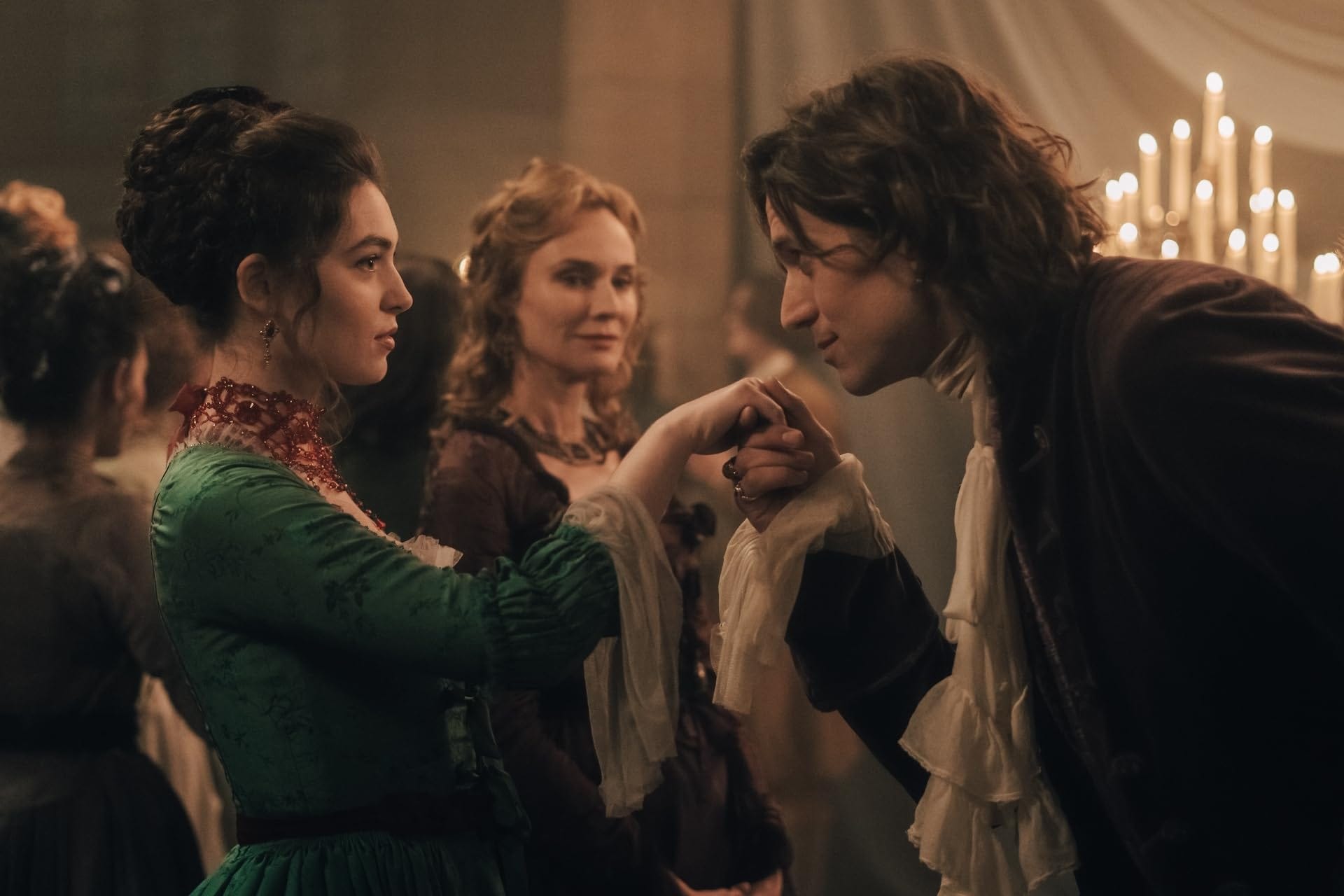
A messy plot can be redeemed by strong drama and compelling characters. The Seduction’s version of the Valmont–Merteuil relationship does have genuinely moving moments. It helps that Vartolomei (who previously starred in Being Maria, Palud’s biopic of actress Maria Schneider) is a luminously beautiful Merteuil, very believable as a heartbroken and angry young woman but also convincing when she discovers her sexual power and her spine of steel. Lacoste brings low-key charm, poignancy, and the occasional flash of impish humor to the show’s New Sensitive Valmont, who has an affectingly tender chemistry with Vartolomei’s Merteuil even as he is troubled by her emerging cold and cruel side. However, he never really sells Valmont as a libertine, and his brief turn as the scoundrel who fake-marries and deflowers Isabelle feels weirdly disconnected from the rest of his character.
Indeed, one of The Seduction’s major failings is that neither lead has any real darkness. The novel’s Valmont is a dashing, narcissistic, predatory sexual swashbuckler whose devil-may-care persona is gradually unraveled by his complicated feelings for Merteuil and his vulnerability with Tourvel. The show’s Valmont is gentle, angsty, and vulnerable throughout. The novel’s Merteuil is a secret libertine adventuress who relishes performing virtue for the public and has fun toying with people’s lives because she can (until she loses control of the game because Valmont’s love for another woman gets under her skin). On the show, Merteuil’s machinations are mostly for self-defense and lack any real malevolence. Yes, she’s the “meaner of the two,” as she acknowledges at the end, but with such a Valmont that’s a very low bar.
The pair’s manipulation of Cécile is certainly morally shady—but it never becomes monstrously exploitative as in the novel, partly because this version of Cécile is far less naïve and because the marquise is sincerely fond of her. When Merteuil tells Cécile to forget Danceny because she’s too good for him, the viewer is likely to nod along; the show’s Danceny is a sulky, sexually inept teen who looks like he’s accidentally wandered in from Clueless (rather than from Bridgerton with the rest of the characters).
Late in the series, The Seduction does hover on the brink of the dark side, seemingly poised to recreate the novel’s shattering final section in which Valmont is torn between Merteuil and Tourvel and the jealous marquise moves ruthlessly to destroy her rival. Then, it chickens out. Valmont’s infatuation with Tourvel, which seems genuine for a moment, vanishes after one night of wild sex, and there’s never any doubt that Merteuil is his only love. (Tourvel, in this iteration, is less a passionate lover than a sexually unsatisfied wife finally releasing her inner nympho.) Merteuil still gets to script Valmont’s breakup letter, nixing his gallant draft and dictating a curt dismissal; one suspects that she’s not entirely sincere when she asserts that it’s kinder to Tourvel not to leave her hanging and hoping Valmont may come back. Even so, this moment, so pivotal and deadly in the book, is here thoroughly defanged.
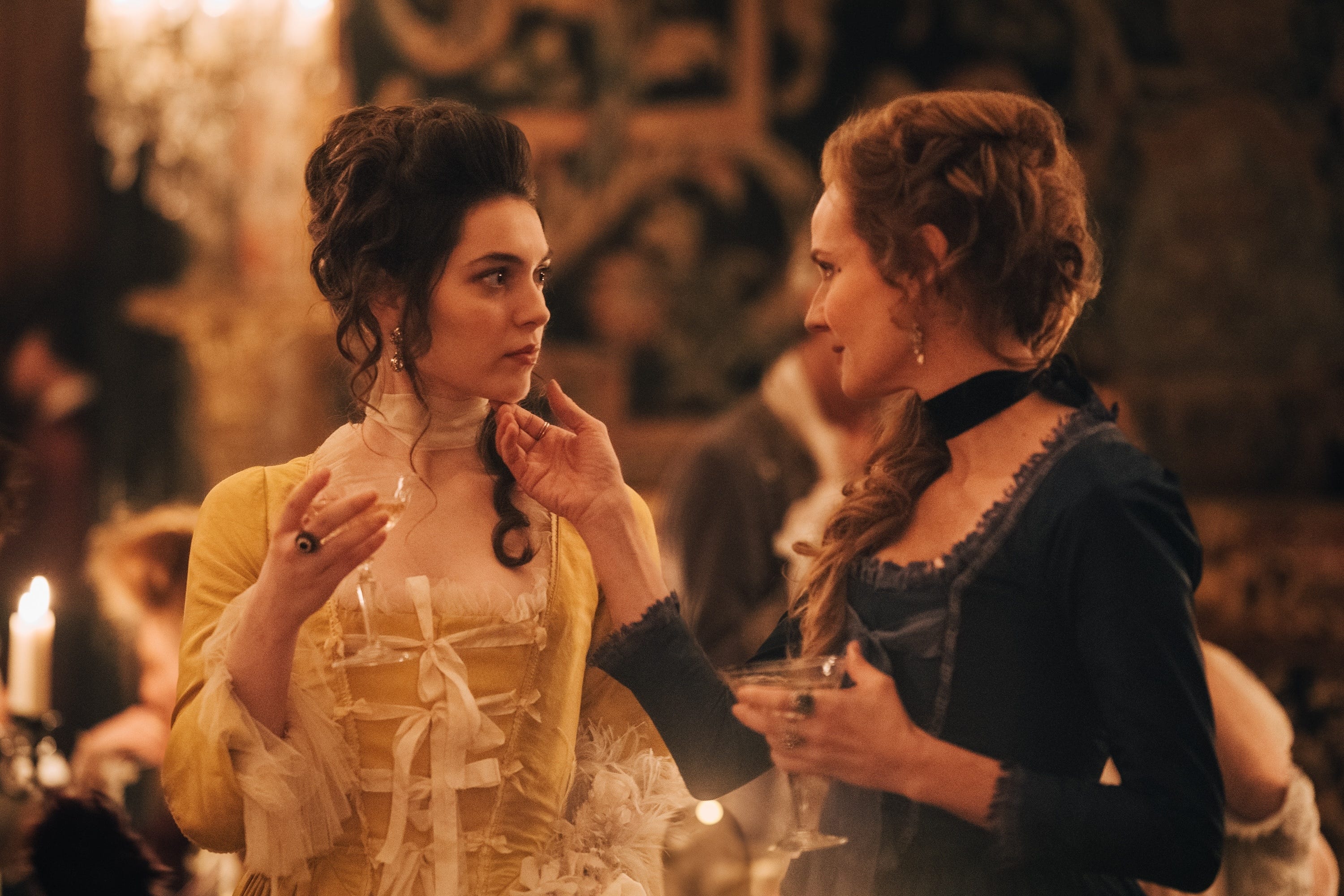
Palud has said that she wanted to explore the origins of the novel’s “horrible” characters. The trouble is, in her interpretation they’re not that horrible. Some of the darkness seems to have been transferred to Rosemonde and Gercourt: Rosemonde’s manipulative mentoring of Isabelle certainly has its sinister overtones, and it’s probably not coincidental that, as splendidly played by Kruger, she bears some resemblance to Glenn Close’s blonde ice-goddess Merteuil. Bravo’s Gercourt, when not on “violent rapist” setting, has a Valmont-like suave charm, dangerous edge, sardonic wit, and sartorial elegance. (Lacoste’s Valmont, for some reason, dresses like a Belle Époque bohemian.)
Frears’s Dangerous Liaisons had its problems (as I’ve written, I’m not a great fan of John Malkovich’s often crass Valmont); but it captured the novel’s sense of dangerousness, its sexual energy, and its dark, biting humor. The Seduction offers us a Liaisons dangereuses in which the danger is neutered, the liaisons are woefully unsexy—orgy scenes notwithstanding—and the humor is limp.
IS THE SEDUCTION A “FEMINIST” VERSION of Les Liaisons dangereuses, as some reviews have asserted? In a sense, the concept itself is redundant: The Laclos novel is plenty feminist in the sense of questioning women’s place. The novel’s Merteuil, who chafes at norms that turn male/female encounters into a “very unequal match,” famously tells Valmont she was “born to avenge my sex and to subjugate yours.”
Of course, Liaisons is so multilayered that it could be read as either feminist or misogynistic; it ends with Merteuil disgraced, in exile (though with plenty of money), and disfigured by smallpox (. . . or not). In The Seduction, Merteuil ostensibly triumphs—but by accepting a role in which she must cater to another powerful older man.3 After her earlier defiant declaration that she will never give up her freedom, that feels like a hollow victory.
There’s a similar hollowness to the series’ female-solidarity theme. Merteuil’s tutelage of Cécile in this version may be far more benign than the novel’s mentorship from hell, but the young girl is still used and still ends up heartbroken. The Merteuil–Rosemonde bond is self-serving on Rosemonde’s side—despite genuine affection for her protégée, she is still an aging courtesan grooming a loyal successor—and somewhat Stockholm-syndromy on Merteuil’s, given that her patroness initially brings her to Paris as a “gift” to her odious ex-lover, Gercourt.
But The Seduction’s biggest misstep lies at the core of the story: the decision to make trauma the key to Merteuil’s character. What makes the marquise’s story in Liaisons remarkable is precisely that her background—as told in her autobiographical letter to Valmont—is entirely ordinary: a girlhood at home followed by marriage to an older man about whom she “had no complaints.” Merteuil’s rebellion is self-motivated: As a girl, she craves the freedom and knowledge her culture denies her, training herself in perfect self-control to protect the inner sanctum of her thoughts and feelings; as a young widow, she is not content with the limited sexual freedom allotted by society’s rules but devises her own rules that allow her (to quote Evita) to call the sexual shots. “I am,” she writes to Valmont, “my own creation.”
The Seduction’s Merteuil, on the other hand, is a staple of sentimental literature: the innocent girl seduced and abandoned by her first lover, then mistreated by a string of other depraved men. She may eventually gain strength and fight back; but between all the abuse by men and the coaching by Rosemonde, it’s fair to say that, as Jennifer Tamas, a French scholar at Rutgers University, notes in the French magazine Philosophie, “the adaptation obliterates all of the Laclos character’s agency.” If this is a Liaisons dangereuses for the #MeToo moment, that says a lot about why—important though it is to expose sexual coercion—#MeToo is an inadequate foundation for feminism: It lends itself too easily to a vision of women’s lives as defined by victimhood.
What makes The Seduction especially frustrating is the squandered opportunity for a Liaisons dangereuses miniseries—which has never been made, and would be the perfect format to explore the novel’s complexities. For some reason, Palud felt that the book was “not adaptable again,” until HBO producers suggested a reboot from Merteuil’s point of view.
A straight-up miniseries reasonably faithful to Laclos would have delivered, among other things, a much better Merteuil story. In the book, Merteuil’s autobiography has a delightful moment in which the future marquise, an adolescent intensely curious about sex but stringently shielded from such information, tries to enlighten herself by telling her confessor she has “done everything women do.” She doesn’t find out any details—but, in her words, “the good father made it out to be so great an evil that I concluded the pleasure must be immense.” That’s smarter, funnier, more interesting and, yes, more feminist than all six hours of The Seduction.
Spoiler: In the closing section, a voiceover letter from Merteuil to Valmont is revealed as a letter to a dead man who will never read it; as in the novel, Valmont has been killed in a duel with Danceny, and in the final scene Merteuil leaves the sealed letter by his grave. In a less felicitous move, the duel scene poaches shamelessly from the Frears film: Valmont takes a fatal hit after spacing out into a montage of tender moments with his love (obviously, switched from Tourvel to Isabelle).
For what it’s worth, the novel’s cultural and historical references clearly set it after the 1760s.
Spoiler: Merteuil keeps her title and fortune by charming Louis XV—in his mid-thirties in show’s real time frame but looking much older here—and gets the (fictional) post of “First Courtesan” at Versailles, tasked with attending to the king’s pleasures. The filmmakers may have been thinking of the actual semi-official title of maîtresse-en-titre or “official mistress,” then held, in actuality, by the Marquise de Pompadour.
Frankly Cathy, you make me realize how pathetic my education (non-education) is. Your splendid metaphor? of Javert and Valjean "teaming up as crime-fighting buddies" gave me a moments pause and much wry laughter.
This got a little too complicated a little too early in the morning for me to fully digest, but I appreciate the effort. And will only say that the late, great Tina Turner will always be for me the woman who came to own her own sexuality. She made a bundle of $$ doing so, and lived out her life as a happily married woman with the husband of her choosing. Sorry if it's kind of off topic, but like I said, it's early morning and this made me think of Tina.