

The President Finds His Happy Place
A smaller and smaller slice of the voting public is still all-in with him.



The Democratic party is leaderless, unpopular, and up for grabs, and in last night’s New York elections, the Democratic socialists showed they’re the faction with momentum in it. “Fresh off sweeping victories across New York City that showcased the growing power of the anti-establishment progressive left inside the Democratic Party,” Politico reports this morning, “Democratic Socialists of America leaders, eager to capitalize on their momentum, are already plotting their next act: making sure one of their own is on the presidential primary debate stage, whether the party wants them or not.”
Isn’t it exciting, living in one interesting time after another? Happy Wednesday.
Join Mark Hertling and Ben Parker for Command Post live on Substack and YouTube at 10 a.m. EDT today.
Old Man Yells at Crowd
by Andrew Egger
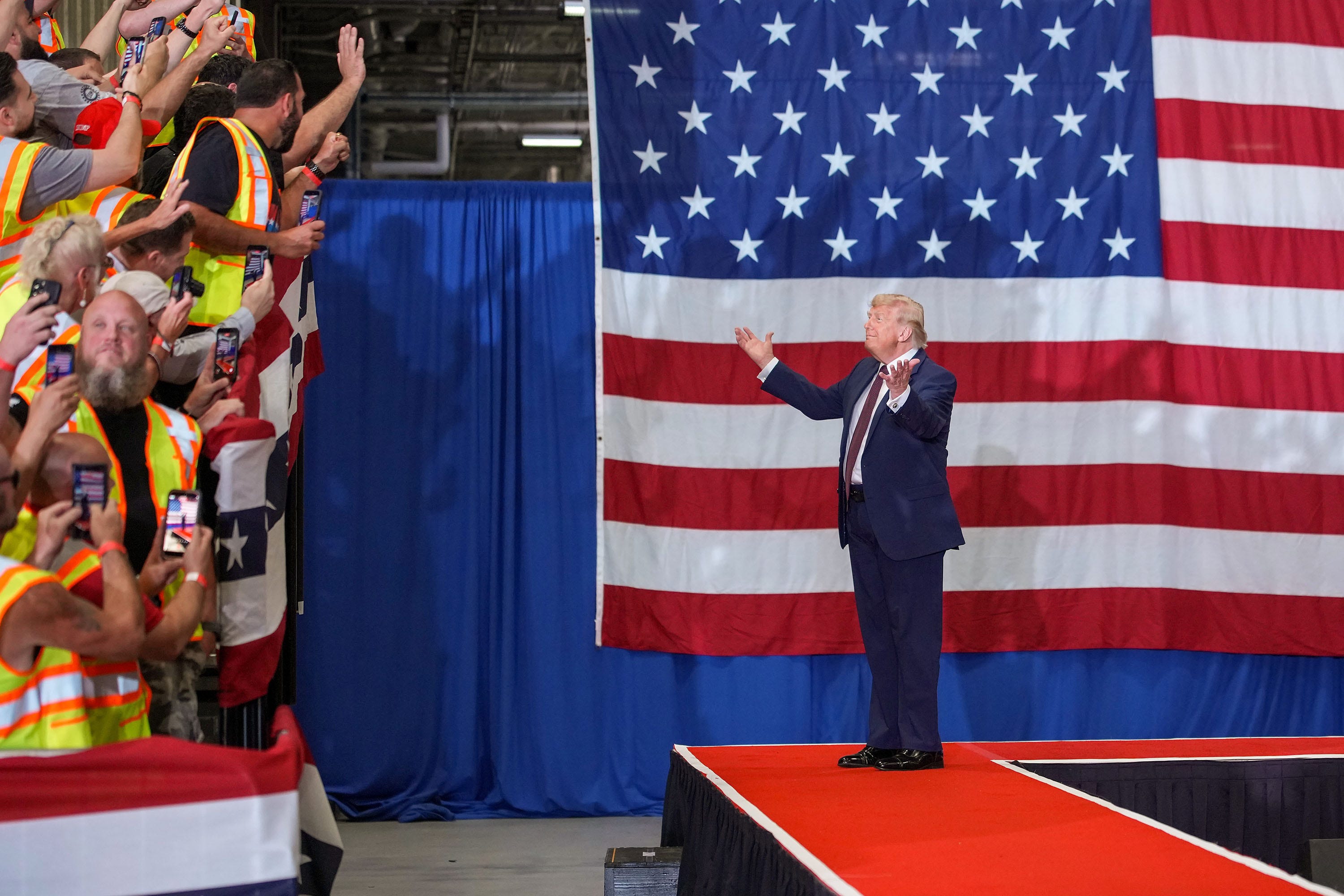
It’s interesting, the things that jump out at you watching your eight millionth1 Trump rally. For instance: Did you know the president is perhaps the sole person on earth who uses the words “won” and “love” as synonyms? “Hello, Pennsylvania,” he said as he arrived on stage Tuesday afternoon to the usual soaring strains of “God Bless the USA.” “I won this place so much.”
Trump hasn’t been doing so much winning lately. Islamist regimes abroad and single-celled organisms at home keep disobeying his extremely clear instructions, no matter how many bombs or gallon jugs of hydrogen peroxide he sends their way. Rogue judges keep ordering his name off of buildings, no matter how much he deserves to put it up and how nice it looks once it’s up there. Even his most reliable whipping boys, the Republicans of the United States Congress, have begun to flash a sudden and alarming new modicum of self-respect, with a small but significant number of them voting against his wars and scuttling his slush funds.
Yeah, D.C. sort of sucks lately; what Trump needed was a rally. So yesterday he schlepped out to a Mack Trucks factory in Pennsylvania’s Lehigh Valley to get one. These rallies have always been a tonic for Trump; this one felt more like a lifeline. Every stupid threadbare brag line, every completely invented cockamamie anecdote and scripted attack on the “Dumocrats”—the crowd, as usual, ate it up with a spoon. “There’s so much love in the room,” Trump said. “There’s so much unbelievable love.”
We could spend far more time and space than this newsletter permits ticking through the president’s usual parade of whoppers. It seems, for instance, that he intends to try to sell a return to the status quo2 in the Strait of Hormuz as one of those Wonderful, Magnificent Deals Only Trump Could Ever Get You: “Yesterday, 19 million barrels of oil flowed out of the Strait of Hormuz, a very beautiful place,” he said. “That’s the most oil in the history of the strait.” (In reality, it’s still a bit subpar—last year an average of 20 million barrels passed through the waterway daily.)
It also appears that Trump, having failed once again to deliver the manufacturing boom he has spent a decade promising, is now using America’s data center buildout as a way to fudge the numbers and pretend he’s delivered on that front too. “Right now, we have more factories being built—and I mean car factories, AI factories, factories of every type—than we’ve ever had in the history of our country, by three times,” he bragged. “That’s because they didn’t want to pay the tariff. How don’t you pay a tariff? You build the factory here and you hire American workers.”
Building a data center in America rather than in Bangladesh, of course, has zero to do with tariffs and lots to do with latency, infrastructure, grid stability, and so on—companies want to keep their data centers as close to their actual users as possible. And a data center, unlike a factory, doesn’t bring with it a whole bundle of blue-collar manufacturing jobs of the sort Trump keeps promising to bring back.
But at a Trump rally, none of that matters. It is a space apart from space and a time apart from time, where the possibilities remain endless and the achievements remain unsurpassed. These people really do think, after all this time, that Trump is giving them the straight, honest truth when he brings out that old canard: “A short time ago, we were a dead country,” but now “we’re the hottest country in the world by a lot.”
The problem is that it’s growing clearer—even to increasingly panicky Republican strategists outside the building—that all this is an illusion. Trump might find these rallies both soothing and invigorating, but the people who show up in that room have never been further from a durable political majority: Trump is still nineteen points underwater in Silver Bulletin’s polling average, and the strong approvers—the rallygoing types—are utterly swamped out by the strong disapprovers: 22.6 percent of Americans say “hell yes,” 48 percent say “hell no.”
Trump might think that the vast majority of Real Americans approve of him. He might think, when he heads out for one of those rallies, that that’s who’s showing up. He might think the polls really are cooked, that the vote totals really are rigged, that he’s sitting on the people-pleasing side of a whole bundle of—as he likes to say—“99–1” issues.
But if he does, he’s sleepwalking into a bruising wakeup call. The MAGA throng—that 22.6 percent—will be showing up at the polls in November. But that 48 percent of Americans, the group he tends to dismiss as polling phantasms or phony ballots or paid agitators, they’ll be showing up too.
Don’t Let Them Memory Hole the Iran Debacle
by William Kristol
“If you’re a Republican, yeah, for God’s sakes, no one wants to talk about Iran.”
That’s Matthew Bartlett, a Republican strategist who worked in Trump’s State Department in his first term. He’s providing good advice to Democrats: Make Republicans—from the Trump administration to members of Congress to House and Senate candidates—talk about Iran. Make them defend their misbegotten and failed war.
This shouldn’t be hard.
The war was, after all, costly. We lost thirteen American service members; we had tens of billions of dollars in direct military expenditures and lost much more indirectly in higher gas prices and other economic effects; we gave up an advantageous strategic position against Iran, as well as the end of the principle of free navigation through the Strait of Hormuz; we did great damage to our alliances; we lost standing and respect in the eyes of friends and foes alike. We gained nothing.
As Sen. Bill Cassidy (R-La.) of Louisiana, put it: “Right now, Iran is ending up stronger than they started, and we’ve achieved none of the objectives originally laid out, so you might say that’s disappointing.”
This was not a bipartisan effort gone awry. This was distinctively Trump’s war. It was never authorized by Congress, and Trump resisted efforts at oversight. And it was also the Republican party’s war. Republicans in Congress voted over and over again to support it even as Democrats voted to end it.
And the American people understand that Trump’s war was a failure. According to a Reuters/Ipsos poll conducted June 18–22, 52 percent of Americans believe our military action in Iran wasn’t worth it, with only 24 percent saying it was, and 22 percent unsure. This same poll has Trump’s approval-disapproval among registered voters at 37 percent vs. 62 percent, with only 18 percent strongly approving while 50 percent strongly disapprove. The war didn’t help Trump, and the deal to end it hasn’t helped Trump.
And it’s hard to see how the next few months of negotiations with Iran will help. The talks have already provided plenty of embarrassing moments for the administration, as they try to defend Trump’s ugly deal, and as even Trump-friendly commentators call them out on their labored efforts.
The Trump administration is now going to be requesting an additional $80 billion in taxpayer money from Congress to cover the costs of this unauthorized, unwise, and unsuccessful war. The amount being sought is far higher than the $29 billion estimate of war costs that Hegseth gave Congress during his testimony last month. This funding request will provide further occasions for Democrats to demand information and insist on hearings on the conduct of the war and on the concessions to the Iranian regime that mark its conclusion.
Speaking to reporters in Pennsylvania yesterday, Trump acknowledged, in his way, the need for continued discussion of the war: “Anybody that’s been critical of it has to be educated.”
Good. Let’s have an educational process. Let’s keep on educating Americans about the administration’s reckless decision to go to war. Let’s keep on reminding Americans about all the empty boasts and outright lies the administration told during the war. Let’s keep on exposing Trump’s defeat, and the bad deal his administration is now defending.
In sum: Keep on talking about Iran. Keep on wrapping Trump’s Iran fiasco around Republicans’ necks.
AROUND THE BULWARK
Why the Trump Administration Is Telling Us So Much About UFOs… YANIV REGEV on how populists weaponize the language of transparency against our institutions.
Trump’s Affront to the Founding… The president besmirches the highest principles of the Declaration of Independence while embodying the tyrannical rule it sought to overthrow, writes JOHN PITNEY.
Trump’s Coalition of the Aggrieved… On the flagship podcast, JOHN GANZ joins TIM MILLER to explain why the era of hell we’re living through may have been ordained by angry GOP voters in the ’90s.
Quick Hits
WAR POWERS REBUKE: The Senate on Tuesday passed a war powers resolution ordering Donald Trump to end the war in Iran or seek congressional approval to continue it—the latest sign of small but growing Republican willingness to defy the White House on the Hill.
The 50–48 vote, which comes three weeks after the House approved the same resolution, saw four Republicans join with nearly all Democrats to pass the resolution, with Sen. John Fetterman (D-Pa.) the lone Democrat to oppose it. (Two other Republicans who would have opposed the resolution were absent: Sen. Mitch McConnell was hospitalized last week and has not returned to the Senate, and Sen. Dave McCormick was campaigning in his home state of Pennsylvania with Trump at the time.)
The New York Times notes that what happens next is unclear:
The measure was a concurrent resolution, a vehicle that does not need a presidential signature to take effect but also does not become law. In 1983, the Supreme Court ruled that to have legal effect outside of Congress, legislative actions generally must pass both chambers and be presented to the president for signature or veto.
But supporters of the resolution say war powers measures are different because the Constitution gives the power to declare war to Congress alone. The issue has never been definitively tested before the Supreme Court.
Regardless, it was the latest rebuke from an increasingly testy Congress over its being frozen out of the decision-making process for an increasingly unpopular war.
HOLY SHITSNA: By now most people know about the big Washington Post story about how former Director of National Intelligence Tulsi Gabbard was in thrall to a cult leader for large parts of her career—up to, possibly, the present. The Bulwark’s Sam Stein spoke with Senate Intelligence Committee Vice Chairman Mark Warner about this, and his concerns extended beyond Gabbard to the Post itself:
The unfortunate thing is, Sam, you know not at the level of detail of the story, because it had literally receipts, but we were aware that she was part of this cult. And you know my friend, Sen. [Brian] Schatz from Hawaii, you know, was very familiar with this.
She never denied it. It was part of her public record. So we went at that. People are understandably reluctant to appear to be attacking someone’s faith, but this goes so far beyond her personal faith—and particularly since the leader of this cult was still communicating or having his agents communicate with the director of national intelligence on a, you know, regular, almost daily basis. It’s again, pretty chilling.
I’ve got so many questions. You know, it appeared the Washington Post had that story for some time, one of the reporters literally left a couple months ago. Why [didn’t they] publish it beforehand? Is this again, the new ownership in [Jeff] Bezos kowtowing to the administration? Was this the reason [the reporter] left? We’ve got a lot of questions.
I’ve talked to a couple of my colleagues about how we can pursue this. Again, this was a case where there was a lot of trepidation on the Republican side about her in the first place. We got very close to not having her confirmed. But a lot of Republicans held their nose and voted for her. But we warned ahead of time that this kind of stuff could happen.
There’s a lot more where that came from. Watch the whole thing.
WHACKING THE PRESS: This White House is in a constant cold war against journalists, but things are heating up: Multiple outlets reported this week that the Justice Department had sought to compel grand jury testimony in a national security matter from reporters for the Washington Post and Wall Street Journal. DOJ ultimately backed off after both papers fought the subpoenas in court. The Post has the story:
The grand jury subpoena to Washington Post reporter Ellen Nakashima this spring was related to sensitive reporting about a national security matter, [a Justice Department official] said. The Justice Department also issued subpoenas to appear before a grand jury to three Wall Street Journal journalists, who also reported on national security issues. . . .
The purpose and scope of the investigations that triggered the subpoenas are not clear, but the person familiar said they relate to national security matters. While the journalists are no longer scheduled to appear before a grand jury, the Justice Department’s action reflected a new front in the Trump administration’s aggressive tactics toward the media as it attempts to crack down on government leaks to the press and content that administration officials think is unfair to the president.
FISHBACK HAS TO PAY BACK: Florida governor hopeful James Fishback has been running a wildly racist Republican primary campaign against Trump-endorsed Rep. Byron Donalds—and he’s been enjoying a disconcerting amount of success in the polls. But now he has a mammoth legal bill to pay.
On Tuesday, a federal judge in New York ruled that Fishback owes his former hedge fund employer $1.3 million in legal expenses and fees incurred as part of a lawsuit over various forms of mischief that Fishback perpetrated against his old bosses. That’s actually $600,000 less than Fishback’s foes initially asked for, thanks to a generous haircut the judge put on the fund’s legal fees from white-shoe law firm Akin Gump. Still, it’s likely far more than the marginally employed candidate can cover—he already has creditors tracking down his Teslas and luxury Cartier watch.
Combined with an earlier loan Fishback took out from the hedge fund while still working there, Tuesday’s ruling means Fishback is now on the hook for roughly $1.5 million, not including other possible creditors.
Undeterred by his financial problem, Fishback reached a new low in his campaign Tuesday, unveiling a video entitled “Byron Donalds is Black.”
Cheap Shots


This is a rough estimate.
Or as close to it as we’re going to get, with Iran still seemingly intent on charging fees for vessels transiting the Strait of Hormuz.
"watching your eight millionth1 Trump rally"
Andrew,
Why didn't you go into a line of work more enjoyable? Like pumping septic tanks?
Thanks, Andrew for another beautifully written piece complete with this sentence: "Islamist regimes abroad and single-celled organisms at home keep disobeying his extremely clear instructions, no matter how many bombs or gallon jugs of hydrogen peroxide he sends their way"