
1. You Guys
We’re going to get to the Washington Post in just a moment, but first: Boy, people did NOT like yesterday’s church-y newsletter.
And that’s okay.
Over the last two days I wrote about guns and God. Big, complicated, divisive, important subjects. Many of you disagreed with me on one (or both). Many of you disagreed with each other. And yet the conversation we had was wonderful.
People were serious and respectful. Everyone worked in good faith. The highest compliment I can give is that the discussion in the comments added value to the product. I can’t thank you enough for that. No writer could ask for a greater gift.
We’ve added a second show in Minneapolis. Tickets have just gone on sale for Bulwark+ members. If you want to join us, I’d encourage you to jump on them now. At 1pm CST tickets will be available for everyone else.
I can’t really tell you what these two shows are going to be about. We don’t have much of a plan. What happened is that we saw how the people of Minneapolis stood up and we wanted to stand with them. Coming to town to raise money for Second Harvest Heartland and to bring our community together in one space . . . I’ll be honest—it feels paltry compared to the physical sacrifices Minneapolis residents are making. But it’s the best we can do.
There’s a lesson here. Solidarity asks us each to do something. If you live in Minneapolis, maybe you go out to be an observer. Or maybe you go to Costco to buy food and toiletries for your neighbors who are in hiding.
If you live in Chicago, maybe you go to Minneapolis for the weekend to support local businesses. If you live in California, maybe you donate to one of the organizations helping folks at ground zero of the DHS occupation. Wherever you are, you don’t stop talking about what’s happening there. You don’t let the rest of America look away.
Not everyone will be a hero. But we can all be part of the movement. Part of the community.
2. The Post
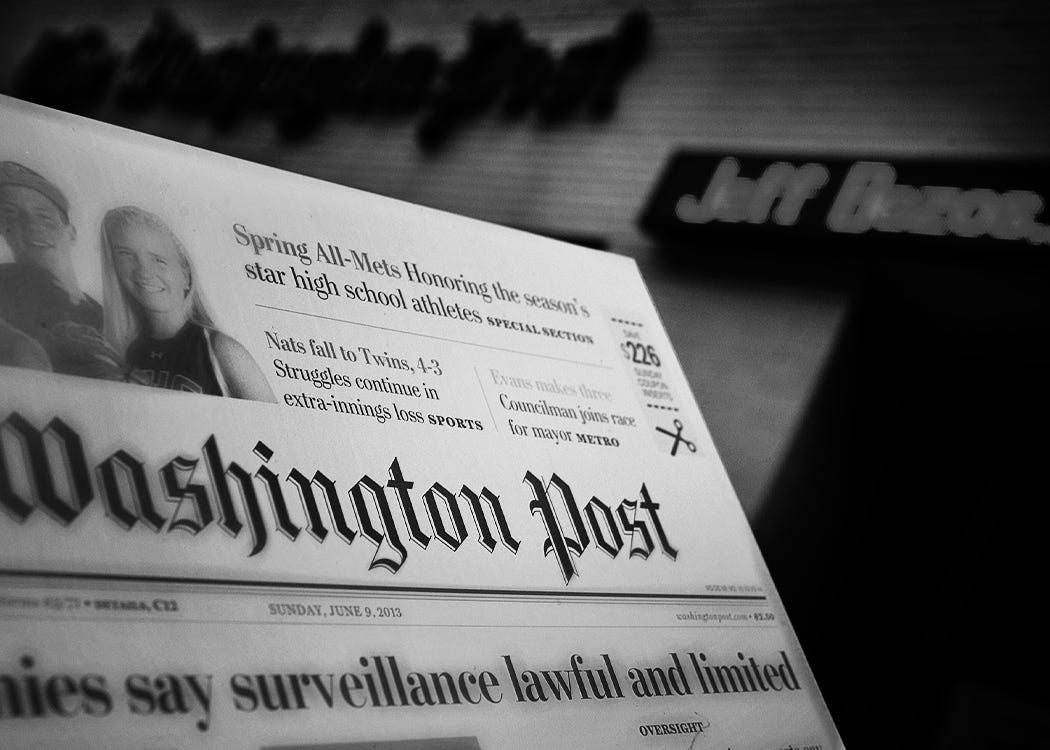
This morning the Washington Post laid off more than 300 people, totaling a third of the organization. The paper has basically shut down its sports, books, and international sections. The metro section is down to roughly a dozen journalists. The Post as it existed last week, has ceased to exist.
What happened?
Most of the obituaries will blame environmental changes of technology and news consumption. These changes are real, but they are not why the Post is now in hospice.
No, this is a story about incompetent leadership that destroyed the paper’s economic viability. It’s a story of self-mutilation.
We’ve discussed the Post before and I’m not going to recapitulate the entire saga—you can read it here.
The short version is that in 2023, Jeff Bezos hired Will Lewis as publisher for the Post. As a business decision, the hire made no sense. Lewis was a disgraced Brit with no experience in American media and no track record of success in digital publishing. He was a reliable hack, though: He would do whatever he was told and clearly he had been told to make the paper friendlier to Donald Trump, no matter the cost.
Lewis’s tenure has been an unbroken streak of failure. Every single initiative he has undertaken became a cost-sink: The “third newsroom”; the pivot to Trump; the remaking of the Opinion section; the creation of an aggregator called “Ripple”; and, finally, the restructuring of the paper.
With each passing month, the Post’s financial losses snowballed under Lewis. And yet he is still at the Post.1
If a newspaper’s publisher makes a bunch of decisions that lose money, and then the owner keeps the publisher while firing the staff who puts out the paper—none of this is really about the money, is it?
Jeff Bezos is worth something like $250 billion. This past weekend he chose to lose about $60 million on a worshipful film about Melania Trump. In 2019 he spent $5 million on a 30-second ad for the Washington Post during the Super Bowl.2 He has spent $40 million building a clock inside a mountain that will supposedly keep time for 10,000 years.3
A man like Jeff Bezos does not do anything because he has to. It has been decades since he was constrained by anything other than his own desires. What happened to the Washington Post over the last three years happened for one reason and one reason only: Because Jeff Bezos wanted it to be so.
Because he gets off on civic vandalism.
It would be nice if some other billionaire would buy the Post from Bezos. But that’s not going to happen as long as we live in an authoritarian context, because owning a media company is not safe unless you are a supplicant to the regime.
All of which leaves us in a bad place. The free market will not save the Post, because its owner is immune to market signals. Politics will not save the Post, because so long as Republican voters demand authoritarianism, no one can own a media outlet without taking on outsized risk. As sad as it is to admit, the Washington Post is beyond help.
The only thing left to us to is build new institutions to take its place. That’s what we’re doing here.
3. The “Free Speech” Racket
One of those new institutions is the Unpopulist. Today they have a great piece by Ken White:
“Free speech culture” tends to pick a speaker, treat that person’s speech as the speech that should concern us, and then apply a set of cultural norms and questions only to the responses to that speech. This is what I call the First Speaker problem.
Imagine that a speaker came to your university to argue that no professor should be allowed to teach “gender ideology” and that the school’s curriculum should be examined for “anti-American” and “pro-communist” content. Imagine further that a group of students protest the speaker’s invitation, call for the speaker to be disinvited, shun and decry the student group that invited the speaker, and protest loudly outside the speech, shouting insults and abuse at attendees.
“Free speech culture” analyzes this situation by asking:
Do the actions of these protestors encourage or discourage speech?
Would such protests deter others from speaking?
Do these protests make students who agree with the speaker less likely to speak up?
Would these protest tactics, if widely repeated, result in more speech or less?
Do these protests support an idealized view of civilized debate and discourse?
Are the students’ reactions disproportionate?
Do they seek to impose “real-world” consequences on someone who is only offering a viewpoint?
But “free speech culture,” as typically used in America, crucially does not ask those questions of the person who has been chosen as the “first speaker”—only those responding to speech. Hence, the speaker in this hypothetical—who is in favor of official state censorship—gets treated as the free speech culture hero, and the students protesting the speaker get treated as the free speech villains.
This incoherence stems from the fact that, within a “free speech culture” framework, selecting the “first speaker” is often an arbitrary exercise. Our speaker came to campus to denounce “gender ideology” because professors and students engaged in protected speech about “gender ideology.” Why aren’t they the “first speaker”? Why isn’t the professor teaching “communist” ideology the “first speaker”? And why isn’t the speaker calling for their censorship violating the social norms of “free speech culture”?
The answer is primarily stylistic and cultural. “Free speech culture” means that you can chill and deter speech, call for censorship, disproportionately abuse other people, even call for violence—so long as you do it in certain ritualized and stylized ways that people who were on the debate team like. If you dehumanize fellow Americans from a lectern or in a moderated debate or as a contributing writer to a magazine, that promotes free speech culture. However, if you denounce the speaker in a social media post, or protest outside, or write a letter to the dean, that harms free speech culture.
Lewis did not deign to join the Zoom call this morning where his colleagues were fired at his direction. What a coward.
The Post Super Bowl spot was vanity advertising at its worst. If you must spend money advertising your product, you want to max out ROI by reaching a high concentration of your total addressable market. You don’t want to pay to reach people who are never going to buy your product.
And it’s not like the Post needed brand awareness. It’s already a household name.
Running an ad for a newspaper during the Super Bowl was setting money on fire.
I love it when “rationalists” undertake unfalsifiable projects.
I'm really coming around to Bernie's argument that every billionaire represents a policy failure. I also hope that there is some form of consequence imposed upon these billionaires when this regime falls. Their companies should be broken up, they should pay much higher taxes, and ideally, shunned from all polite society. Alas, I'm probably hoping for too much.
I found it ironic to ask WWJD in a situation where DHS has likely detained several men actually-factually named Jesus