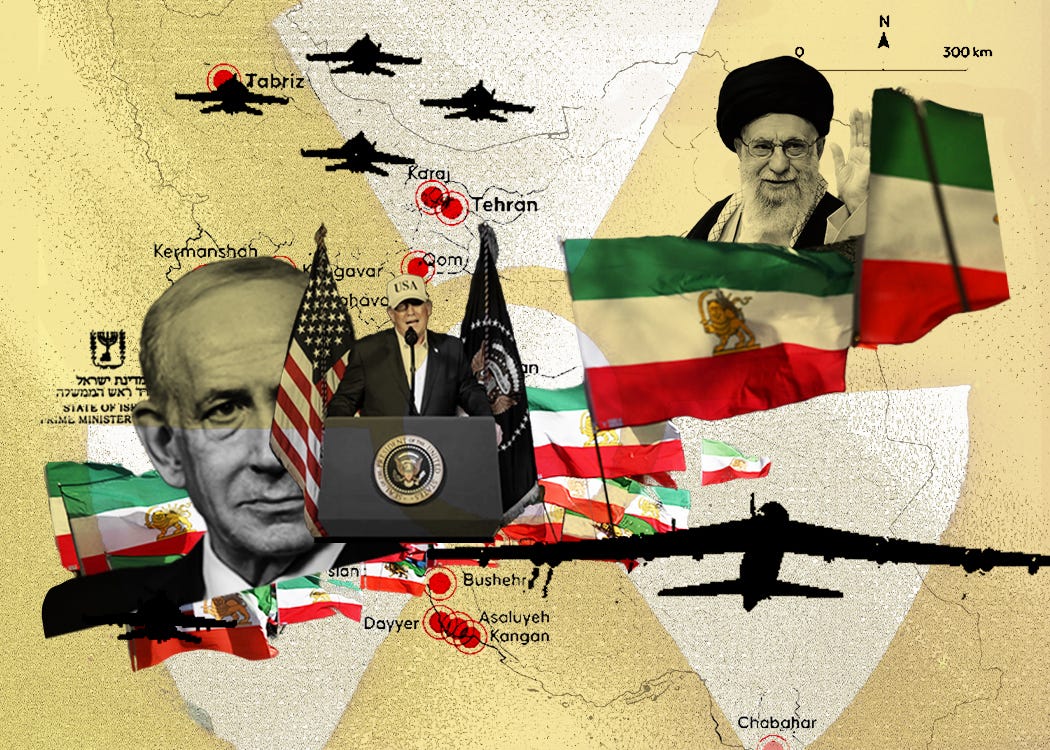
Three Massive Questions Concerning Trump’s War in Iran
Through the fog of war, some things are dimly discernible.

THE UNITED STATES, IN CONJUNCTION with Israel, initiated a series of air attacks against Iran Saturday. Early reports indicate that American forces attacked military targets throughout the country while Israeli forces targeted Iranian Supreme Leader Ali Khamenei, President Masoud Pazeskhian, and other high-level figures in the regime. The Israeli government and President Donald Trump both announced mid-day Saturday that Khamenei had been killed.
In response, Iran launched missiles at American bases throughout the Middle East and reportedly moved to halt shipping through the Strait of Hormuz.
As always, the earliest reports of combat are often confused, sometimes contradictory, and probably wrong, at least in some respects. But there are some questions that we can already answer, provisionally and partially, to gain some clarity on what’s going on.
1. Why now?
LET’S START WITH WHAT we don’t know: Was there some secret exigency that required a decision at this point? Donald Trump’s special envoy, Steve Witkoff, said within the last week that Iran was “probably a week away from having industrial-grade bombmaking material.” Witkoff isn’t an expert in nuclear weapons or international relations; there have been no other reports corroborating his statement; and it directly contradicts open-source intelligence about the state of the Iranian nuclear program, to say nothing of the Trump administration’s own claim that the air strikes U.S. forces conducted as part of last summer’s Operation Midnight Hammer “obliterated” Iran’s nuclear sites.
Then again, if Iran had made some secret breakthrough in its nuclear weapons program, the Trump administration would have had every reason not to announce it, given those claims of “obliteration” last year. It’s possible, but unlikely, that Witkoff slipped up and accidentally told the truth.
Then, too, the Canadian and Australian governments—both members of the Five Eyes intelligence partnership, along with the United States, the United Kingdom, and New Zealand—issued statements expressing support for the operation on the grounds that it would prevent Iran from obtaining a nuclear weapon. (The U.K. released a slightly more ambivalent statement about the strikes that nonetheless emphasized that Iran must be prevented from acquiring nukes.) Maybe our intelligence partners know something the American public doesn’t.
Trump has made clear, though, that unlike Midnight Hammer, these attacks are not designed just to incapacitate Iran’s nuclear program. He intends them to topple the regime. The optimal time to do that might have been mid-January, when the largest protests since the fall of the Shah in 1979 seemed to destabilize the regime—until it responded with massive violence, effectively quashing them. (The protests restarted this week, but not on the scale of last month.)
Trump promised the protesting Iranians in mid-January that “help is on the way,” less than two days after the raid on Caracas, Venezuela in which American forces seized former Venezuelan President Nicolás Maduro and effectively replaced him with his deputy, Delcy Rodríguez. That operation, like the current attacks against Iran, followed a long buildup of American forces—especially naval forces. As a result, most of America’s spare naval power was still deployed around Venezuela when Trump made his promise. It took weeks to reassemble those forces for Trump’s next adventure half the world away.
If there was some nuclear exigency requiring these strikes on Iran, did the president know about it when he ordered the forces necessary to first focus on Venezuela, which was not exigent? That’s one question members of Congress might want to ask the administration. Otherwise we’ll have to wait for the historians to puzzle it out.
2. What role did Israeli Prime Minister Benjamin Netanyahu play in Trump’s decision to attack Iran?
THIS ONE MAY STUMP even future historians. So much of the answer, in a specific sense, depends on what’s going on in Trump’s head. And since Trump seems less inclined than most presidents to preserve his decision-making processes on paper, we may never get a detailed view of how much Netanyahu influenced Trump.
But, in a larger sense, we do know some things. One is that Netanyahu wants to make it look like he’s leading Trump around by the nose. He met with Trump in Washington earlier this month, reportedly to lay out a plan to attack Iran and to urge Trump to include Iran’s ballistic missile program and support for terrorism in the negotiations the United States and Iran had been conducting about the latter’s nuclear program.
Late Saturday morning, hours after the attacks in Iran had begun, Netanyahu’s official X account posted a picture of him, purportedly on the phone with Trump, with a copy of Tim Bouverie’s Allies at War sitting conspicuously on the desk. Superficially, that could be a symbol of camaraderie between nations—or at least governments—engaged in combined military operations. But the book, a history of the American–British–Soviet alliance during World War II, also details how each of the “Big Three” allies sought different aims, sometimes undermined each other, planned for very different post-war worlds, and often used each other to advance their own interests unrelated to ultimate victory in the war. In other words, the inclusion of the book could be seen as an esoteric troll.
If Netanyahu is shaping Trump’s foreign policy as much as he wants people to think he is, he wouldn’t be the first foreign leader to have a dramatic influence on an American president. Just to take a few examples within living memory: Lee Kwan Yew, the first leader of Singapore, was an early proponent of President Richard Nixon’s decision to open relations between the United States and the People’s Republic of China. (Lee made these claims after Nixon had died, but there’s reason to give them credence: As Tom Switzer has pointed out, Nixon heaped praise on Lee’s statesmanship in his 1982 book, Leaders; and Henry Kissinger, Nixon’s secretary of state and national security advisor, said of Lee, “No world leader has taught me more.”)
British Prime Minister Margaret Thatcher’s famous friendship with Ronald Reagan gave the former significant influence over the latter. While the two occasionally clashed on foreign policy—they held different views on nuclear disarmament and ruffled each other’s feathers during military operations in Grenada and the Falkland Islands—perhaps the defining decision of Reagan’s political career was shaped by Thatcher’s judgment. It was Thatcher’s praise for Mikhail Gorbachev—“We can do business together”—that convinced Reagan that the new Soviet leader might conduct nuclear arms negotiations.
Thatcher’s eventual Downing Street successor, Tony Blair, would shape the American-led invasion of Iraq a generation later. President George W. Bush lacked foreign policy experience when he came into office and was almost immediately confronted by a generational national security challenge; he trusted Blair as a sort of senior statesman. As the Bush administration struggled internally to develop a policy toward Iraq, Blair’s liberal interventionism became a strong counterweight to the more realpolitik-minded members of the Bush administration who preferred installing a more palatable strongman to replace Saddam Hussein, or other options short of trying to build democracy.
3. Doesn’t this seem familiar?
SPEAKING OF IRAQ: Enough time has passed since the 2003 war that good histories are being written about how it came about—especially Melvyn P. Leffler’s Confronting Saddam Hussein and Joseph Stieb’s The Regime Change Consensus. One thing that becomes clear from these histories is that the American confrontation with Iraq did not result from the personal whim of one person, but was the result of a complex, decades-long conflict. It’s important to be cautious about drawing historical parallels, but provided we remain circumspect in how we interpret them, there are a few disturbing ones worth considering.
Both regimes created chronic problems in the Middle East and beyond. In Saddam Hussein’s case, he hardly spent a year in power without getting involved in some kind of international crisis, from invading his neighbors to using chemical weapons to attempting to develop nuclear weapons to mass-murdering his own people, and on and on.
In Iran’s case, the Islamic Republic has attempted to build a quasi-empire from Afghanistan to Lebanon. It has been the world’s leading state sponsor of terrorism for generations, has abused and massacred its own people, has killed Americans through its proxies, and has covertly attempted to build nuclear weapons. Both Iraq and Iran have also threatened the free passage of oil out of the Persian Gulf, which threatens the entire global economy.
In both cases, the American government committed to doing something about the problem long before identifying what that something was. The decision to support the overthrow of Saddam crystallized sometime during the Bill Clinton administration, and it became official U.S. policy when Congress passed, and Clinton signed, the Iraq Liberation Act of 1998—a bill that stipulated support for Iraqi opposition groups, the provision of humanitarian aid, and other measures meant to pressure the regime without committing to open war against it.
In the case of Iran, since its secret nuclear program became public in 2002, every American president has vowed that Iran wouldn’t be allowed to possess a nuclear weapon. Taken together, Bush, Obama, Trump, and Biden tried every available option, from polite requests to painstaking negotiations to cyberattacks to surprise air strikes.
Nuclear weapons dominated the conversation about both countries. We can identify the point at which Iraq’s alleged nuclear program was made to crowd out all the other preexisting threats posed by Saddam. It happened in early 2003, during then–Secretary of State Colin Powell’s preparations for a speech at the United Nations in which he would make America’s case against Saddam to the world. In Leffler’s telling, staffers for then–Vice President Dick Cheney gave Powell “a comprehensive indictment focusing on Hussein’s possession of weapons of mass destruction, violations of past obligations, links to terrorists, and disgraceful record of brutality and ecological degradation.”
The problem was that “Powell did not like what he read. . . . He wanted to focus mostly on Hussein’s WMD.” That became the focus not only of Powell’s U.N. speech but of the administration’s public explanation of the need for war. And when it turned out that Saddam had dismantled his nuclear program and had no WMDs, no one cared much about the other arguments for war in Iraq that the administration hadn’t made.
In his statement announcing the attacks on Iran, Trump didn’t overemphasize the nuclear angle (though he did hint cryptically at “imminent threats from the Iranian regime” and said they have steadfastly refused to “renounce their nuclear ambitions”). He instead walked through Iran’s many foreign and domestic abuses from the advent of the Islamic Republic in 1979 to today. It’s possible his administration, with the lessons of 2003 in mind, decided to lay out every possible rationale for war, just in case the Iranian nuclear threat didn’t match what they have said about it.
But that may not be enough to keep them from making a variation of the mistake the Bush administration made. The problem in both cases is substantively identical: Either the administration is keeping secret some “imminent threat” that requires war now, or there is no reason for war now.1
In making the public case for the war in Iraq, the Bush administration put too much emphasis on factual conclusions that turned out to be wrong. The Trump administration, in neglecting to make the case for war against Iran, has put itself in a position where it can’t be proved wrong—but it also can’t be proved right.
It’s also possible that “imminence” here is providing a legal justification for why these attacks are really “self-defense” under international law—the United States has long defined “imminence” in this context to mean something much broader than what it says in the dictionary in order to justify preemptive action—but we won’t be able to know that until they explain the nature of the threat.


It's extremely likely that "preemptive" is being used simply to justify the attack. I don't believe it myself. I think this was always Trump's plan.
I imagine this attack is a confluence of factors and not just a couple of reasons. Some that likely or in some cases certainly contributed to this decision in no particular order are:
1. Benjamin Netanyahu has wanted this for a long time. Go back to his cartoon bomb presentation at the UN in 2012 where it was obvious he was asking the US to strike the deepest nuclear facilities of Iran even then.
2. Trump has seen from Venezuela that launching these types of overwhelming force attacks sure up several elements of the traditional Republicans while not having the attrition among his base that Democrats wishcast. The Turning point USA and so many other hard MAGA factions may not want wars with ground troops but love bombing things and killing strikes just as they love not necessarily the deportations of immigrants but the cruelty to immigrants.
3. Trump’s domestic policies are either becoming unpopular or stagnant. The loss at the courts on tariffs and the perceived backdown in Minneapolis has him trying to get back on the offensive and large military strikes allow him to remain front and center demonstrating power.
4. Trump attacks the tyrants he doesn’t like (Maduro, Khamenei, Diaz-Canel), has a lovefest with the ones he does like (Putin, Erdogan, Bukele, Orban, MBS, Kim Jong Un, Xi Jinping, …), and talks tough & threatening to traditional allies.
5. Attacking Iran furthers his family’s business interests in the Middle East by signaling to other Middle Eastern States not to cross him.
6. Trump curries favor with several members of his so-called board of peace.
7. He can make the USA the center of Middle Eastern diplomacy again. While some view Trump as taking his queue from Israel and Netanyahu, the reality is by using US military technology the Middle East will work through the US and Trump not Israel.
8. Trump probably has part of him where he wants the uprising in Iran to succeed even if he won’t commit what us necessary to allow them.