Trump Sounds a Lot Like You-Know-Who
He’s no Hitler. But his speech in Davos about Greenland eerily echoes 1938.

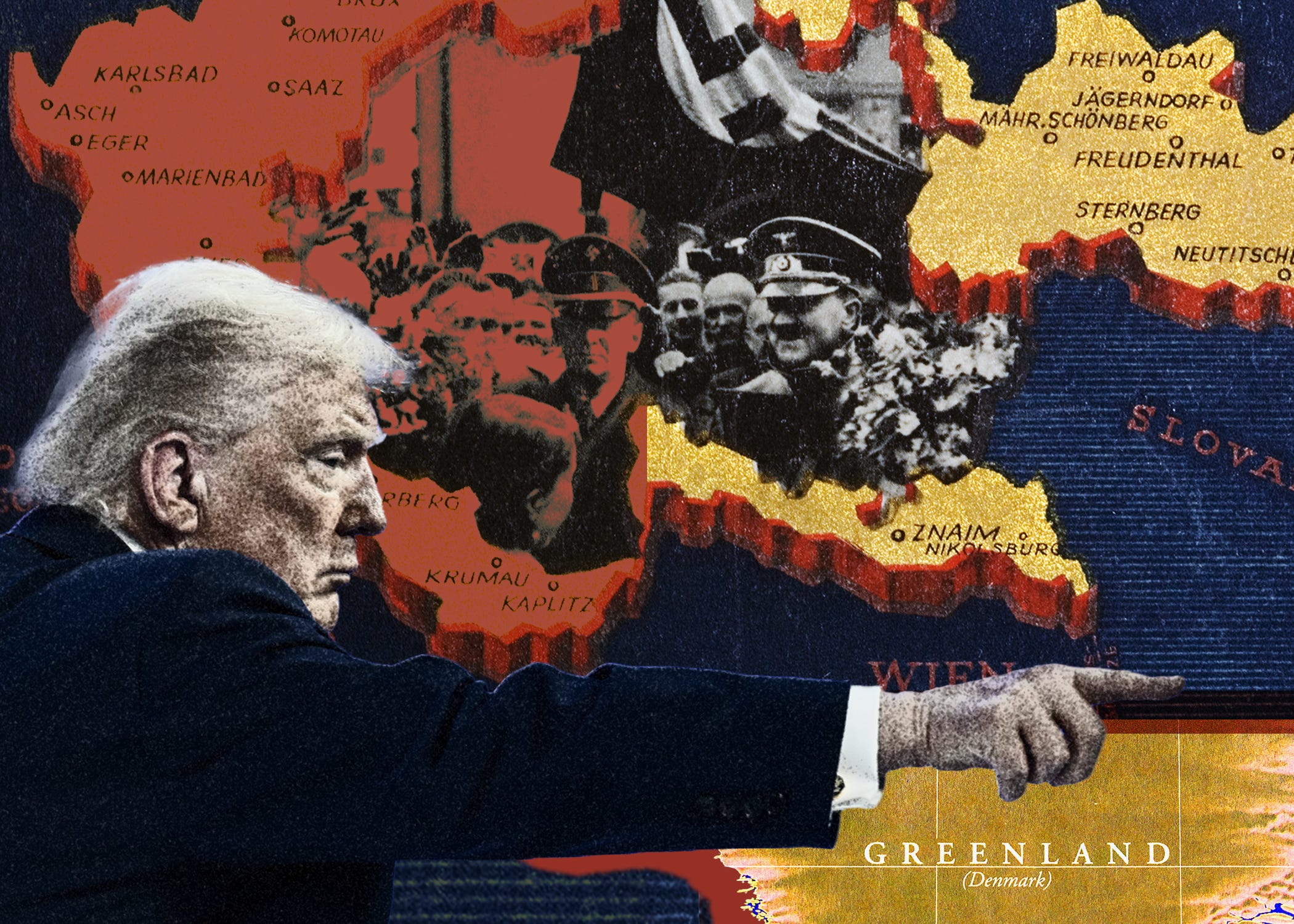
IN DAVOS, DONALD TRUMP asked for a piece of land. “I’m seeking immediate negotiations to once again discuss the acquisition of Greenland by the United States,” he told the World Economic Forum on Wednesday. Trump said his request was well founded in history, because “many of the European nations” had similarly acquired foreign territories.
One European nation, in particular, acquired a lot of territory about eighty-five years ago. A few minutes before he talked about taking Greenland, Trump recalled that in World War II, Denmark, which had sovereignty over Greenland, “fell to Germany after just six hours of fighting.”
Trump’s reference to World War II Germany raises an awkward question. One of Germany’s first land grabs in that period began with a request. On September 26, 1938, Adolf Hitler delivered a speech in the Berlin Sportpalast calling on England, France, and other European powers to give him the Sudetenland, part of what was then Czechoslovakia.
Trump isn’t Hitler, of course, and any attempt to compare Hitler with a current political figure can seem laughable or outrageous. Trump is an incipient fascist; Hitler was a full-fledged totalitarian dictator. Trump likes to sue, indict, and humiliate people; Hitler orchestrated history’s worst mass murder. So let’s stipulate up front that in any analogy to Nazism, the differences dwarf the similarities.
But with all that being said: It’s disconcerting how much Trump’s speech resembles Hitler’s.
HITLER SAID HE NEEDED the Sudetenland to protect Germany against a national security threat. He said this threat came from “Bolshevism” in Czechoslovakia. That was an allusion to Russia, the source of Bolshevism.
Trump has invoked a similar threat. For months, he has said he needs Greenland to protect the United States against Russia and Communist China. Obviously, the world has changed since 1938: Russia is no longer officially Communist, and China wasn’t on Hitler’s mind. But Trump is trying the same tactic Germany used back then: playing up a Communist menace to justify his aggression.
Second, in his Sportpalast speech, Hitler claimed that based on its culture and geography, the Sudetenland belonged to a broader vision of Germany. Trump, in a similar way, argued in his Davos speech that Greenland was “part of North America, on the northern frontier of the Western Hemisphere. That’s our territory. It is therefore a core national security interest of the United States of America.”
Trump’s argument is different in two respects. The Sudetenland was adjacent to Germany, whereas Greenland is not adjacent to the United States. And while most people in the Sudetenland had ethnic ties to Germany, most people in Greenland have no ethnic ties to the United States. These differences make Trump’s argument even flimsier than Hitler’s.
Third, Hitler demanded political control over the Sudetenland, as well as “legal title” over the territory. Trump, in his Davos speech, used almost the same phrase: “All we’re asking for is to get Greenland, including right, title, and ownership.”
Fourth, Hitler disputed Czechoslovakia’s sovereignty over the Sudetenland, claiming that the Czechs “simply took” the land and its people. Trump, in a similar way, disputes Denmark’s sovereignty over Greenland. A Danish “boat went there five hundred years ago and then left,” the president scoffed on Monday. “That doesn’t give you title to property.”
Fifth, Hitler bragged that he had built a military so powerful that no one could stop it. “I gave orders to rearm the German Wehrmacht and to bring it to the highest level possible,” he declared. “We rearmed to an extent the like of which the world had not yet seen.” He said his army had “the newest, most modern weapons that exist” and was a force “the world will respect whenever it shall be introduced.”1
In light of this vast power, Hitler claimed that he had “shown great restraint” in choosing not to seize the Sudetenland. “When someone displays such unending patience as we have demonstrated,” he said, “you cannot accuse him of being a warmonger.”
Trump frames his power and forbearance in almost the same way. “We probably won’t get” Greenland, he told the audience in Davos, “unless I decide to use excessive strength and force where we would be frankly unstoppable. But I won’t do that, okay? . . . I won’t use force.” He went on:
All the United States is asking for is a place called Greenland. . . . We are a much more powerful force now, after I rebuilt the military in my first term and continue to do so today. We have a budget of $1.5 trillion. We’re bringing back battleships [that are] 100 times more powerful than the great battleships you saw in World War II.
In case anyone doubted Trump’s willingness to use that arsenal, he pointed to his attack on Venezuela three weeks ago. “Once the attack ended,” he noted, Venezuela’s leaders “said, ‘Let’s make a deal.’ More people should do that.”
That sounded a bit like Hitler’s praise, in his Sudetenland speech, for countries that had chosen “to negotiate” with Germany rather than risk war. It’s a not-so-subtle way of dangling a threat.
LOOKING AT THAT LIST OF PARALLELS, it’s perfectly reasonable to think: Sure, Trump is an aggressor, but he’s not Hitler. Again, let me stress: That’s true. Nobody should diminish the unique enormity of Hitler’s crimes.
But it should worry us—and it should worry Europe—that Trump has been taking on more and more of the behaviors that define a fascist. He has seized authorities from Congress, ordered prosecutions of his critics, led a violent coup to try to stay in power, and built a paramilitary force that kills civilians with “absolute immunity.” At a reception in Davos, he suggested that he wasn’t really a dictator. But then he added, “Sometimes you need a dictator.”
Trump is also wading into the cesspool that has led to atrocities in fascist countries: using state power to enforce the leader’s bigotry.
In his Sudetenland speech, Hitler dismissed the idea of ethnic pluralism—“There is no such thing as a Czechoslovakian nation,” he sneered—and he accused other European leaders of failing to appreciate “völkisch matters.” He claimed to speak for his people, “the German Volk,” and he advised other politicians to fall in line. “Some of the other statesmen might do well to consider if this is the case with their people as well,” he warned.
Trump doesn’t use the word Volk. He uses the word recognizable. “The places where you come from can do much better by following what we’re doing” in America, he told the European elites in Davos. “Certain places in Europe are not even recognizable, frankly, anymore. They’re not recognizable.” He described what people in his social circle were saying about Europe: “Friends come back from different places . . . and say, ‘I don’t recognize it.’”
As Trump continued, his meaning became clear. He lamented that “European capitals” had allowed “unchecked mass migration” and were “importing new and entirely different populations from faraway lands.” And he argued that welfare fraud by some Somali immigrants in the United States showed “the West cannot mass-import foreign cultures which have failed to ever build a successful society.”
To purge this infestation, Trump recommended a solution he claimed to be pioneering in America: “reverse migration.” He named Somalis as his first target. “They all ought to get the hell out of here,” he declared from the White House podium on Tuesday. “They’re bad for our country.”
You can tell yourself that all of this is okay because Trump hasn’t called for putting Somalis—or, as he refers to them, “garbage”—in camps. You can tell yourself that he won’t use force in Greenland because that’s what he promised in Davos, right before he warned Greenland and Denmark that if they rejected his demands, “We will remember.” You can tell yourself that when he referred to his target four times as “Iceland,” it was just a slip of the tongue.
And you can tell yourself what Europe told itself in 1938: Just give him this one piece of land, and we’ll have peace for our time.
Hitler’s rearming of the Wehrmacht was, as his audience well understood, in direct violation of the Treaty of Versailles.
Will, Thanks for the piece. The moral of the story is clear. However, where do you think Trump gets these thoughts? We know he's not very bright, ok, we know he's an idiot. So who is directing all this threatening hate speech? Who in this administration is a student of Nazism? Steven Miller is the guy who has made this his life long ambition and somehow has found the way to make Trump believe this will make him the greatest force in history. Miller is the most dangerous man in America at the moment. He's behind the ICE terrorism, he's behind the ignoring of the rule of law and he's behind the bullying on the world stage. Our best chance to stop him is to keep saying he's in charge, keep saying he's manipulating Trump and he's the guy using the violent intimidation tactics on the Republicans in Congress. We must say it loud, we must say it often and we need to start now.
Hitler didn't start with camps either. It started with the office of resettlement. Plus the current detention centers are, by any measure, camps. Germany didn't create death camps until Barbarosa. The concentration camps were prisons.
Nazism didn't reach it's final form in 1932. It escalated over time. Kristalnacht wasn't the day Hitler took over.