The Expanded Trump War Glossary: Still More of What He *Really* Means About Iran
Trumpisms in translation.

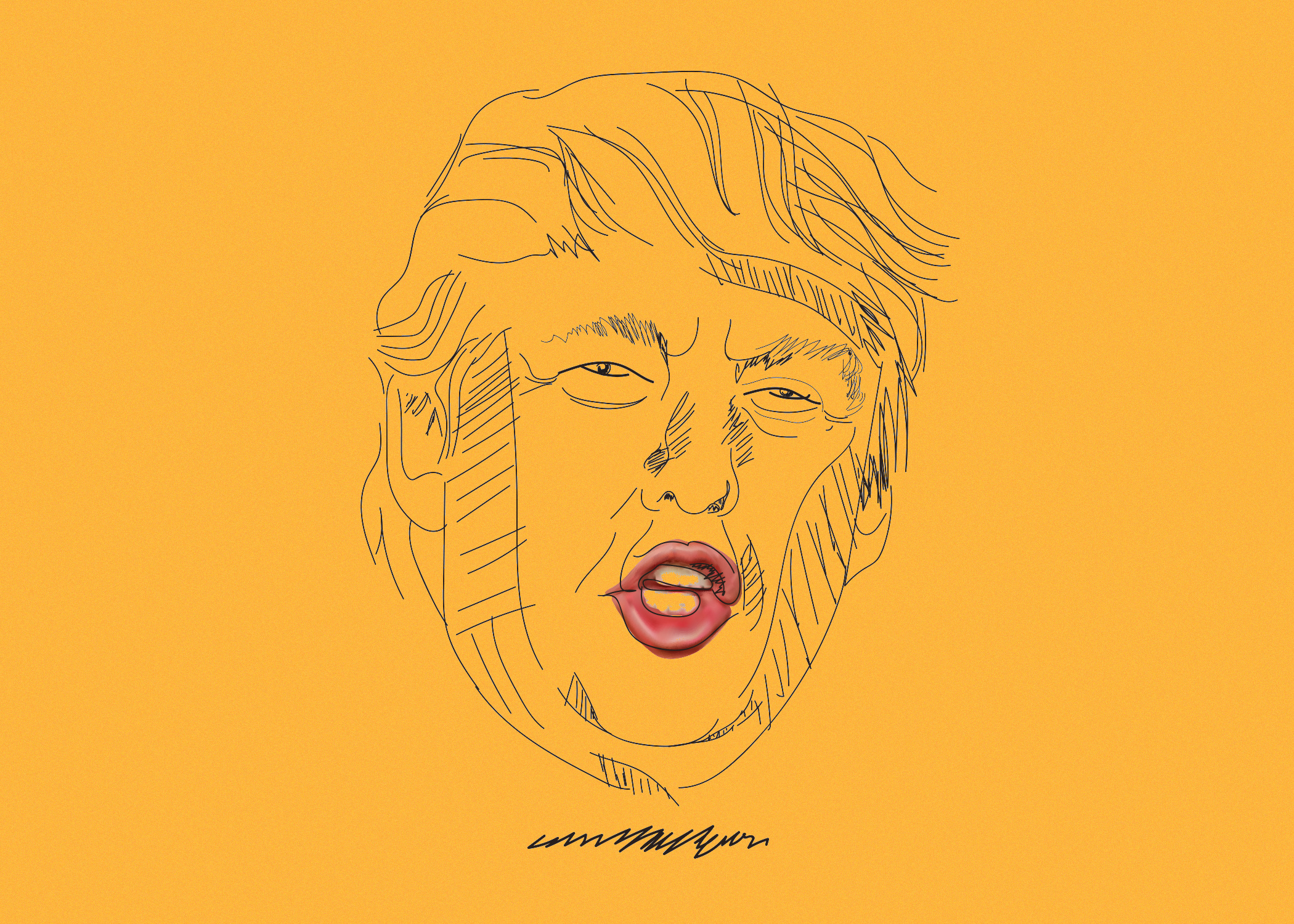
LANGUAGE IS CONSTANTLY EVOLVING, and Donald Trump is a restless innovator. Three weeks ago, The Bulwark published a glossary of terms he had redefined in his war with Iran. The list included imminent, obliterate, and unconditional surrender. Since then, he has added more words and phrases to his lexicon. Here are some of the most creative.
Before (adj): after. On March 15, Trump rebuked British Prime Minister Keir Starmer for failing to supply aircraft carriers “before we start the war.” Trump repeated this complaint on March 16 (“I want them before we start”), March 17 (“We want things sent before the war”), and March 19 (“I want the aircraft carriers before the war”).
But two minutes after repeating that gripe on March 19, Trump said he had deliberately kept America’s allies in the dark about his plan to start the war. “We didn’t tell anybody about it, because we wanted surprise,” he explained.
That means Starmer couldn’t have sent help in advance. So when Trump says before, he must mean sometime later.
Begging (v): communicating. At a cabinet meeting on March 26, Trump asserted four times that Iran was “begging” for a deal to end the war. He repeated that assertion on Truth Social. But two sentences later, in the same post, the president accused Iran of refusing to meet his terms. “They better get serious soon, before it is too late,” he warned. Apparently, Iran wasn’t begging hard enough.
On Tuesday, Trump insisted again, “They’re begging to make a deal.” But as of Thursday night, the beggars still hadn’t made a deal.
Cherish (v): seize. Trump has often claimed to “cherish” women, despite being found liable for sexual abuse. He uses this word the same way in foreign policy, promising to “cherish” Canada and Greenland as he threatens to capture or coerce them.
On Wednesday, the president extended this term to the Strait of Hormuz, calling for military action to gain control of it. “The countries of the world that do receive oil through the Hormuz Strait must take care of that passage,” he declared. “They must cherish it. They must grab it and cherish it.”
Journey (n): war. Trump has added this word to his previous euphemisms excursion (“this excursion, as I call it, excursion into hell”) and detour (“We had to take a little detour. Won’t be long”).
“We took a little bit of a journey,” the president told a White House audience on March 17. Last Friday, speaking at a Saudi investment forum, he said he had chosen to “go on a little different journey for a little while and take [Iran] out and then go back to life. And that’s what we did.”
A week later, the journey continues.
Military operation (n): war. “I won’t use the word ‘war,’” Trump told congressional Republicans at a dinner last Wednesday. He explained that his advisers “don’t like the word ‘war,’ because you’re supposed to get approval” from Congress for a war. “So I’ll use the word ‘military operation.’”
Seven minutes later, to smear Democrats, Trump reverted to the term “war.” He accused them of defunding airport security “during a war. They’re doing this during a war.”
NATO (n): Nations for Anything Trump Orders. Previously, this acronym stood for the North Atlantic Treaty Organization, which was chartered to defend Europe and North America. But after attacking Iran without consulting NATO allies, Trump has demanded NATO’s help and has threatened to abandon the alliance. “We would have always been there for them. But now, based on their actions, I guess we don’t have to be,” he told the Saudi forum. “Why would we be there for them if they’re not there for us?”
Need (v): 1. require. 2. not require. In a Truth Social post on March 17, Trump accused NATO countries of doing “nothing for us, in particular, in a time of need.” But two sentences later, he scoffed, “We no longer ‘need,’ or desire, the NATO Countries’ assistance — WE NEVER DID! . . . WE DO NOT NEED THE HELP OF ANYONE!” Parents of small children might be familiar with this alternation between the two meanings of need.
Nothing (n): something. On March 16, Trump proclaimed that Iran’s regime had “been literally obliterated.” On March 22, he pronounced “the death of Iran.” On March 24, he insisted, “Pretty much everything they have is gone. . . . Can you name one thing that’s not gone?” On Tuesday, he bragged, “They have no navy, they have no military, they have no nothing.”
Yet somehow, Iran has continued to hit ships and block traffic in the Strait of Hormuz. So Trump has added a caveat:
A guy can take a mine, drop it in the water, and say, “Oh, it’s unsafe.” It’s not like you’re taking out an army or you’re taking out a country. . . . They can drop it. Or you can take a machine gun from the shore and shoot a few bullets at a ship. Or maybe an over-the-shoulder missile, small missiles. That’s not for us. That’ll be for France. That’ll be for whoever’s using the strait.
In other words, Trump has destroyed everything in Iran’s arsenal. And if he hasn’t, well, that’s somebody else’s problem.
Over (adj): unfinished. On March 9, Trump said the war was “very complete.” On March 17, he added, “Iran is something that was essentially, largely over, in two or three days.”
But today, four weeks after it was over, the war is still going. “In a fairly short period of time, we’ll be finished,” the president promised on Tuesday. On Wednesday he assured the public, “We are on track to complete all of America’s military objectives shortly, very shortly.”
Partner (n): victim. At last week’s cabinet meeting, Trump was asked about taking control of Iran’s oil. He said that was an option. As a model, he cited Venezuela, where the United States lets Nicolás Maduro’s regime stay in power, minus Maduro, in exchange for Venezuelan oil. “We have a deal. We get a lot of it,” Trump boasted, referring to the oil. “Call it a partner,” he suggested.
Trump explained that thanks to the oil, his January 3 attack on Venezuela, which captured Maduro and gained control of the country’s government, had turned a profit. “We’ve paid for the cost of that military hit many, many times over. And we’ve only just started,” said Trump. On Wednesday, he called Venezuela and the United States “joint-venture partners” in the oil business.
As with cherish, this use of partner to describe coercion mirrors Trump’s language about women.
Regime change (n): personnel changes, or non-changes, made by a regime. Previously, this term referred to overthrowing or replacing a regime. But since March 23, Trump has asserted at least two dozen times that American and Israeli assassinations of Iranian officials amount to regime change.
“We killed all their leadership. And then they met to choose new leaders, and we killed all of them. And now we have a new group,” the president crowed on March 24. “We have really regime change,” he concluded, “because the leaders are all very different than the ones that we started off with.”
This is a particularly creative argument, since Iran’s new leader is the son of its previous leader. But on Tuesday, Trump insisted again, “We have a new regime, and the new regime is much better than the past.” And on Wednesday, he praised “Iran’s New Regime President” for being “much less Radicalized and far more intelligent than his predecessors”—even though Iran’s president has been in place since 2024. To Trump, even a non-change can count as regime change.
Spoken to (v): imagined. On March 16, Trump implied that in a private conversation with him, a former Democratic president had endorsed the war. “I’ve spoken to a certain president,” a “former president,” said Trump. “He said, ‘I wish I did it.’” When reporters asked which former president, Trump replied, “I can’t tell you that. I don’t want to embarrass him.”
Later that day, Trump repeated his claim. He denied that the former president was George W. Bush, and he declined to say whether it was Bill Clinton or Barack Obama. But people close to Clinton, Obama, and Joe Biden said they hadn’t spoken to Trump about the war.
In all likelihood, Trump made up this story, just as he has fabricated other conversations. Last Friday, he did it again, implying that he had interacted with former NFL coach Vince Lombardi. “I knew him,” said Trump. But there’s no record of Trump ever meeting Lombardi, who died when Trump was 24. And Trump has previously indicated he never met Lombardi.
Stopover (n): war. “I had to do a little stopover,” the president said at his cabinet meeting. “I had to do a little stopover in Iran, and we had to knock the hell out of ’em.” (Synonyms: detour, excursion, journey.)
Treason (n): journalism about failures or shortcomings in the war. “If you read the Times, you think we’re doing poorly,” Trump complained at the Saudi forum, referring to the New York Times. “It’s almost treasonous. I have to be honest. It’s almost treasonous.”
IN HIS ADDRESS to the nation on Wednesday night, the president once again adjusted his timetable for ending the war. “We are going to hit them extremely hard over the next two to three weeks,” he vowed. By then, he might be ready to announce a new timetable. And we’ll have a new set of Trumpian terms to explain.
“In two weeks…” = Never
“I know everything about it!” = Trump knows nothing about it.
“I know nothing about it!” = Trump knows everything about it.
“Big strong men with tears in their eyes called me “sir” = figments of Trump’s imagination.
“I love so and so!” = Trump is about to kick him/her to the curb.
“This was a day of love…” = This was a day when a howling mob of Trumpers tried to kill capitol police, the Congress and Trump’s Vice President.
“This project will be on time and under budget!” = This project is a grifting excuse that will never be completed.
“This isn't about Epstein!” = It’s about Epstein.
Will, It's uncanny how you interpret this President's idiosyncratic language. I believe you stumbled on to something neurological that needs some researchers and medical scientists to explore. We may have a new virus spreading throughout the country with its epicenter in Washington, D.C.. Let's call it, Liars Amnesia Syndrome. Symptoms include telling a lie and immediately forgetting you ever even spoke and then repeating this in a continuous loop. Additionally, when asked about it, you deny it and attack the questioner.