
Trump’s Fed Chair Nominee Fails the Big Test
The senators grilling Kevin Warsh didn’t cover themselves in glory either.

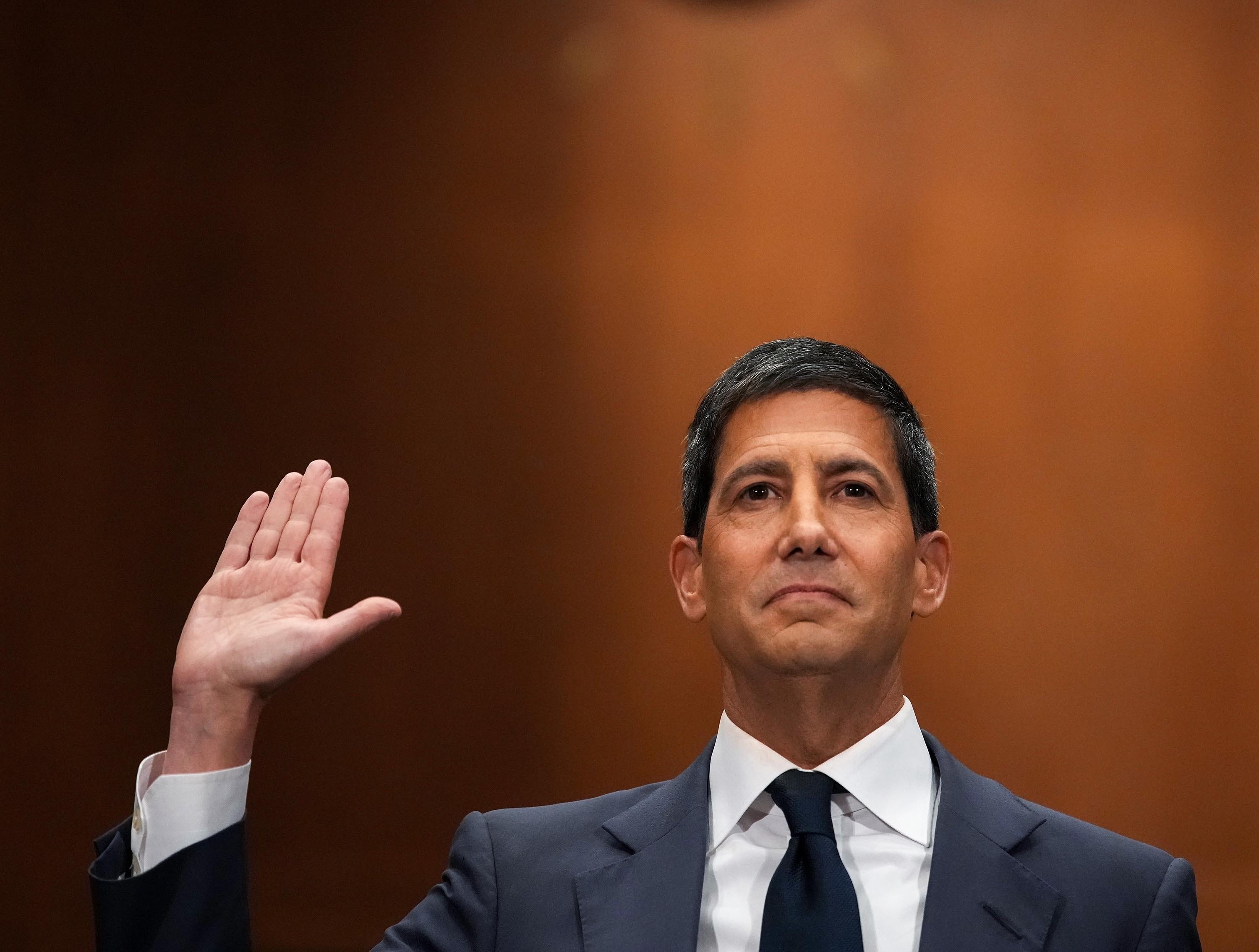
KEVIN WARSH, DONALD TRUMP’S pick for Federal Reserve chair, had his confirmation hearing before the Senate Banking Committee yesterday. The hearing was held under the shadow of Trump’s ongoing efforts to persecute (and prosecute) the current Fed chair, Jerome Powell—a vendetta that simultaneously undermines both the rule of law and the nation’s long-term economic prospects.
It was Warsh’s chance to prove his commitment to independence, and he failed.
He gave plenty of lip service to Fed independence, but he actually needed to answer two specific questions:
1) Is Trump’s criminal investigation into Powell appropriate?
2) What would Warsh do if Trump threatened retribution against him for monetary policy decisions the president disliked?
Both questions are critical, given that Trump’s demands for interest rate cuts—and Warsh’s promise to deliver them—will almost inevitably come into conflict with the inflation stoked by Trump’s war in Iran. But Warsh answered neither. In fact, no one even bothered to ask him the second question.
Kevin Warsh’s “Evolution”
Unlike some of the other candidates Trump has considered for Fed jobs, Warsh is not obviously insane or incompetent. He’s not a clown, or a hack, or someone who makes easily falsifiable claims on TV. On paper, he looks like a terrific candidate. He is polished and fast on his feet, has market experience, and has even served on the Fed Board before (from 2006 to 2011, as an appointee of President George W. Bush). Plenty of people I respect have said he more than clears the bar.
But the question has never been whether Warsh has the brains for the job. It’s whether he has the spine for it. Which he will very much need, given who is in the White House.
As I’ve noted before, Warsh spent nearly his entire career advocating for policy positions the exact opposite of those that Trump demands today. Trump wants looser monetary policy, regardless of economic conditions. Trump even has affirmed that a commitment to cut interest rates immediately was a “litmus test” for anyone wanting his nomination to lead the Fed. But Warsh has generally been considered an inflation hawk, favoring tighter monetary policy with higher interest rates and a smaller Fed balance sheet.
Even in the deepest, darkest depths of the financial crisis—as in, literally one day after Lehman Brothers failed—Warsh said he was worried about inflation. Instead, we immediately experienced deflation.1
Warsh has been fairly consistent about this positioning with two major exceptions: Each time Trump happened to be entering the White House. Less than two months before Trump was re-elected, Warsh chided the Fed for cutting interest rates. Warsh then reversed himself a few months later, when Trump just happened to be scouting out a new Fed chair.
The timing certainly smelled funny. Particularly given the fact that Warsh had been passed over for the Fed job before, in Trump’s first term, and had attributed his rejection then to the fact that he hadn’t said what Trump wanted to hear.
“My meeting with the president went on for a bit more than an hour, and he was transparent in his views,” Warsh told Simon Bowmaker in a 2023 interview for a forthcoming book (Fed Reckoning: Conversations on America’s Central Bank, due out in January 2027). “It was a very rigorous interview. He asked some very relevant questions, and I offered my best judgments. I left the interview, however, not overly enthused about my prospects for selection. I did not put my ambitions ahead of my principles.”
We don’t know if Warsh’s subsequent transformation from inflation hawk to dove was actually politically motivated. As Warsh said in Tuesday’s hearing, “My opinions change when the facts change.” That is certainly a reasonable approach, and words I hope to live by too.
What makes this latest conversion concerning, however, is how it overlays Trump’s efforts to politicize the Fed, and how Warsh has responded to those efforts.
Trump’s Attacks on Fed Independence
The central bank is supposed to be politically independent. The only way it can keep price growth in check is by being willing to take painful actions that politicians won’t, such as raising interest rates when the economy starts getting too hot—or taking away the “punch bowl” just when the party gets going, as the expression goes.
Politicians pretty much always want to put more booze in the punch bowl—i.e., lower interest rates—regardless of the long-term consequences for the economy. That is why countries where politicians control the money supply tend to have much worse inflationary outcomes.
This was a problem here in the United States too, in the 1970s, when Nixon leaned on the Fed chair to keep rates low. But ever since Paul Volcker helmed the central bank, the Fed has proved its willingness to do “whatever it takes” to crush inflation, no matter how unpopular, and it has aggressively guarded its independence in the process.
Presidents got the memo: However much they might gnash their teeth in private about Fed policy, they knew it was important to stay out of the bank’s way and let it do its thing.
At least until Trump got into office in 2017.
Trump elevated Powell to Fed chair for a term beginning in early 2018, and within months he was already publicly berating Powell for not doing his bidding. Trump’s angry tweets and interviews about Powell were pretty shocking at the time, at least to us Fed watchers.
But now those early rage-tweets seem almost quaint. Trump has escalated from smearing Powell as an “enemy” of the United States to repeatedly threatening to fire him. Trump actually did try to fire another Fed governor, Lisa Cook, on unsubstantiated allegations that she committed mortgage fraud (this case is now before the Supreme Court). And now Trump’s Justice Department is conducting a politically motivated criminal investigation into Powell, ostensibly related to cost overruns on a building renovation.
The irony is that Powell’s term as Fed chair is already scheduled to end next month. Trump could have just waited him out. But our president cannot help but continue to harass, threaten, and punish his perceived personal enemies, even after a federal court tells him to lay off.
This has all backfired tremendously for Trump.
Retiring Sen. Thom Tillis (R-N.C.) has said he likes Warsh but will not advance any Fed appointments until the investigation into Powell is over. This actually means that Powell could remain leading the Fed for longer, since the law allows the chair to stick around until a replacement is named.2

The gang returns to California for two live shows in May. Join Sarah, Tim, and Sam in San Diego on May 20 or in L.A. on May 21 for a night of politics and laughs, and a community built on good faith. Bulwark Live: California is sure to sell out—don’t delay.
Warsh Ducks the Issue
So where is Warsh in all this? Mostly silent. But at times, he has encouraged Trump’s bad behavior, at least when he was publicly auditioning for the Fed job.
When asked last year about whether it was appropriate for Trump to publicly jawbone the Fed, Warsh defended Trump’s behavior, and said Fed officials must not be “pampered princes.”
Likewise, when every living former Fed chair signed a Supreme Court amicus brief warning of the dire economic consequences should Trump succeed in firing Cook, Warsh mocked them. “I did not know that senior economic officials’ at the Treasury and the Federal Reserve expertise went all the way to constitutional jurisprudence,” he snarked.
And then came yesterday’s confirmation hearing.
Sen. Angela Alsobrooks (D-Md.) asked Warsh if he would “commit to defending Governor Cook’s tenure as Chairman Powell has done.” She also quoted Supreme Court Justice Brett Kavanaugh as saying that Cook’s firing “would weaken, if not shatter, the independence of the Federal Reserve,” and asked Warsh if he agreed.
Alsobrooks then asked about the criminal investigation into Powell, and asked Warsh if he disputed Powell’s assertion that the investigation and threats of criminal charges are pretexts for disagreements over the Fed’s interest-rate policy.
Warsh refused to answer any of these questions. His rationales (or excuses) were some combination of: he shouldn’t comment on ongoing litigation before the Supreme Court; he trusts the courts; and though he “took a constitutional law class,” he lacks the legal expertise to weigh in.
This was a test, and Warsh failed it. And he knows it. In 2023, in that interview with Simon Bowmaker, Warsh said he had conveyed to the first Trump administration that he would not cooperate with any effort to remove Fed officials over policy disagreements:
Bowmaker: In Nick Timiraos’s recent book, Trillion Dollar Triage, he wrote that at a White House signing ceremony in January 2020, President Trump told you, “I would have been very happy with you [as Fed chair].” What would you have done differently if you had been Fed chair in the 2018–19 period?
Warsh: If you are referencing media reports that the president had grown unhappy with the Fed chairman at certain points, recognize that the Federal Reserve chairman is appointed with a fixed term. If the president wanted to truncate that term and replace the Fed chairman, I suspect that is a case that would have ultimately been decided by the Supreme Court. During the period that you reference, I did hear on occasion from senior administration officials querying about my interest in the role of chairman of the Federal Reserve. My response was that the position was not open and would not be open until the chairman’s term was complete.
How things have changed.
A Trump–Warsh Confrontation Is Coming
Now one might argue—as some of Warsh’s friends have said to me privately in recent months—that Warsh has to make unseemly rhetorical concessions to get the job. There’s no way around it.
This kind of slippery elision may just be the price of admission for the job. As is the expectation that Trump appointees refuse to acknowledge Trump lost the 2020 election. (When Sen. Elizabeth Warren asked Warsh about this on Tuesday, he also declined to answer.) Most charitably, we can say that however gross these kinds of comments seem, they don’t mean Warsh will do Trump’s bidding if he’s confirmed.
After all, Warsh understands markets, and he has waxed poetic about Fed independence in the past. What matters is how he plans to respond when (not if) Fed independence comes under pressure on his watch.
Unfortunately, in the hearing, Warsh was never asked how he would react if Trump were to, say, call Warsh an “enemy,” or launch a bullshit criminal investigation into him, or try to fire him, or otherwise take him to court. (At the recent Alfalfa dinner, Trump “joked” about suing Warsh if the Fed didn’t cut rates.) When faced with such an onslaught, Powell stood his ground. Would Warsh? We don’t know! He wasn’t asked.
Maybe Warsh thinks he can manage Trump. Certainly every other onetime Trump ally or appointee seems to believe they’re uniquely able to survive a disagreement with him. But smooth and well-connected as Warsh is,3 I am dubious he’ll be able to sweet-talk his way out of presidential wrath. That’s important, because a confrontation over interest rates between Trump and a Warsh-led Fed is starting to look inevitable.
Why? First: Warsh will be just one of twelve votes on the committee that sets interest rates; he can’t deliver them solo.
Second, markets don’t seem to think he’ll really want to. When Warsh was first announced as Trump’s nominee in January, long-term Treasury yields ticked up slightly—suggesting investors expect the Fed to become somewhat more hawkish under Warsh, despite Trump’s demands and Warsh’s recent dovish transformation.
Third, that market reaction occurred before Trump started bombing Iran, leading to severed global supply chains and higher prices.
Developments in the war have led markets to further downgrade the likelihood of big rate cuts this year. Maybe investors will be wrong—particularly if the energy shock leads to a recession—but at the very least, the Fed will be in an even trickier position than it was before the war. Even Treasury Secretary Scott Bessent recently said he’d “understand” if the Fed held off on further rate cuts for a bit while monitoring the war’s impact. If at some point all the Fed’s internal models suggest inflation risks are high and rate hikes are necessary, but at the same time Trump is screaming for rate cuts because he wants to survive the midterms, how will Warsh react?
Senators should have asked that. Warsh should have to answer. Because the public deserves to know.
It is a good thing the Fed didn’t heed Warsh’s advice, as tightening monetary policy at the time might have led to a global depression. Fortunately, when Warsh was scaremongering about inflation, Ben Bernanke was chair of the Fed. Bernanke is perhaps the leading economic historian of the Great Depression, and was awarde his Nobel for his research on the subject. He has also specifically blamed the Fed’s rate hikes for worsening the 1929 crisis. As he said in a 2002 speech honoring Milton Friedman, who with Anna Schwartz had famously detailed the Fed’s role in turning the financial crash into the worst depression in American history: “Regarding the Great Depression . . . we did it. We’re very sorry. . . . We won’t do it again.”
Powell can also remain as a regular member of the Fed Board even after a successor as chair is confirmed. This almost never happens—who wants to stay after being demoted?—but Powell says he’ll remain if the investigation persists.
I thought Elizabeth Warren demonstrated fairly convincingly that Warsh would NOT be independent. When she asked him to name one way in which his thoughts differed from the president’s, he said that he didn’t think he was “right out of central casting” in appearance. When she asked if Trump lost the 2020 election, we heard crickets for maybe 17 seconds, then a weaselly answer, She pointed out that she had been looking for independence and courage, and he had shown neither.
Does it matter? Not unless Tillis carries through on his threat not to approve any Fed Chairman as long as the case against Powell continues. It does seem as if Republicans care about financial policy more than they do about, say, healthcare, so we’ll see. I’d love to see Powell continue on the board after his term as Chair ends - we KNOW he’s independent and courageous (not to mention knowledgeable and quick on his feet), and his presence there would really piss off Trump.
I don't think you're being too cynical at all; After everything that's gone down, how are we supposed to trust anyone who is hand picked by Trump? The last thing we need is another big financial factor to further bring down the American economy.