


Fresh off the Supreme Court’s decision in Callais v. Louisiana, Democrats received a second major blow Friday in their attempts to keep pace with Republicans in this year’s Total Gerrymandering War: The Virginia Supreme Court struck down the new congressional map, heavily gerrymandered in Democrats’ favor, that Virginia voters approved in a referendum last month, ruling 4–3 that the legislature had cut procedural corners demanded by the state constitution in putting the measure before voters this year. Instead of the map voters okayed, which likely would have given Democrats a 10–1 advantage, the current 6–5 map—which could plausibly grow to 8–3 in a strong blue year—will remain in place.
The national political environment remains hellish for the GOP, but the outcome of the mid-cycle gerrymanderfest has helped them hedge their bets. However the midterms turn out in November, the House will likely be ten or so seats more Republican when the dust settles than it would have had this fight never begun. Happy Monday.
Today, on MAGA Mondays, Sam Stein and Will Sommer will talk about Trump’s golden idol statue and the other latest reports from the land of crazy. Join them live at 10 a.m. EDT on Substack and YouTube.
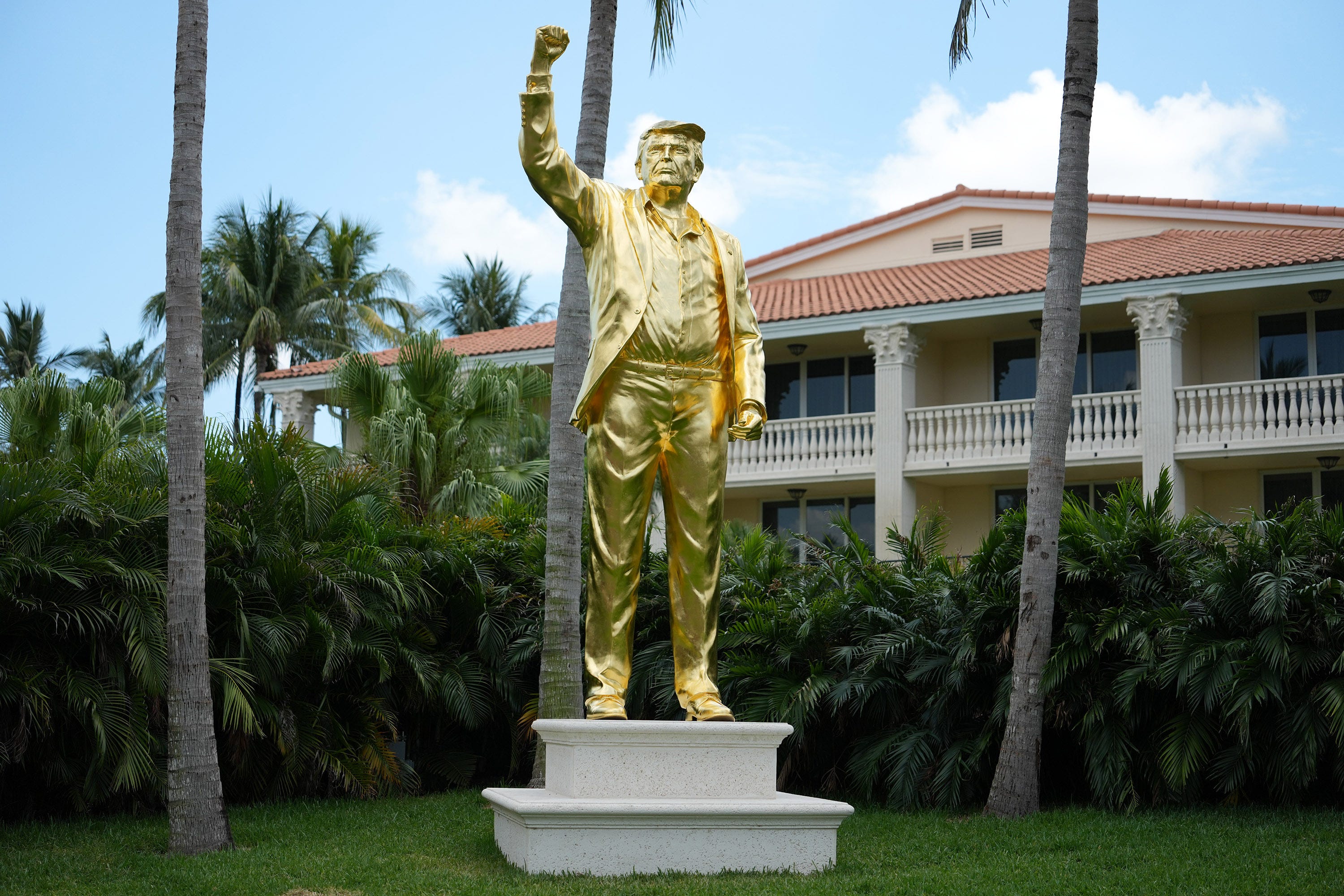
The Golden Donald
by William Kristol
I remember the day I came face to face with the horrifying prospect that Donald Trump could win the presidency. It was Wednesday, June 22, 2016. Trump had delivered a run-of-the-mill speech in New York City attacking Hillary Clinton on a host of issues. But then he said, “Her campaign slogan is, ‘I’m with her.’ You know what my response to that is? I’m with you, the American people. She thinks it’s all about her. I know it’s all about you.”
I remember thinking, Yikes. ‘I’m with her’ vs. ‘I’m with you.’ That could work.
A month later, at the Republican convention in Cleveland, Trump returned to his theme: “My opponent asks her supporters to recite a three-word loyalty pledge. It reads: ‘I’m With Her.’ I choose to recite a different pledge. My pledge reads: ‘I’M WITH YOU—THE AMERICAN PEOPLE.’”
Flipping Clinton’s unfortunate campaign slogan against her was effective. She wanted you to stand with her. Trump promised that he would stand with you.
Fast forward eight years. What was generally thought to be Trump’s most effective line against Kamala Harris in the 2024 campaign? “Kamala is for they/them. I am for you.”
One might think it ridiculous for Trump, this selfish and self-centered con man, to present himself as being for you the people. But he pulled it off. His opponents tried to show that Trump’s policies hurt the public, including those he claimed to care about most. But their arguments fell flat in the face of Trump’s demagoguery. The people felt he was with them, that he spoke for them.
Yet a demagogue can lose his touch. Demagogues are vain. An effective demagogue must keep his vanity at least to some degree disguised, to some extent in check.
But the demagogue ages. The fear of death moves closer to the center of his psyche. Merely holding power and commanding public attention is no longer enough. Mere vanity gives way to a needy and almost insatiable narcissism. Mere self-centeredness morphs into self-obsession. The narcissism escapes containment.
Last Wednesday, a twenty-two-foot-tall statue covered with gold leaf was unveiled at Trump’s golf course in Doral, Florida. Much of the commentary has understandably focused on the claim of the pastor, Mark Burns, who presided over the ceremony and explained afterwards, “Let me be clear: This is not a golden calf.”
The pastor surely doth protest too much. But Trump’s words were more striking than the pastor’s. The president celebrated the statue, posting, “The Real Deal - GOLD - At Doral in Miami.”
Pathetic. It’s not any kind of real deal. It’s a cheesy statue covered by gold leaf. But for Trump, it’s important.
And when he called into the unveiling ceremony, he marveled: “Everyone is taking pictures of it. Everybody is—my people tell me that it’s unbelievable. All day long, they’re taking pictures. They stand up next to it, and have their pictures taken.”
He’s president of the United States. He’s arguably the most famous and powerful man in the world. And he can’t help but revel in people taking pictures of his statue.
But at least this vulgar statue is on his golf course. We don’t have to see it. We don’t have to think about it ever again.
That’s not the case with the 250-foot high triumphal arch Trump wants to build here in in Virginia, just across the Potomac River from the National Mall, directly in front of Arlington National Cemetery. He aims to impose his vanity on all of us. The arch would dominate the view of Arlington Cemetery both as you approach it from the District and as you look back toward the Lincoln Memorial from Arlington House at the top of the hill. It’s a grotesque intrusion on one of our most sacred public spaces.
In a video for the group Home of the Brave,1 Vietnam veteran Ronn Easton eloquently expressed his disgust:
For me, Arlington is hallowed ground. I’ve been there 10 times. Whenever I visit, I go see the Vietnam Wall first, where the names of more than 58,000 of my fallen brothers in arms are inscribed. Then I head across the river to Arlington to pay my respects. On your way in, you pass through Memorial Circle, which is the very space where Trump wants to put his arch. I can’t think of anything less fitting to welcome Americans to this particular place.
Arlington is a place for solemn, serious reflection, where we memorialize American heroes. The arch is a desecration of that.
Arlington House stands at the top of a hill inside the cemetery, looking out over the Arlington Memorial Bridge, the Lincoln and Washington monuments, and the Capitol dome beyond. When you stand there looking out, it is awe-inspiring. You are overcome by the feeling that you are surrounded by heroes—more than 400,000 of them—people who stood for America, fought for it, and died for it. To have that view disfigured by an archway honoring a president who has spent his life denigrating servicemembers is simply a bridge too far.
The golden statue is on Trump’s private property. There’s nothing to be done about it. A grandiose arch defacing the public approach to Arlington Cemetery in the nation’s capital is another matter. I do think opposition by veterans like Easton can block it.
And I think opposition by citizens can block Trump’s vainglorious ballroom, for which he wants one billion dollars of taxpayer money. There were reports late last week of Republicans on the Hill getting queasy about having to vote for this. But Trump’s not backing away. In a spate of narcissistic Truth Social posts last night, mostly reposting praise of him as the greatest president ever, Trump couldn’t help but include a couple touting his ballroom, “The Magnificent Ballroom, under construction, and ahead of schedule, at the White House!”
Trump’s golden statue. Trump’s triumphal arch. Trump’s “magnificent” ballroom. They’re all about him. His narcissism is out of control. And no Republican has said a word critical of any of his narcissistic projects.
In 2016, Trump defeated Clinton by contrasting her slogan, “I’m with her,” with his claim, “I’m with you.” In 2026, Democrats can return the favor. They just need to explain the self-evident truth, “The Republican party is with him.” And then they simply need to show, “We’re with you.”
Is Putin Finally About to Do Something Smart?
by Benjamin Parker
Vladimir Putin is a master manipulator, an effective autocrat, one of history’s most accomplished thieves, and a wily opportunist. But he is not a very good strategist. If he were a good strategist, he would not have gotten involved in the war in Donbas in 2014; he would not have ordered the full-scale invasion of Ukraine in 2022; he would not have repeatedly doubled down on that war when it wasn’t going well; and he would not have ignored that the price he was paying for his losing war, in addition to hundreds of thousands of dead Russians and severe strain on the Russian economy, was his country’s increasing vassalage to China. In time, perhaps even the seizure of Crimea in 2014 may be viewed as the first step down a path to Russia’s ruin.
But on Saturday, in remarks following Russia’s annual Victory Day parade marking the anniversary of the German surrender in World War II, Putin said something that, if he means it, would be an excellent strategic decision. According to the independent news outlet Meduza, he said,
I think the conflict with Ukraine is coming to an end. Mr. Zelensky is ready to have a personal meeting. Whoever wants to meet, let him come. We can also meet in a third country, but there must be final agreements for this. The peace treaty should be designed for a long historical perspective. This should be the final point. Negotiations are the business of Russia and Ukraine, but we are not against U.S. mediation.2
As always, the first question one needs to ask is why Putin is saying this now. He could be trying to satisfy some faction within Russia that wants to try to strike a deal. He could be trying to give Trump even more (false) evidence that Russia is willing to make “peace.” Whatever the explanation, Putin has still not signaled a willingness to agree to terms that Ukraine would find acceptable, so at least for now, any peace agreement still seems a long way off.
But if Putin were serious about suing for peace, it would be a smart move. A historical analogy is apt:
Just looking at a map, there would be little reason to expect in early 1918 that Germany was going to lose World War I. Its armies still controlled big swaths of its neighbors’ territories, and no enemy soldier had set foot on German soil for the whole duration of the war. The U-boat campaign against allied shipping continued apace. One of the major Allied powers, Russia, had not just collapsed but was preparing, in March of that year, to sign away huge swaths of land and people to Germany in the treaty of Brest-Litovsk.
But Germany’s allies were collapsing. Austria–Hungary was imploding due to the economic stresses of the war, even as nationalist movements were tearing it apart from the inside. The Ottoman Empire, long the “sick man of Europe,” was also collapsing. While Germany could still field large armies, it could hardly feed itself thanks to the Allied blockade. And the United States was just getting around to fielding a massive new army in Europe.
In short, by the fall of 1918, it had become clear to the German high command that things were about to start getting a lot worse.
Russia finds itself in a similar situation now. It still controls roughly a fifth of Ukrainian territory, and it’s still capable of killing Ukrainian soldiers and civilians. But Ukraine’s latest adaptations—especially its use of unmanned vehicles on the ground, in the air, and on the sea, plus its long-range strike campaign against Russian military and economic targets—are starting to take a real toll. Russia’s massive advantages—manpower, geography, deep reserves of weapons and platforms from the last century—are increasingly irrelevant, if not liabilities. Even its world-beating nuclear arsenal is all but useless thanks to Indian and Chinese warnings against nuclear war. As the military historian Phillips O’Brien said in a recent interview with Bill, the Ukrainians “believe that they now are taking a bit of the initiative in the war and have the ability to hurt Russia very badly, the Russian military and the Russian economy. And so they think Putin’s now being faced, I think, with more dilemmas than they are.”
The Russian economy is working in the short term, but apart from massive government spending on the war machine, the outlook is grim. Demobilization, when and if it happens, will be a major challenge, and long-term growth prospects have already been damaged by redirection of resources to the military; millions of workers dead, injured, or fled from the country; a labor shortage; and negative GDP growth despite massive government spending on the war.
Now is the perfect time to sue for peace. It’s reasonable to predict that from this point on, Russia will have fewer advantages, and its bargaining position will only get worse. War is unpredictable, but it would be a wise and savvy move, from Putin’s perspective, to quit now, while he’s at least nominally ahead.
Then again, that could be why he won’t do it.
AROUND THE BULWARK
We Have Six Months to Crush Trump. Here’s the Playbook… On The Bulwark on Sunday, SARAH LONGWELL joins BILL KRISTOL to discuss the Virginia redistricting shock, the fight for the 2026 Senate map, Trump’s falling approval numbers, and why Democrats have a much bigger opening than they realize.
Putin’s Pathetic Parade… A spectacle of fear and loathing in Moscow, writes CATHY YOUNG.
Turkey’s New Missile Is a Symbol of Global Chaos… Why does Turkey want an ICBM? There are no good answers, observes ERIC EDELMAN.
Trump is Destroying Our Diplomatic Corps… On Shield of the Republic, ERIC EDELMAN and ELIOT COHEN lament the firing of 200 Foreign Service officers and the recent large-scale exodus of senior diplomats from public service.
Trump’s Tariffs Trashed the Economy. Why Won’t We Say That? On The Mona Charen Show, MATT BENNETT joins MONA CHAREN for a diagnosis of where the Democratic party actually stands: a brand stuck at 28 percent approval, an immigration message that still hasn’t landed, the Hasan Piker debate, a Supreme Court that just made gerrymandering easier, and a tariff-driven economic crisis that Democrats inexplicably won’t run on.
Quick Hits
HUSH, LITTLE BABY: Donald Trump has been in his feelings lately, and it hasn’t all been rage and bombast. In a long Truth Social post last night, the president offered a strangely woebegone lament that two of “his” Supreme Court justices—Neil Gorsuch and Amy Coney Barrett—helped to strike down his “liberation day” tariffs earlier this year, and now seemed poised to rule against him on birthright citizenship as well.
“I’m working so hard to, MAKE AMERICA GREAT AGAIN, and then people that I appointed have shown so little respect to our Country, and its people,” Trump wrote plaintively. “It’s really OK for them to be loyal to the person that appointed them to ‘almost’ the highest position in the land, that is, a Justice of the United States Supreme Court.” Trump also suggested his feelings had been hurt by the justices not acknowledging his presence when, in the birthright citizenship case, he became the first president ever to sit in on oral arguments: “which fact was not even recognized or acknowledged, out of respect for the position of President, by the Court—Something which did not go unnoticed by the Fake News Media!”
Fortunately, the president’s handlers know how to get him out of a funk. Someone apparently got some soothing paper to wave in front of his face, because three hours later, Trump posted simply: “Excellent Poll Numbers. Thank you!” He then spent a while scrolling and retweeting his Truth Social replies, including one call to “start arresting poll workers that cheated in elections” and seven posts calling him the greatest president of all time.
DON vs. XI: President Trump heads to China this week to talk trade with Xi Jinping, and the New York Times reports that prospects seem dim for a trade-war deescalation:
In recent weeks, China has made clear that it no longer fears another escalation. It reached for a new legal mechanism to counter U.S. sanctions. It blocked Meta’s acquisition of a promising A.I. start-up founded in China. And it codified rules aimed at punishing foreign businesses that comply with Western efforts to pull back from China.
The moves are part of Beijing’s broader campaign to push back against what it sees as Washington’s intensifying efforts to constrain its economy and technological rise. Over the past year, the two countries have ratcheted up their economic offensives, whacking each other with steep tariffs, restricting the flow of rare earths and critical technologies and imposing sanctions on major industrial companies.
Whether Mr. Xi and Mr. Trump can agree to place even modest guardrails on their expanding economic weapons will be a critical litmus test of whether their meeting succeeds.
One of the unfortunate consequences of Trump’s trade war on the entire world is how much more difficult it has made it for him to put trade pressure specifically on China—both in terms of the pain the U.S. economy can tolerate and in terms of bringing other countries along to pressure China with us. The president will arrive in Beijing on Wednesday.
PYRRHIC VICTORY?: The Supreme Court’s gutting of the Voting Rights Act is likely, at least in the short term, to help Republicans capture a swath of districts across the south currently held by black Democrats. But over at Politico, Jonathan Allen makes the case that this could backfire on the GOP—by dealing the killing blow to the multiracial coalition that Trump put together to win in 2024:
Do you think GOP nominees will get 21 percent of Black men, as Trump is estimated to have received in 2024, in future elections when you’re handing Democrats perhaps the easiest racial messaging they’ve had in the post-Civil Rights era? In case you needed a primer, that would be: You can’t trust Republicans, they only want to silence your voice.
Anybody who has ever talked to a Black voter, particularly those under 60, can recall a recurring conversation: ‘I don’t have any particular attachment to the Democrats, they’ll say, but I almost always vote for them because they’re the less racist of the two parties.’
You think that voter will be in play anytime soon when Democrats can point to Republicans as the party that, once Trump demanded it and the courts allowed it, came for elders such as Reps. Emanuel Cleaver II and Jim Clyburn?
Cheap Shots

Both The Bulwark’s publisher, Sarah Longwell, and I are on Home of the Brave’s advisory board.
Meduza provides this caveat: “We briefly retell what he said. These are not exact quotes, but the meaning of his words is fully preserved.”
If you're a Democrat running for president in 2028 and you're not promising to raze Trump's various monuments in D.C. to himself on Day One, just get outta here.
“Trump’s for himself, not for you”
This is news?