




As the Iran crisis spirals back out of control, it’s a big day for the president of the United States: His official schedule suggests he will have “Executive Time” all morning until 1:30 p.m., followed by a ninety-minute policy meeting and a closed-press session to sign executive orders. Heavy is the head.
Programming note: After a week’s hiatus, MAGA Monday is back! Sam Stein and Will Sommer are going live on Substack and YouTube at 10 a.m. EDT. Happy Monday.
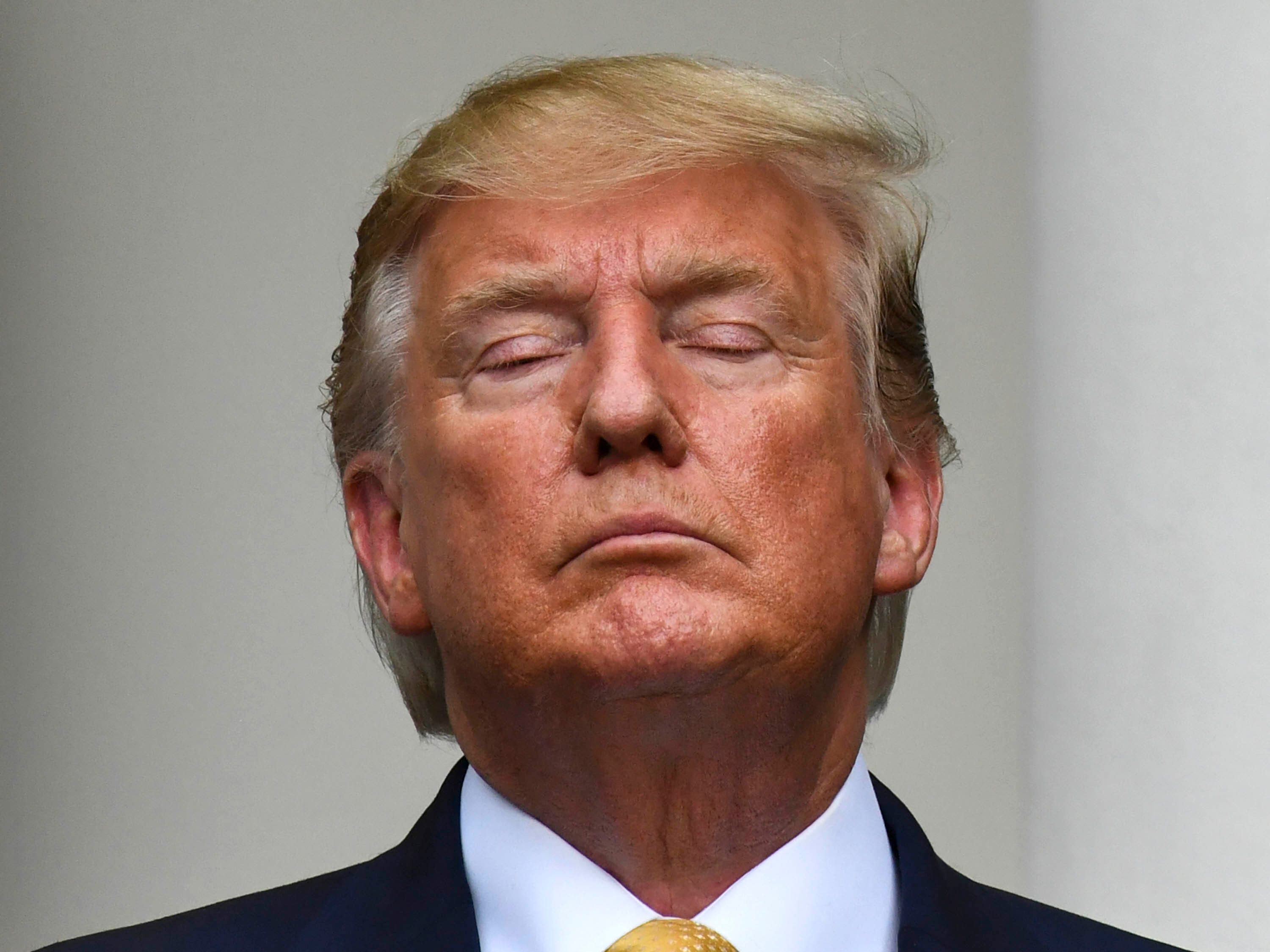
Donald Distracted
by Andrew Egger
Well, here we are again: The ceasefire in Iran is once again in a state of near-total collapse. The U.S. military hasn’t yet resumed its bombing campaign of the Iranian mainland, but the danger in the Strait of Hormuz is as bad as ever.
After claiming Friday that the strait was now open and letting a trickle of ships through, Iran abruptly reversed course Saturday, firing on at least two merchant vessels and insisting the strait would remain closed as long as America maintained its military blockade of Iran’s ports. Then, yesterday, U.S. forces fired on and seized an Iranian cargo ship that they said had tried to run their blockade—causing Iran to announce it was pulling out of the second round of Islamabad peace talks, which were scheduled to begin today. Oil prices, which on Friday had fallen by more than $10 a barrel on Iran’s claims of an open strait, rocketed back upward, now hovering back around $100.
In one sense, we’re right back where we were last month—the strait closed, Iran intransigent, Donald Trump threatening. But that undersells the damage. A cancer patient who goes under the knife and wakes to discover they couldn’t remove the tumor isn’t likely to be comforted that at least the doctors stitched him up properly. The ongoing closure of the Strait of Hormuz is becoming a global economic catastrophe, and it’s clear Trump is running out of options to compel Iran to stop throttling it.
The White House has suggested two ways this all might end, and neither seems particularly close to materializing. Trump still seems to think he can bully the Iranians into submission, even though his strategy of making theatrical threats and then backing down at the last second has already failed to accomplish this four or five times. And Defense Secretary Pete Hegseth keeps announcing confidently that Iran’s weapons stockpiles are all but depleted. But the Pentagon has quietly acknowledged the hollowness of this story: “Iran retains thousands of missiles and one-way attack UAVs that can threaten U.S. and partner forces throughout the region,” Defense Intelligence Agency Director Lt. Gen. James Adams noted in a budget memo to the House Armed Services Committee last week. “In addition, Iran poses a persistent threat to freedom of navigation through the Persian Gulf, Strait of Hormuz, and Gulf of Oman, including retaliatory seizures of commercial ships and the threat of mining the Strait of Hormuz.”
But it isn’t just that Trump low on options: More and more, he barely seems to understand what’s going on in the conflict at even a basic layman’s level. His pronouncements—whether they be threats, triumphant announcements, or even just descriptions of what’s underway in the strait—resemble reality less with every passing day.
Sometimes this is a good thing: His genocidal threats that “a whole civilization will die tonight” never materialized. But other times it’s simply an alarming reminder of how fitfully and flightily the president is monitoring his own war. “Iran has agreed to never close the Strait of Hormuz again,” Trump posted Friday morning. “It will no longer be used as a weapon against the World!” He was so confident the end was in sight that he was already throwing the conflict in Iran and the proxy fight in Lebanon on his fanciful list of eight wars he’s “solved”: “It has been my Honor to solve 9 Wars across the World, and [Lebanon] will be my 10th, so let’s, GET IT DONE!” he posted. None of these statements had the slightest bearing on reality.
One other weekend example of Trump’s unaccountably gauzy grasp of the conflict bears pointing out. In announcing America’s blockade of Iran last week, Trump claimed that the United States would be “BLOCKADING any and all Ships trying to enter, or leave, the Strait of Hormuz.” In the following days, U.S. leaders hastened to clarify that America was not blockading the entire strait—which would have violated international law—but was merely blockading Iran’s ports.
But somehow nobody managed to get this simple and crucial fact to lodge in the president’s tortuous mind. “Iran recently announced that they were closing the Strait,” Trump posted Saturday, “which is strange, because our BLOCKADE has already closed it. They’re helping us without knowing, and they are the ones that lose with the closed passage, $500 Million Dollars a day!”
The hour is growing very late. Already the political damage is irreversible for Trump and his party: Energy Secretary Chris Wright acknowledged Sunday that domestic average gas prices would likely not return below $3 a gallon until 2027. (Today gas is north of $4.) And the simple fact causing it all—the same as it’s been all along—is that Trump, having chosen to kick the Iranian hornet’s nest, remains at a loss for what to do next. We’ve known he had no plan for months. But what’s becoming shockingly apparent now is how little he’s even paying attention to the problem.
Donald Distrusted
by William Kristol
It was the afternoon of April 3. An American F-15E fighter jet had been shot down over Iran. The two airmen aboard were missing. The president of the United States was screaming at aides about Jimmy Carter’s hostage crisis and how this incident could cost him the next election.
Meanwhile, the military was devising and then executing a complex and challenging operation to rescue the airmen. And in order to help make this operation a success, “Aides kept the president out of the room as they got minute-by-minute updates because they believed his impatience wouldn’t be helpful, instead updating him at meaningful moments, a senior administration official said.”
“Aides kept the president out of the room.” It’s worth dwelling for a moment on this remarkable detail from a Wall Street Journal report this weekend on the state of Trump’s psyche. Aides—presumably senior military officials in particular—believed that they had to exclude the president from the decision-making if it were to succeed.
And Trump was excluded, and the operation succeeded.
On the one hand, it’s good news that some of Trump’s subordinates understand, at least somewhat—the truth about the man and the dangers he poses. And it’s good news that they are willing and able—at least in some circumstances, and to some degree—to act on it.
In the short term, we can only hope that other aides will similarly act to mitigate their boss’s furious irresponsibility.
On the other hand, it’s an untenable situation when the president can’t be trusted to be part of—or even present at—a crucial national security operation.
So as soon as is practically possible, which probably means early in 2027, Congress should take responsibility and remove him from office.
The fact is that Trump is far more reckless, unstable, and detached from reality than Richard Nixon was in 1974, when some of his senior aides also acted to protect the nation from his worst impulses. They did their job, but it was a short-term expedient. Two more years of Nixon in office would have been dangerous. Today, two more years of Trump in office would be unacceptably dangerous—not least because many more of Trump’s subordinates than Nixon’s are pandering to his whims rather than checking them.
As it happens, Trump has also committed acts of corruption and abuse of power even more deserving of impeachment and removal than Nixon’s. In other words, Trump’s removal from office would be in the national interest and would serve the cause of justice.
I’ll be the first to acknowledge that we would be much better off if someone like Gerald Ford were vice president. But JD Vance isn’t deranged. And to paraphrase Don Rumsfeld, you have to go to impeachment with the vice president you have, not the vice president you might wish to have.
But it’s important to the country’s well-being to remove the unfit president we do have.
AROUND THE BULWARK
What Would You Give Up to Make American Health Care Better? It’s a question everyone—from executives to practitioners to consumers—needs to ask. But few seem willing to think about it, observes EZEKIEL EMANUEL.
Ukraine’s Second Miracle Year… The war isn’t won, but for the first time in years, outright victory seems possible, argues BRYNN TANNEHILL.
How Trump Could Weaponize Surveillance… On The Bulwark on Sunday, RYAN GOODMAN joins BILL KRISTOL to discuss how surveillance powers could be used—and abused—by the Donald Trump administration.
A Beautiful Victory in Hungary… On The Mona Charen Show, MONA CHAREN brings the Beg to Differ panel (BILL GALSTON, LINDA CHAVEZ, and DAMON LINKER) back for a reunion. They address Orban, Democrats, and Trump Jesus, among much else.
Eliot’s Return & Schrodinger’s Strait… On Shield of the Republic, ERIC EDELMAN welcomes ELIOT COHEN back from his sojourn in Spain to break down the latest jackassery from the administration. They discuss the current state of the Iran war, including the somehow simultaneously open and closed Strait of Hormuz, the ongoing negotiations, and how China factors into the conflict.

The gang returns to California for two live shows in May. Join Sarah, Tim, and Sam in San Diego on May 20 or in L.A. on May 21 for a night of politics and laughs, and a community built on good faith. Bulwark Live: California is sure to sell out—don’t delay.
Quick Hits
KASH IN JEOPARDY: If you’re a Trump mook in hot water, there’s one accepted best practice for making sure you don’t lose the boss’s favor: Immediately make a big show of the work you’re doing to punish his enemies.
Last week, we noted how Director of National Intelligence Tulsi Gabbard has been availing herself of this strategy. Now it’s FBI Director Kash Patel’s turn. Fresh off the Atlantic’s lacerating Friday report alleging an impulsive, binge-drinking, oversleeping FBI director who is “deeply concerned that his job is in jeopardy” and has good reason to be, Patel took to Fox News on Sunday to do some damage control: He says the Atlantic’s report is all a pack of lies, and he says he’s suing. And he tried to change the subject by tossing out some red MAGA meat of his own.
Fox’s Maria Bartiromo teed him up: “Every time I see President Trump, he says this repeatedly, that the election was rigged in 2020. . . . You’ve been at the FBI now fourteen months. Have you done anything about that? Do you have anything to tell us about that?”
“I am never going to let this go,” Patel said. “They tried to thwart our elections and rig the entire system. And that is not something that I am going to allow on my watch. But you just have to remember. They built this disease temple over twenty and thirty years. We’ve got all the inference—I can announce on your show that we’ve got all the information we need. . . . We are going to be making arrests, and it’s coming, and I promise you it’s coming soon.”
The Department of Justice formally has a policy never to comment on ongoing investigations, which apparently has an out clause for those desperate enough for Trump’s praise.
TOO GOOD TO QUIT: Officially, the Defense Department considers the AI company Anthropic a klatch of radical-left psychos who are too dangerous and untrustworthy for their products to be allowed to touch the U.S. government in any way. But it turns out Uncle Sam is finding it tough to quit Claude. Axios reports that the National Security Agency—a component agency of the Department of Defense—is already using Anthropic’s latest model, Mythos, despite the DoD’s ongoing claim in public and in court that the company is a “supply chain risk”:
The government’s cybersecurity needs appear to be outweighing the Pentagon’s feud with Anthropic. . . . The military is now broadening its use of Anthropic’s tools while simultaneously arguing in court that using those tools threatens U.S. national security.
It’s unclear how the NSA is currently using Mythos, but other organizations with access to the model are using it predominantly to scan their own environments for exploitable security vulnerabilities.
DUBAI TO ALL THAT: As the world grapples with the fallout from the closure of the Strait of Hormuz, Gulf states that have spent years cultivating close ties with Donald Trump are starting to call in favors. The Wall Street Journal reports that the United Arab Emirates has begun petitioning the White House about America backstopping a possible Persian Gulf financial crisis:
U.A.E. Central Bank Gov. Khaled Mohamed Balama raised the idea of a currency-swap line with Treasury Secretary Scott Bessent and Treasury and Federal Reserve officials in meetings in Washington last week, the officials said. The Emiratis emphasized that they had so far avoided the worst economic effects of the conflict but might still need a financial lifeline, the officials said.
The talks highlighted the U.A.E.’s concern that the war could inflict major damage on its economy and its position as a global financial hub, depleting its foreign reserves and scaring away investors who once saw it as a stable and secure place for their money. The conflict has damaged Emirati oil-and-gas infrastructure and shut off their ability to sell oil using tankers transiting the Strait of Hormuz, depriving it of a key source of dollar revenues.
Emirati officials haven’t made a formal request for a swap line, which would give the U.A.E. central bank inexpensive access to dollars to support its currency or shore up its foreign reserves in case of a liquidity crisis. In talks with the U.S. in recent days, they have portrayed the proposal as preliminary and precautionary, the U.S. officials said.
Cheap Shots

Of course Donald is bored with the Iran War. He is unable to conceptualize that there are other people in the world besides himself. Like any child, eventually he will tire of playing with his toys, and will want new ones. Iran, and our military are not people to him, just playthings.
“MOOOOMMMM, can we get “Invasion of Cuba”? CMONNNNNN…”
For those looking for a thin reed of hope: At least someone leaked that Trump is being excluded from critical meetings.