



Would you be shocked to learn that Donald Trump’s months of claims that the White House ballroom would go up with zero taxpayer spending were a total lie? And we don’t just mean the $1 billion in “security improvements” for the project they tried (and failed) to get in the latest spending bill. The Washington Post reports this morning that tens of millions of dollars of public funds have already gone into the project.
“Multiple project summaries provided to the White House by Clark Construction show that internal cost estimates have been significantly higher than administration officials have acknowledged in public comments or court filings,” WaPo writes. “They also show that the work was projected to rely heavily on taxpayer dollars from the moment it was announced.” Knock us over with a feather. Happy Tuesday.
Join Bill and Andrew on Substack and YouTube for Morning Shots Live today at 10 a.m. EDT today.
Trump’s Arrested Agenda
by Andrew Egger
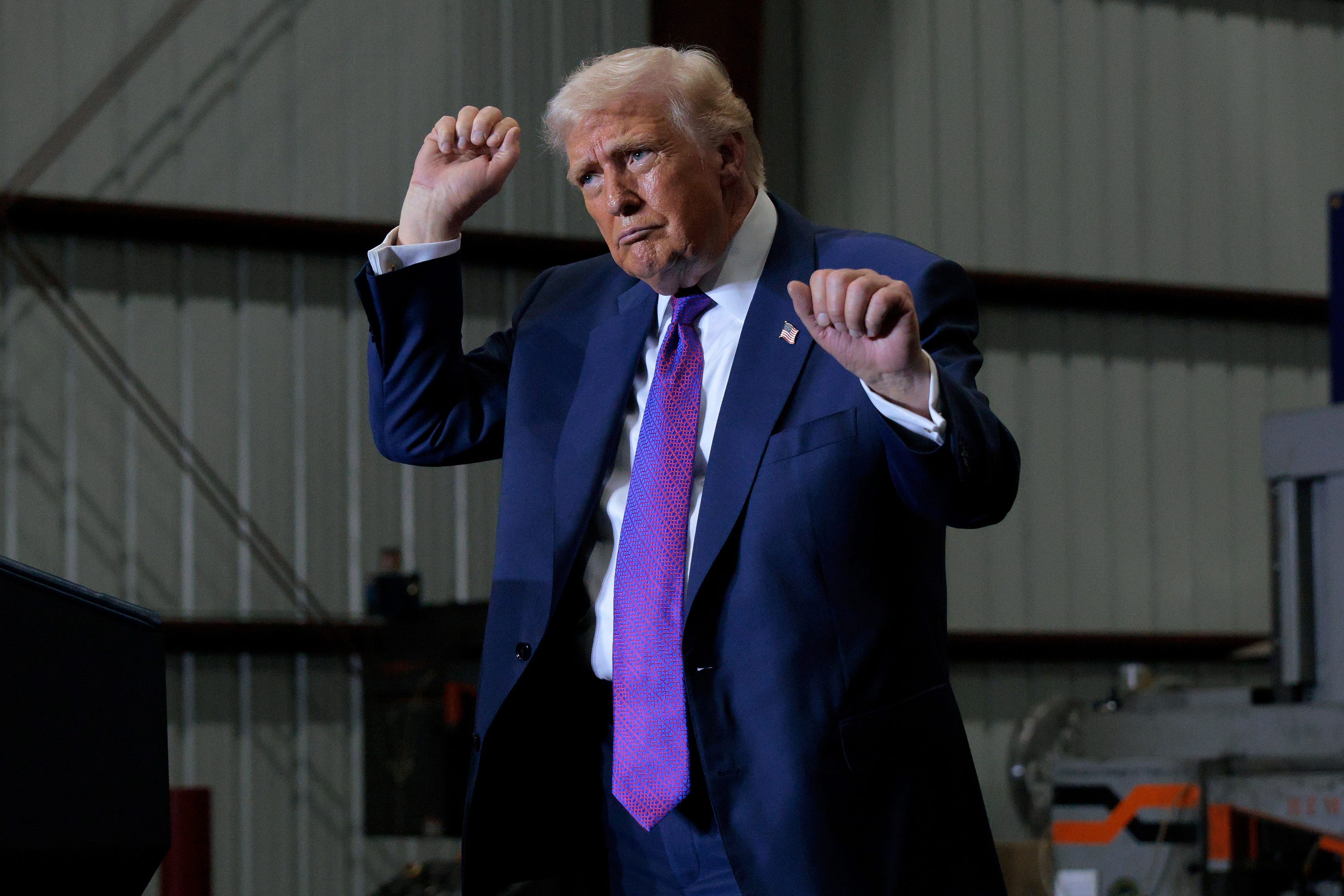
Donald Trump is, above all, a showman. While he’s plainly slowing with age, he has certainly not lost his ability to deliver near-daily shocks with his attacks on good government, ethics, and taste. But the nature of those shocks has been changing lately. More and more, they’ve seemed calibrated to obscure a harsh truth: Not yet two years into Trump 2.0, the administration’s momentum has ground to a halt.
I’ve written about this slowdown before. But I was forcibly reminded of it yesterday while reading the latest piece of jaw-dropping reporting from the New York Times’s Maggie Haberman and Jonathan Swan, which pulled back the curtain on a secret internal White House fight from April of last year: Stephen Miller’s campaign to get Trump to suspend the right of habeas corpus for accused illegal immigrants.
The fight came at a time when the White House was charging ahead at max speed with its mass-deportation plans, with Miller and Trump hoping to deport millions in relatively short order. They’d already twisted America’s existing laws into pretzels to set the stage for those deportations, most notably by invoking the Alien Enemies Act. But they were still being slowed by individual migrants’ ability to bring their cases before a judge. Miller proposed: What if we simply took that away? It was “an opportunity for Mr. Trump not only to speed up deportations,” Haberman and Swan write, “but also to assert vastly expanded power over a legal system that was getting in his way.”
Ultimately, miraculously, cooler heads prevailed:1 Trump never pulled the trigger on trying to suspend the right for migrants.
Reading this report was a shocking experience for two reasons. First, obviously, are the merits—it’s insane that any White House would contemplate such measures in peacetime at all.2 But the piece also yanks the reader back to a time last year when pretty much everything was like this.
At this moment, months into his second term, Trump was hurtling forward on everything everywhere all at once. DOGE was ripping through the government, USAID was vanishing in a puff of smoke, “Liberation Day” tariffs were slamming into place, ICE was off the leash, planeloads of migrants were being shipped to an El Salvador torture prison, the National Guard was preparing to march into U.S. cities, suspected deep-staters were being purged from law enforcement and having their security clearances yanked, law firms and colleges were being strong-armed into submission, Trump was threatening to invade Greenland and the Panama Canal, and on and on.
This period of Trump’s furious maximalism seemed to die in Minneapolis early this year. It has stayed dead since. Instead, Trump has spent the first half of 2026 mostly just fighting to keep stuff from sliding away from him. Simply reauthorizing funding for ICE and the Border Patrol turned out to be an enormous, sweaty legislative lift. So was maintaining his tariff regime after the Supreme Court ruled huge portions of it unconstitutional. Ditto maintaining his government’s ability to conduct warrantless surveillance of foreigners—a typically uneventful legislative renewal Trump managed to capsize with his clownish appointment of hatchet man Bill Pulte to a top intelligence role. His top 2026 legislative priority, the elections grab-bag Save America Act, is a running joke that the Senate will never seriously consider. Other major initiatives, like the $1.776 billion “anti-weaponization fund,” barely made it past the announcement stage before blowing up in the face of furious public opposition.
Increasingly, the things that have occupied Trump this year are the things that, last year, were just a sideshow to the major policy work. He has become obsessed with the minutiae of his self-aggrandizing monument building, from his Freedom250 birthday bash to the Kennedy Center to the East Wing Ballroom to the reflecting pool to his planned triumphal arch near Arlington National Cemetery.
And even that isn’t all going to plan: A judge’s order that his name come off the Kennedy Center has provoked a world-historical hissy fit, with Trump declaring the institution dead and installing an apparently permanent cover over the building’s facade rather than allowing it to be seen with his name removed.3
All this could change, of course. We are approaching the end of this chapter for the White House, a period dominated by the Iran war on the one hand and by Trump’s myopic focus on D.C. bric-a-brac ahead of the 250th anniversary of the country on the other. It’s far from impossible that Trump—his war concluded, his ICE re-funded, his White House UFC fights all brought to a satisfying conclusion—could seriously reapply himself to recapturing his god-emperor domestic-policy mojo. It’s safe to say that he intends to do this in at least one seriously chilling way: by monkeying with the upcoming 2026 and 2028 elections.
But for now, we should allow ourselves to take heart. It’s perfectly natural to remain outraged at Trump’s ongoing parade of obscenities: It’s not fun, exactly, to see him and his people squee and gibber while a bloodsport fighter hoots that “MICHELLE OBAMA IS A MAN!” from a fight cage erected preposterously on the White House lawn. But these circuses aren’t just intended to trigger the libs and titillate his base—they’re designed to distract both camps from how little the president is actually getting done these days. Compared to where we were last year, it’s a damn good start.
On the Middle East and Minnesota
by William Kristol
Two brief comments today, first on the Iran deal, and then on one phrase in the New York Times article by Maggie Haberman and Jonathan Swan that Andrew discusses above.
On Iran: Donald Trump’s deal is less than a week old, and it already isn’t aging well. Indeed, it’s increasingly obvious that it isn’t a real deal. It doesn’t seem to bind Iran to anything and as things move forward, whatever we were supposed to get out of it seems to be evaporating into thin air.
This New York Times headline is a nice illustration of the deal’s Wizard of Oz–like nature: “Iran Says Strait of Hormuz Won’t Have ‘Tolls’ but It Will Have ‘Fees.’”
So it turns out that the deal depends, in a Clintonian way, on what the definition of the word “tolls” is.
But to put too much emphasis on criticizing the deal can miss the point. The main problem isn’t that Trump didn’t negotiate effectively—though that’s also true. The problem is that he lost the war. Failed wars end in bad deals.
As one looks back on the last few months, it’s increasingly obvious that Trump was played by pretty much every country in the Middle East—from Israel and Saudi Arabia at the beginning of the war, to the UAE and Qatar and China during it, and at the end by Iran itself. Our second-rate con man encountered first rate-con artists, and, as is often the case, it’s the second rate-con men who turn out to be the biggest suckers.
We’ll stay with the Iran deal as we move through this week toward the planned signing of . . . something short and vague in Geneva on Friday. I actually wonder if even that will happen. I wouldn’t be surprised if Iran decided to jerk Trump around some more by finding reasons to postpone the signing. In any case, we’ll be following the depressing denouement of Trump’s failure.
Meanwhile, I want to add a note to Andrew’s excellent item by remarking on one phrase at the beginning of the penultimate paragraph of Haberman and Swan’s article that jumped out at me. Haberman and Swan describe a meeting at the end of January at which Trump basically decided to retreat from the threat of invoking the Insurrection Act. “The vice president and Mr. Miller were still searching for a reason to put federal troops on American streets,” the Times reports. But,
Under immense public pressure, the administration would subsequently take a different course of action. The most vocal immigration hard-liner, Gregory Bovino, the Customs and Border Protection commander-at-large, was removed from his post, and the administration held back on ICE pushes in cities in the weeks after Mr. Pretti’s death.
“Under immense public pressure.”
Public pressure matters. That pressure has come over the last year and a half in many forms and from many places. But the pressure in January came especially from the streets of Minneapolis. Looking back on the long arc of the second Trump administration’s decline, one can tend to assume it all had to happen as it did, and to forget moments of choice, to smooth over particular inflection points. But Minneapolis was key.
All honor to the people of Minneapolis, who, with the Trump administration at the height of its power and presumption, stood up against Trump and his army of goons, and who stood with their neighbors, for our country, and in defense of its principles.
AROUND THE BULWARK
This Far-Right Thought Leader Is Embarrassingly Vacuous… Auron MacIntyre’s world is one of resentment, decline, and perpetual emergency, writes MATT MCMANUS.
Trump’s Iran Deal Looks Worse Than Obama’s—And I’m Glad He Made It… Trump promised “total victory” and instead got a sixty-day ceasefire with uncertain nuclear talks ahead. It was still better than the alternatives, argues DANIEL B. SHAPIRO.
Trump’s Weak, Sad, and Embarrassing Weekend… On the flagship pod, BILL KRISTOL joins TIM MILLER to discuss Donald Trump’s embarrassing birthday weekend.
Quick Hits
ANTHROPICGATE AGAIN: We crossed a major AI-development Rubicon over the weekend: For the first time, the U.S. government stepped in to essentially force an AI company to shut down its latest, most powerful model.
Once again, the company in hot water with Uncle Sam was Anthropic, creator of the AI platform Claude, which had already been beefing with the Trump administration over the government’s use of the company’s most advanced models. Anthropic’s latest model, Mythos, is purportedly so effective at breaking through cyber defenses that the company feared releasing it to the public; instead, it released a neutered version of Mythos called Fable to the public, while a small number of favored companies got access to Mythos itself. But the administration decided that wasn’t going far enough. On Friday, Secretary of Commerce Howard Lutnick ordered Anthropic not to allow any foreign person, including employees of Anthropic itself, to access either Fable or Mythos. With no way of screening people en masse, Anthropic was forced to pull the product altogether.
This is a huge story without obvious right answers: The administration may have been perfectly justified in slamming the brakes on Mythos, or it may have been a matter of overreach against a company they already distrust. Either way, as one person familiar told Axios, one thing is clear: “This is a de-facto licensing regime. Companies will not screw with the White House. That is the ultimate effect.”
DODGING PULTE?: There’s a way for Democrats to keep Bill Pulte out as acting director of national intelligence after all—but they may not like it. Per President Trump, Pulte is slated to take over the job this Friday, June 19. But with Trump having announced his permanent DNI replacement, Jay Clayton, last week, Senate Republicans are now hustling to get him confirmed potentially even sooner than that, with a confirmation hearing Wednesday potentially followed by committee and Senate votes Thursday. Such a timetable, however, would require the unanimous consent of all 100 senators. If any object, Clayton could not be confirmed until next week at the earliest.
Democrats “ought to be happy with Clayton,” Majority Leader John Thune said yesterday. And it’s true that the U.S. attorney and former SEC chair is nowhere near as corrupt and contemptible a figure as Pulte. Still, it’s easy to imagine at least a few Democrats bristling at the dilemma Republicans are forcing them into: Hustle this guy through, or the hack gets the job for a bit.
Cheap Shots

The key internal campaigner against suspension, per the reporting, was the White House staff secretary, conservative lawyer Will Scharf, who penned a memo arguing that habeas corpus was legal bedrock that the administration would challenge to its peril. You go, girl!
Lincoln famously suspended habeas corpus during the Civil War and even upheld that decision against the Supreme Court. But, he explained, there was a civil war on! “Are all the laws, but one, to go unexecuted, and the government itself to go to pieces, lest that one be violated?”
Last week, the institution’s board of Trump toadies voted to create a new endowment for the center with Trump’s name on it, the equivalent of trying to buy off a tantruming toddler with treats.
Trump is currently at the G7 openly criticizing Netanyahu and Israel, calling Israel’s attack in Beirut vicious, lavishing praise on the Syrian President, saying no country has ever been treated as unfairly as Lebanon, and saying Syria is better at controlling Hezbollah than Israel is. I don’t know if it ultimately means anything, but maybe Netanyahu is about to run into the immutable law of ETTD. If so, it couldn’t happen to a nicer guy.
I wish I could share Andrew's optimism, but to my eye, the administration now seems squarely focused on manipulating elections in every way possible. That seems worse. Way worse.