Donald Trump vs. America’s Moms
He says America should be the best country for having and raising kids—but he’s cutting the safety net that protects millions of mothers.

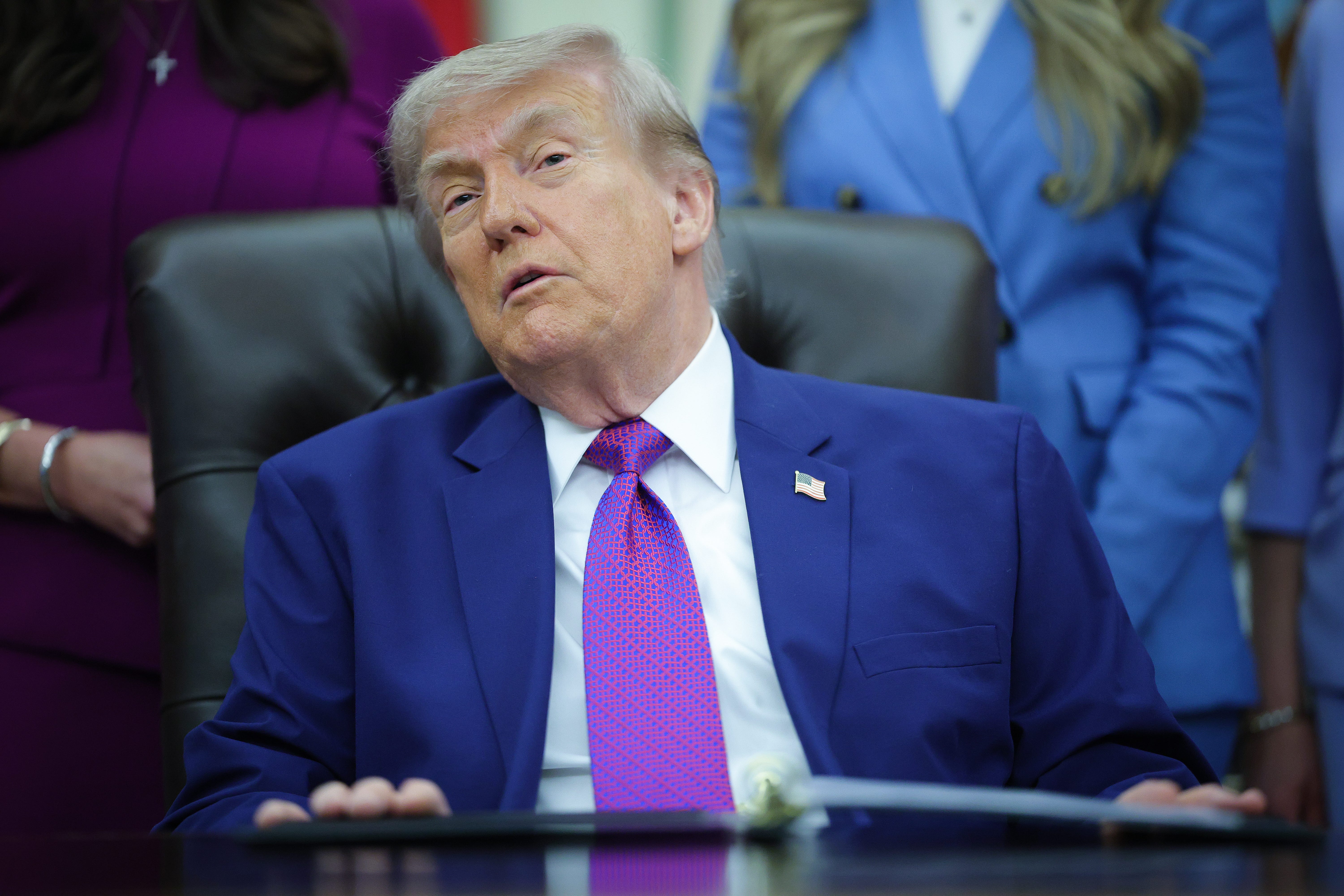
DONALD TRUMP ON MONDAY hosted a forty-minute Oval Office event focusing on maternal health, and mostly it got attention because he seemed to nod off in the middle of it.
But the president and his invited guests also got some news coverage for the intended message, which was about a series of initiatives like reducing the cost of some fertility drugs, and launching an informational website called Moms.gov. These are supposed to demonstrate, as one attendee put it, that “President Trump wants to make America the best place to have a baby.”
That’s a laudable goal, though it would require an awful lot of policy work.
Both the maternal and infant mortality rates in the United States are the highest among economically advanced countries, according to analyses by the Commonwealth Fund. And when UNICEF last year rated several dozen nations for child well-being, the scores for the United States were terrible, way behind the world leaders: the Netherlands, Denmark, and France.
Those facts may come as a shock to anyone used to hearing about those other countries as socialist hellholes. But spend time in the countries of Northern and Western Europe and you’ll see all the ways people living there benefit from universal health care, cash support for newborns, guaranteed paid leave for new parents, and heavily subsidized childcare.
Several U.S. presidents have tried to replicate versions of those supports here, piece by piece. And some have made real headway.
Today, millions of young children and their mothers have health insurance because of Barack Obama and the Affordable Care Act. Child poverty fell dramatically—if, alas, temporarily—thanks to Joe Biden and the income support measures that he signed into law as part of his pandemic-relief efforts. Lyndon Johnson’s Great Society is the reason so many millions of low-income families can enroll in Medicaid and Head Start. Richard Nixon got behind a substantial increase in food assistance for young families.
Trump is well on his way to creating his own legacy when it comes to maternal and child well-being. But it’s not the kind his predecessors left. Whatever the modest contributions of the initiatives he was touting in the Oval Office last week—and “modest” is a generous description—they aren’t the real story about what the president has done for young families with children.
No, the real story is about what Trump has done to young families with children, by downsizing or undermining some of the most important programs on which many of them rely. And because it’s a big, sprawling tale that involves several programs—not to mention wonky policy details—it may be easiest to follow the way it would affect a typical family as it grows.
So you’re having a baby. . .
If you care about improving maternal and child health, the place to start is with prenatal care.
Research makes a strong case that women who get proper care in pregnancy are less likely to develop gestational diabetes, high blood pressure, and other health problems. They are also less likely to give birth to low-birthweight babies, which is a big risk factor for all kinds of poor child health outcomes—up to and including death in infancy.
Exactly how big an impact prenatal care has is the subject of ongoing debate, because the subject is tough to study. The same goes for how much health outcomes for pregnant women and newborns truly depend on insurance status per se. But there’s plenty of evidence that people with insurance are better off in other ways, including financially. People who have coverage are less likely to fall behind on rent, or to run up debt.
For most of the last decade, the United States has been making steady progress at getting people insurance thanks to the Affordable Care Act’s creation (under Obama) and then its expansion (under Biden). The one interruption was during Trump’s first term, when progress stalled for a few years. But that was just a preview of what’s happening now, thanks primarily to the $1 trillion taken out of Medicaid over the next decade as part of Trump’s “One Big, Beautiful Bill.”
Trump and the Republicans have defended their cuts by saying (among other things) that they are merely targeting waste—and that the whole point is to preserve the program for people like pregnant women who really need it. They have also noted that pregnant women are, by definition, not subject to the law’s controversial work requirements.
But there’s good reason to think that the cuts will end up affecting pregnant women anyway, partly because the financial pressure the cuts place on states will force them to scale back outreach or special services that target the most at-risk parents. That’s in addition to the fact that, historically, work requirements have reduced enrollment by ensnaring people in paperwork, so that even people who qualify for exemptions end up without insurance anyway.
“With the punishing amount of administrative burden that’s on state Medicaid agencies, it could take three, four months to sort that out,” Sarah Gordon, co-director of the Boston University Medicaid Policy Lab, told the New York Times after the cuts became law last year. And three or four months out of a nine-month pregnancy can make a big difference.1

San Diego here we come! We’re thrilled to announce our lineup for this Bulwark Live featuring special guest San Diego Mayor TODD GLORIA. Plus our very own MAGA culture expert WILL SOMMER.
Join Sam, Tim, and Sarah for this one-night live show at the Balboa Theatre on May 20. Grab your seats today.
So you just had a baby. . .
Nutrition is another big factor in prenatal health, as it is for postnatal health—and especially for young children. At least in theory, improving nutrition is supposed to be a priority for this administration. Health and Human Services Secretary Robert F. Kennedy Jr. talks about it all the time!
But the focus for Kennedy has been ultraprocessed foods and artificial dyes. A far more important issue for many pregnant women and their soon-to-be-born children is whether they can simply pay their grocery bills. And like access to health care, that too is becoming a lot more expensive because of historic cuts to food assistance Trump and Republicans have enacted, including many that impose new paperwork requirements that in theory are there to stop fraud.
Those cuts are also part of the One Big, Beautiful Bill. But unlike the Medicaid cuts, they are already having a visible and substantial effect. Enrollment in SNAP, the Supplemental Nutrition Assistance Program, has fallen by more than 10 percent since a year ago, according to newly released federal figures. That works out to more than 4 million people, with nearly 700,000 losing benefits in just the latest month captured by the data.
Enrollment has already plunged by nearly 50 percent in Arizona, where—as a recent ProPublica article reported—implementation appears to be farthest along.
“We’re seeing people being denied when they can’t provide the additional documentation the state is requiring, stuck in backlogs because the state doesn’t have the capacity to process the additional paperwork, being denied because they can’t get through on overloaded phone lines for required interviews,” Katie Bergh, senior policy analyst at the Center on Budget and Policy Priorities, told me recently.
Not all of the current enrollment decline is because of the Republican cuts. Some of it is a reversion to pre-COVID pandemic levels, following the expiration of rules that Biden put in place to ease enrollment. But there’s plenty of evidence that the cuts are a big factor, according to Georgetown University economist Diane Schanzenbach, just as there’s plenty of evidence that they will end up hurting women and children.
“The research backs up what you and I would think of as common sense,” Schanzenbach, coauthor of a groundbreaking paper on the subject, told me in an interview. “If you have enough resources to get the food that they need as they’re growing up, they grow up to be both healthier and more academically inclined, so they’re more likely to finish high school and get a job.”
And it’s not just the food-assistance cuts already in law that could affect infants. It’s the cuts that could still become law in the future. Trump’s budget for 2027 calls for reducing spending on an initiative that covers produce for people in the Women, Infants, and Children (WIC) food program.2
“WIC is targeted at the youngest children, when their brains are developing,” Schanzenbach said. “I’m just kind of speechless to think about cuts there.”
So now you have a young child. . .
The evidence linking health insurance and nutrition to the well-being of young children is, if anything, stronger than it is for pregnant women. “The literature shows that expanding Medicaid to kids increases use of preventive care, reduces mortality—and pays itself back by age 30 in increased tax collections,” Jonathan Gruber, the MIT economist whose CV includes foundational research on the impact of Medicaid, told me via text.
But it’s not just health insurance and food that families need for their kids. They also need childcare—or, at least, support for parents who stay at home. Not so long ago, Trump seemed to recognize that. During his first term, he talked frequently about the importance of paid leave and childcare, hosting White House events where his daughter and then-close adviser Ivanka Trump helped to preside.
But that was then. This time around he’s barely mentioned the subject, except the time a few weeks ago when—in the midst of justifying the cost of the war in Iran—he said “We’re fighting wars, we can’t take care of daycare.”
And while he and the Republican Congress haven’t reduced spending on early childhood programs the way they have health and food assistance, the Trump administration has repeatedly disrupted funding streams for both the federal subsidized childcare program (which states operate) and the Head Start program (which the federal government operates directly).3
It has done so through a combination of executive actions—like slashing the Health and Human Services staff that oversees grants, slowing the distribution of money to providers that operate on paper-thin margins. And just this past week it finalized new rules for subsidized childcare that could make financial survival for providers even more precarious, by paying them based on day-to-day attendance rather than enrollment.4
Here, too, there’s ample reason to believe that reducing childcare support will have adverse effects on children, especially among the low-income children for whom a nurturing program—or a more intensive Head Start program—might equip them with the tools to succeed in school and at work much later in life.5
That’s not to say these and other supports for mothers and children always work well. Sometimes there really is fraud. And many times the programs could simply be more efficient. All of this matters given that a real tradeoff of these programs is their cost: Creating anything that approached a European-level welfare state would require a bigger tax base, including—almost certainly—finding a way to get more revenue from the middle class.
“It’s certainly not the case that every single program is going to have the beneficial effects we hope it’s going to have—that’s one reason we need to do careful research,” Harold Pollack, a widely respected and cited University of Chicago poverty scholar, told me.
But Pollack was quick to add that “we know that when it comes to health care for children generally, educational inputs for children, for those we’ve got a good evidence base showing they’ll be beneficial.”
Making America a great place to raise kids is an admirable goal. But it requires more than a PR summit. It requires adding rather than taking away resources—not to mention the commitment of a president who cares enough about the subject to stay awake.
Gordon was speaking to Times columnist Jessica Grose, whose article on the effects of the Medicaid cuts is well worth your time.
WIC works alongside SNAP, focusing exclusively on the mothers and their children most likely to have health problems because of poor nutrition. It provides a combination of food (including milk and formula, as well as baby food) and vouchers to pre- and post-partum mothers, and to their babies up through age 5. The key is that a medical professional has to certify they are in danger of “nutritional risk” because of their economic situation, medical condition, or some other outside factor. The program, which currently serves more than 6 million people per year, dates back to the Nixon era and has long enjoyed bipartisan support. When Trump proposed cutting WIC in last year’s budget, Congress refused to go along.
For an overview of the many different ways the Trump administration has disrupted childcare funding, read Elliot Haspel’s recent article on the subject for the Atlantic. He also writes a Substack called “Family Frontier” that I recommend.
It’s a problem for providers because they can’t adjust salaries and other fixed costs every time a few kids are out sick. And it’s not something that affects providers who rely mostly on unsubsidized kids, since the convention in the private sector is to charge by the month, season, or year.
There is a long, contentious, and still active debate over the impact of early childhood programs generally and Head Start specifically. I think the evidence of benefit is substantial, with the caveat that the big impact comes only from well-designed, well-run programs—which is not easy to replicate at scale. But that’s a subject for another day.
The most corrupt, performative regime in our history. He hates women - look at how he insults female reporters just asking a question he doesn't like. Grotesque excuse for a human.
Propaganda at its most efficient! Launch a website with Moms in the URL, stage a photo op with happy women in blue suits (doesn’t matter if you fall asleep), then snatch a trillion dollars from a Medicaid program that keeps pregnant women insured. MAGAs just hear “Moms” and see that UNICEF is using evidence to push back (Yucky elites!! Must be another woke lie!!!)... and they’re ready to defend their dear leader against their own best interests.