Trump’s Summer of Lost Causes
Rather than starting new fights, Trump is fixating on ones he’s already lost.


Big personnel news out of the White House yesterday: Press Secretary Karoline Leavitt is leaving the administration. Leavitt, who had her second child in May and returned from maternity leave last month, wrote in a post that “I cannot be the best mom my two young children deserve while devoting the constant time, energy, and attention required of the White House Press Secretary.” She will remain, she said, a top outside White House adviser.
Leavitt, who had already richly earned a reputation as a virtuosic, remorseless spin artist and dissembler on the president’s behalf, now gets a second one as an icon of work-life balance. Trump will find it difficult to track down a replacement with her same combination of easy, cheerful dishonesty and panache. Happy Thursday.
Desperate Times for a Desperate Trump
by Andrew Egger
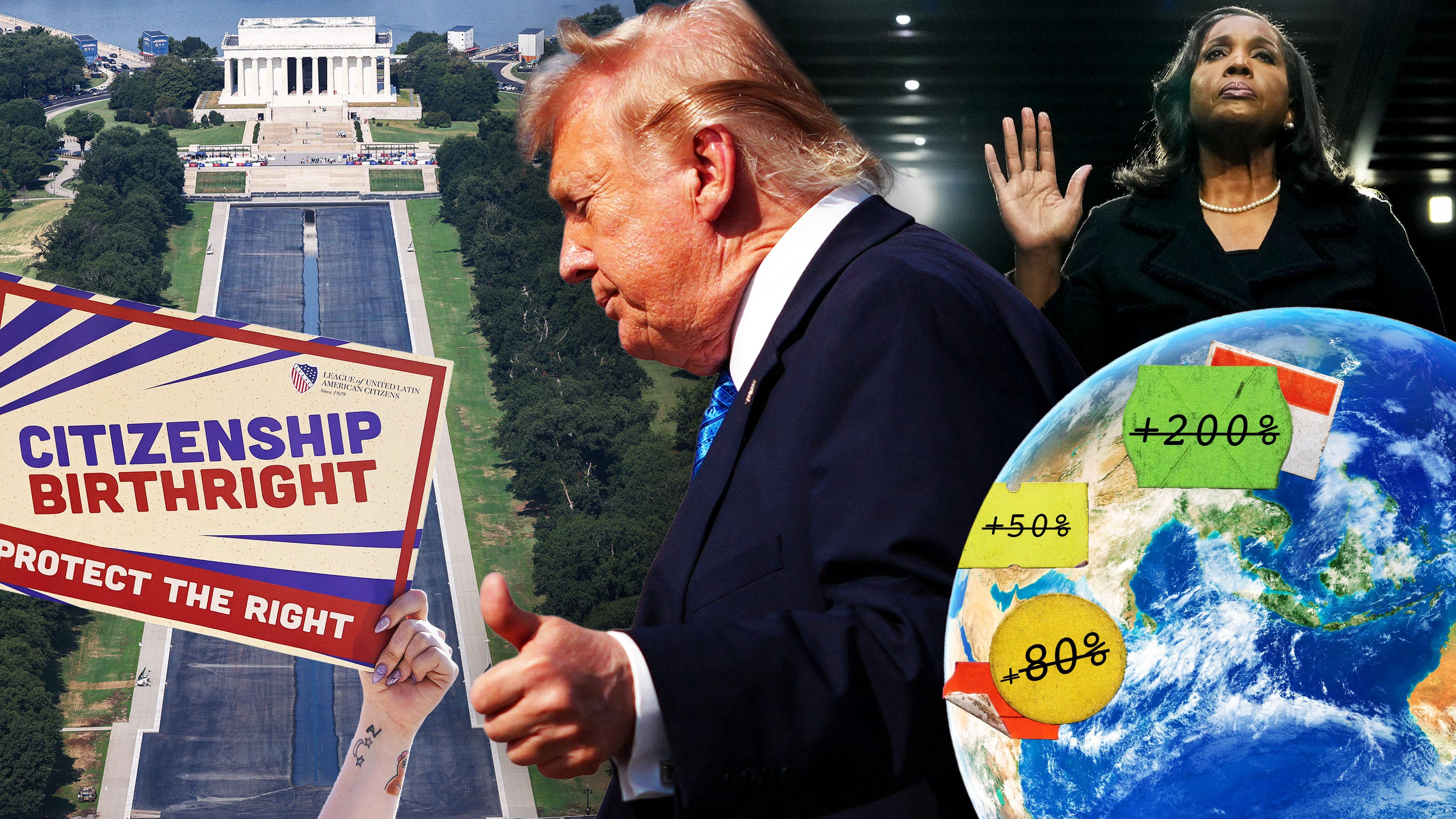
The Supreme Court told Donald Trump he couldn’t fire Fed governor Lisa Cook. He’s trying to do it anyway.
They told him he couldn’t slap tariffs on the whole world for no reason or end birthright citizenship by fiat. He’s still trying to do both anyway.
U.S. Attorney Jeanine Pirro was forced to admit in court that the government didn’t have the goods to prosecute former Olympian David Hearn for supposed Reflecting Pool vandalism. He’s trying to resurrect the charges anyway.
Until recently, Trump had a different strategy when faced with adversity: Pack it up and pivot. Sure, Trump had had glittering plans for President Nayib Bukele of El Salvador to house huge numbers of deported migrants in his prisons—even to build him new ones to make room. Sure, he’d hoped Elon Musk would move like a cleansing fire through the federal government, firing thousands of bureaucrats and balancing the budget by unearthing nebulous “fraud and abuse.” Sure, he’d thrilled to the idea of marching the National Guard or ICE through blue cities, arresting migrants and criminals by the thousands and roughing up protesters for the sizzle reel as a bonus.
But it never seemed to concern Trump too much when he had to mothball any of these efforts. He was waging war on a million fronts at once; what did it matter if a few initiatives went by the wayside?
Today, things couldn’t be more different. As his domestic agenda has stalled, Trump has run out of thrilling new initiatives to pivot to. As a result, he has begun to hyperfixate. It’s Trump’s summer of reruns, his summer of lost causes.
The most obvious example of this is the Reflecting Pool prosecutions. Former Olympic canoeist David Hearn and the others indicted this summer for allegedly defacing the pool’s already peeling sealant are not longtime personal enemies of the president, and there was never any evidence to suggest they had done a shred of damage to the pool. Meanwhile, the rest of the world has moved on: The Reflecting Pool could hardly be less of a story today.
But Trump can’t let it go. U.S. Attorney Jeanine Pirro, who found herself saddled with the undesirable job of admitting in court that the Justice Department couldn’t back up its charges against Hearn and the other accused vandals, has been fighting for her job ever since.
First, there was Pirro’s high-profile Oval Office showdown with Interior Secretary Doug Burgum, whom she accused of misleading both the Justice Department and the president about the evidence in the case. Since then, Pirro has seemed determined to find Trump some sort of consolation prize. On Tuesday, the Wall Street Journal reported that the White House has kept pestering Pirro to resurrect the charges against Hearn in some form. Yesterday, the Washington Post reported that she had convened an unusual special grand jury in Washington, with the possible aim of releasing investigation reports on subjects against whom “prosecutors do not find enough evidence to bring the person to trial.”
In ordinary times, under an ordinary administration, this sort of story would be shocking and deeply unnerving, revealing extraordinary sycophancy at the Justice Department and extraordinary contempt for the criminal-justice system at the White House.
But maybe I’m crazy: I’ve found myself reading such stories lately with an unexpected sense of reassurance, bordering on relief. They’re a mark of just how far Trump has fallen off the pace. This man, who views himself as a world-historical figure à la Caesar or Napoleon, who once plotted a glorious return to power that would see him driving his enemies before him like an avenging angel—he now finds himself instead frittering away his last days of trifecta power flogging his incompetent lackeys to figure out some way, any way, to make somebody pay for the violence done to his poor Reflecting Pool. Total stasis never tasted so good.
Two Stories About Air Force One
by Mark Hertling
On the morning of November 22, 2003, a DHL Airbus A300 cargo plane lifted off from Baghdad International Airport on a routine flight to Bahrain. Minutes later, at about 8,000 feet, a shoulder-fired surface-to-air missile slammed into its left wing. The explosion started a fire and destroyed the plane’s hydraulic systems. The three-man crew suddenly had almost no conventional means of controlling their airplane. By varying the thrust of the two engines—adding power to one, reducing it on the other—they somehow managed to turn the crippled A300 around and bring it back toward the airport. Twenty-some minutes after taking off, they put it back on the ground, and all three survived.
I heard much of that drama unfolding. At the time, I was the assistant division commander of the 1st Armored Division. Our headquarters was inside the airport terminal, while most of our nearly 30,000 troops were scattered across Baghdad. We were in a battle update brief at the time, and we heard the takeoff, the explosion, and the DHL aircraft’s engines surging and changing pitch as those extraordinary pilots fought to bring their airplane home.
That attack was the first to confirm our suspicions that insurgents armed with shoulder-fired missiles and could attack planes on the arrival and departure routes around Baghdad’s airport. There were more. Later, in December, a U.S. Air Force C-17 was struck by hostile fire after departing and returned safely. In January, a C-5 Galaxy was hit after takeoff and also made it back.
The airport closed to commercial flights after the DHL attack, and military aircraft flying into Baghdad adopted unusual procedures. Instead of the long, gradual approaches familiar to commercial passengers, pilots often remained high over the relatively secure airport perimeter and descended in a tight spiral—the famous “corkscrew” landing—minimizing their exposure to small-arms fire and shoulder-fired missiles.
Which makes what happened five days after the DHL attack even more remarkable. On Thanksgiving evening, November 27, another large aircraft descended toward Baghdad International: Air Force One.
President George W. Bush had secretly flown to Iraq to have Thanksgiving dinner with American troops. His aircraft approached in darkness, lights extinguished and window shades drawn, and his pilots used a corkscrew pattern to reduce the possibility of being shot. The secrecy was extraordinary because the danger was extraordinary. President Bush understood that. Nicolle Wallace, who worked in his White House, once told me that Bush had a very small party for that trip, and wouldn’t allow her, as the White House communications director, to accompany him. He knew the trip was too dangerous. Yet he went.
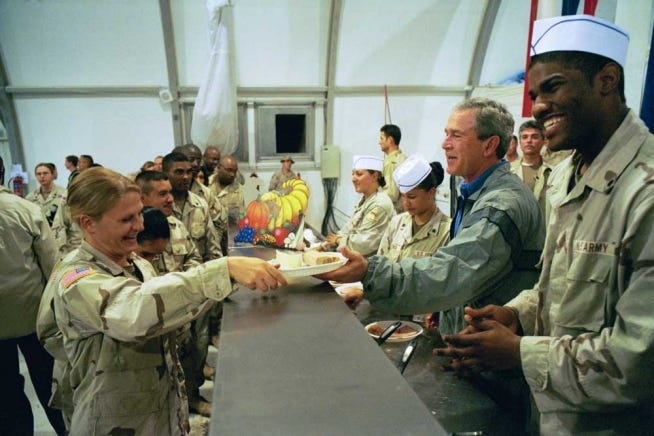
Bush wasn’t reckless. The Secret Service and military planners took every precaution possible. But after assessing the danger, he decided that being with American troops on Thanksgiving was worth accepting personal risk. Bush later explained that he wanted those in harm’s way to know their commander in chief—and their country—supported them.
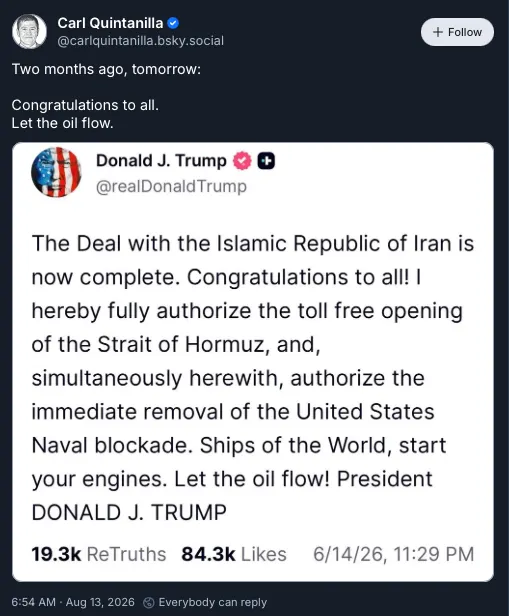
I thought about those five days in Baghdad when I read the extraordinary accounts of President Trump’s departure from Ankara after last month’s NATO summit. We now know that American officials and the Secret Service had intelligence concerning a possible Iranian threat against the president, so they devised an elaborate deception operation. President Trump first boarded Air Force One, then was secretly moved across the airport in a catering vehicle and transferred to another military aircraft while Air Force One served as a decoy—even though White House staff, journalists, and Secretaries Marco Rubio and Scott Bessent remained onboard. Trump has now confirmed the episode.
Threats against an American president aren’t funny, and protecting the commander in chief is an enormous responsibility. No one outside the security team knows everything they knew about the Iranian threat, and we still don’t know the whole story. But the episode brought me back to Baghdad because leadership is partly about how we balance risk against mission.
Military commanders learn quickly that recklessly exposing yourself serves no purpose. But they learn something else, too: Where a leader chooses to be when conditions are dangerous sends a message.
Five days after insurgents demonstrated that they could put a missile into a large aircraft departing Baghdad International Airport, George W. Bush flew into that same airport. There was no summit to attend, no treaty to sign, no diplomatic meeting requiring his presence. There were just American soldiers, far from their families, at war on Thanksgiving.
And their commander in chief decided it was important enough to be there, and he limited the risk to others.
AROUND THE BULWARK
Donald Trump’s Uncle Joe Moment… He promised to be a dictator. Now we know which one, observes MONA CHAREN.
Democrats’ Progressive Influencer Problem… Candidates seem happy to benefit from toxic online supporters—right up until the toxicity becomes politically inconvenient, argues KAIVAN SHROFF.
To Fix Congress, Party Leadership Must Give Power Back to the Lawmakers… It’s not enough simply to replace congressional party leaders. Their power has to be reduced, writes STEVEN PEARLSTEIN.
Career Prosecutors Wanted No Part of What Trump’s DOJ Was Doing… On The Illegal News, ANDREW WEISSMANN joins SARAH LONGWELL to discuss the escalating campaign against Anthony Fauci, why his lawyers may see the congressional investigation as a perjury trap, and what happens now that his contempt referral is headed to Trump’s DOJ.
Mike Lindell Burned It All Down for Trump… and Lost Anyway… On Bulwark Takes, SAM STEIN and WILL SOMMER look back at the wildest moments from Mike Lindell’s career after the Trump-backed election denier lost the Republican primary for Minnesota governor.
Quick Hits
STINGY SECRETARY: Treating Democrats like a traitorous fifth column is part of the guiding ethos of the Trump administration. But as Defense Secretary Pete Hegseth now routinely freezes elected Democrats out of classified briefings, Politico reports that some congressional Republicans are starting to worry that they’re laying it on too thick:
The freezeout underscores the Trump administration’s hyperpartisan approach to Congress—particularly the Pentagon’s penchant for secrecy under Hegseth. Whether keeping lawmakers in the dark about the rationale behind prolonged boat strikes in the Caribbean or a decoy Air Force One flight, the administration risks jeopardizing its main priorities by cutting out key players.
Blowing off Democratic lawmakers could doom Hegseth’s push to enact President Donald Trump’s unprecedented Pentagon budget increase, which worries Republicans who are largely supportive of it. Without Democratic support in the Senate, the effort could fail this fall.
Hegseth’s stinginess with information isn’t just bad for the administration’s legislative priorities. It also breaks with years of bipartisan defense tradition to set a ridiculous new precedent: Only half of the legislature can get up to speed on the various actions of the U.S. military. Read the whole thing.
NEXT SPOX UP: Who will replace Karoline Leavitt as Trump’s top flack? The New York Post runs through the bench of possible candidates, reporting that early frontrunners include Trump attorney Alina Habba and Breitbart Washington Bureau Chief Matthew Boyle, while a host of other names are buzzing around conservative circles, too: former White House Deputy Chief of Staff for Communications Taylor Budowich, current Communications Director Steven Cheung, former DOGE aide Katie Miller, Principal Deputy Press Secretary Anna Kelly, and U.S. Chief of Protocol Monica Crowley.
“Other names bandied about include pro-Trump commentator Scott Jennings and former Arizona political candidate Kari Lake,” the Post adds. The future is bright!
Cheap Shots
Looks liked Karoline Leavitt has aged out of her job. She's 28, which is 84 in Epstein years.
Re: "...frittering away his last days of trifecta power flogging his incompetent lackeys..."
A lovely turn of phrase, Andrew, and a mental image I will cherish through the day.