


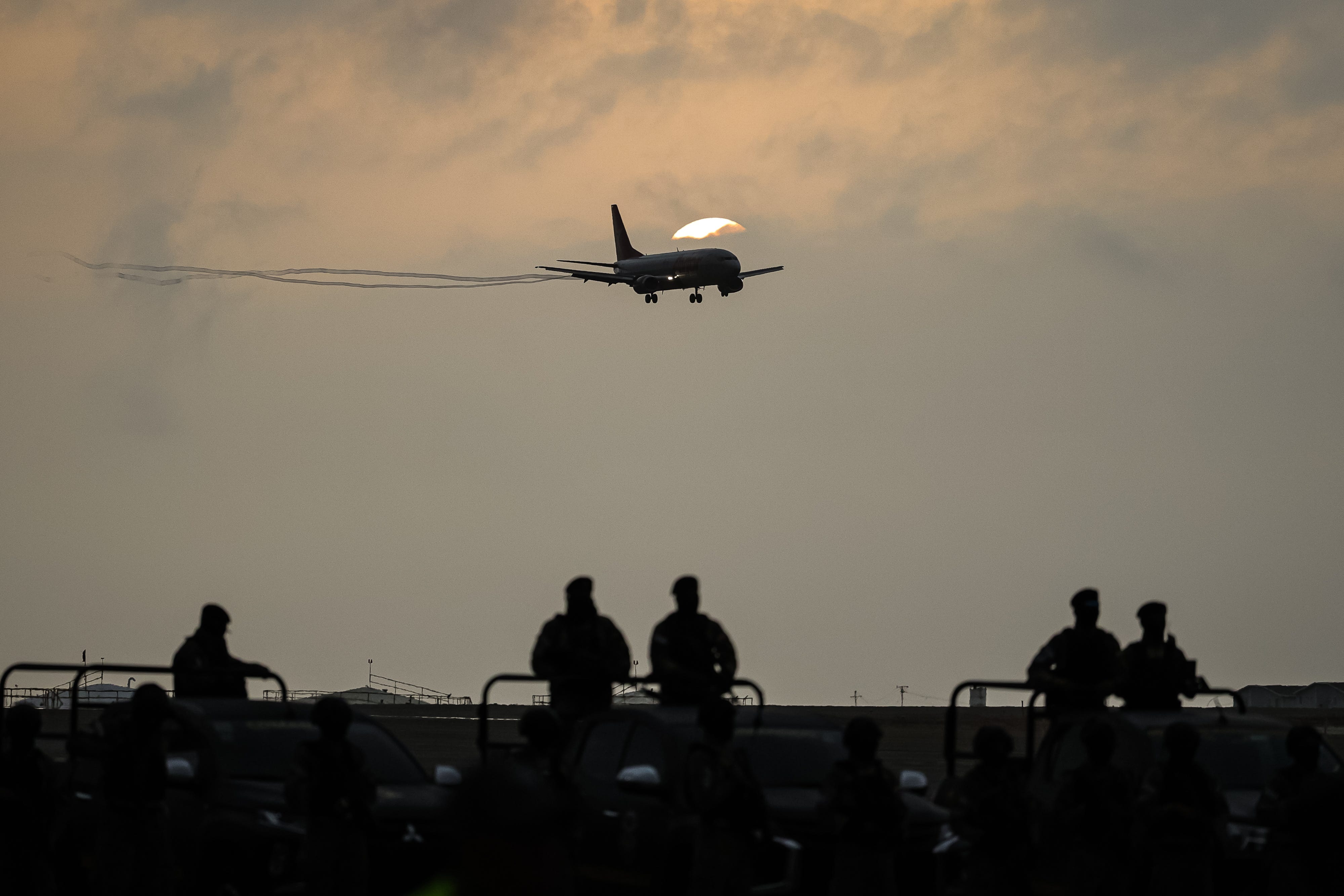
1. Airspace
It hasn’t gotten as much attention as the war crimes (more on those in a minute), but last Friday Trump tweeted out the following on Truth Social:

What the f#$! does this mean?
First, the stupidest question: Is this U.S. policy, or merely an observation from a private citizen? Not everything Trump posts on Truth Social is official U.S. policy. For instance, this video seems to have been posted not as instructions from the commander-in-chief, but as a comment in Trump’s capacity as a private citizen exercising his First Amendment rights:

Maybe Trump’s declaration about Venezuelan airspace isn’t official policy, but just a guy shitposting?
But what if it is a formal declaration of U.S. policy?
Usually, when a military force announces a no-fly zone it uses precise language through an official channel. This language serves to:
specify the exact geographical dimensions of the no-fly zone and the time at which it commences;
stipulate which kinds of aircraft it applies to;
describe which sorts of flights are prohibited and which are allowed; and
detail the modes of monitoring and enforcement.
For instance, in 1992 the United Nations issued Resolution 781 declaring that it:
1. Decides to establish a ban on military flights in the airspace of Bosnia and Herzegovina, this ban not to apply to United Nations Protection Force flights or to other flights in support of United Nations operations, including humanitarian assistance;
2. Requests the Force to monitor compliance with the ban on military flights, including the placement of observers where necessary at airfields in the territory of the former Yugoslavia;
A year later the U.N issued Resolution 816, expanding on the initial resolution by further clarifying which kind of aircraft were prohibited and explaining what enforcement would entail:
1. Decides to extend the ban established by resolution 781 (1992) to cover flights by all fixed-wing and rotary-wing aircraft in the airspace of the Republic of Bosnia and Herzegovina, this ban not to apply to flights authorized by UNPROFOR in accordance with paragraph 2 below; . . .
4. Authorizes Member states, seven days after the adoption of this resolution, acting nationally or through regional organizations or arrangements, to take, under the authority of the Security Council and subject to close coordination with the Secretary-General and UNPROFOR, all necessary measures in the airspace of the Republic of Bosnia and Herzegovina, in the event of further violations, to ensure compliance with the ban on flights referred to in paragraph 1 above, and proportionate to the specific circumstances and the nature of the flights;
Why are these declarations so lawyerly? Because it serves the interests of the more powerful nations.
By being clear and detailed, the military imposing the no-fly zone is fully transparent about what is allowed and what is not allowed, so that if the exclusionary zone is violated and it shoots down an aircraft, there is no confusion as to who is at responsible.1
Look at the wording of Trump’s declaration and ask yourself: To whom does it apply?
He addresses not the Venezuelan government but “all Airlines, Pilots, Drug Dealers, and Human Traffickers.” Are Venezuelan military flights allowed? They are not mentioned and Venezuela has an air force. Trump specifies commercial airlines but not military or humanitarian flights.
Maybe the word “pilots” is meant to apply to anyone at the stick of an aircraft? I doubt that though, because unless the pilot is the owner of the aircraft, he is not the decision-maker about whether or not it flies. He is merely an employee of a larger organization.2
Or maybe Trump is only talking about ghost flights? Presumably drug dealers and human traffickers do not file flight plans or use approved, official routes. Perhaps Trump only intends to say that the U.S. military is now preparing to strike at drug traffickers and human traffickers making non-sanctioned flights?
The American president says that this air space is closed, but he does not stipulate what the penalty is for violating his edict.3 Is the United States monitoring Venezuelan airspace for violations? If the United States sees a commercial airline in Venezuelan airspace, will it issue a fine? Or revoke that carrier’s ability to fly to the United States? Or will it shoot the plane down?
What are the geographic limits of the exclusionary zone? Trump says the area “above” but also “surrounding” Venezuela? How far out does that “surrounding” area go? Does Trump mean that some of the airspace above Colombia, near the Venezuelan border, is also closed? How about the airspace over the Caribbean off Venezuela’s coast?
How far around Venezuelan air space should flights be diverted in order to not be subject to whatever penalty Trump has left unstated?
Oh, and what are the various players here supposed to make of what Trump said on Sunday when he was asked if his tweet declaring a no fly zone meant that the United States was preparing military action?
Did you see this? Trump was asked what closing Venezuelan airspace in its entirety meant and he responded: “Don’t read anything into it.”

This insanity makes America less safe. Because either it means that America cannot create no-fly zones. Or that if we do create them, it will be done in such a haphazard way as to create political risk for us, which makes it harder to achieve our objectives.
But, you know, that’s the world we live in? I guess? If you’d like someone to take the crazy pills with you every day, I’m your huckleberry. Come and sign up for Bulwark+.
2. TACO Time
How many times is Trump going to declare a military objective to be in America’s vital national interest and not follow through on it?
You may recall that earlier this year the president said that annexing Greenland was vital to America’s long-term security. We have not annexed Greenland.
Around the same time, Trump said that coercing Canada into becoming part of the United States was also vital to our national security. Canada remains a sovereign nation.
A few months ago Trump said that destroying the Iranian nuclear program was vital to American national security. Iran’s nuclear program has been degraded and delayed, but it still exists.
And now Trump is threatening military action against Venezuela under the pretext that, as a “narcoterrorist” state, it is a threat to our national security.
Okay. So if we take the president at his word, then regime change in Venezuela is imperative. What is he waiting for? Why haven’t we invaded?
But that’s the point, isn’t it? You can’t take Trump at his word. No one can.
And this also makes us less safe.
Deterrence is always preferable to the use of force. And deterrence works best when your adversaries believe they have a clear understanding of what you will do.4 If Trump continually signals that America will act, and then fails to act, it emboldens our adversaries in two ways.
It causes them to doubt that any particular American interest is actually vital to us.
It establishes a pattern suggesting that when we say we will act, we’re bluffing.
When you embolden competitors you invite them to either carefully test boundaries that they believe are weak, or accidentally confront America because they do not believe that our stated interests are real.
3. War Crimes
Which brings us to the war crimes.
Why do we care about war crimes? It’s not because we’re nice people.
The laws of war evolved over centuries, as moral philosophers and statesmen grappled with atrocities; some of the principles they developed over time became norms, and some were codified in laws and treaties. But in a practical, realpolitik sense, the laws of war are maintained by powerful, advanced nations because these laws serve their interests. They are part of our built-in advantage. They help the military recruit people who aren’t violent monsters; they help our forces work together with other professional militaries; and they minimize the degree to which the populations our forces fight around oppose our actions. Adhering to a military code of conduct makes your fighting force more cohesive, disciplined, and efficient, and makes it easier to maintain all-volunteer forces—which are inherently more professionalized and effective than conscripted forces.
When an army seeks to attract volunteer soldiers, they want high-quality aspiring professionals, not erratic psychopaths. An army known to be an eager practitioner of war crimes will attract more of the latter and fewer of the former.
Why? Partly because normal people don’t want jobs where they may be told to commit war crimes. But also because normal people understand that when an army commits war crimes it gives license to our enemies to retaliate in kind.
Another reason to uphold the laws of war—including not shooting survivors floating in a ship’s wreckage—is because you do not want the enemy to shoot your survivors, or to kill or torture your soldiers, should they be captured.
Again: This distinction may not matter to a force made up of conscripts. But for countries that field all-volunteer forces—which, again, are more effective than conscripted armies—the distinction matters a lot. Most people signing up for military service are willing to risk honorable death on the battlefield. Very few people would willingly risk being slaughtered or vivisected.
If the American military is shooting Venezuelan survivors of American attacks at sea, as the Washington Post reports, do you think our soldiers will be treated properly if they wound up in the hands of the Venezuelan military?
Now maybe this increased risk would be acceptable if the immoral act of shooting survivors achieved some larger national war aim. But it does not. The only thing Trump’s alleged actions did is put American soldiers at greater risk.
One of the tactics of asymmetric warfare is for the weaker power to attempt to goad or trick the stronger power into shooting down a civilian aircraft, with the goal of creating enough internal political pressure that the stronger power is forced to back down.
Being exceptionally clear about the definitions and limits of no-fly zones is one way the stronger power makes such gambits hard to execute.
The most reasonable interpretation of Trump’s tweet here is that the word “pilot” applies to private pilots in their personal aircraft. If Trump meant anyone piloting an aircraft, then there would have been no need for him to add any other identifying classes to his description. The inclusion of “airlines,” “drug dealers,” and “human traffickers” suggests that the word “pilot” was intended to be narrowly interpreted.
We should be absolutely clear that this is an edict. Trump has no legal justification. There has been no congressional debate or authorization. He didn’t even make his statement on government letterhead. He simply declared it to be so on the private communication platform he owns.
There is a deterrent effect created by strategic ambiguity about what you won’t do. But that’s an entirely separate matter.
We have gone from the realm of madman theory to madman practice.
Madman theory was defensible on some level. It takes the logic of deterrence to its eventual event horizon - a nuclear war would devastate the Earth and destroy both civilizations engaged in it. As such, you could 'rattle the nuclear saber' in a situation where you didn't actually intend to use it, threatening that if something happened you didn't like that you had no conventional way of stopping, you might, accidentally or intentionally, escalate to the use of nuclear force and kick the board over. So by gesturing in the direction of your nuclear weapons every time something happened you didn't like, you increased the costs of doing things that you don't like. It's why in the first Civilization video game every state with nuclear weapons reminds you that they have them at the start of all diplomacy with them. You know. Just in case.
It kind of breaks down when there's an actual madman in office. No one knows what the United States' goals are, or what they will respond to, or what their negotiating stance is going to be tomorrow. It's one thing to draw a red line in the sand and refuse to enforce it. It's quite another thing to say 'You're violating my red line!' and refusing to elaborate on what that red line is, who violated it, or how anyone can stop it.
We are blowing up ships in the Caribbean and shooting the survivors. We give no explanation for this other than that the people aboard the ship were 'narcoterrorists'. We give no way for people to stop us from blowing up the ships. You can't be scared into complying with a madman, because *the madman doesn't want anything you're actually capable of giving him.* It's, at the geopolitical level, the guy who attacked Dan Rather screaming "What's the *frequency*, Kenneth?" because he thought that Dan Rather was a CIA agent named Kenneth who was controlling him via radio frequencies in his teeth. Dan Rather can't give him the frequency because Dan Rather isn't Kenneth. That doesn't matter to the madman.
It's schizophrenia with nuclear weapons. But hey, Biden didn't know who Olivia Nuzzi was, so I guess this is a wash.
“Is this U.S. policy, or merely an observation from a private citizen?”
Yes. The answer is yes. For any question in this format, the answer is yes. All random bleatings both are and are not actual US policy until proven otherwise. It’s Schrödinger’s Policies: They both do and do not exist as formal policy until and unless the Dear Leader renounces them. It’s not…great. But this is the current form of government we have, which is the one the voters chose last November.