


There’s a natural ebb and flow to Donald Trump’s cycle of threats and walk-backs against Iran. On Friday, he blinked for a second time on his supposed ultimatum for Iran to reopen the Strait of Hormuz, announcing that his deadline—originally a 48-hour window that Trump had already extended by five days—would be extended again until April 6. But this morning, he was back to rattling his saber, with some new war-crime threats thrown in for good measure: If Iran did not reopen the strait, Trump said, “we will conclude our lovely ‘stay’ in Iran by blowing up and completely obliterating all of their Electric Generating Plants, Oil Wells and Kharg Island (and possibly all desalinization plants!), which we have purposely not yet ‘touched.’”
Blessed Holy Week to all observing it. Happy Monday.
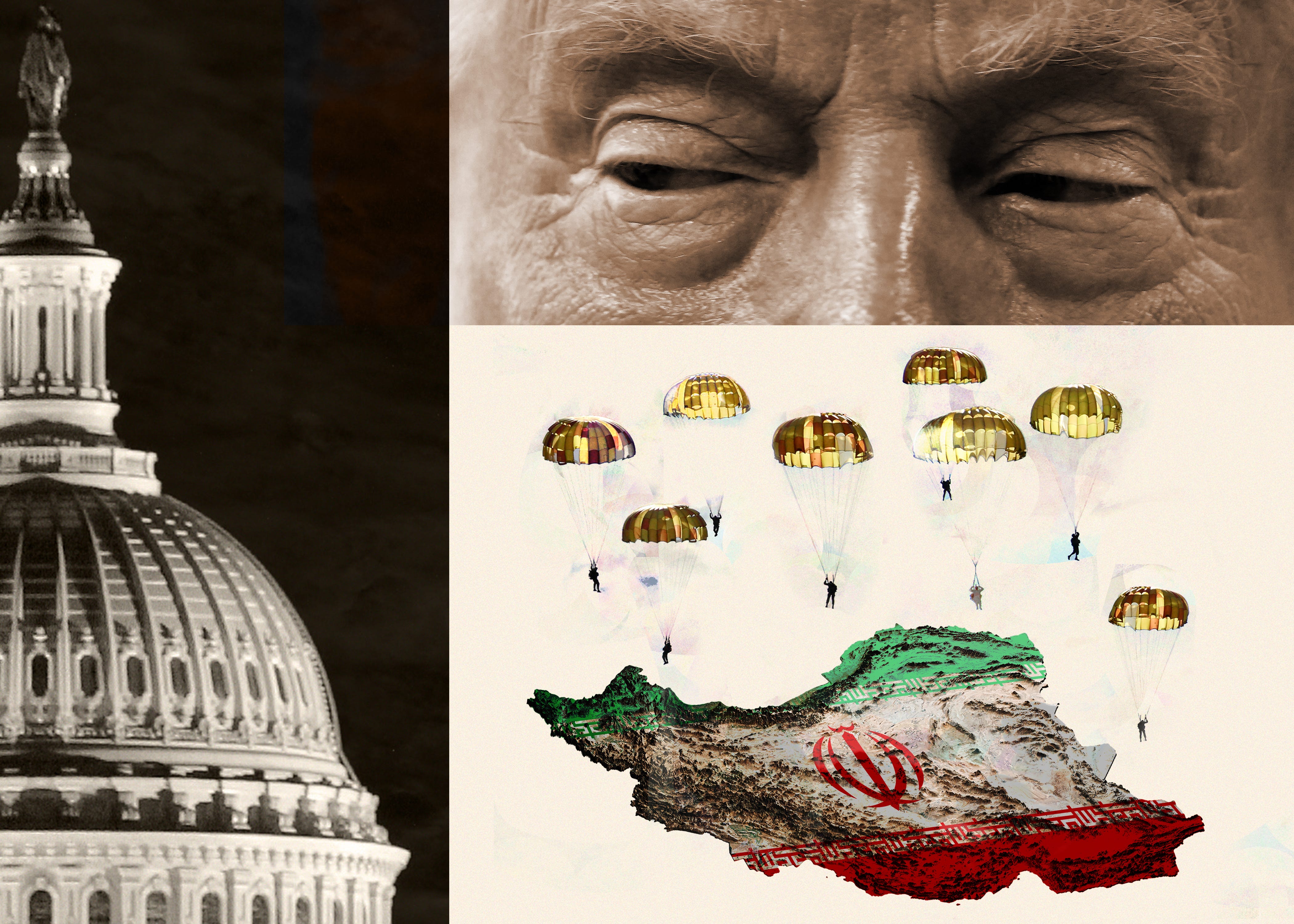
The King’s Congress
by William Kristol
We’re entering the second month of President Trump’s unauthorized war in Iran. Thousands more U.S. troops are being rushed to the Middle East.
Where, you may ask, is Congress?
Remember Congress? It’s the branch discussed in the first article of the Constitution. There it’s charged with the responsibility “to declare war,” “to raise and support armies,” and “to make rules for the government and regulation of the land and naval forces.”
Congress is in recess. Until mid-April.
Why not? So far, the Republican majority that controls Congress has blocked it from exercising its authority over matters of war and peace. We’re a month into the war and we haven’t even had public hearings, with testimony and questioning of administration officials. Democrats’ attempts to invoke congressional power and their pleas for congressional oversight have been waved aside.
Combat operations on Iranian soil may well be imminent. On Saturday, Dan Lamothe reported in the Washington Post that “The Pentagon is preparing for weeks of ground operations in Iran, U.S. officials said, as thousands of American soldiers and Marines arrive in the Middle East for what could become a dangerous new phase of the war should President Donald Trump choose to escalate.”
How can members of Congress—yes, even Republican members of Congress—read that and not think: What the hell about us? This shouldn’t be the president’s decision alone. We need a say here. We need to get back to town, hold hearings, have debates in depth on the floor, and vote on various measures on the war in general and on ground troops in particular.
Some members of Congress are thinking this, and saying so. But not enough are saying it loudly or insistently or urgently enough. The public surely deserves more than occasional cryptic and contradictory comments from the president and his advisers. Both Congress and the American people are now entitled to hear the arguments for ground troops set out formally and publicly by administration officials.
Perhaps Congress will find the arguments for U.S. troops on Iranian soil convincing. I’ve tried hard to find the best arguments for ground troops and to speak with knowledgeable experts about them, and they seem utterly unconvincing to me.
More importantly, those arguments have so far been unconvincing to the American people. A survey conducted from March 19–23 by the Associated Press and the National Opinion Research Center at the University of Chicago found 62 percent of the American public opposed to deploying U.S. troops on the ground to fight Iran. Only 12 percent were in favor, and 26 percent were uncertain.
But perhaps the public could be convinced to change its mind. And in any case, members of Congress have an obligation to act as they think best, not simply to follow their constituents’ views. But they do have an obligation to act. And that obligation remains no matter how eager the executive branch is to act on its own. To the contrary: When the executive is eager to ignore Congress is precisely when Congress most needs to step up.
Abraham Lincoln served one term in the House of Representatives, from 1847 to 1849, during which he opposed President Polk’s decision to go to war with Mexico. In an exchange of letters debating the issue with his friend and law partner, William Herndon, Lincoln characterized Herndon’s pro-executive argument defending Polk as this: When the president judges it necessary, he can invade another country. And “whether such necessity exists in any given case, the President is to be the sole judge.”
Lincoln warned that if you allow the president this, “you allow him to make war at pleasure.” He continued,
The provision of the Constitution giving the war-making power to Congress, was dictated, as I understand it, by the following reasons—Kings had always been involving and impoverishing their people in wars, pretending generally, if not always, that the good of the people was the object—This, our convention understood to be the most oppressive of all Kingly oppressions; and they resolved to so frame the Constitution that no one man should hold the power of bringing this oppression upon us—But your view destroys the whole matter, and places our President where Kings have always stood.
Donald Trump is now involved in what Lincoln considered the “the most oppressive of all Kingly oppressions,” placing himself “where Kings have always stood.” Lincoln was very much a No Kings man, and Democratic leaders in Congress claim to be sympathetic to today’s message of No Kings, for which millions of Americans rallied Saturday. But No Kings isn’t a wish or a sentiment. It’s an imperative and a responsibility.
Democratic members of Congress—even if joined by a few constitutional Republicans—may not be able to stop Trump. They may not even be able to get Congress to reconvene urgently. But they may be able to raise enough of an outcry to deter Trump from deploying ground troops, which would itself be a service to the nation. In any case, our elected officials have an obligation not to sit by while a wannabe King plunges us deeper into an unwise and unconstitutional war.
What can Democrats in Congress actually do to oppose the war—besides tweeting about it? Share your ideas in the comments.
AROUND THE BULWARK
Save D.C. Golf From Donald Trump… The city’s courses are not meant for the elite. They’re meant for the people. The president is trying to change that, writes PATRICK GRANFIELD.
What We—and You—Saw at No Kings… On The Bulwark on Sunday, JIM SWIFT joined BILL KRISTOL to discuss what they and Bulwark members saw at #NoKings.
Orbán Will Lose Hungary’s Election in Two Weeks—If It’s Clean… Péter Magyar is a seemingly unstoppable force—but don’t expect the embattled Orbán to give up without a fight, observes H. DAVID BAER.
Trump Needs Approval for This War… On Shield of the Republic, MICHAEL O’HANLON joins ERIC EDELMAN to discuss his op-ed in the Financial Times on the Trump administration’s $200 billion supplemental budget request to fund the Iran War.
Quick Hits
THE END OF EVERYTHING: There’s never a good time to kick off a global energy shock, but there are definitely bad times and worse ones. And the current moment—with the world economy hyper-leveraged in building out AI technology that may soon become hugely profitable but isn’t anywhere close yet—is about as bad a moment as you could imagine, as the Atlantic’s Matteo Wong and Charlie Warzel report:
Just a few things going a bit wrong could compound, all at once, into a cataclysm. To wit: Qatari and Saudi money dries up. Sustained high oil and natural-gas prices drive up the costs of manufacturing chips and running data centers. Already cash-strapped hyperscalers struggle to make lease payments on their data centers, while similarly strained private lenders suffer as all of the AI bonds become deadweight. Tech valuations fall, taking public markets with them; private-equity firms have to sell and torch their assets, putting intense stress on the institutional investors and banks. The rest of the economy, drained of investment because everything was poured into data centers for years, is already weak. Unemployment goes up, as do interest rates. “Bubbles pop. That’s the system,” [former senior advisor to the Consumer Financial Protection Bureau Brad] Lipton said. “What isn’t supposed to happen is that it takes down the whole financial system. But the concern here is that AI investment isn’t confined and may spread to the whole economy.”
The Iran war is exposing much of this fragility, but it’s far from the only source of it. “There are too many ways for it to fail for it not to fail,” investor and MIT researcher Paul Kedrosky said of the AI industry’s web of risk. “All you can say for sure is this is a fragile and overdetermined system that must break, so it will.” Read the whole thing, if you don’t love sleeping at night.
NO BREAKTHROUGH AFTER ALL: When we sent Morning Shots Friday, it looked like we’d finally seen a breakthrough in the partial government shutdown after Senate Republicans agreed to back a Democratic proposal to fund all of DHS except ICE and the Border Patrol. But later on Friday, House Speaker Mike Johnson poured cold water on the deal, describing the package, which would have paid TSA agents and re-funded FEMA, as a “joke.” Instead, late that evening, the House passed its own party-line measure, which would fully fund DHS for eight weeks—a nonstarter for Democrats, who continue to insist they will not consent to further funding for ICE until Republicans agree to procedural reforms. Despite the ongoing stalemate, both houses have now left town for the two-week spring recess.
CRUNCH CHECK: A new Politico poll finds cracks appearing in the MAHA coalition that helped Donald Trump retake power in 2024:
Republicans hope the Make America Healthy Again movement becomes a permanent fixture of a big GOP tent. But the party can’t count on its support heading into midterm elections this November.
The burgeoning political movement that officials in both parties credit with helping President Donald Trump win in 2024 has already begun to reshape how the GOP approaches health policy—driving everything from a redesign of the food pyramid to a rollback in vaccine recommendations.
At the same time, however, many poll respondents view Democrats as better positioned on the movement’s key health priorities. They were more likely, for example, to say the Democratic Party can be trusted to make the country healthier and are more eager to improve health in America, while fewer said the same of Republicans. The GOP, on the other hand, is seen as more likely to be influenced than Democrats by lobbyists for the food and pesticide industries, who rank among the MAHA movement’s top enemies.
Read the whole thing. Yesterday, when Trump was asked if he might withdraw his nomination of MAHA ally Casey Means to be surgeon general, he teased, “Something like that would be possible.”
Cheap Shots

Where's Congress? About where the German Reichstag was from the early 1930s through 1945 and for similar reasons. No, it's not exactly the same, but it's also not totally different. We need to stop labeling everything as Trump and start pointing out the responsibility of Republicans for our national disassembly.
"If Iran did not reopen the strait, Trump said, “we will conclude our lovely ‘stay’ in Iran by blowing up and completely obliterating all of their Electric Generating Plants, Oil Wells and Kharg Island (and possibly all desalinization plants!), which we have purposely not yet ‘touched.’”"
Oh yes, the War Crime gambit. Trump is a weapons grade moron, but he's got a feral sense about when things aren't going well for him. He realizes he's fucked up good, which is why he's got tens of thousands of troops on their way to that region and he's puffing out his chest on social media in order to save face. Say what you will about Iran's clerics; they've taken Trump's measure, and they've concluded they're dealing with what Tom Nichols has called a little boy from Queens. Trump is dangerous, but he's weak.
Also, I'm not an expert like Bill on this stuff, but I imagine if Trump were to order such an attack on Iran's power plants and desalination plants, what's left of our frayed alliances throughout the world would be irrevocably severed. NATO allies wouldn't want to be associated with a rogue head of state like Trump, and our allies in the Pacific would start their nuclear programs tomorrow. All because the great and good American people couldn't deal with high prices after a 100 year pandemic.