Why Quitting NATO Would Be a Huge Mistake
How to understand the value of the alliance.

WINSTON CHURCHILL ONCE OBSERVED that “There is only one thing worse than fighting with allies, and that is fighting without them!” His statement was born of both experiences—first standing alone against Nazi Germany at the zenith of its power, and then managing the competitive, often mistrustful, frustrating alliance that won World War II. He understood that alliances are imperfect but ultimately indispensable.
That wisdom is now colliding with a very different view of the world.
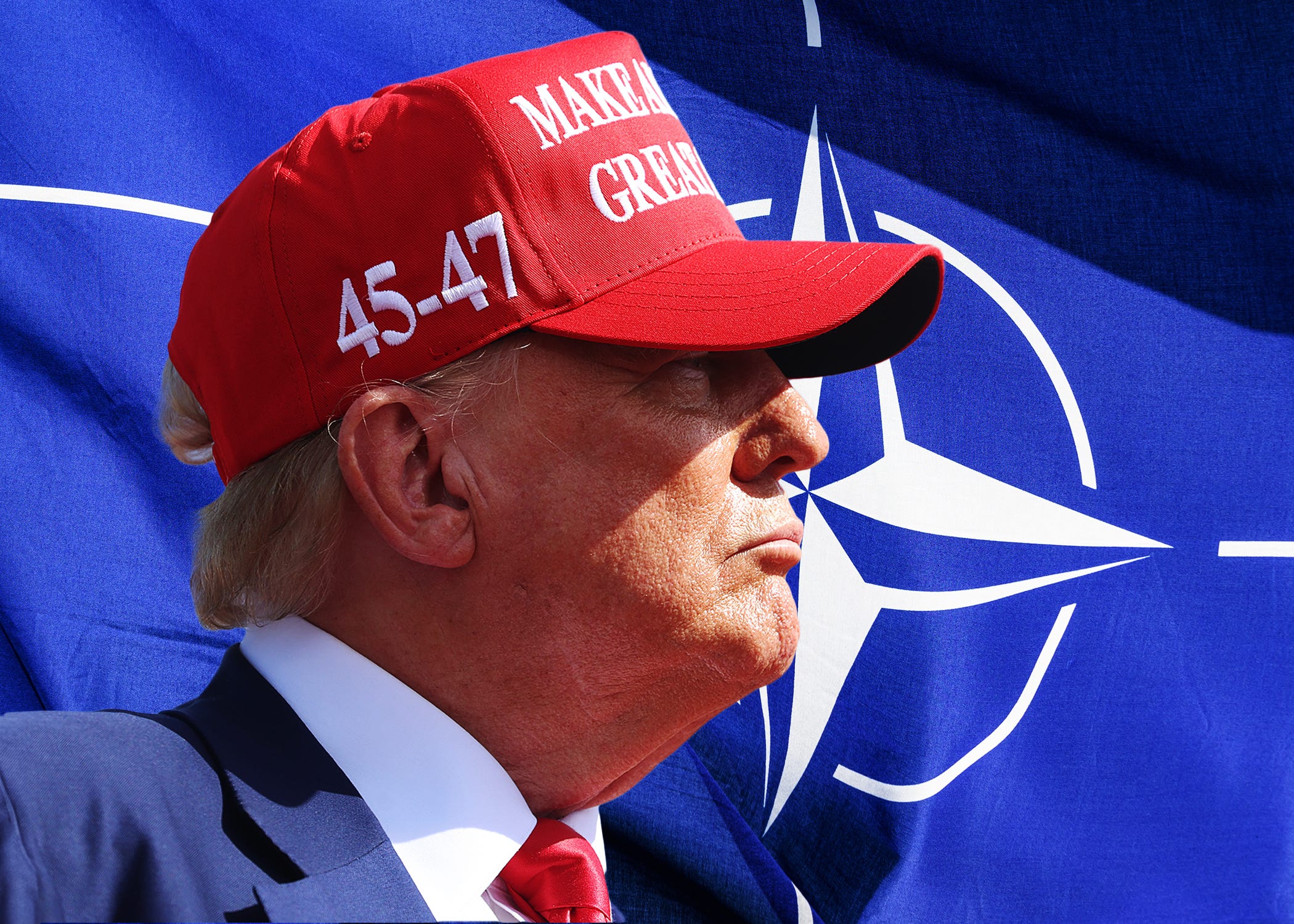
In an interview on Tuesday with the Telegraph, President Donald Trump again took aim at NATO, calling it ineffective, indicating that he was “absolutely” thinking about withdrawing the United States from the alliance (about which more in a moment), and—most tellingly—locating the source of his frustration in what he perceived as the failure of European allies to support U.S. military operations against Iran. In his mind, the argument is straightforward: America acted; allies didn’t follow or do what we wanted them to do; therefore the alliance is broken.
He continued in that vein in rambling remarks on Wednesday evening, saying that “NATO treated us very badly” in Iran and “they’ll be treating us badly again if we ever need them” and “won’t be there if we ever have the ‘big one.’”1
But Trump’s version of events, like so many of his comments, leaves out many critical details: the way the action against Iran proceeded, how other nations approach their own national security, and how security alliances work.
The operation in question was conceived, planned, and executed by the Trump administration in a vacuum, without the approval of either Congress or the American people. There was also little to no prior consultation with any NATO partner. There was no shared planning process, no collective agreement on objectives, no information or intelligence sharing, a mixed and constantly changing operational plan, and no clearly articulated strategic vision. Only after the operation was underway did the United States look to its allies and ask for support in what had become a chaotic and open-ended mission. When allies hesitated—seeking clarity in the goals, risks, and duration of operations that they would have to sell to their—the president cited this as proof that NATO doesn’t work.
In President Trump’s mind, the failure of our allies to provide unquestioning support reinforces the argument he has made since 2015: that NATO is a bad deal, that allies are not “paying their way,” and that the United States is carrying a disproportionate burden for nations unwilling to defend themselves.
None of those claims is valid. What matters in war—and in deterrence—is capability.
THE IDEA THAT NATO ALLIES are “freeloaders” reduces an agreement about how thirty-two countries can achieve common goals together to a single metric: defense spending as a percentage of GDP, right now. That number matters, but it’s far from the whole story. Because what NATO allies contribute, often outside the headlines or the budget sheet, is both substantial and indispensable.
Across Europe, NATO has built a training and command architecture that reflects the true nature of the alliance. In Norway, the Joint Warfare Centre integrates multinational forces across the land, air, maritime, and cyber domains. In Poland, the Joint Force Training Centre prepares allied forces for major operations, particularly along NATO’s eastern front. At the Grafenwoehr Training Area in Germany, U.S. and allied forces train together at scale, building the muscle memory required for real-world operations. The U.S. Army’s Europe Mission Command Center in Wiesbaden has been the focal point of multinational operations, including most recently the Security Assistance Group–Ukraine, which integrates and organizes support for Ukraine from dozens of countries.
These centers are not American outposts with foreign observers. They are multinational institutions—staffed, funded, and operated by a coalition of nations. Officers from across the alliance plan together, train together, and learn together.
NATO naval forces—often led by European allies—have conducted sustained operations around the region, including the little-known counterpiracy operations off the Horn of Africa and in the Gulf of Aden. Operations like these, under NATO command, protect global shipping lanes (including those that bring American goods to foreign consumers and foreign goods to American ports), ensure the free flow of commerce, and reduce piracy to a fraction of its former levels. American forces participated, but they did not always lead. In many cases, European navies provided the command ships, the bulk of the forces, and the operational continuity.
In Estonia, the NATO Cooperative Cyber Defense Center of Excellence has become a global leader in cyber defense, shaping the alliance’s understanding of and approach to countering digital threats. In the Nordic and Baltic region, nations like Finland, Sweden, Norway, and the Baltic states bring specialized expertise in cold-weather operations, Arctic and maritime security, territorial defense, and resilience against hybrid warfare. These are not marginal contributions. They are essential ones—particularly in a world where conflict transcends traditional battlefields.
Airpower and special operations are two major areas where NATO’s value is often underappreciated—but where the alliance quietly delivers some of its most decisive advantages. Across Europe, allied air forces train and operate in tightly integrated formations, sharing air policing missions over the Baltics, conducting combined air operations from dispersed bases, and building a level of interoperability that allows pilots from different nations to fly, refuel, and fight together almost seamlessly. Special operations forces from across NATO routinely train and operate side by side, developing common tactics for counterterrorism, unconventional warfare, and crisis response. These SOF units—often small, highly capable, and regionally expert—provide access, intelligence, and precision options that conventional forces cannot. In many cases, European allies bring niche capabilities, language skills, and regional familiarity that significantly enhance U.S. operations. The result is a force that is far more agile and effective than any single nation could field alone—one that can respond quickly, operate in politically sensitive environments, and deliver strategic effects out of proportion to its size.
Across Europe, NATO intelligence fusion centers and national intelligence services contribute to a shared picture of threats against American interests or the American homeland. Whether it’s tracking terrorist networks, monitoring Russian military movements, or identifying cyber threats before they reach U.S. infrastructure, allied intelligence contributions are constant, quiet, and critical. Many of the terror plots disrupted in Europe—and some that might have reached American shores—were stopped because of allied intelligence work.
Sharing the burden of collective security is important. But budget figures don’t capture the complexity and particularity of allied cooperation.
AS COMMANDER OF U.S. ARMY EUROPE, I worked alongside all the allies and various partners—some of whom have since become NATO members—who brought different capabilities, different perspectives, and a shared commitment to the mission. And what we were building—day after day, exercise after exercise—is trust. Because trust and understanding are the currency of alliances.
You don’t build trust in speeches or summits, but you certainly detract from it by insulting fellow members. You build trust in the field, through shared hardship, consistent leadership, and demonstrated reliability. Over time, that trust becomes confidence that when the moment comes, allies will stand together. But now, we have seen that confidence tested and broken.
When allies hesitate to join an operation that was neither coordinated nor clearly defined, it’s not because they’re weak or freeloading. After all, many of these same allies followed us into Iraq and Afghanistan. Their current reluctance is evidence of a breakdown in the trust that makes alliances effective. NATO isn’t designed to rubber-stamp unilateral decisions, especially the decisions that run counter to individual nation’s security. It’s designed to align strategy, coordinate action, and share risk.
To interpret that hesitation as abandonment is to misunderstand the alliance entirely.
THERE IS ALSO A CONSTITUTIONAL REALITY that cannot be ignored. The United States joined NATO when the Senate ratified the North Atlantic Treaty in 1949. It’s an open constitutional question whether a president can unilaterally withdraw from a treaty, but since there’s a 2023 law specifically stating that the president can’t withdraw from NATO without the approval of the Senate or an act of Congress, Trump’s threats to withdraw the United States should be treated as legally dubious until and unless the courts rule otherwise.
That does not mean a president is powerless. A misguided president can weaken NATO—by reducing U.S. presence, by undermining trust, and by signaling that American commitments are conditional. And those signals, which are echoing in this president’s current narrative, have consequences.
Recent strategic documents—the National Security Strategy and National Defense Strategy—have emphasized that the United States must be prepared to act independently if necessary. That is always true. But there is a profound difference between being able to act alone and choosing to do so because of hubris or a misguided understanding of the security and strength that an alliance provides.
What recent events have demonstrated—perhaps more clearly than any policy document—are the limits of unilateral action. Without allied support, the United States faces greater logistical challenges, reduced access, constrained basing, reduced intelligence sharing, and diminished political legitimacy. Operations become more complex, more costly, and more uncertain.
In other words, the real world has a way of correcting erroneous assumptions.
Trump continues to treat alliances as transactions—measured in dollars and cents, assessed in terms of immediate return on investment. Consultation or risk assessments—when sending young people of many nations into harm’s way—don’t enter into his calculus.
But alliances are not transactions. They are relationships. They are built on shared interests, shared values, and shared risks. They require investment—not just financial, but informational, political, and strategic. And when they function as intended, they multiply power.
NATO is not perfect. It never has been. But it has endured because it works. For more than seventy-five years, it has deterred aggression, prevented major wars in Europe, and extend American and European influence. It has provided a framework for cooperation and an anchor to global stability. It has also, time and again, delivered for the United States—not just in moments of crisis, but in the daily, often invisible work of security: protecting sea lanes, sharing intelligence, deterring adversaries, and preparing for the worst. To dismiss NATO as a bad deal—or to threaten withdrawal in response to predictable allied caution—is to ignore that reality.
And it is also to ignore the alternative. Because the choice is not between a flawless NATO and a collection of countries in NATO that does a president’s bidding. It is between an imperfect alliance and the far more dangerous prospect of standing alone.
Churchill understood that. Trump would be wise to learn it.
Trump told Reuters that he would be “discussing my disgust with NATO” in his Oval Office address later on Wednesday night but he ultimately did not.