


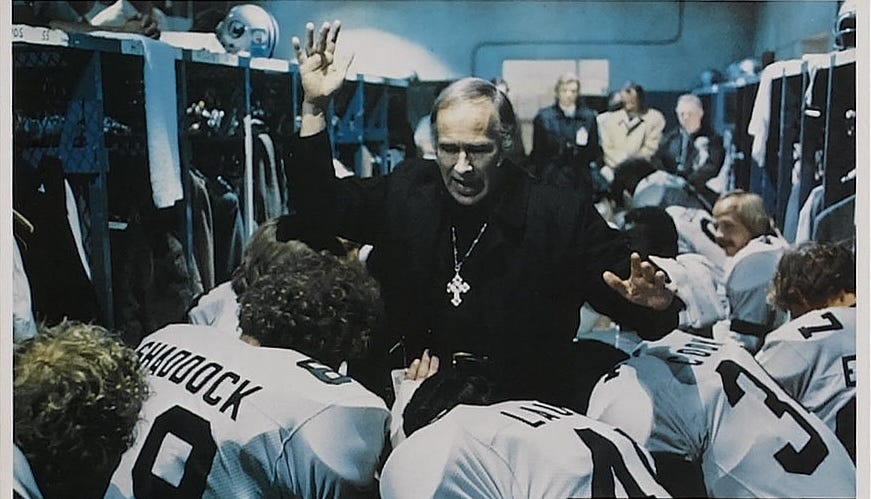
On this week’s Bulwark Goes to Hollywood, I was pretty excited to get Chuck Klosterman on the show to discuss his new book, Football. There is a Hollywood angle here and I’ll get to it in a minute. First, though, I want to highlight a brief passage from the book because I think it helps explain why I find Klosterman’s work so engaging and have for the last quarter century.
“Maybe you agree with me about football and television,” he writes after explaining how we all see football through the lens of television, specifically through the lens of the sideline angle that is used at the start of virtually every play broadcast on television. “Maybe you don’t. Probably you don’t. Perhaps you think my argument is wrong and my conclusion is stupid, or perhaps you think my conclusion is right but my explanation is crazy. I know how you feel. I argue with myself, in my own mind, every minute of every day.”
Emphasis mine because I think this really gets to the crux of why Klosterman is an interesting thinker and an engaging writer. You can almost feel him working out what he thinks about something while he’s engaging with it. More than that, though, you can feel him wrestling with why he thinks the thing he thinks. And I do think this is, increasingly, the most important thing a writer can do. In the age of Google—in an age where you can marshal evidence for virtually anything you want to argue regardless of its actual truth—understanding why we think what we think, what influences we’re laboring under, how our own biases are affecting what we think, is incredibly important work. Maybe the most important work.
Anyway, here’s an incontrovertible fact about football, regardless of the amount of googling you do to try and disprove it: Football is by far the most popular single thing in America. Granted, football itself is not really a single thing, as peewee football, high school football, college football, and professional football all have remarkably different connotations.1 But football, particularly televised football, is the closest thing we have to a unifying idea of the country and what it means. (As Klosterman notes, this applies to people who hate the sport as well, possibly even more than people who love it.)
This is a stat I’ve highlighted before, but since Klosterman brings it up, it’s worth repeating: Ninety-three of the one hundred most-watched programs in 2023 were football games. And these were not all playoff games or bowl games or even particularly good games. “The fifty-ninth most popular broadcast was a football game between the 9–7 Jacksonville Jaguars and the 5–11 Tennessee Titans,” Klosterman notes. The sixtieth highest-rated program of the year? The Academy Awards.
Meanwhile, the streaming services and the television networks continue to put up huge numbers with their NFL acquisitions. Here’s a nugget from the latest streaming ratings guide from the Entertainment Strategy Guy: “The Kansas City Chiefs versus Dallas Cowboys was actually the most-watched NFL regular season game ever, with 57.2 million average viewers, or 171.6 million hours total.” Now, there are some caveats here having to do with how Nielsen has changed how they count overall viewership for all programming, but still: That’s an enormous number, roughly one-sixth of the country, watching a game between two teams that seemed unlikely to make the playoffs. And if you look at his chart of programs that made the “40 million hour club”—an arbitrary dividing line, maybe, albeit one that denotes an astounding level of success—you’ll see football show up for the first time in the beginning of 2024. Of the last seven entries on the chart, five are NFL games. And this is a streaming-only chart, meaning that games broadcast on NBC and Peacock or CBS and Paramount+ don’t make the cut. Those were all Thursday Night Football games exclusively on Amazon Prime.
The point here is simple: For a large portion of the country, the NFL is must-watch TV.
Which makes it a must-own property for the streaming services.
Which means that the costs of the rights deals for the NFL are exploding.
Which means they have to be subsidized by advertising.
Which means that the cost of the ads themselves continues to spiral up.
But eventually, as Klosterman notes, this becomes unsustainable: Either companies stop paying for ads, seeing no return on their investment, or the streaming services simply decide the juice isn’t worth the squeeze. Eventually, once the number of bidders drops off, the money’s going to plateau or decline. And that’s when real trouble for the sport will start. It’ll be too big to fail, but fail it will. The question, then, is what happens to the audience. Do they wait for the sport to return? Or do they simply shift their newfound supplementary pleasures—gambling, fantasy, gaming, whatever—into other pursuits?
Supersized episode of our spun-off Across the Movie Aisle this week, as Peter, Alyssa, and I broke down our top tens. I hope you give it a listen!


I’ll be honest, I did not expect 28 Years Later: The Bone Temple to so distinctly resemble a stoner comedy with giant naked zombies, but, uh, it greatly resembles a stoner comedy with giant naked zombies. From my review:
It is, for a long stretch of the film … a buddy comedy. There’s really no other way to explain the relationship between Kelso and Samson. And The Bone Temple only really works because Ralph Fiennes commits so completely to the bit: You absolutely buy him as a hermit whose mind has been warped by loneliness into hoping there’s still a chance for the Alpha whose rage he has soothed by enormous doses of morphine. Indeed, long stretches of the picture involve nothing zombie-oriented at all; rather, Kelso has turned his open-air ossuary into an open-air opium den, he and his big naked friend rolling in the grass, stoned out of their minds, letting the world wash over them.
Look, I know we’re in the early going, but Fiennes has delivered the performance of the year and it’s only mid-January. I’m sure there will be other very good performances this year, but none that will commit so fully to the complete insanity that Fiennes has to commit to here as Kelso. Importantly, he does it without making his character seem insane. This is a role that needs wry, dry wit to accompany the over-the-top mania of several of its sequences, and by God, Fiennes pulls it off. The audience I saw this with unexpectedly burst into cheers and started clapping at the end of one of these bits: If you see it in a theater, you’ll know it, and I’ll be curious to hear how y’all’s audiences reacted to it.
Read the whole thing here.
Assigned Viewing: The Rip (Netflix)
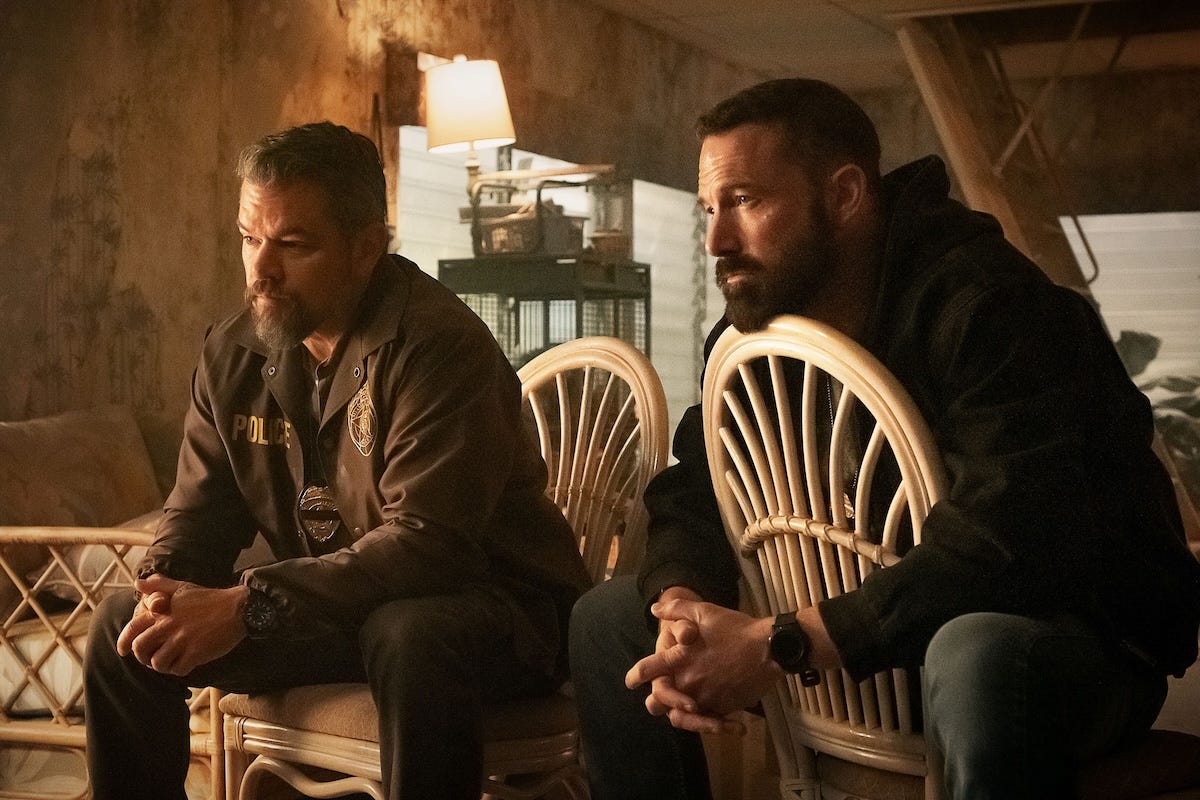
Okay, in this case, the assignment is not just for you but for me: I’ll admit haven’t seen this yet. But I like everyone involved: Joe Carnahan directs Matt Damon and Ben Affleck as (possibly crooked?) cops who come across a big score and have to survive the night against fellow police and the gangsters they’re stealing it from. Or something, I dunno. Scott Adkins, the human special effect, is also in this! That’s good! Point is, I’ll be watching it this weekend.
In order: chaos, Texas, corruption, and the monoculture.
I have to say, before I'd seen the description of Klosterman's book, I had not thought of the idea of pro football as the nation's last bastion of a monoculture — but having been exposed to it, I can't stop thinking about it.
(Having not yet read the book, I'm curious if Klosterman will also address the ways that more traditional pop culture presences — thinking here of both Taylor Swift and Hailee Steinfeld — connect with the larger world of the NFL through their relationships with athletes currently playing in the league in question.)
O. W. Shaddock: You and B.A. and all the rest of you coaches are chickenshit cocksuckers. No feeling for the game at all, man. You'll win, but it'll just be numbers on a scoreboard. Numbers, that's all you care about. Fuck, man, that's not enough for me.
Coach Johnson: I don't have to listen to this.
O. W. Shaddock: Oh, yes, you fucking do! You got to listen to me for once! All you coaches are chickenshit cocksuckers! You're all chickenshit cocksuckers! God damn you!
Phil Elliott: Far out.