You Should Be Watching ‘Widow’s Bay,’ a Single-Screen Show
Plus: A Spielbergian assignment.

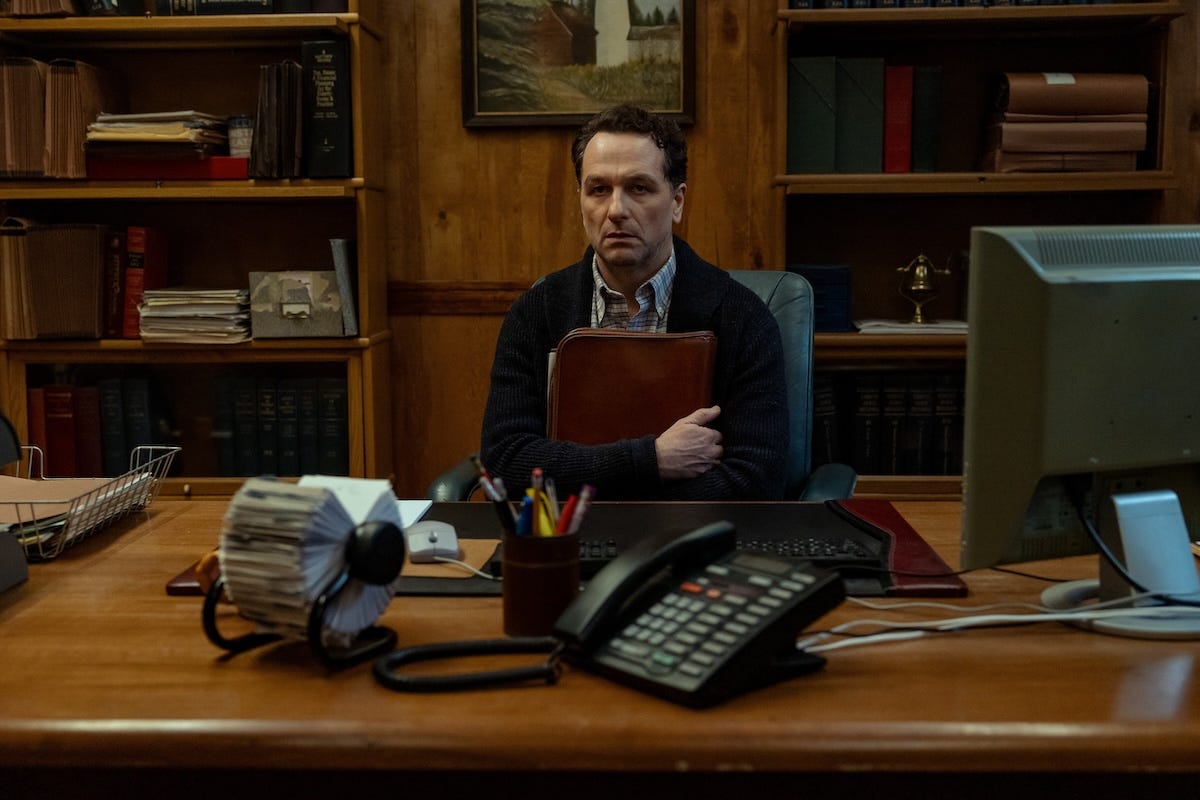
ONE OF THE REAL TREATS of the early summer season has been Widow’s Bay, the new Apple TV show that wraps up its first season on Wednesday. I haven’t seen the finale yet, so I don’t know if it’ll stick the landing, but the streamer seems to have a decent amount of faith in it given that they’ve already signed off on a second season.
This renewal comes despite the fact that, according to the Entertainment Strategy Guy, the numbers on Widow’s Bay are somewhat soft. Okay, very soft, given that the show “didn’t make any of the viewership charts.” Well I say “charts schmarts”! Because it’s been a long time since I’ve seen a show that was this well constructed, nailed this precise mixture of comedy and horror, and featured performances that elicited quite this many literal laugh-out-loud moments from me.
Here’s the setup: Tom Loftis (Matthew Rhys) is the mayor of Widow’s Bay, a small fishing island off the coast of New England. In the opening moments, a mysterious fog descends upon the village, leading to a disappearance and much more consternation; this is the first of several weird occurrences to trouble Loftis and his fellow citizens. Bad timing, this: Loftis has gotten the New York Times to send someone out to profile the town in the hopes they might be the next vacation hotspot.
The Times reporter raves; the tourists come; and things continue getting weird. Local sailor Wyck (Stephen Root) believes the island to be cursed and tells Loftis that the evil fog means it has “woken up.” To do what? Mostly creep everyone out. Every episode features a new manner of spook or zombie or goblin. Revenants, witches, sea hags: You name it, Widow’s Bay’s got it. And the joy of the show is watching Loftis come to accept that the townspeople have been right all along, at least potentially. Maybe his assistant, Patricia (Kate O’Flynn), really was almost killed by the Boogeyman. Maybe there is an evil presence haunting the town inn.
For all these horrifying elements, Widow’s Bay is much more of a comedy than, I think, early ads let on. This is an incredibly funny show, prompting a guffaw or two an episode, at least. It is also, almost defiantly, a single-screen show: the jokes are frequently sight gags, either relying on the audience seeing Loftis react to something bizarre or the bizarre thing itself laid out for all to enjoy.
Just one small early example: In the second episode, Tom—who has been dared to spend the night in the town’s supposedly haunted hotel—is playing a board game with a fellow lodger. The game, “Daddy’s Home,” was found on the inn’s shelves next to other games like “Teeth,” the box for which simply contains a pair of pliers. Which is to say: Something’s off here. Among the cards one can draw are actions like “Daddy’s younger boss yelled at him today, move back three spaces.” But it’s all the little design choices that really drive home the morbid humor of the situation: “Daddy’s Home” has a harried-looking man on the front; the tokens contain, it appears, a belt and a bottle of booze; the spinner wheel has a spot titled “Daddy had a bad day, move back three spaces.”
Now: This is a very dark joke if you think about it for any length of time. But you have to work for that darkness, you really have to pay attention. And this is a show that rewards doing the very basic thing of simply paying attention: In the fourth episode, for instance, you’ll miss flashes of what’s really happening at the town mixer if you’re looking at your phone the whole time.
I feel like I’m going nuts even having to emphasize this: Duh, of course you should be looking at the TV while you’re watching it. But we live in an age of second-screen programming. At least, this is what Netflix tells some of its showrunners and writers and executives, according to Daphne Rena Idiz of the University of Toronto. Here’s how one of her interview subjects put it: “What you need to know about your audience here is that they will watch the show, perhaps on their mobile phone, or on a second or third screen while doing something else and talking to their friends, so you need to both show and tell.”
Maybe Widow’s Bay creator Katie Dippold was told by Apple she needed to show and tell. But I kind of doubt it. This is a show that only really lands if you’re watching it with some focus. It’s a single-screen show. And you need to start watching it.
What else is everyone watching this summer? My wife and I just finished up Hacks, which closed pretty well. Anything else on the docket? Let everyone know what you’re watching in the comments, let’s crowdsource a summer viewing guide.
The creator of the revered graphic novel, Persepolis, died last week. To honor Marjane Satrapi, Peter, Alyssa, and I revisited the film of the same name and discussed its lasting impact—as well as the disgusting reaction in certain quarters to her passing.

I interviewed onetime Carolco CEO Peter Hoffman this week about his new memoir, Karmic Winds, and how films got made in the 1980s. He’s a good person to ask, given that under his watch Carolco churned out a string of hits that included Basic Instinct and Terminator 2. I hope you give the episode a listen!
The Wild West of 1980s Movie Financing

I’m joined by Peter M. Hoffman this week to discuss his new memoir, Karmic Winds, about his time in Hollywood as the tax lawyer who could figure out how to get movies financed and get people paid. Fan…
Assigned Viewing: Close Encounters of the Third Kind (Criterion, Peacock)
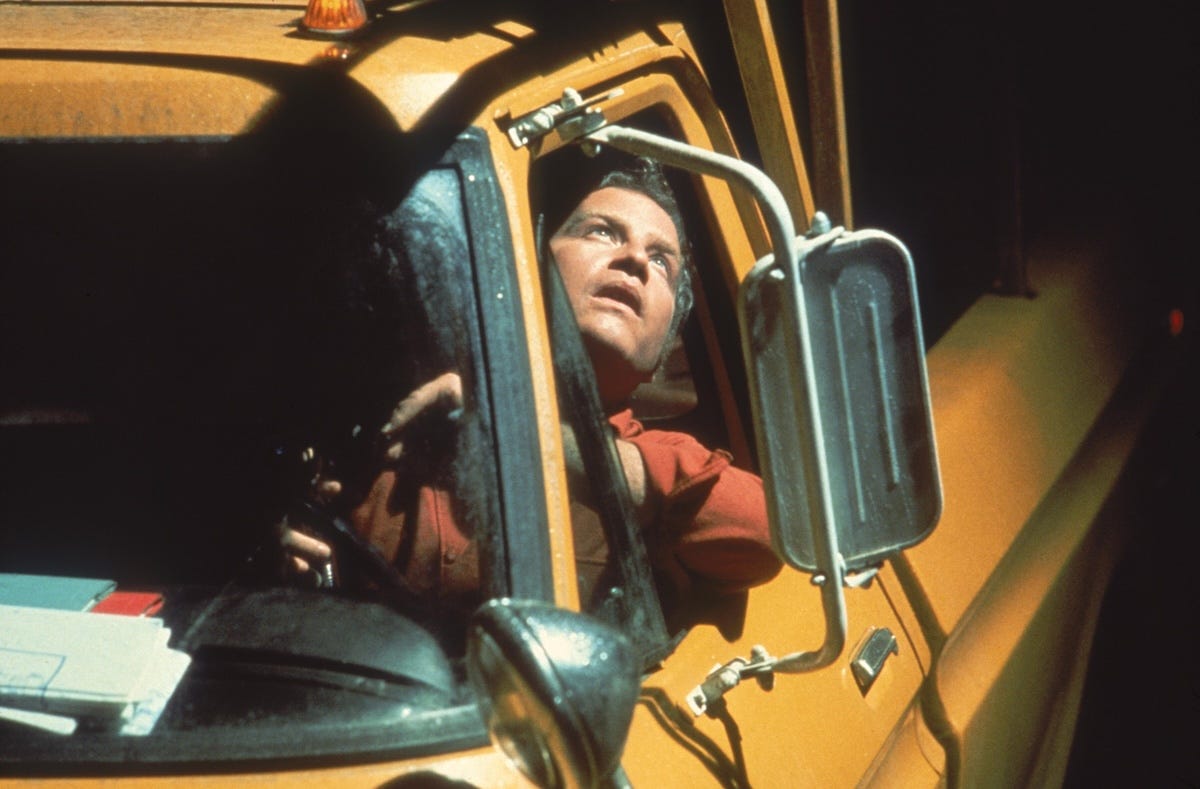
Unfortunately, I did not love Disclosure Day, the new film from Steven Spielberg. From my review:
Disclosure Day is rarely boring but it’s never exciting, an oddity for a Spielberg action film. This is not to say that it’s a film made without skill: This is Steven Spielberg, after all, and the man can direct a killer set piece. It’s the little things he does with such seeming ease, like a tracking shot through a newsroom as Margaret is running to her post to make it on air just in time, a oner that would take most directors two days to set up and light and that Spielberg probably drew up the morning of shooting. The performances are good—Blunt as the fast-talking broadcaster is the best of the leads and I haven’t even mentioned her boyfriend, who is played with perfect comic timing by Wyatt Russell—but rarely rise beyond that.
You can practically feel Spielberg straining to convey the importance of Disclosure Day’s message, and there’s something admirable in his desire to say what’s clearly so deeply felt. But it’s that very strain that makes the film feel silly, almost trite.
I rewatched Spielberg’s Close Encounters of the Third Kind this week and it really is just better in almost every way, at least in part because it doesn’t make any grand pronouncements: It doesn’t demand the audience feel anything aside from awe and wonder at the unknown. There’s a message in that, of course, but it’s a less didactic one, a little more open-ended.
I love this show, too. It never really gets "scary" IMO. Only the episode about the original colony was a little on the darker side. This show builds the tension very well but the release is usually a laugh rather than a scream, even for the well-telegraphed jump scares. It's like the horror version of the big hill on a roller coaster. You inch up the hill knowing it's going to launch you in a free fall but once you crest the top you are grinning in spite of yourself the whole way down. Couple that with the great cast and quirky characters and it is my favorite show of the early summer.
I am not really a horror guy. I've seen the big classics and found them to be enjoyable, despite not being my thing. The torture porn era of films in the aught was about as far away from anything that I would ever want to watch.
Which is to say that it's very weird that this show is EXTREMELY MY SHIT. Comedy is like the citrus that cuts the heat that I don't otherwise like on it's own (this is a bad analogy; I love spicy food). I do not like, "oh no, I'm so scared, ahhh, this is terrifying," horror. I, apparently, love "What the fuck? Fuck this! No fucking way, I'm out," horror. When Loftus took one look at that crawlspace and said, "not a chance," I felt very seen.
I love this show.