Abortion Politics Are About to Bite Trump Again
A new fault line is emerging in the president’s coalition.


The Met Gala was last night—and if you’re hoping for commentary on that, we’re afraid you’ve come to the wrong place.
Sam and Bill (Andrew is ailing) are going on Substack and YouTube at 10 a.m. EDT for Morning Shots Live. Happy Tuesday.
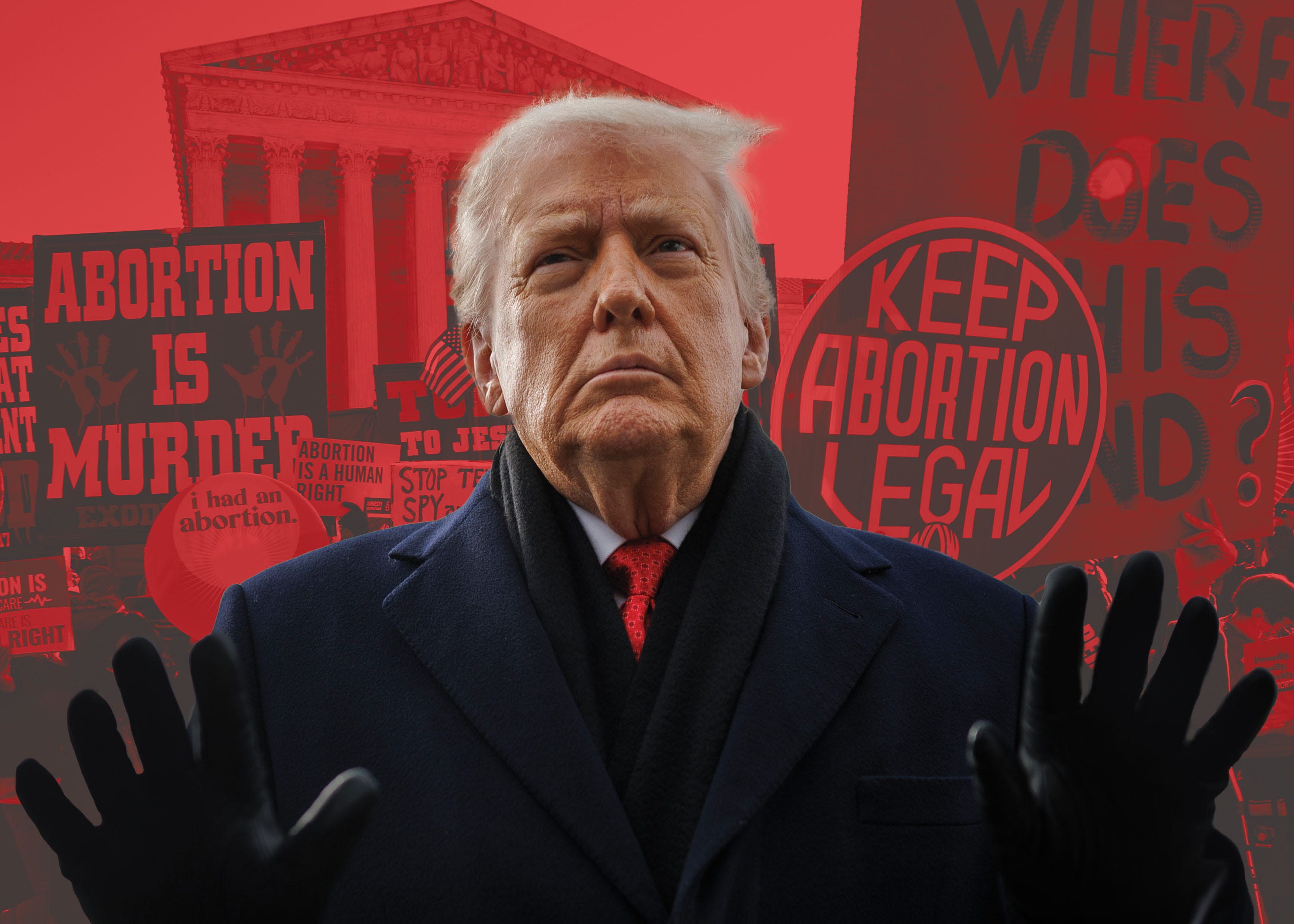
Trump’s Lose-Lose Abortion Dilemma
by Andrew Egger
One of the million strange things about our political moment is how abortion politics has all but dropped out of it. Donald Trump, who has never cared personally about abortion bans, functionally cut the pro-life movement loose during his 2024 campaign and has more or less ignored the issue since his re-election, while Democrats have had their hands full opposing the things Trump is doing right now. It’s a far cry from four years ago, when the end of Roe v. Wade caused a backlash so ferocious that Democrats made it a tentpole of their messaging in both 2022 and 2024.
But abortion politics may be coming back. Red states with active abortion bans have been suing to end the chief federal policy blunting their anti-abortion efforts: a substantial Biden-era expansion of clinics’ ability to mail abortion drugs to patients without a physical visit. This Food and Drug Administration policy has meant that even living in a total-ban state is hardly a barrier to access: Women seeking abortions can simply request drugs from an out-of-state clinic and receive them discreetly by mail.
Last week, a federal court upended that uneasy status quo. In a case brought by the state of Louisiana, a New Orleans-based appeals court ruled unanimously that the FDA’s authorization of the telehealth prescription and nationwide mailing of mifepristone—one of two drugs typically taken in tandem to induce abortion—violated the state’s right to regulate the practice within its borders.
Yesterday, the Supreme Court placed that decision on a short-term hold to give the parties time to appeal. Mifepristone’s two manufacturers, Danco and GenBioPro, are arguing that the Fifth Circuit’s decision is a recipe for “immediate chaos” since it “renders inoperable an agency action that has already been in effect for years.” But the current conservative Court, which already issued the most significant anti-abortion decision in history in Dobbs v. Jackson Women’s Health, may prove sympathetic to Louisiana’s argument that the current FDA posture amounts to complicity in facilitating large numbers of abortions that are illegal under state law.
Reproductive-rights groups see this as a nightmare scenario. Ironically, so does President Trump. His administration has been doing everything it can to kick the can down the road while keeping the mifepristone status quo frozen quietly in place. Last September, amid a barrage of pestering from Republican state attorneys general, Health and Human Services Secretary Robert F. Kennedy Jr. said that the FDA would conduct a “review” of mifepristone’s authorization. But they seem to be in no hurry to complete it—and meanwhile, the Trump administration has consistently asked courts to delay weighing in on the subject until that review is completed.
Trump’s political bind here is obvious. He sees abortion policy as political deadweight, a loser of an issue with an electorate that he’s in no position to press at the moment. But it also happens still to be the central issue for the social conservatives who still constitute a non-trivial portion of his base. Any action he or his government might take on the matter would infuriate some group of voters that he can ill afford to infuriate. But his attempts to slow-walk the process are no longer working, either.
Meanwhile, antiabortion groups like Susan B. Anthony Pro-Life America—which Trump essentially bludgeoned into silence during his 2024 campaign—are getting tired of waiting quietly in the hope the president will throw them a bone. “Trump is the problem. The president is the problem,” SBA President Marjorie Dannenfelser told the Wall Street Journal this week. The status quo, whereby abortion policy is decided at the state level beneath an umbrella federal policy that permits unlimited abortion pills by mail, is no longer acceptable to Dannenfelser and her allies. If Trump’s stance on abortion becomes the broader Republican stance, she said last week, “then the movement as we know it is finished.”
If the Supreme Court throws out the mifepristone-by-mail status quo, it will dramatically sharpen the salience of abortion as a political issue—one that currently favors Democrats. But if they decline to throw it out, the pressure from pro-lifers on Trump and Kennedy to simply change the rules in question will become astronomical.
In 2016 and again in 2024, Trump unified the GOP’s various factions and interest groups more or less through sheer force—he made himself the only game in town. But as his presidency founders and electoral catastrophe looms, Trump is making it far easier for various types of conservative to start planning for how to survive in what comes next—in other words, to start taking a good, hard look at what comes after the Trump Era for the first time in years. Pro-life groups won’t be the last rats off this sinking ship.
Trump Lost Ukraine
by Benjamin Parker
Here’s a thing that could have happened over the past fifteen months: Ukraine could have turned the tide of its war with Russia with the enthusiastic support of the United States, rather than doing so in spite of limited help and a heavy dose of interference from the Trump administration.
Here’s what actually happened.
When Trump took office, Ukraine faced some serious problems: air defense, manpower, public finances, and the necessity of putting strain on the Russian war machine chief among them. The United States stopped offering new aid, temporarily cut off intelligence support, publicly broke with Ukraine, repeatedly accused Ukraine—not Russia—of being the impediment to peace, consistently pressured Ukraine to give up territory in exchange for worthless promises from Russia, bragged about having hung Ukraine out to dry, and lifted sanctions not only on Russian oil, but also on individual Russians.1
Ukraine, while still in a desperate situation, has solved or ameliorated most of those problems. It has improved its air defenses against Russian drones, though ballistic missiles still remain an issue—especially due to the scarcity of PATRIOT interceptors. It has addressed its manpower problem through a combination of personnel policy reforms and the widespread use of autonomous ground combat vehicles, leaning on robots instead of people whenever possible. Its long-range strike campaign pushes ever deeper into Russian territory, damaging or destroying military and economic targets. And it has used Russia’s vast geography against it—Russia is simply too big for air defenses to cover all of it.
Now, as the strategic balance of the war is shifting in Ukraine’s favor, Ukrainian President Volodymyr Zelensky has signed a series of security cooperation agreements with Gulf states. In non-diplomatic terms, that means that America’s security partners in that part of the world were underwhelmed by our ability to protect them from Iranian drones and missiles, and are choosing to take their business elsewhere.
Ukraine also just signed a joint defense production agreement with Germany, which means that not only will Ukraine’s military benefit from the German arms industry, but the German arms industry and military will benefit from close cooperation with the Ukrainian military—which is the most experienced fighting force in the world when it comes to high-intensity, drone-age, AI-enabled warfare. As Germany pours 100 billion euros into recapitalizing its military, it will have the best information in the world on what to buy, where to spend, and how to organize itself because it will be able to learn from Ukraine’s experience. The two countries also signed a deal on the joint exploitation of Ukraine’s vast mineral wealth. The difference between this agreement and the minerals deal Ukraine signed with the Trump administration last year is that the one with Germany isn’t vaporware.
It’s impossible to not look at all this and wonder about an alternate world in which the United States had continued or even stepped up its support of Ukraine. Instead, Kyiv’s public posture toward Washington is apathy. As former U.S. Ambassador to Ukraine Steven Pifer recently pointed out, despite Trump’s constant attempts to pressure Ukraine into what amounts to surrender, Zelensky and his government have continued to wage their just war as if the United States didn’t exist.
From Donald Trump and JD Vance on down, almost every member of the Trump administration has talked about Ukraine as a sort of geopolitical beggar, always taking, never giving, and certainly unworthy of generosity or support. That view has always been not only morally idiotic but strategically short-sighted. Ukraine is now a valuable partner and ally for a host of countries that are willing to be good partners and allies in return. Unfortunately, the United States decided it didn’t want to be one of them.
AROUND THE BULWARK
In Russia, Victory Day Is Starting to Feel Like Defeat… Drones are landing in Moscow, critics are starting to speak out, and Putin is even more paranoid than usual, reports CATHY YOUNG.
This Oil Crisis Could Last Over a Year… On Bulwark Takes, TIM MILLER is joined by GasBuddy’s Head of Petroleum Analysis PATRICK DE HAAN for his take on the escalating oil crisis, surging gas prices, and why Americans could be feeling the effects for a long time.
Trump Is Putting His Face on Everything—And the GOP Is Cool With It... JARED POLAND reports from Capitol Hill.
Trump’s Revenge Tour Is Backfiring… BILL KRISTOL joins TIM MILLER on the flagship pod to chat about why revenge isn’t working for Donald Trump.
Quick Hits
MEET THE NEW WAR, SAME AS THE OLD WAR: The Trump administration’s gyrations to avoid seeking congressional approval for war in Iran continue. By law, the administration cannot continue a military action against another country for more than sixty days without getting Congress’s blessing. Last week, however, Defense Secretary Pete Hegseth claimed that the sixty-day clock stops during a ceasefire. And on Friday, Trump sent lawmakers a letter claiming that the Iran conflict had been “terminated.”
This morning, at his regular Pentagon press conference, Hegseth tried to nail two new planks into this rickety argument. The first was that the “ceasefire” remains in place—despite the fact that U.S. and Iranian forces spent yesterday shooting at each other in the Strait of Hormuz. And the second is that what is happening now, in any event, is no longer the same conflict at all: Hegseth insisted that “Project Freedom,” the new effort to unplug the strait by force, is “separate and distinct from Operation Epic Fury.”
The administration’s argument: We were at war with Iran then, we’re at war with Iran now, but if you squint at it juuuuuust right you’ll agree that lawmakers needn’t worry their pretty little heads about getting involved. Seems laughable, but then again: These Republican lawmakers are by now pretty much Olympic-caliber squinters.
CHAOS AT THE COURT: Days after throwing out Louisiana’s congressional map as unconstitutional, the Supreme Court last night set aside its usual one-month cooling-off period for its decisions and cleared the way for the state to redraw new maps immediately—a boon for state Republicans, who are racing against the clock to pass new maps despite primary elections being just around the corner.
The Court’s decision was more notable, though, for the striking breakdown of comity it featured among the justices. In a ferocious dissent that was not joined by the Court’s other liberals, Justice Ketanji Brown Jackson accused the majority of nakedly meddling on Louisiana Republicans’ behalf: “Not content to have decided the law, it now takes steps to influence its implementation.”
In a response joined by Justices Clarence Thomas and Neil Gorsuch, Justice Samuel Alito derided Brown Jackson’s critique as “baseless and insulting,” and denied her accusation that “our decision represents an unprincipled use of power” as “a groundless and utterly irresponsible charge.”
“What principle has the Court violated?” Alito writes. “The principle that Rule 45.3’s 32-day default period should never be shortened even when there is good reason to do so? The principle that we should never take any action that might unjustifiably be criticized as partisan?”
ABOUT THAT FREE BALLROOM: Donald Trump’s lusted-after East Wing ballroom, long billed as free to the taxpayer, now has a distinct—and mammoth—proposed taxpayer cost. Republicans on the Senate Judiciary Committee announced yesterday they are seeking an eye-watering $1 billion—that’s billion, with a b—for “security adjustments and upgrades” to the “East Wing Modernization Project.”
The ask mirrors Trump’s recent rhetorical swerve—even predating the assassination attempt at the White House Correspondents’ Dinner—into talking about his ballroom not just as a nice place to host visiting dignitaries, but as a national security imperative. In a Truth Social post, he ticked off a laundry list of construction features, including “Bomb Shelters, a State of the Art Hospital and Medical Facilities, Protective Partitioning, Top Secret Military Installations,” and on and on. Without all this, “no future president,” he insisted, “can ever be Safe and Secure at Events, Future Inaugurations, or Global Summits.”
Cheap Shots

Sanctions on Russian oligarchs are probably of limited value as a policy, but the symbolism of lifting them is no good.
It's an objectively good thing for Ukraine to decouple from the United States; we are not a reliable ally.
"The Met Gala was last night—and if you’re hoping for commentary on that, we’re afraid you’ve come to the wrong place."
Thank God! I'm so sick of news sources acting like celebrities eating cake is News!