As Gas Prices Go Up, Senate GOP Candidates Pipe Down
Out-of-state criminals are crowding a Florida House primary.

Oil of oy vey
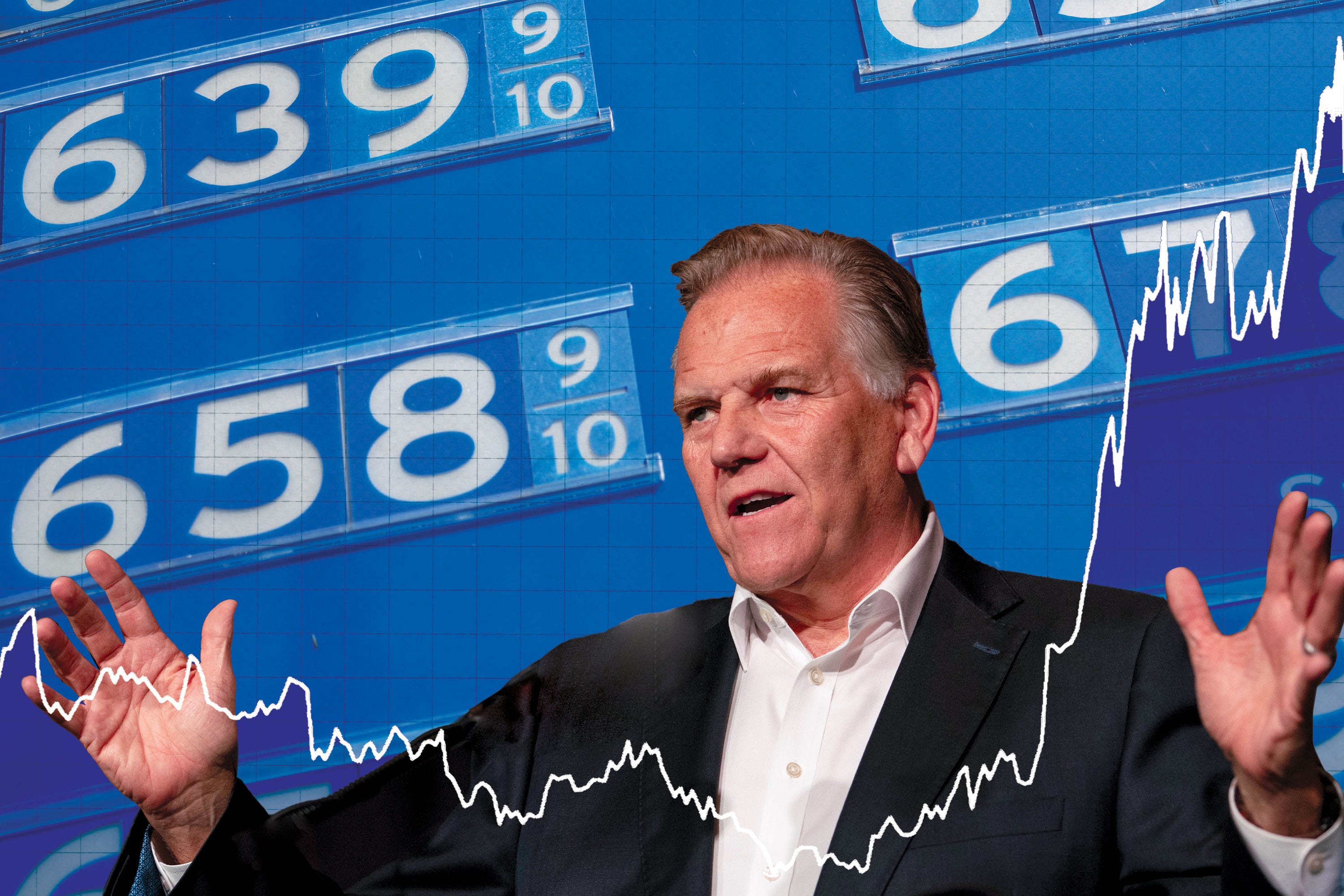
Rising gas prices often provide a convenient index for dissatisfaction with the current president, even if the increases have little to do with the administration’s policies.1 When a war breaks out in major oil- and gas-producing regions, prices go up. When gas prices rise, so do the anxieties of political candidates who belong to the party in power. And this year, that includes many Republicans whose campaigns are crucial to maintaining a GOP Senate majority.
At the onset of the Trump administration’s unilateral military action (war) against Iran, gas prices in the United States skyrocketed, which immediately spooked Republicans concerned with holding on to their Senate majority. In the two months since the opening of hostilities, prices have fluctuated in some states while continuing to climb in others, with those around the Great Lakes seeing particularly challenging increases.
“We’re gonna be fine, we got plenty of oil,” Mike Rogers, a Republican candidate for Senate in Michigan, said in March. “You’ll get your oil, because we’re going to pump our oil right here in America, and we got plenty.”
Six weeks later, though, GasBuddy’s Patrick De Haan reported gas prices leaping upward in several middle-American states. In Rogers’s Michigan, they went up 88 cents. In Ohio, they climbed 94 cents. In Wisconsin, 33 cents. And in Indiana, prices grew by a calamitous dollar and nine cents.2
On Thursday, Rogers addressed the issue once again. When Newsmax host Ed Henry asked the candidate, “Are you nervous . . . about these stubbornly high gas prices?” Rogers finally acknowledged the reality of higher costs at the pump:
Listen, high prices of anything hurt people in Michigan. . . . Iran is about stopping their nuclear program, stopping their ballistic missile program so they can’t hurt others. I think most Americans are there. We all want this to come to a quick end—I think including the president of the United States. The president’s also taking really direct actions to try to bring those prices down and I support those actions to bring those prices down. I’ll tell you this, Ed. I get around and talk to voters all around this state. The main thing about affordability is they do not trust Democrats.
Well, Rogers sure doesn’t trust Democrats on affordability, at least. That might be why he framed the situation so differently when gas prices surged to four dollars per gallon during the Joe Biden administration.
“I’m not sure we can survive $3.99 a gallon going forward,” Rogers said in a 2024 video campaigning against Democrat Elissa Slotkin. “Listen, the [Democratic] agenda moving forward on gas prices is only gonna make that worse. We must get America back on track.”
The national average price per gallon now sits at just under $4.50 per gallon, according to AAA. In Rogers’s Michigan, it’s over $4.80 per gallon.
Sen. John Cornyn, who is hanging by a thread in the Republican primary for his long-held Texas Senate seat, told me in March that on the subject of higher fuel prices, “we gotta compare that to the threat of a nuclear Iran.” Within that frame of reference, he seemed untroubled by his constituents’ pain at the pump: “I would say it’s a small price to pay to avoid a nuclear weapon in the hands of the number-one state sponsor of terrorism.”
However, Cornyn quickly acknowledged that Republicans aren’t doing a very good job of helping everyone else see things the way they do.
“I think we have to do a better job of explaining it,” he said. “But I think if the American people understood, they would certainly agree that a nuclear Iran is a terrible idea.”
In Ohio, where gas prices are hovering above $4.80 per gallon, Republican Sen. Jon Husted has been largely silent on the issue. His Democratic opponent, former Sen. Sherrod Brown, has been slamming him over his reticence.
“It’s clear this war is hurting people financially and in other ways. There’s no end in sight. [Republicans] have no idea how to end this war. They didn’t plan anything,” Brown said at a campaign event last week. “Husted hasn’t raised one voice against this war or any idea about how to end it.”
Another battleground-state Republican who has been avoiding the subject is Sen. Susan Collins (R-Maine). While Collins said in mid-March that she hoped the Iran war effort would be “both brief and successful,” her stock portfolio has benefited from the protracted engagement: It includes oil and natural gas investments that are booming thanks to the price increases. Collins owns stock in ConocoPhillips, which has grown substantially since late February, when Trump started the war.
The two House Republicans vying for a chance to face off against incumbent Sen. Jon Ossoff (D-Ga.) in Georgia’s Senate race have been vocal in their support of the Iran war while staying relatively quiet on the increased price of gas.
Rep. Mike Collins touted lowering gas prices two months ago, but since then has avoided the issue. Nevertheless, Collins supports the war effort.
Rep. Buddy Carter (R-Ga.) briefly addressed the high gas prices in a Fox Business interview on Friday, shifting blame toward Democrats and asking viewers to remember previous fluctuations.
“He’s made us more prosperous through the Working Families Tax Cut Act3 that has put more money in people’s pockets,” Carter said of Trump. “Now, yes, we’ve seen some gas-price fluctuation. Gas prices will go back down. Remember: High gas prices are the work of the Democrats. Remember 2022: five and six dollars a gallon. That was the Democratic leadership that led to those high gas prices. But gas prices are gonna come back down.”
Georgia residents can get gas for about a dollar cheaper per gallon than folks can around the Great Lakes. Average prices in the Peach State are sitting at $3.91 as of this morning.
In a party that demands complete loyalty to the president, members’ silence on a given issue is often a key indicator of stress. That very few have even attempted to discuss high gas prices suggests the matter is top of mind for them amid the midterm election cycle.
Small-dollar donors
In Florida’s 19th Congressional District, the Republican primary for the open House seat is attracting a very particular type of candidate: carpetbagging criminal ex-congressmen whose last names start with a “C.”
Former Reps. Chris Collins of New York and Madison Cawthorn of North Carolina have both relocated to DeSantisland in a bid to fill the vacancy left by Byron Donalds, who is campaigning for governor. Unfortunately for both candidates, there isn’t much enthusiasm for their campaigns: The primary donor to each campaign is the candidate himself, and by a massive margin.
Cawthorn donated $500,000 of his own money to his race in October. He’s also received smaller donations from a handful of other contributors, including right-wing influencer Robby Starbuck, bringing Cawthorn’s total donations up to almost $520,000. According to the FEC, Collins has not raised any outside funds at all, but he has given his own campaign more than $900,000, including an in-kind donation of approximately $8,000 worth of his autobiography, My Remarkable Life: The First Sitting Member of Congress to Endorse Donald J. Trump for President. Beyond Collins and Cawthorn, Sun Broadcasting President Jim Schwartzel—who is actually from Florida and does not have a criminal record—is also dealing himself into the race: He donated over a million dollars to his own 19th-district campaign last year.
As mentioned in the subtitle of his book, Collins famously endorsed Donald Trump in 2016 before any other elected federal official. He was later sent to prison for insider trading before catching a pardon from Trump, who has shown similar beneficence to many other criminal members of Congress. Cawthorn pleaded guilty to attempting to bring a handgun through airport security. He did not receive prison time as part of his sentence, and Trump has not indicated that he intends to pardon him again.
Collins’s and Cawthorn’s fundraising totals seem even weaker when set alongside the donations pile of Catalina Lauf, who served as a Commerce Department adviser during Trump’s first term. Lauf has raised more than $900,000 from a diverse pool of large- and small-dollar donors, which is more in line with traditional campaign behavior.
There isn’t polling on how either of the criminal carpetbaggers are expected to perform in the state’s August primary, but both campaigns have paid for internal polling services. The 19th district remains largely unchanged following Gov. Ron DeSantis’s signing of Florida’s new congressional map, so we’ll get to see how all the candidates ride this one out. How wonderful for all of us.
The many-faced god
My Bulwark colleague Jared Poland ventured to D.C.’s hottest club (the U.S. Capitol Building) to ask members of Congress how they felt about Trump putting his face on U.S. passports to “celebrate” America’s 250th birthday, along with the follow-up question of what the president should add his mug (shot) to next.
Give the video a watch, and please let us know in the comments if you have ideas for further TMZ-style questions we can pose to lawmakers.
On the American side of things, it’s quite clearly Trump’s fault. He took military action that directly resulted in price increases. He has also haphazardly continued the campaign, including by blockading the Strait of Hormuz, which has pushed prices up even further.
If you hear a politician refer to the “Working Families Tax Cut Act,” be assured that they’re trying to pull one over on you. The law in question is actually called the “One Big Beautiful Bill Act,” but Republican leaders in the House and Senate decided to rebrand it after some poor reception and confusion about the tax-cut package they allowed Trump to name.
Welcome back and congratulations to you and your wife!
"Oil of oy vey"
Absolutely fantastic. No notes.