


ICE agents are heading to airports today, with President Trump deploying them in an apparent effort to reinforce TSA agents working without pay due to the government shutdown. Trump seems dead-set on keeping those agents working without pay rather than agreeing to Democrats’ demands that he put new civil-liberties checks on ICE—obliging them to wear badges and uniforms and ditch the masks and broad enforcement sweeps. We can’t imagine how putting untrained ICE agents in a series of stressful encounters with on-edge air travelers could backfire for Trump at all. Happy Monday.
The Least Worst Option
by William Kristol
Early this morning, with about twelve hours left in his 48-hour ultimatum threatening Iran’s civilian power plants, President Trump announced:
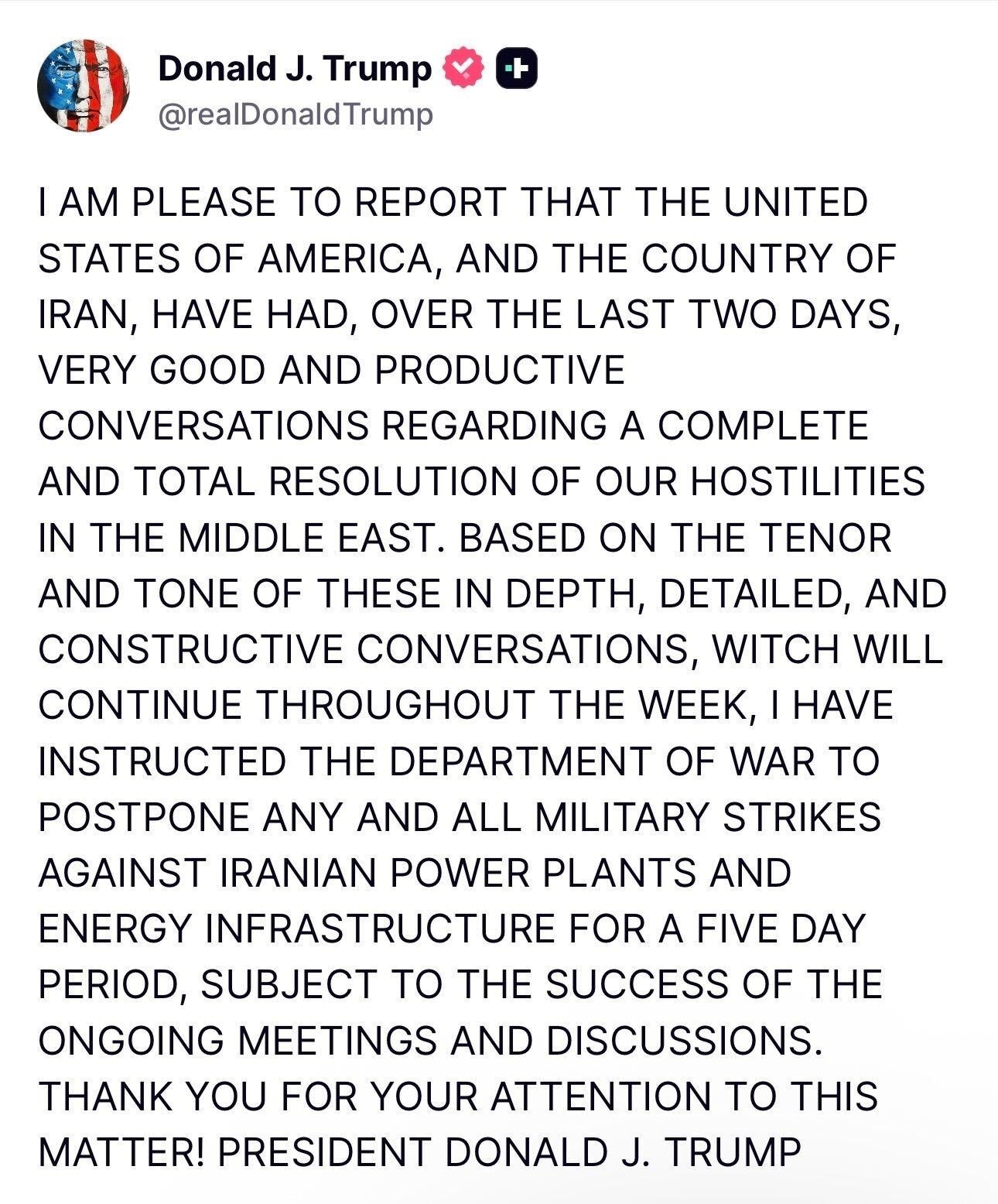
Some may cry, “TACO!” And they’d be right. But just over three weeks into his ill-advised and incompetently managed war, Trump had reached a fork in the road from which neither path led to a happy place. He’s chosen the less bad option—for now.
The other, disastrous path would have been escalation. Trump seemed to be heading down that road Saturday afternoon, when he threatened to bomb Iran’s civilian power plants:
If Iran doesn’t FULLY OPEN, WITHOUT THREAT, the Strait of Hormuz, within 48 HOURS from this exact point in time, the United States of America will hit and obliterate their various POWER PLANTS, STARTING WITH THE BIGGEST ONE FIRST!
And he echoed this threat just yesterday, during a phone interview with Israel’s Channel 13: “You’ll find out what’s gonna happen. You’re gonna find out soon. It’s gonna be very good. Total decimation of Iran.”
Though Trump has now delayed this decision for another five days, it’s worth pondering what would have happened (and what could still happen) if he’d chosen escalation.
One assumes that the United States military would have refused to obey orders to commit a war crime like attempting the “total decimation” of a country.
But even if the military had gone ahead with some version of striking Iran’s civilian power plants, Iran would surely have responded by attacking similar targets in the Gulf, which they’ve shown they retain the capacity to do. The war would have widened and its economic effects would have worsened. And then we would have been faced with the possible introduction of ground troops to secure the Strait—which would have invited an extended conflict and an even more severe economic crisis.
But notice beneath Trump’s bluster what he was demanding: Simply reopening the Strait of Hormuz. Trump’s central war aim is now just to fix the situation that his “excursion” caused.
Presumably the end-point of the negotiations between the Trump administration and the Iranian regime will look something like this: A stop to the attacks on Iran in exchange for a return to the status quo ante bellum; i.e., how things were before Trump launched this war in the face of no imminent threat and with no authorization from Congress.
As for Trump’s other objectives, they’ve of course been kaleidoscopic. But the most recent time he’s laid them out in a semi-coherent way was in a post late Friday afternoon:
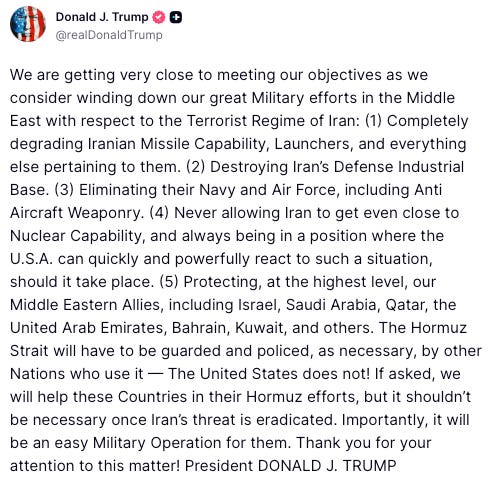
This list of objectives omits some of his previous goals, like overthrowing the Iranian regime, or at least its “unconditional surrender.” Friday’s post also watered down other stated goals, such as putting a nuclear weapon permanently out of Iran’s reach. In the negotiations before the war, the Trump administration had demanded that Iran ship all of its nuclear material out of the country. Now all Trump asks is merely “Never allowing Iran to get even close to Nuclear Capability, and always being in a position where the U.S.A. can quickly and powerfully react to such a situation.” Trump’s announcement this morning seems to confirm a contraction of his war aims.
In fact, as of now, it appears, we are left with just one real remaining goal: reopening the strait.
The question is whether the Iranian regime will do that in return for a cessation of our attacks. I suspect they might, because the pummeling has been severe, and they can’t be certain Trump’s threats to escalate are entirely empty talk. But even if Iran won’t agree to a deal now, Trump has the option of just claiming success and proclaiming a ceasefire. He can count on there being a ton of international pressure on Iran to then reopen the strait soon. It will be in their interest to do so, and Trump will claim victory whenever it happens.
Trump seems, for now at least, to have blinked. This outcome—which I hasten to add, may only be temporary—is still of course an indictment of his unjustified, reckless, and damaging war. But it’s the better path for the nation and the world. So all I have to say to the president is, “Keep on blinking.”
What are the odds Trump reverses himself again? How seriously should we (and Iran) take his threats? Share your thoughts in the comments.
It’s a Mad, Mad Madman Theory
by Andrew Egger
Donald Trump’s impulsiveness, his erratic tendencies, his chest-thumping macho posturing, his hyper-fixation on random secondary objectives, his questionable object permanence—all the traits that he’s put so thoroughly on display during the Iran conflict were evident during his first-term foreign policy, as well. Back then, Republicans desperate to find a silver lining hatched a theory of Trump: Perhaps he was simply a madman diplomat in the school of Richard Nixon, deliberately cultivating a volatile, irrational image to wrongfoot our adversaries. Don’t cross him—he might just be crazy enough to do it!
There were always several problems with this. For one thing, it’s never been clear that the madman theory ends up working out well for anybody. But just as importantly, Trump—for all his lunatic swerves—has never actually been able to effectively hide his own motivations, which usually turn out to be childishly simple. All the tantrums in the world haven’t obscured the fact that he tends to be ludicrously easy to predict.
It is for this reason that Iran appears not to have taken Trump’s threats to target their domestic power generation very seriously. Taken on their merits, these threats were astonishing: a 48-hour deadline for Iran to surrender its primary point of geopolitical leverage, or suffer widespread strikes against civilian infrastructure. But while such strikes would have been catastrophic for Iran, they would have been terrible for America, too, sending the price of oil spiraling into the stratosphere for God knows how long and even further alienating our allies, who still take things like the laws of war seriously. Iran immediately called Trump’s bluff, pledging to close the strait indefinitely and to carry out further strikes on its neighbors’ gas and oil production should Trump target its energy infrastructure.
How thin did Trump’s bluff turn out to be? The president didn’t even wait until his 48-hour deadline was expiring to call it off. He blinked with twelve hours to spare—ensuring that the entire threat period took place while markets were closed over the weekend. Trump insisted this was because of “good and productive conversations” with Iran over the weekend; Iran, meanwhile, bluntly denied any conversations whatsoever had taken place.1
All the madman posturing in the world can’t change this simple fact: Iran knows how badly Trump needs to get the oil-price situation under control. Again and again, Trump has signaled he will let other foreign-policy objectives fall by the wayside to address this major domestic concern. It was just last week that the administration, reversing decades of U.S. foreign policy, announced it was lifting sanctions on Iranian oil. It said, right out loud, that it was willing to let Iran sell at a premium on an oil-starved market—that it would essentially bless Iran’s economic monopoly on travel through the Strait of Hormuz—rather than risk further spikes in oil prices. The idea that Trump would turn around days later and cripple Iran’s oil production by shutting off its energy system never passed the laugh test.
Madman theory never really works. But what we’ve got now is a president who gives us all of the obvious drawbacks and none of the purported benefits—who shakes the global economy around like a rag doll yet whose economic bluffs remain easy for our adversaries to predict.
AROUND THE BULWARK
GOP Grows More Unpopular, More Desperate… Feeling cornered, Republicans are willing to try anything but shift to policies Americans want, argues JILL LAWRENCE.
MAGA’s Mueller Myths… CATHY YOUNG on the 7 lies that the Trumpists are still clinging to.
DOGE Dumbed Down the Nation…On the Mona Charen Show, Brookings scholar JESSICA RIEDL analyzes the DOGE debacle and the failure of Americans to make grown up choices about spending and taxes.
Trump Celebrates Robert Mueller’s Death…. TIM MILLER joins BILL KRISTOL on The Bulwark on Sunday to break down Robert Mueller’s life and legacy, and Trump’s grotesque attack after Mueller’s passing at 81.
Iran and the Roots of Islamist Terror… On Shield of the Republic, ERIC EDELMAN and ELIOT COHEN are joined by JASON BURKE to discuss the Iran war’s strategic ripple effects and the evolution of modern Islamist terrorism.
MAGA Isn’t a Majority—So Why Is It Winning? Why do small factions end up with outsized power in American politics? JOHN AVLON talks with DAN CANTOR about how the two-party system distorts representation—and how fusion voting could break the gridlock.
Quick Hits
TRUMP SAYS NO DEAL: The Department of Homeland Security shutdown situation is getting messier, with TSA agents going without pay and airport-security lines going on without end. But Democrats are sticking to their guns, insisting that while they’re happy to pass a bill funding non-ICE parts of DHS, they won’t fund the whole thing until Republicans agree to their demands about ICE enforcement, including banning masks and requiring agents to wear uniforms, badges, and body cameras.
Yesterday, Punchbowl News reports, Senate Majority Leader John Thune approached Trump with a proposal that might pick the shutdown lock. Republicans would agree to fund all of DHS without ICE, solving the shutdown problem. Then, they would figure out how to include ICE funding in a party-line reconciliation bill, much as they did when they expanded ICE’s budget in the One Big Beautiful Bill last year. Not only would it reopen the government, Thune argued, it would do so without having to give any of the concessions Democrats were demanding.
But Trump, Punchbowl reports, said no:
The president wants Republicans to stay in D.C. and keep fighting with Democrats over DHS funding and the SAVE America Act, the GOP’s voter ID and proof-of-citizenship bill.
Not only that, Trump warned that he’d publicly slam Senate Republicans if they left town for the upcoming recess. Trump also said he’d invite all the GOP senators and their families for Easter dinner at the White House. Some Republicans took that as a threat, not a reward.
In a Sunday night Truth Social post, Trump made clear his position: “I don’t think we should make any deal with the Crazy, Country Destroying, Radical Left Democrats unless, and until, they Vote with Republicans to pass ‘THE SAVE AMERICA ACT.’”
It’s not that unusual to see the minority party threatening to keep the government shut down to demand policy concessions from the majority, as we’ve seen during this ICE-funding fight. It’s far stranger to see what Trump is doing now: threatening to keep his own government shut down until the minority consents to help him pass his top piece of partisan legislation this year. What a time to be alive.
ROBERT MUELLER, RIP: Robert Mueller—the former FBI director who became a household name and an unwilling #Resistance icon for his role as the special counsel who ran the Russiagate probe during Trump’s first term—died Friday night after a yearslong battle with Parkinson’s disease. He was 81.
We could dwell on the president’s hideous reaction to the news, or on the now-standard cowardly response to Trump’s comments from congressional Republicans. Instead, let’s sweep these small, bitter men to the side for a moment and dwell on Mueller himself, courtesy of a weekend dispatch from one of the foremost authorities on his work, the journalist Garrett Graff:
By the early 1990s and the end of the George H.W. Bush administration, Mueller had risen to the top ranks of the Justice Department—assistant attorney general for the criminal division, overseeing all of the nation’s federal criminal prosecutions. It’s normally a terminal career role—the type of role that people then cash in and refer to for the rest of their careers. Mueller, indeed, did that for a brief moment—but he hated the private sector. (Instead of offering to defend one wrongdoer, Mueller said the defendant, then in jail, was “right where he belongs.”) After a while, Mueller called Eric Holder, then the US attorney for Washington, D.C., and asked to come back as a homicide prosecutor—it was the rough equivalent of a three-star general retiring and then asking to re-enlist as a first lieutenant. . . .
By stepping back into not just prosecuting, but specifically prosecuting homicides in Washington, D.C., Mueller was signing up for the biggest challenge—and highest service—he could find.
Over the course of the 1990s, he rose through the ranks of DOJ all over again, taking over the troubled U.S. attorney’s office in San Francisco and then, becoming acting deputy attorney general in the first months of the George W. Bush administration. He had a uniquely strong code of personal honor and integrity, one deeply inspired by his father. . . . Bob Mueller might have been the last person in the US government that both parties agreed upon and respected beyond reproach.
There’s so, so much more there; read the whole thing.
Cheap Shots

Can they both be lying?
So, if you follow the markets, today was looking bleak. Around 6 am - 6:30 am we were looking at some significant losses as the markets freaked out over the possibility of Trump instructing the military to start doing war crimes and the conflict escalating. Oil futures up. Lots of F.U.D. (fear, uncertainty, doubt) which is not good for Wall Street.
Then between 7 am - 7:30 am, Trump "TACO'd," and the markets flipped in the opposite direction. Oil futures fell. The DOW jumped +800 points (+1.8%) at open at 9:30 am, other indexes similar (S&P500 +1.4%, NASDAQ+1.6% at opening bell at 9:30 am).
Meanwhile, the Iranians are denying that talks are even happening, let alone confirming Trump's bleats from before the markets opened.
And his deadline? Well, let's see, 5 days after Monday would be... the weekend! After markets close! Don't forget he started this whole cockamamy war late in the night Friday / early AM Saturday.
So, it's the same sort of market manipulation he's always been doing. He's punting. He's hoping he can jawbone oil futures downwards and the stock market upwards while he stalls. My guess is if the strait isn't opened by the close of markets Friday (4:00 PM) then we will see an escalation over the weekend with regards to bombs and explosions and the Marines, and then an early Monday AM bleat again about how much progress Trump is making negotiating.
I know it's self-destructive, and not kind to the whole world who it will affect, but I really want one of these TACO manoeuvres to backfire on him. He thinks he can just speak a lie into reality and I want him to fail spectacularly and it really to hurt him.