

Dems Aren’t Buying Reports of Alito Staying Put
How the left is preparing for a midterm-year Trump SCOTUS vacancy—or even two.

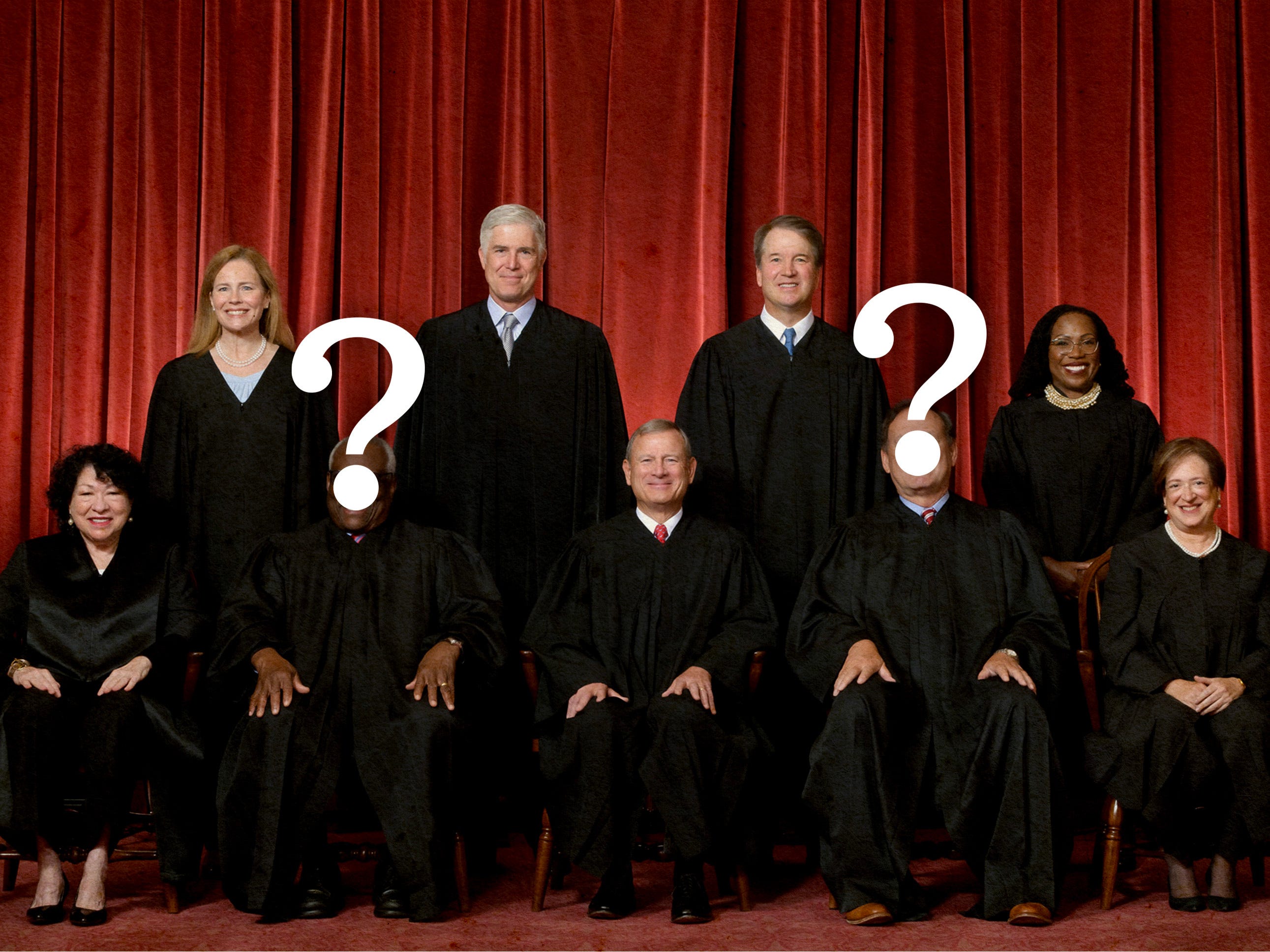
ONE OF THE MAJOR OPEN QUESTIONS that could jolt this year’s midterms—a known unknown—is whether Donald Trump will get a chance to nominate another Supreme Court justice before Election Day. Will 76-year-old Justice Samuel Alito retire? What about 77-year-old Justice Clarence Thomas? Or both?
On Friday night, CBS News’s Jan Crawford, a journalist well connected in conservative legal circles, reported that neither of the Court’s two oldest members would step down “this year”—that timeframe being significant as it would extend to after the election and assuredly into the next Congress. Fox News followed up with a similar report. Yet both men are under pressure from Republicans to vacate their posts before the possibility arises that control of the Senate changes hands. And Democrats, for their part, are treating the reports as smokescreens, choosing instead to plow forward with a major campaign for the likelihood that a vacancy (or two) will emerge before November.
That campaign is being led by Demand Justice, a liberal judicial advocacy group. The group plans to spend an initial $3 million on framing a pending Supreme Court nomination battle in the public mind, and another $15 million if and when a justice retires. Its executive director, Josh Orton, told me the reporting of Alito and Thomas sticking around for another term was a case of the justices simply wanting “to look like they’re in control of their own destiny. Ultimately, he said, “if Trump wants them off, they’re off.”1
Even before this weekend’s reporting, the possibility of a Supreme Court confirmation fight has been the subject of rampant chatter among the Washington political class. A retirement—whether truly voluntary or forced by Trump—would not just reshape the contours of the midterm elections, it would give the president the chance to have the most enduring stamp on the judiciary of anyone to hold the office in nearly a century.
“This could be unlike any other Supreme Court nomination fight in modern times, in that the first question will be: Is this person loyal to the truth or loyal to Donald Trump?,” said Orton. “In the coming months, we have this opportunity to call the question on whether or not we will continue to allow Trump to attack and undermine our democratic institutions.”
Orton said Demand Justice plans to run TV and digital ads, although the timing and content are to be determined: The group will conduct polls and focus groups in battleground states in the coming weeks with the goal of finalizing messaging that resonates with not just their base voters, but independents and Republicans. Orton said he intentionally brought together a team of operatives across the left’s ideological spectrum out of a desire for the campaign to appeal to the broadest possible range of voters. Demand Justice’s leaders have also been meeting with Democratic Senate candidates to work on consistency in messaging.
“For all the reasons that you see Senate battleground candidates talk about needing to rein in [Trump’s] authoritarian excesses, how he’s much more willing to serve the billionaire and the corporate class than average working people—the reason that him appointing a crony creates this opportunity is because, almost by definition, that person will not be a reliable vote on the Court for everyday people,” said Orton.
DEMOCRATS HAVE HISTORICALLY been outmatched by Republicans when it comes to waging federal judicial fights. That’s in part because the right has unified around originalism, while the left lacks a similar intellectual framework to rally its donors, advocacy groups, and think tanks. Well-funded conservative groups like the Judicial Crisis Network and the Federalist Society have spent decades working to tilt the courts to the right, while liberals have struggled to come up with a long-term game plan, both for confirmation fights and around landmark decisions, including the overturning of Roe v. Wade.
Demand Justice was founded in 2018 for this precise purpose. Its success has been mixed. In the aftermath of the group’s founding, Trump got two nominees—Brett Kavanaugh and Amy Coney Barrett—confirmed to the high court. But each of those fights was bruising and it’s fair to say that Democrats have a heightened appreciation for the stakes in confirmation battles and the resources needed to fight them in Washington and the states.
A battle this year over a fourth Trump-nominated Supreme Court justice (Neil Gorsuch was confirmed in 2017) would likely be another intense political clash. But the outcome would likely prove the same as the first three: with success for the president.
That’s because without control of the Senate, Democrats have limited tools to stop a Trump nominee from getting confirmed. Party leaders whom I spoke with were clear-eyed about the fact that it’s unlikely that four Senate Republicans would break with Trump—although some said not to rule out possible defections from GOP Sens. Susan Collins (Maine), Lisa Murkowski (Alaska), or Thom Tillis (N.C.).

The gang returns to California for two live shows in May. Join Sarah, Tim, and Sam in San Diego on May 20 or in L.A. on May 21 for a night of politics and laughs, and a community built on good faith. Bulwark Live: California is sure to sell out—don’t delay.
But even Orton acknowledged that blocking a nominee might not be achievable. Rather, the aim of Demand Justice’s campaign is to make a confirmation vote as politically painful as possible—ultimately damaging vulnerable Senate Republicans who are up for re-election, making Trump look weak in the process, and doing something past confirmation fights have not: motivate Democratic voters more than Republicans.
“You need to make the fight as painful for the regime as possible so that the Susan Collins of the world face a steeper climb to stay in the Senate if they go along with it,” said Ezra Levin, a co-executive director of the liberal grassroots group Indivisible, which is working with Demand Justice on the project. “It’s a good fight for policy grounds and it’s a good fight for political grounds. You don’t need to start at the outset knowing ‘Here are the five senators who are going to join us from the Republican side.’ You’re not going to find those senators unless you engage in the fight. And whether you find those senators or not, you set yourself up better for November.”
DESPITE FRIDAY’S REPORT to the contrary, a vacancy could still pop up this year. While Alito and Thomas, as mere mid-septuagenarians, are slightly on the young side to be stepping down,2 they have both had health scares in the past few years: Alito was taken to a hospital last month after falling ill during a Federalist Society dinner, and Thomas was hospitalized for a week in March 2022 for “flu-like symptoms.” Plus, Alito has a book scheduled to come out on October 6, one day after the new Supreme Court term starts, timing that contributed to widespread speculation about his pending retirement.
Should either retire, Republican leaders on Capitol Hill have signaled that they’re ready to move quickly. Last week, Majority Leader John Thune said that the Senate would be “prepared to confirm” if a retirement arises, and President Trump said in an interview with Fox Business that he had a short list of possible replacements ready to go. Trump pointed to Justice Ruth Bader Ginsburg’s death in office as a cautionary tale.
Democrats, for their part, have become increasingly convinced that the conservative justices won’t stick around and risk dying on the bench, especially as the Democratic party’s chances of retaking the Senate continue to improve—along with the prospect of a Dem winning the White House in 2028.
“It would fit the pattern that we’ve seen previously under President Trump, where they jammed through a last-minute Supreme Court nomination,” Sen. Chris Coons (D-Del.) said in a recent interview with The Bulwark, estimating a 70 percent chance that a justice would retire before the midterms. “I also bluntly think Trump’s going to need something else to distract from Epstein now that the first lady has marched out to a podium and demanded public hearings from Epstein victims and saying ‘I’m not an Epstein victim.’”
As of now, Democrats see a Supreme Court fight having the most impact in Senate races in Alaska, Maine, Ohio, North Carolina, and potentially Texas and Iowa. But it’s still unclear just how much voters would punish Republicans for confirming a justice, should the opportunity arise. After Collins voted to confirm Kavanaugh in 2018 following allegations of sexual assault, Democrats were certain that she’d lose her 2020 re-election. Instead, she cruised to a comfortable 8.6 percent victory.
But Anna Greenberg, a Democratic pollster working with Demand Justice on the project, said that the politics of the Supreme Court have shifted since then. Greenberg argued that the 2022 Dobbs decision made voters more aware of the Court’s impact on their everyday lives and primed people to pay more attention to a nomination fight. And while some Democrats emerged from the 2024 election believing that it was a mistake to center an election message on the need to protect the Constitution and democratic institutions, Greenberg said that voters are much more receptive to those messages now that they’re living through Trump’s second term.
“The reality of Trump being in power makes the democracy issue quite different,” said Greenberg. “The words everyone always uses in the swing [focus] groups is ‘Too far; he’s going too far.’”
My open tabs:
— California’s Blue Armageddon
— The Seaside Town Trying to Reclaim Its Title as ‘Submarine Capital of the World’
— All Powerful or Cursed: The Ambitious House Class of 2012
Orton said he thinks that the justices will on their own come to the decision that it’s time to step down; he argues that both of them are deeply ideological and won’t want to risk giving Democrats a chance to add a liberal to the bench. But if they don’t, Orton predicted Trump would act both privately and publicly to ramp up pressure on them to retire—which would only further expose the president’s lack of respect for judicial norms.
Democrats have to play unapologetic hardball with this.
If either one steps down, they have to delay, delay, delay to scuttle a Trump nominee until after they (hopefully) take the Senate and can truly drive a sensible replacement. Not Ted Cruz, not Mike Lee. A truly vetted constitutional purist. And if they don't get exactly what they want, then they increase the size of the court and stack it high with liberal transgender, visible minorities.
What McConnell did to block Garland and ram Coney Barrett through were two of the most cynical, calculated end-arounds in US political history. It needs to be returned.
It is going to be this country‘s great misfortune and Trump‘s golden luck, if he gets to appoint 5. SCOTUS members. That would be grounds to expand the court.