Dems Huffing the Hopium
“It’s crystal clear that voters are fed up with Republican rule and ready to kick them to the curb.”

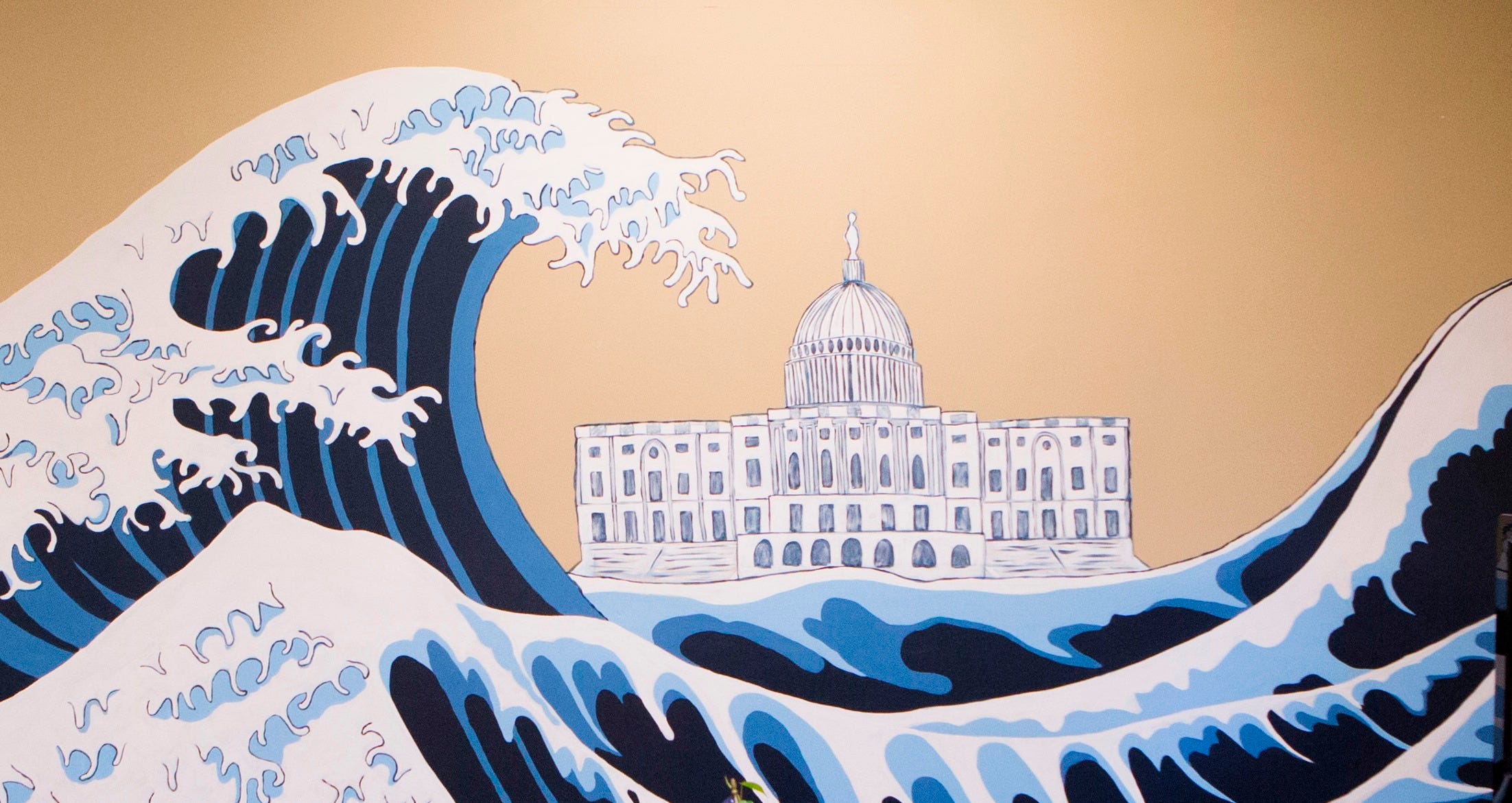
FOR A PARTY PERPETUALLY anticipating doom and engaging in acts of self-destruction, Democrats have, in recent weeks, grown shockingly optimistic about the state of the midterms.
It’s not just that the party expects to win back control of the House or even make a serious play for the Senate. No, no. Those are the aspirations of the mere mid-tier dreamers. The chatter among the party bulls these days is of flipping states once thought entirely out of reach; of unseating GOP incumbents once thought untouchable; of election waves that rival some of the most memorable in recent history.
“Democrats were always viewed as having a good shot at taking the House this cycle. But I think a lot of folks thought it would be a modest gain,” said Zac McCrary, a Democratic pollster. “Instead of being 15 or 20, maybe it’s 35 or 40 in terms of the actual seats that are in play here. I think the margin could be a lot bigger than we would have thought.”
As for the Senate? “Six months ago, you really had to squint to see how Democrats could take the majority,” said McCrary. “Now, I think it’s a very straightforward path—and a very plausible and realistic path that Democrats can get to 51 or 52 [seats]. And maybe there’s even an upper end of that as well.”
Some context may be helpful here. McCrary is hardly the type of operative to offer an overly optimistic outlook just to be a good party cheerleader; he lives in a deep-red district in Alabama and knows the danger of Democrats getting their hopes up on races they have no chance of winning. Not so long ago he was telling me that the Senate was almost certainly out of reach. But he’s among a growing number of Democrats who are allowing themselves to get buzzed on a little bit of electoral hopium.
And, frankly, why not? There are plenty of signs that Americans aren’t feeling great about the direction of the country. Despite a stronger than expected March jobs report, consumer sentiment is declining. Young people are stressed about job opportunities. Families are wondering how they’re going to tighten their budgets to pay for rising gas prices. And Americans are deeply worried about finding affordable health care. Not to mention the unnerving prospect of getting bogged down in yet another conflict in the Middle East.
As my Bulwark colleague Catherine Rampell noted last week, it’s not difficult for Democrats to tie these anxieties to President Donald Trump’s policy decisions—from his war of choice in Iran to his Medicaid cuts to his tariffs.
“If you were trying to actively shipwreck the Republican party in 2026, candidly, I don’t know what he’d been doing differently,” said Ian Russell, a Democratic strategist who served as the political director of the Democratic Congressional Campaign Committee in 2014 and 2016.
In my conversations with Democratic officials, there was a general consensus that the party’s strength in the midterms was being underestimated and that the ceiling is much higher than they thought even just a few weeks ago.
“This cycle very well might be more like a 1974 post-Watergate cycle, where voters are saying ‘burn the ships,’” said David Jolly, a former Republican congressman who switched parties and is now running as a Democrat for governor of Florida.
Jolly certainly needs to pray for a ’74-like climate—in which Democrats gained 48 House seats in the midterms—owing to Florida’s dramatic rightward tilt over the past few cycles. But even if he doesn’t win his statewide race, there are real possibilities that fellow Democrats will make inroads elsewhere in the state. Already, the party has seen major gains.
On the congressional level, Democrats need to flip 4 seats to retake the Senate; Minority Leader Chuck Schumer has said he views North Carolina, Maine, Ohio, and Alaska as the most winnable. In the House, the party needs a net of just 3 seats and the Democratic Campaign Congressional Committee has identified 44 districts it believes are in play this year.
Those are relatively straightforward propositions. But lately Democrats have been asking themselves whether they should be thinking bigger—and acting more boldly.
“When there’s a wave, odd things can happen. Long shots can become competitive,” said Simon Rosenberg, perhaps the party’s most rosy-eyed operative. “A month ago, we would have said the Senate is competitive, and the Democrats had a shot. But we now have Democrats ahead in states that get us to 51 [seats],” he said, alluding to several recent polls, “and that’s without Iowa and Texas.”
Although most Democrats I spoke with last week still acknowledged that it would be incredibly difficult for the party to get beyond 52 seats in the Senate, no one said it was impossible. While Schumer seemed hesitant just a few weeks ago to spend money in Texas or Iowa, the strategists I spoke with said they expected that to change. Some also mentioned that Senate races in Nebraska, Kansas, Montana, and Mississippi could get more attention from Democrats, particularly if the Iran war drags on, the economy continues to sputter, and Trump’s approval rating continues to crater. Operatives also said they expected the DCCC to add more seats to its target list, particularly in rural districts where it’s relatively inexpensive to advertise.
“From Pennsylvania to Iowa, Texas, and heck, even in Trump’s backyard, it’s crystal clear that voters are fed up with Republican rule and ready to kick them to the curb,” said DCCC spokesperson Viet Shelton. “2026 is shaping up to be a lot like 2006 and 2018 when voters repudiated Republicans in favor of Democrats, and our map of offensive opportunities across the country reflects this on-the-ground reality.”
In a recent focus group of swing voters conducted by The Bulwark, many expressed concern about the state of the country. Few believed that going to war with Iran was in America’s best interest; several worried that the country was too politically divided. The strength of the economy was a widespread concern for nearly all the participants. Some even said they preferred the Biden years over how Trump’s second term was going, which is especially remarkable considering how unpopular Biden became (at his lowest point, his approval rating matched Trump’s today) and how sour voters were over Biden’s job performance on economic issues.
“The economy is going down. Gas prices are super high. . . . Food is expensive, of course. I just think the economy is on a downward spiral right now,” said one focus group participant, a Pennsylvania voter who backed Biden in 2020 and Trump in 2024. “Even my husband right now, like, it’s really hard to find a job. So I have a lot of people I know who have bachelor’s [degrees] who have been working [in] retail for the past couple years.”
SO WHAT COULD DEFLECT A BLUE WAVE? A few things. Trump could try to interfere with the election in a way that gives his party a boost. Or he could get a bump in approval should he bring a quicker end to the war. And then there is the matter of cash.
Nearly every Democrat I talked with mentioned that the party was still having trouble raising money. Few people thought that Democrats could realistically catch up to the GOP’s war chest, even if their donors grow more optimistic and thus more willing to open up their pocketbooks. Trump, meanwhile, is sitting on a pile of cash in his political action committee. And Elon Musk could spend seemingly unlimited money to keep Republicans in control.
If they do, it will surely be spent on ads reminding voters why they still don’t trust Democrats all that much—even in this moment of backlash directed at the president. That, for sure, would take some of the hopium out of the balloon. Though even those Democrats inclined to be nervous believe such an anti-Dem ad blitz might matter more in the next presidential election than in a cycle like this.
“Voters are still not that into us, but this is going to be—at least, based on all the available evidence—a massive, massive refutation of Trump and a rejection of Trumpism. That is not the same thing as an embrace of Democrats,” said Russell. “Heading into 2028, we need to have a real lengthy conversation inside the party about what will work going forward, and resist our urge to constantly fight the last battle.”
🫏 Donkey Business:
— ActBlue, the Democratic donation platform, is in turmoil after news broke that its then-lawyers warned it in 2025 that its chief executive might have misled Congress about steps the organization was taking to make sure that it wasn’t processing donations from foreign citizens. According to the New York Times, the law firm Covington & Burling warned ActBlue that it didn’t always follow the safeguards that Regina Wallace-Jones, the group’s CEO and president, had described to congressional investigators. “Within weeks” of the law firm telling the organization that it could be vulnerable to criminal investigation, “ActBlue and Covington parted ways.”
“ActBlue is now all but declaring war on its own past lawyers, an extraordinary turn of events at a moment when President Trump has already ordered a Justice Department investigation into the organization. Democrats are nervous that any additional upheaval at ActBlue could destabilize the party’s critical fund-raising apparatus ahead of the midterm elections,” the Times reports.
— In a New York Times opinion piece last week, Sen. Mark Warner (D-Va.), the top Democrat on the Senate Intelligence Committee, wrote that since Russian President Vladimir Putin attempted to sway the 2016 presidential election, there has understandably been a lot of focus on protecting future elections from foreign meddling. But “foreign interference is no longer the most pressing danger to our elections,” he warned. “It is increasingly evident that the greatest threat now comes from inside our own government.”
Warner noted that Trump has called for the federal government to “take over” elections and pointed to recent reporting from the Washington Post about a draft executive order that has been circulating among Trump’s allies that would declare a national emergency based on fabricated claims of foreign interference as a way to grant the president enormous control over elections.
My open tabs:
— The Women Who Believe That Women Should Lose the Right to Vote
— Judge Jeanine’s Big Audition
— Running for Congress at 30,000 Feet: A Flight Attendant’s Campaign Trail
God willing the Dems retake the Senate. The one mistake they cannot and must not make is electing Chuck Schumer the majority leader again. No one has missed the moment more than that clown. This man cannot be allowed to even sniff any sort of leadership position. If for some god forsaken reason he becomes the Senate leader again it would kill any victory in its infancy.
Schumer and Jeffries will snatch defeat out of the jaws of victory.