Discouraged? Yes. Despairing? No.
Charlie Kirk’s killing and the degradation of the rule of law raise difficult questions about our future. But they don’t foreclose a positive one.


Sorry about the false start yesterday: JVL’s Substack talk with Heather Cox Richardson had to be postponed due to some unfortunately timed outages on the Substack app. They’ll be going live tomorrow at 3 p.m. EDT instead. Watch for more details in The Triad today. Happy Tuesday.
Failure Is a Possibility
by William Kristol
As I waded this morning through the torrent of disheartening news washing over us, a remark of Mary Ellen O’Connell, a University of Notre Dame professor of international law, struck me. O’Connell told the New York Times that the new killing by U.S. armed forces of alleged drug smugglers at sea “appears as problematic as the first,” which certainly seems to be the case. Then O’Connell made this observation: “International lawyers uniformly found his first such attack on Sept. 2 unlawful. All of the criticism and warning of blowback has had no impact. People are dead again in killings that violate the law.”
The line kept coming back to me: “All of the criticism and warning of blowback has had no impact.”
It’s chilling. And for now, as well, it certainly seems to be true.
One would like to think that criticisms and warnings—if the criticisms are well-grounded and the warnings justified—might have some impact in a nation that, as Federalist No. 1 put it, is intended to vindicate the proposition that “societies of men are really capable . . . of establishing good government from reflection and choice” rather than being “forever destined to depend for their political constitutions on accident and force.”
But as the Founders understood—as we should understand today—“government from reflection and choice” is difficult both to establish and to maintain. So far, we’ve had a pretty decent track record in this endeavor. One might even call it an exceptional track record.
But all good things come to an end. Perhaps this generation of Americans will turn out not to have been very good at resisting an authoritarian movement. Perhaps this generation won’t be moved by criticisms and warnings. After all, many other nations haven’t been.
Failure is a possibility. And it’s pretty difficult to read the news, and to reflect on where things seem to be going, and not to wonder if that possibility isn’t approaching a probability. Certainly I felt that way as I continued my morning labors, making my way through the rest of the news: The vice president of the United States threatening opponents of the Trump administration; the attorney general of the United States assaulting the right of free speech; and leading Democrats squabbling about what to say about their nominee for mayor of New York, and about what to do about a possible government shutdown only two weeks away.
But politics, like life, is full of twists and turns. Just as a healthy confidence in our national well-being can become an unhealthy complacency, so can understandable discouragement about our situation turn into unwarranted despair.
There are levers of resistance, from state governments to the private sector, from elite organizations to popular mobilization. There are models of resistance to injustice and authoritarianism in our own history, of course, and abroad—in Ukraine today for example. The authoritarians have vulnerabilities, even if they work diligently to hide them.
Since the murder of Charlie Kirk, I’ve been asked by lots of young people if this moment felt like the late 1960s. I answer, truthfully, that I was in high school then, and don’t think I had a very good sense of what the real world felt like. But I do remember what it felt like a few years later.
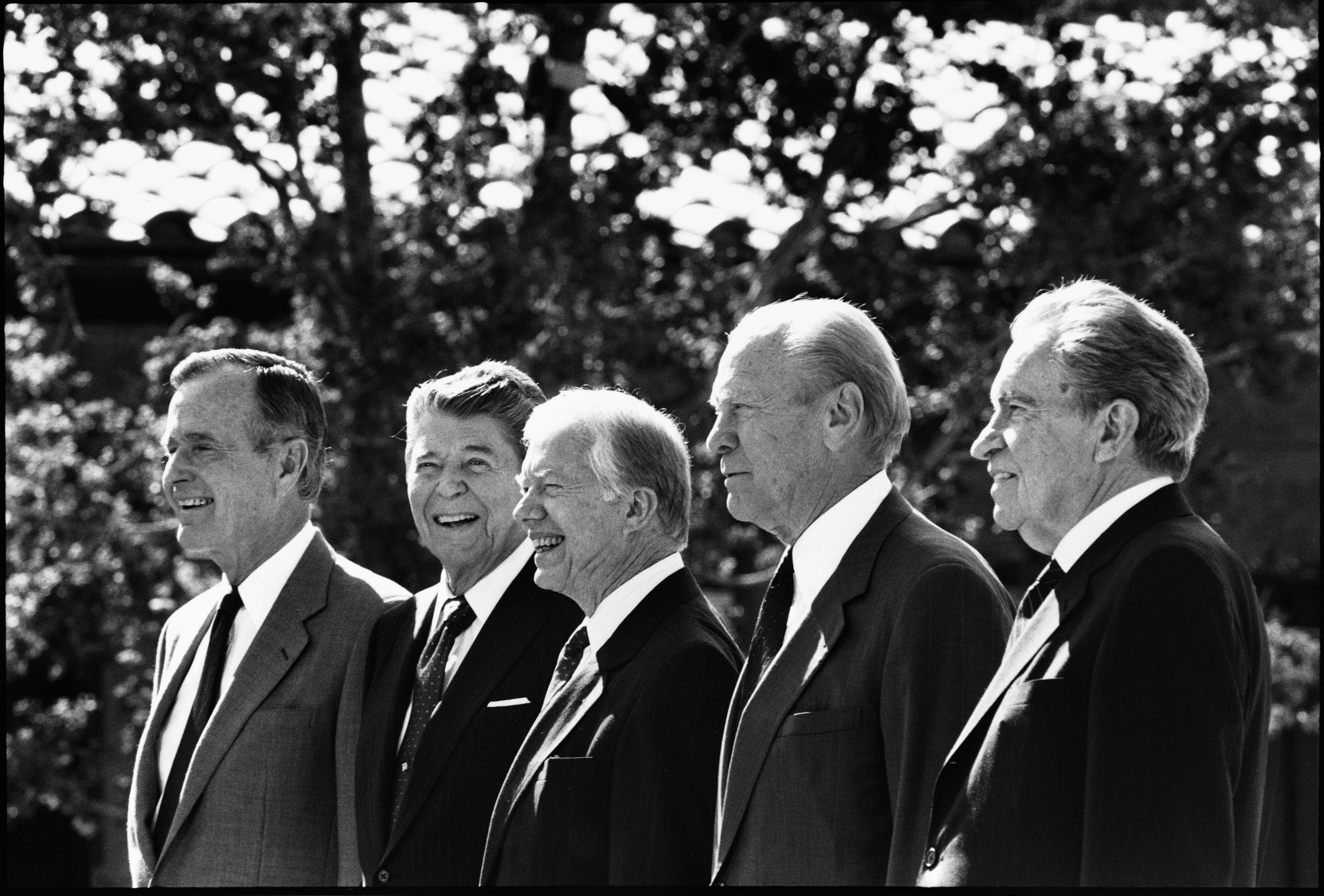
By the mid 1970s, we’d had two failed presidencies in a row, Johnson and Nixon. The nation seemed ungovernable, the public at once polarized and bewildered. Vietnam had fallen, perhaps marking our first true military defeat. The slaughter in Cambodia had begun. The Soviet Union seemed to be on the march. The U.S. economy and the global economy were in a severe recession.
And in September 1975, fifty years ago this month, there were two assassination attempts against President Gerald Ford. On September 5, a follower of jailed cult leader Charles Manson stood a few feet from the president as he walked through a crowd near the California State Capitol building in Sacramento, pointed a pistol at his chest and pulled the trigger. Thankfully, she had failed to operate the slide mechanism correctly.
Seventeen days later, on September 22, 1975, Ford survived a second assassination attempt, this time in San Francisco. Oliver Sipple, a 33-year old disabled former Marine and Vietnam War veteran, grabbed the shooter’s arm after she’d fired one shot at the president outside the St. Francis Hotel, and was about to fire again. Sipple may well have saved Ford’s life. Sipple was outed in the press the next day as a gay man. His family, who were unaware of his sexual orientation, would disown him. But President Ford sent him a personal letter of thanks: “I want you to know how much I appreciated your selfless actions last Monday . . . you acted quickly and without fear for your own safety.”
President Ford survived the assassination attempts, and the United States came back from that time of troubles, much more quickly than then seemed possible. Good fortune played a part. But so did the willingness of countless individuals, including such an unlikely duo as Gerald Ford and Oliver Sipple, to act honorably and fearlessly.

SECOND SHOW ADDED! Tickets will be on sale Wednesday at 10:00 a.m. EDT for this matinee edition of Bulwark Live in Toronto on Saturday, September 27. Go to TheBulwark.com/events for details.
AROUND THE BULWARK
The Religious Impulse Behind Trumpism… On The Mona Charen Show, HOLLY BERKLEY FLETCHER explains to MONA CHAREN the mindset of white evangelicals from a unique perspective—that of missionary kids. She was one. Her new book sheds light on a key MAGA constituency.
Charlie Kirk Conspiracy Theories Roil MAGA Media... Right-wing media demands the “real” truth about Kirk’s death, reports WILL SOMMER in False Flag.
Is Trump Crazy? Or Is He Cunning?… The two big theories that critics put forward to explain Trump are each associated with different kinds of autocrats, argues LEE MORGENBESSER.
Trump Hasn’t Invaded Chicago, But the City Is Still Rattled… ICE has had a chilling effect on businesses, schools, and communities in the Windy City, writes ADRIAN CARRASQUILLO in Huddled Masses.
Quick Hits
YOU’RE NOT ALLOWED TO DO THAT!: Just about every member of Donald Trump’s cabinet was hired in part because of their ability to go on TV. But different members have different TV roles.
Stephen Miller, as we discussed yesterday, is a Bond villain, issuing baroque ideological screeds and promising complex retributive schemes against MAGA’s foes. Attorney General Pam Bondi, on the other hand, profiles more as a meathead enforcer—powerful but maybe not the best at articulating it. Here she was on Fox News last night:
Businesses cannot discriminate. If you want to go in and print posters with Charlie’s pictures on them for a vigil, you have to let them do that. We can prosecute you for that.
Bondi was responding to a clip that went viral on right-wing social media of an Office Depot employee in Michigan who refused to fulfill a print order of posters of Kirk for a vigil because “he’s a political figure,” saying that “we don’t print propaganda.” Office Depot later fired the employee and apologized.
All this was a perfectly legal example of the right-wing version of cancel culture we’ve seen a lot of in the wake of Kirk’s death, with a conservative social media mob working to extract social punishments on those who have reacted with callousness or cruelty—or even just insufficient sympathy—to the assassination. But Bondi’s pledge is hilariously, cartoonishly illegal. A business refusing to provide services to a person due to his or her political affiliation is simply not prohibited by federal law, under which “political affiliation” is not a protected class.
That might not even be the most remarkable utterance Bondi made yesterday. For that honor, just watch this screed about “hate speech” not being free speech.1
When you’re the attorney general, apparently, you get to just make up the law.
YOU’RE NOT ALLOWED TO WRITE THAT!: Donald Trump’s latest punitive legal action against a media company, a $15 billion suit filed in Florida yesterday against the New York Times, was not actually written in crayon. Reading through it, though, you get the strong impression the first draft was. It’s remarkable the content that results when highly paid, bar-accredited lawyers know their main assignment isn’t actually to win over a judge but to flatter the personal pathologies of their client. The whole thing is a bizarre exercise in childish poutiness and breathless Trump-worship, predicated on—among other things—the Times’s decision to put its Kamala Harris endorsement on the front page last year. As the suit reads:
It came as no surprise when, shortly before the Election, the newspaper published, on the front page, highlighted in a location never seen before, its deranged endorsement of Kamala Harris with the hyperbolic opening line “[i]t is hard to imagine a candidate more unworthy to serve as president of the United States than Donald Trump.” . . . The Board asserted hypocritically and without evidence that President Trump would “defy the norms and dismantle the institutions that have made our country strong.”
One might argue that ridiculous speech-punishing lawsuits like this are themselves evidence of exactly that. We don’t often say it about legal filings, but in this case we mean it: Read the whole thing.
DOLLAR DOLLAR BILLS: It’s a great era of post-truth, post-corruption politics we get to cover, where stories that would once have sparked massive, months-long scandals now get a brief mention down below the fold. Take for instance this New York Times report on the double negotiating duty Trump ally Steve Witkoff has played with Sheikh Tahnoon bin Zayed Al Nahyan of the United Arab Emirates this year. The two hashed out a deal to allow the sale of advanced U.S. chips to the UAE at roughly the same time they put together another deal to make billions in crypto for the Trumps and Witkoffs personally:
Over the past few months, Mr. Witkoff and Sheikh Tahnoon had become both diplomatic allies and business partners, testing the limits of ethics rules while enriching the president, his family and his inner circle, according to an investigation by The New York Times.
At the heart of their relationship are two multibillion-dollar deals. One involved a crypto company founded by the Witkoff and the Trump families that benefited both financially. The other involved a sale of valuable computer chips that benefited the Emirates economically.
While there is no evidence that one deal was explicitly offered in return for the other, the confluence of the two agreements is itself extraordinary. Taken together, they blurred the lines between personal and government business and raised questions about whether U.S. interests were served.
Cheap Shots
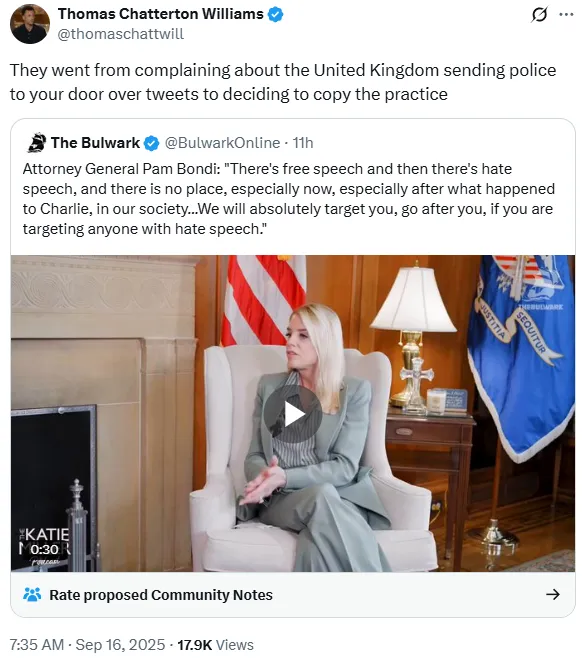
Bondi attempted to walk that back this morning by basically reimagining what she had said.
I voted for Nixon in 1972, my first election, so I want to remind people that LBJs failure were mixed with real and heroic achievements in Civil Rights. And Nixon's failures were also mixed with environmental policies and even affirmative action. Today we see something entirely different where one party is not completely divorced from honesty and honest policy.
Failed presidency of LBJ…..I would argue that his achievements in addressing racism and poverty are hardly failures. Because he had one term and chose not to run? Perhaps that too was the best decision at the time.