Crazy or Cunning: The Trump Contradiction
Critics’ two big theories explaining Trump are associated with different kinds of autocrats.

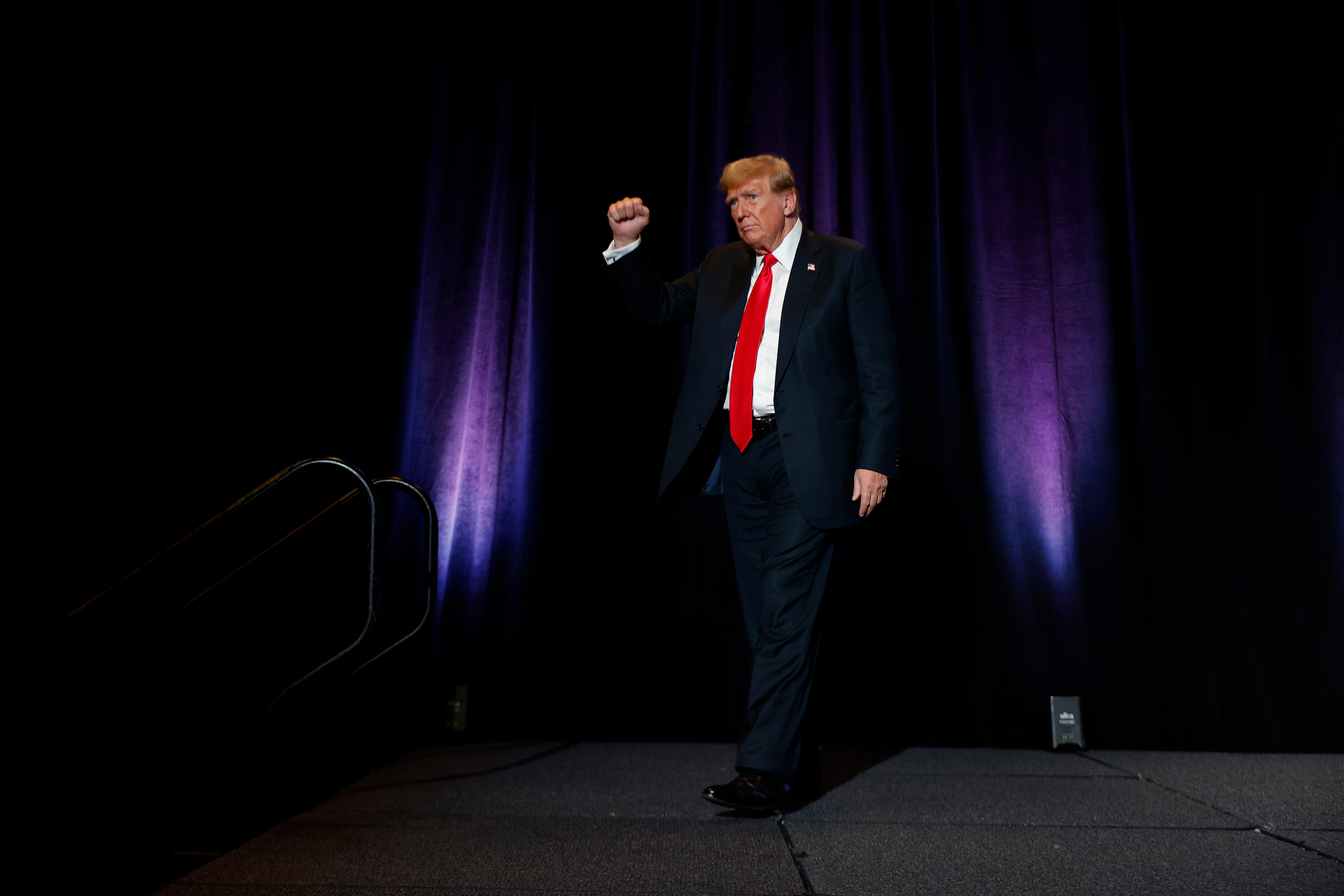
A DECADE INTO THE TRUMP ERA, there remains a fundamental tension in the way critics and opponents think, write, and talk about Donald Trump. He is alternately a conniving destroyer of republican institutions or a mentally and emotionally debilitated, increasingly senile wackjob. Both accounts have much to recommend them. There is evidence to support both, and each helps explain the man and his effect on American politics and policy. Yet if Trump’s opponents are to understand the president and his movement—a necessary precondition for fighting it—the inconsistencies between the two theories should be resolved, or at least understood.
In a sense, the more flattering view of Trump is that he is implementing the so-called “authoritarian playbook.” In this view, he is diligently working his way through a series of established techniques that autocratic leaders—Hugo Chávez, Recep Tayyip Erdoğan, Narendra Modi, Viktor Orbán, Daniel Ortega, and Vladimir Putin—have used to remove executive constraints, weaken opposition parties, silence the media, undermine elections, and curtail civil liberties and political rights.
This playbook has been on full display during Trump’s first eight months back in office. He has fired inspectors general responsible for preventing inefficient or unlawful operations, appointed unfit loyalists to key positions of power, launched investigations targeting the fundraising capacity of the Democrats, cut funding to NPR and PBS (while also suing CBS News and, yesterday, the New York Times), given himself extraordinary new powers over the American economy thanks to his unilateral tariffs, and pushed Congress to massively finance a security agency that (he imagines) will be loyal to him, to name but a handful of the playbook’s techniques. Even George Conway, perhaps the foremost proponent of the theory that Trump suffers from diagnosable mental disorders, identified the deployment of the National Guard to the streets of the capital as a calculated authoritarian act.
The other view is that Trump is nothing more than a mad king (or, at least, a mad aspiring king). By this theory, Trump is more comparable to Caligula, Charles VI, Henry VI, Peter III, or Idi Amin, all of whom were autocratic and, for lack of a better word, crazy. There are plenty of reasons to give credence to this theory, too. Just to name a few: During his 2024 election campaign, Trump repeatedly paused rallies for twenty minutes or more just to listen to piped-in music as the crowd waited awkwardly. He regularly confuses the names of places (for example, conflating Afghanistan with Alaska and then Alaska with Russia) and people (“Tim Apple” for Tim Cook and “Kristi Whitmer” for Gov. Gretchen Whitmer). He claimed on numerous occasions that he had run or was running against Barack Obama for president. He asserted, erroneously, that his uncle had taught the Unabomber. His speech patterns have become so obviously nonlinear that he himself nicknamed his style “the weave.” He has spent an inordinate amount of time and attention on the Kennedy Center.
But which is it? Is Trump cleverly, methodically attacking the foundation and pillars of free government with cunning and guile? Or is he a madman whose danger lies in his recklessness? How should we reconcile these two versions of Trump?
TODAY’S PLAYBOOK AUTHORITARIANS are astute, calculating, subtle, and patient, while history’s mad kings were inherently greedy, incompetent, reckless, and cruel. One way of understanding Trump’s autocratic behavior is to acknowledge its messy duality, indicating both method and madness.
Nothing exemplifies Trump’s two-headedness more than his suggestions about staying in office for a third term, which is obviously unconstitutional. Even though several playbook autocrats have used this technique—Alberto Fujimori, Chávez, Ortega, and Putin—they did not dare do so until after they had consolidated power. Like a mad king, though, Trump expressed a desire to stay on before he even finished his first term.
So perhaps Trump is merely implementing the authoritarian playbook poorly. Like a high school squad trying to run the same plays as an NFL team, the play sheet can be identical but the results won’t look the same. Early in Trump’s first term, Benjamin Wittes dubbed this synthesis “malevolence tempered by incompetence.”
In How Democracies Die, Steven Levitsky and Daniel Ziblatt note that elected authoritarians kill democracy in ways that are gradual and imperceptible to citizens. “Each individual step seems minor—none appears to truly threaten democracy. Indeed, government moves to subvert democracy frequently enjoy a veneer of legality. . . . Many of them are adopted under the guise of pursuing some legitimate—even laudable —public objective.” The drift toward autocratic rule doesn’t always set off alarm bells.
Yet Trump’s actions have raised alarm bells. His assault on American democracy has resulted in a stream of court cases, spawned some of the largest protests in American history, stirred opposition from political elites, and started to sink his approval rating.
The sheer speed with which Trump is implementing the autocrat’s playbook is a key differentiator. In other countries, would-be autocrats spent years slowly chipping away at constraints on their ambition and challenges to their authority. This incremental approach leaves citizens in a state of ambivalence about the type of regime they live under and the kind of country they live in. By moving so aggressively, Trump has made his abominations clear and conspicuous.
THERE ARE OTHER WAYS to resolve the contradiction between the wily authoritarian and the mad king. One is to distinguish between what we might call the ‘personal Trump’ and the ‘collective Trump.’ The personal Trump spends much of his time on social media, calls in to cable news shows on a whim, watches unhealthy amounts of television, and is often seen with flagging energy. The collective Trump, including his staffers, allies, informal advisers, and appointees, can together tirelessly do a significant amount of work. Many of the people working for Trump are intelligent, well educated, canny, capable, and limited more by their rivalries with each other than by their consciences.
Trump’s evolution over time suggests that the collective Trump is cleverly breaking down the guardrails of democracy for an absolutist personal Trump. First-termers Reince Priebus, James Mattis, Jeff Sessions, and John Kelly were unwilling to do so; second-termers Susie Wiles, Pete Hegseth, Pam Bondi, and Kristi Noem have no qualms. In this sense, Trump’s malevolence isn’t tempered by his own incompetence, because the people around him are competent—if not according to the normal definitions of their jobs then at least enough to help him consolidate power. “A clown with a flamethrower,” a Bulwark reader quoted by Charlie Sykes observed, “still has a flamethrower.”1
Another explanation is that, like many leaders and especially dictators, Trump’s mental health has deteriorated over time. The list of supreme rulers who gradually lost their touch, or lost their sanity altogether, is long and sundry. Some of them may have been (or definitely were) influenced by toxic or psychotropic substances: George III, the Jiajing Emperor, Adolf Hitler. For others—Stalin, Saddam Hussein, Ivan the Terrible—the causes are more opaque, though the years of high-stakes power games and court intrigue probably didn’t help. Trump, who had just turned 69 when he announced in 2015 that he was running for president, has ruled the Republican party like a dictator since his first election; he has aged significantly over the past decade.
The theory that Trump was once a canny authoritarian but is becoming a mad king does have one conceptual problem, though, which is that the relationship between mental health and morality—between sanity and evil—is difficult to describe. The existence of the authoritarian playbook implies that one can be evil but sane. But what motivation would a “sane” person have for destroying the world’s leading democracy in the first place?
NOT ALL AUTHORITARIAN takeover attempts are successful. Even in the last few decades, attempted takeovers in places like Brazil, Peru, Poland, Sri Lanka, and South Korea were turned back, resulting in strengthened democracies. Rather than despairing, Trump’s opponents should keep in mind that all is not yet lost and that Trump and his movement have significant weaknesses.
One is that Trump lacks the skill and character of a top-tier destroyer of democracy. His impetuousness is already prompting anger and action from a broad cross-section of civil society, even more quickly in this term than in his last.
And time may not be on Trump’s side. He is already 79, showing signs of deteriorating health, and liable to be under considerable stress for the foreseeable future. And he does not seem mentally robust, which is too bad for him and too bad for the United States. While elected autocrats can numb citizens to their actions by generating economic growth, stoking nationalist fervor, and providing political stability, mad kings wreck just about everything they touch.
Lee Morgenbesser is an associate professor in comparative politics at the School of Government and International Relations, Griffith University in Australia. His research focuses on authoritarian politics, democratization, dictators, election observation, and Southeast Asian politics.
Sykes has also pithily suggested another theory for explaining Trump’s remarkable political rise in light of his apparent cognitive and social deficits: what Sykes calls his “lizard brain,” shorthand for a savant-like sense for human weakness.
 | A guest post by
|