


Since the firing of his boss, Pam Bondi, acting Attorney General Todd Blanche has been hustling like crazy to get the top job permanently. His latest caper: Yet another federal indictment of FBI Director James Comey, this time on the ludicrous grounds that an Instagram picture he posted last year—of seashells on the beach spelling out “86 47”—represented “a serious expression of an intent to do harm to the President of the United States.” Happy Wednesday.
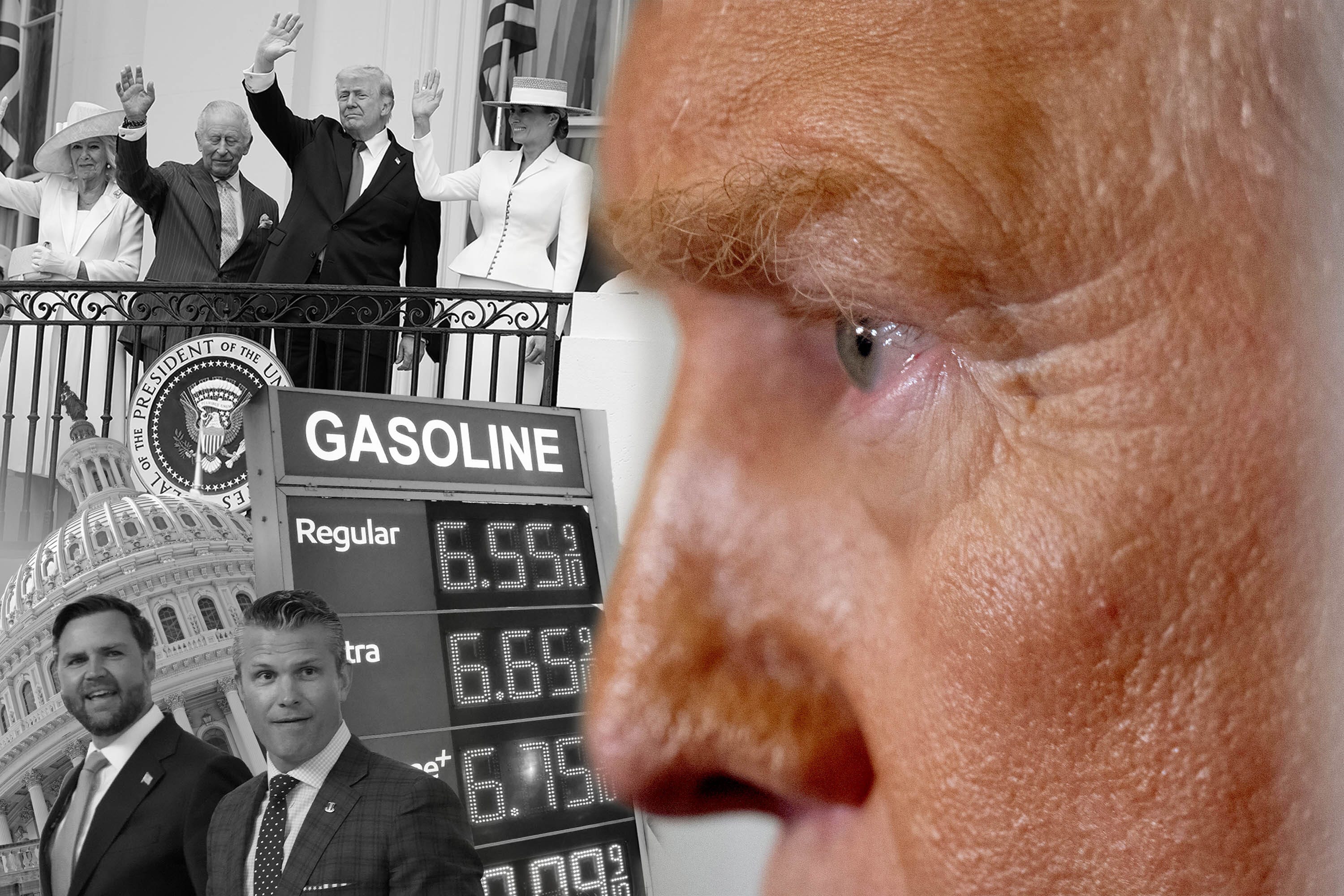
Reading Trump’s Mind
by William Kristol
Christ. It’s four in the morning, and I can’t get back to sleep. I dunno why. I mean, that state dinner for King Charles went fine. And I still look good in white tie!
So why can’t I get back to sleep? I’m getting like that goddamn Macbeth in that play Ivanka made me see. Macbeth was a tough guy. I liked him. But I guess it didn’t end well.
I gotta be honest. I do know why I can’t sleep.
For one thing, the dinner was okay, but I knew all along what the King was thinking: “Really? This is the best they can do?” A “state dinner”? The King doesn’t have state dinners. He throws state banquets. And he doesn’t live in some run-down White House with 132 rooms. He lives in Buckingham Palace. A palace. With 775 goddamn rooms.
And I can’t even get a ballroom added to this dump.
We tried pushing for the ballroom after that assassination attempt over the weekend. But maybe we laid it on too thick? It doesn’t seem to be convincing anyone. And some of the idiot Republicans in Congress are making it worse. They decided to try to suck up to me by saying the government should pay for it. Dunces. I’ve said over and over the ballroom wouldn’t cost the taxpayers anything!!! So now it’s gonna be, “First Trump raised your gas prices, and now he wants you to pay for his ballroom.” That’s just great!
Congress is such a pain in the ass. I was trolling when I told the guys to post that picture this afternoon of me and Charles together, with the caption “TWO KINGS.” But goddamn it—it would be good to be a king.
If you’re king you can ignore Congress. And you can ignore the polls. And now they tell me there’s a new poll that shows 17 percent of my voters say they regret their vote. And they say the war with Iran was the number-one reason, followed by the economy.
Well, shit. Those are connected! Look at the goddamn gas prices. And that goddamn strait they didn’t warn me about.
The Iran thing, that’s the real reason I can’t sleep. What the hell am I going to do?
I gotta get out of there. They keep telling me I have to stay the course and raise the pressure and get the nuclear dust out and not let Iran have any control over the strait. But two months ago they told me it would all be easy. I don’t believe a thing they tell me anymore.
Am I becoming Jimmy Carter? Am I becoming Jimmy Fuckin’ Peanut Farming Carter? That’s like the opposite of being a king.
I gotta get out. But I can’t look weak. Gotta look tough. Especially if you’ve gotta back down, you gotta declare victory. Can’t look like I’m a loser or a sucker. Can’t let people listen to the goddamn German chancellor saying I’m being humiliated by the Iranians!
But Merz was right when he said, “I hope that this ends as quickly as possible.” So do I. Maybe I can get lucky to get out of there without too much damage to my brand.
But it’s tricky. Get out too quickly and things go to hell. Stay too long and . . . things go to hell. So I’ll keep on blustering for a while, like I did with that Truth Social post I just put up:
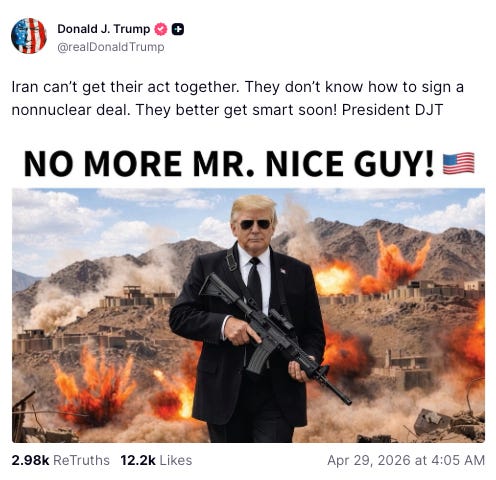
That’ll help. For a while.
And I’ve got to tell Karoline to get the word out that I’m preparing for an “extended blockade” of Iran. I gotta look determined for a while.
But in reality I’ve got the intel guys looking at what would happen if I just declare victory and call it a day. I can’t believe they leaked that one. Gotta get rid of Tulsi.
Venezuela was so great. But then this thing! I can’t believe I let Hegseth talk me into it. Gonna get rid of him, too. JD’s a slippery character, but I gotta admit, he was right about Iran. And I’m not putting his guy Driscoll in to replace Hegseth—can’t trust him. But who can I trust?
Because trust is what matters. Especially as the election nears. No. Not the midterms. I’m thinking about 2028.
You see, the best thing about being a king is you don’t leave office. And I’m not gonna. Gotta focus on that. This year’s gonna be rough. But 2028 is the prize. After that the White House becomes a Palace. Trump Palace.
[A smile spreads across Trump’s face as, at 4:30 a.m., he drifts off to sleep.]
The Scandal at ‘Stars and Stripes’
by Mark Hertling
The Pentagon’s recent decision to remove the Stars and Stripes ombudsman, Jacqueline Smith, may look like a minor personnel move, but it isn’t. It’s more of a signal about how the Department of Defense views independent information within the force, and how it may be attempting to erase the line between journalism and messaging.
Stars and Stripes is a newspaper that occupies a unique place in American military life. It’s funded by the Pentagon but protected by Congress, and it operates as an independent news organization for U.S. troops overseas. That independence was hard-earned over decades, and the ombudsman is charged to protect that independence—serving as a watchdog for readers and ensuring the paper remains free from any command influence.
Smith’s firing, reportedly after she voiced concerns about editorial pressure, raises a basic question: Was the problem performance, or was it independence itself?
During my years in uniform, particularly when serving overseas, Stars and Stripes was more than just a newspaper. It was often the only American paper consistently available at our bases. Soldiers read it, shared it, folded it into rucksacks, debated its stories, chuckled at their favorite comics, and reviewed the baseball box scores from the games that ended outside their time zones. In combat zones, its value was even more pronounced. Sometimes the paper arrived three or four days late, coming in with supply convoys or carried by a senior sergeant as a way to boost morale. Troops would grab it as soon as it showed up, passing it around. It was a connection to the military and the country they served—and importantly, it was a source they trusted.
Stars and Stripes has long employed and published stories from a mix of its own experienced reporters—many embedded with units or deeply familiar with military life or local activities and actions of various units—and it has carefully intermingled those stories with selected content from respected independent organizations like the Associated Press. The outside stories were never chosen for political effect, but for relevance and newsworthiness—providing troops abroad a credible world view without the filter of official messaging. That mix mattered. It reinforced the idea that what soldiers were reading was journalism, not institutional narratives.
Most soldiers understand that Stars and Stripes is not linked to their chain of command. The paper reports on problems, questions, and decisions, presents the soldier’s view, and offers a fuller picture of events than might appear in official briefings. That distinction matters in a profession where information is often tightly controlled and where clarity can mean the difference between success and failure.
The U.S. military is built on the principle that its own forces—and the citizens they serve—deserve access to accurate, unvarnished information. That’s not just a democratic value protected by our Constitution; it’s a warfighting advantage. Leaders make better decisions when information flows honestly, and units perform better when they understand the reality around them.
Influence operations—what the military used to call psychological operations—have a very different purpose. They are directed outward, toward adversaries, to shape perceptions, degrade morale, and influence behavior. They are tools of competition and conflict, used against an enemy.
The difference is important, because those two concepts are not interchangeable. One is about informing your own people. The other is about influencing a foe.
When the lines between the two begin to blur—when internal information channels start to look more like messaging platforms than independent sources—it results in skepticism. Troops are not naïve. They know the difference between being informed and being misled. And once they begin to question the credibility of what they’re reading, they start looking elsewhere for the news. Alternative sources—accurate or not—are always available. If trusted outlets lose credibility, they are quickly replaced by less reliable ones. That creates a vulnerability not just in morale, but in operational understanding.
Recent reporting suggests the Pentagon has been moving to reshape Stars and Stripes—reducing reliance on independent wire services in favor of internal reporting, emphasizing themes aligned with the Defense Department’s priorities, and now removing the ombudsman. None of those steps, taken individually, is inherently problematic. But taken together, they point toward a shift from independent journalism toward controlled messaging. That changes the nature of the publication. And soldiers, as smart as they are, will be able to tell the difference.
The United States military has long demonstrated that it is strong enough to tolerate—and benefit from—independent reporting within its ranks. That’s part of what distinguishes it from the forces of authoritarian regimes, where information is tightly controlled and dissenting views are suppressed. There is confidence in our force, in our leaders, and in our system. Undermining that independence sends a different message.
It suggests a preference for narrative over reporting, for control over transparency. It risks weakening one of the quiet but essential connections between the military and the nation it serves.
Stars and Stripes has never been perfect. But it has been a reliable, independent voice for American troops—a source of information, a connection to home, and occasionally, a mirror held up to the institution. That’s what Jacqueline Smith was there to protect. This may seem like a small story, buried in the chaos of daily news. But inside the force, it touches something fundamental: how information is delivered, and whether it is trusted.
In any military, that distinction matters more than most people realize.
AROUND THE BULWARK
State Dept. Finalizing Plan to Put Trump Picture on U.S. Passports… The new design would mark yet another U.S. government property upon which the president has plastered his likeness, BENJAMIN PARKER reports.
We Still Haven’t Answered the Basic Questions of the Iran War… The old lessons still apply to modern war, observes MARK HERTLING.
How Péter Magyar Toppled Viktor Orbán’s Illiberal Regime… By reviving Hungary’s liberal traditions, argues H. DAVID BAER.
The Loons and the Loyalists Running the DOJ… On the flagship pod, CAROL LEONNIG and WILL SOMMER join TIM MILLER to talk about the rot at the top at main Justice.
Quick Hits
WELCOME TO HELL: Now that Donald Trump has agreed to drop his government’s buffoonish criminal investigation of Fed Chair Jerome Powell, Trump’s nominee to replace him, Kevin Warsh, finally has a clear path to confirmation.
Warsh may live to regret it. As Politico notes, he’s inheriting a monster pile of economic difficulties to slog through:
[Walsh will] take over a central bank that has been beset by political battles with President Donald Trump, who has relentlessly pressed for lower interest rates and threatened to fire Powell and another Fed governor for cause—a power that the Supreme Court will soon weigh in on.
Against that backdrop, the Fed faces crucial dilemmas on everything from the war’s economic fallout to the potential tectonic effect that artificial intelligence will have on jobs. And Warsh—a Trump nominee who faces a close confirmation vote Wednesday by the Senate Banking Committee—is poised to be the one who will have to see them through.
“Right now, you’ve got different signposts pointing in 18 different directions, and you have to decide how they will interact with each other,” said Martha Gimbel, the executive director of Yale’s Budget Lab. “Thoughts and prayers to them all.”
Read the whole thing before the Senate Banking Committee votes to advance Walsh’s nomination today.
PETE OFF THE LEASH: For the most part, Defense Secretary Pete Hegseth has managed to avoid tough questions about the conduct of the Iran war, giving his frequent military press briefings in front of a new-look Pentagon “press” corps entirely constituted of MAGA-influencer suckups. That will change today when Hegseth heads to the Hill for a hearing before the House Armed Services Committee on the Pentagon’s annual budget request. The administration is seeking a 50 percent jump in defense spending, to $1.5 trillion. Here’s ABC News:
The appearance—the first before Congress for Hegseth since the war in Iran began in February —lands just two days before a 60-day deadline to wind down hostilities.
It also comes amid intensifying questions on the Hill about how quickly the Pentagon is depleting weapons stockpiles, and as lawmakers continue to scrutinize Hegseth’s unusual spate of firings of senior defense officials without a public explanation.
Questions over civilian casualties in the Iran war, as well as whether the U.S. was properly prepared for retaliatory strikes, and broader questions over the strategic rationale for the conflict, are likely to be a key part of committee members on both sides of the aisle questioning of Hegseth, multiple congressional aides explained.
Hegseth is an easily irritated loudmouth with a career’s worth of TV jabbering experience—safe to say we can expect plenty of fireworks.
Cheap Shots


“a serious expression of an intent to do harm to the President of the United States.”
Seashells-on-a-beach as an artistic medium are about as threatening as an embroidered throw pillow.
NBC News headline: "James Comey indicted over seashell photo that officials said threatened Trump"
Photos of seashells: I think we just found our new protest sign.