A Downbeat Gathering at MAGA’s Dead End
National conservatives have the power they’ve been craving. What they can’t seem to agree on is what to do with it.


It’s the strangest thing: Grand juries in Washington, D.C. just keep declining to indict people arrested by federal officers amid Trump’s capital crime crackdown—a very rare phenomenon normally, but one that has happened at least six times since that crackdown began. Longtime lawyers are gobsmacked: “Not only have I never heard of this happening, I’ve never heard of a prosecutor who’s heard of this happening,” a former federal prosecutor told CBS News. Happy Thursday.
A Day with the NatCons
by Andrew Egger
One thing you learn about this year’s National Conservatism Conference just by chatting with those in attendance at the Westin DC Downtown is that the National Conservatism Conference apparently sucks now. The old pleasurable sense of hip transgression—the punk of it all—just isn’t hitting the way it used to, back when they were taking an AMERICA FIRST-brand flamethrower to all the hoary old conservative institutions, from fusionism to CPAC.
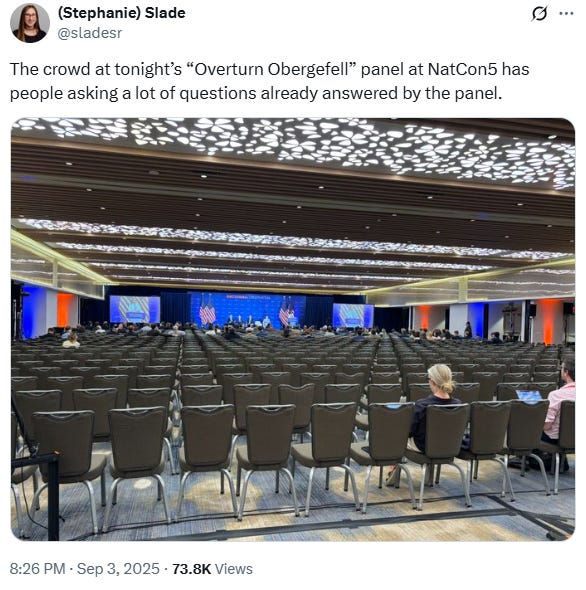
Looking around at the rows and rows of empty ballroom seats, hearing the occasional speaker’s admonishment that young NatCons should be more grateful for Trump’s second-term achievements, observing the “sure, you can clap” surprise from daytime main-stage speakers whenever the audience bestirred itself to scattered applause, you could definitely see why they felt that way.
The juxtaposition was odd: National conservatism, as a political force, has never been stronger. Many of the young right-wing strivers who filled these seats in former years are now spending their weekdays in government buildings instead, pounding out policy for the Trump administration. The long list of White House officials who addressed the meager crowd speaks to its outsized political reach.1
This gang of erstwhile outsiders is plainly enjoying its newfound power. Over and over, conference speakers repeated the same refrain: “You can just do things!” The problem is that, having obtained the power to do things, it’s quickly becoming clear that the NatCons are anything but united about what it is they actually want to do.
The glue that binds the NatCon coalition is their contempt for the proceduralism of the conservatism that preceded them, their conviction that Republicans’ old focus on small government and personal liberty amounted to nothing more than unilateral disarmament against the teeming hordes of the left. Seizing and wielding federal political power, not restraining it, is the mission.
This, of course, helps explain why the NatCons have become the intellectual power base2 of the GOP of today: Their grievances and hangups map conveniently onto Donald Trump’s own. They share all his enemies: not just the left, but free traders, civil libertarians, and neoconservatives. And they are in agreement that he should crack the whip of the state as hard as he likes against all these groups.
The NatCons are aware, however, that a working alliance with any one president can only take them so far. They’re not just interested in running the GOP of today; they want to hold on to the GOP of tomorrow, too. In his Wednesday speech, OMB Director Russell Vought emphasized the importance of maintaining national conservatism as a “durable event”—not just “an unhealthy stream built around the personality of one person and their ability to win elections,” but “a durable intellectual river that becomes a flood that cuts through the work of saving this country.”
Frankly, this is going to be difficult. Because the other major takeaways from NatCon this week were, first, that a group oriented toward a shared love of coalition-purging vengeance may not be particularly suited to coalition-building. And second, the NatCons are all chasing a vision of national greatness, but it turns out that “national greatness” is a concept with as many definitions as there are NatCons.
Peter Thiel has a vision of national greatness. The gay tech gazillionaire, who was the NatCon conference’s original bankroller, envisions a future characterized by a great secular fusion of populism and tech, a prosperous America led into a new golden age by a tech industry both purged of wokeness and let off the leash.
Thiel, however, wasn’t at NatCon this week. And many who were there denounced his secular tech-happy approach as benighted. In her day-one speech, the Conservative Partnership Institute’s Rachel Bovard singled out “Silicon Valley disrupters” as a leading danger to the NatCon movement, warning that their embrace of tech transhumanism presented an “existential threat to human dignity.” AI was out; going outside and touching grass was in. And changing attitudes on tech were far from the only swerve away from Thiel. Thursday’s programming ended with a primetime panel moderated by the editor of the Christian-right journal First Things on the need to overturn Obergefell v. Hodges and end the national right to gay marriage.
The conference’s lean into an overtly Christian form of nationalism raised other thorny coalitional questions, too. For instance: What to do about all these Jews? For conference honcho Yoram Hazony—who is Jewish himself—the right’s growing strain of antisemitism was something to be sublimated for the good of the coalition. “Nobody ever said that to be a good NatCon you have to love Jews,” he said in his Tuesday speech. “Go take a look at our statement of principles, it’s not a requirement.”
One of Wednesday’s breakout sessions involved a sequence of mini-discussions on “the Bible and American Renewal,” featuring three talks from Christian nationalists—William Wolfe of the Center for Baptist Leadership, Timon Cline of the publication American Reformer, and Colorado Pastor Chase Davis—and one from the Jewish writer Josh Hammer. While Wolfe, Cline, and Davis offered exhortations on the need for an explicit and muscular Christian right-wing politics in America, Hammer instead offered a modest defense of a right-wing Christian ecumenism that still includes space for Jewish thought. When an audience member suggested America was a “Judeo-Christian” country, Hammer pushed back: “America was founded as a Christian country. I’ll be the first to say that. . . . I think the more interesting conversation is, what kind of a Christian country is America?” The Christian speakers politely declined to address the “Judeo-Christian” question—although Wolfe did offer Hammer the olive branch that they could certainly make common cause against Islam.3
The matter of America’s alliance with Israel provoked perhaps the conference’s hottest debate. In a testy Tuesday panel, Curt Mills of the paleocon magazine the American Conservative faced off against poli-sci professor Max Abrahms. While repeatedly professing his admiration of Trump’s foreign policy, Abrahms teed off on the faction he described as “MAGA isolationist realists,” who were disastrously turning on America’s most reliable regional ally while firing off “probably the most inaccurate Mideast punditry that you can find anywhere.” Israel, Abrahms maintained, remained a crucial helper in one of America’s most critical international tasks: preventing Iran from obtaining a nuclear weapon. Mills wasn’t having any of it: “Why are these our wars? Why are Israel’s endless problems America’s liabilities?” he asked. Here, too, the speakers could find common ground only about a group for whom they shared equal disdain: nation-building neoconservatives.
The whole conference seemed to run this way. It should be easy going for the NatCons now: Trump is the great uniting figure. Their intellectual project is ascendant, for the moment. But it’s far from clear how any of these people are supposed to keep playing nice when they no longer have Trump’s banner to march behind—or their shared enemies to kick around anymore.
Toward a Republican Waterloo
by William Kristol
In his fine piece Tuesday outlining the political problems facing Hungary’s Viktor Orbán, David Baer quotes Napoleon: “The thing to avoid is not so much error as self-contradiction. It is especially by the latter that authority loses its force.”
In my own limited and non-Napoleonic political endeavors, I’ve seen the truth of this. As a candidate in 1988, George H.W. Bush memorably said: “Read my lips: No new taxes.” As part of the 1990 budget deal, he raised taxes. It may well have been the right thing to do in terms of policy. But it was a killer politically.
Fast-forward to today. What did candidate Donald Trump say in 2024? He promised he’d release the Epstein files. He hasn’t. He promised he’d bring costs down. He hasn't. In each case, Trump said he’d do one thing, and he’s doing the opposite. These are two instances of self-contradiction that make Trump particularly vulnerable .
Here’s another area of self-contradiction begging to be exploited.
The centerpiece of the Republican legislative agenda in 2025 was Trump’s One Big Beautiful Bill Act. Republicans tried to sell the bill as providing tax cuts that would help everyone.
But in at least one area the bill will result in raised taxes: It failed to extend the tax credits for purchasing insurance in the health care marketplace. The 2025 Republican tax bill—so full of other goodies for the more fortunate—chose not to extend those credits that have helped make health insurance more affordable for millions of working and middle-class Americans.
And this was a choice, not an oversight. Democrats and analysts warned that the credits were expiring at the end of the year. Congressional Republicans, who have repeatedly attacked those tax credits, chose to ignore those warnings and not extend them.
Letting the credits lapse at the end of the year will lead to large insurance premium price increases—so large that the Congressional Budget Office estimates that more than 4 million people will lose health insurance. Millions of others will be paying much more. And these tax hikes are about to become visible to one and all, with open enrollment for 2026 coverage on the exchanges starting November 1.
As Punchbowl reported this morning, Republicans are worried, maybe even beginning to panic. Senate Majority Leader John Thune let it be known yesterday that he was open to figuring out a way to extend those credits as part of the government-funding legislation that will be considered this month. But Thune wants Democrats to come up with a plan to deal with this problem.
To which Democrats should say: “You caused the problem. You fix it.”
A group of vulnerable House Republicans have already broken ranks. They’re looking for cover, and have introduced a bill that would extend the subsidies for a year.
To which Democrats should say: “You could have saved those credits and chose not to. You need to restore them permanently. This is just a political maneuver to let Republicans dodge the issue until after the midterms—and then get rid of them.”
So, if I were to wax Napoleonic, I’d say to the Democrats: Accentuate the Republican self-contradictions.
Republicans said they’d release the Epstein files. They haven’t.
Republicans said they’d bring prices down. They haven’t.
Republicans said they’d help middle-class Americans. They didn’t.
Democrats need to hammer home this message. If they do, we could be on course toward a Republican Waterloo.
AROUND THE BULWARK
The Man Who Enlarged NATO… On Shield of the Republic, ERIC EDELMAN welcomes STEPHAN KIENINGER, author of Securing Peace in Europe: Strobe Talbott, NATO and Russia After the Cold War. They trace Talbott’s central role in Bill Clinton’s post-Cold War strategy and its relevance to Europe today.
Judge Spells Out the Danger of Trump’s Lawlessness… The President’s National Guard deployment in Los Angeles “violated the Posse Comitatus Act,” according to a new ruling KIM WEHLE reports on.
Trump’s War on Latino Art… He doesn’t just want immigrants out, but also their history and culture erased, observes ADRIAN CARRASQUILLO in Huddled Masses.
GOP’s Epstein Freakout! Mace in Tears! MTG Joins the Rebels!... The Next Level is back! Trump disappears for a weekend and sets off health rumors, Epstein victims speak out on Capitol Hill, and Congress releases “new” files that turn out to be mostly recycled.
Quick Hits
FLORIDA TO AXE VACCINE MANDATES: Robert F. Kennedy Jr.’s firing of Centers for Disease Control and Prevention director Susan Monarez has America’s most prominent cranks brushing up their résumés, eager to be the anti-vax rubber-stamp he chooses in her place. Perhaps the most prominent of these is Joseph Ladapo. The Florida surgeon general put his best foot forward Wednesday with a shock announcement: He was recommending the Sunshine State scrap all vaccine requirements, including for schoolchildren.
“Every last one of them is wrong and drips with disdain and slavery,” Ladapo said of state vaccine mandates. “Who am I to tell you what your child should put in their body? I don’t have that right. Your body is a gift from God.”
“You want to put whatever different vaccines in your body, God bless you. I hope you make an informed decision,” Ladapo went on. “You don’t want to put whatever vaccines in your body, God bless you. I hope you make an informed decision.” What informed might actually mean under these circumstances isn’t something Ladapo got into.
This is a remarkable thing to hear from a state surgeon general, a post that exists to advise and inform people on what is and isn’t healthy to put in their bodies.4 If Ladapo feels himself insufficient to that challenge, perhaps he should find another line of work. Then again, perhaps that’s the whole idea—there is that CDC vacancy to consider. (DeSantis made this explicit at yesterday’s event: “I hear there’s an opening for a new CDC director. Maybe we can help send Joe on his way up there.”)
While Florida, like all states, mandates an assortment of vaccinations for school-aged children, it already has carveouts for parents who want to exempt their kids for medical or religious reasons. During Ladapo’s tenure as surgeon general, the number of schoolchildren receiving these exemptions has grown dramatically. In 2013, only 1.8 percent of kindergarteners sought exemptions; in 2023, 4.5 percent of them did.
MEDDLING IN THE MAYOR’S RACE: Donald Trump really doesn’t want Zohran Mamdani to be the next mayor of New York—so much so that he’s reportedly putting a major thumb on the scale for a onetime enemy, Andrew Cuomo, who despite losing to Mamdani in this year’s Democratic primary is now running as an independent.
In an attempt to winnow the general-election field to a Cuomo-Mamdani rematch, the White House is reportedly trying to lure the other two prominent candidates out of the race. Politico reported yesterday that Trump has offered a job at the Department of Housing and Urban Development to incumbent Mayor Eric Adams, who is also running as an independent. And the New York Times reports that Trump advisers have also discussed finding a place in the administration for the race’s Republican candidate, Curtis Sliwa.
Adams denied an offer had been made. And Sliwa hasn’t been too impressed by the overtures either. “Every day it’s Trump versus Zohran Mamdani, it’s a good day for Zohran Mamdani,” he told a local news station last month. Back in June, Sliwa said that “the only way you get me out of this race before Nov. 4 is in a coffin, in a pine box.” Come on, Curtis—don’t give Trump any ideas!
Cheap Shots
Border czar Tom Homan, Office of Management and Budget Director Russell Vought, Director of National Intelligence Tulsi Gabbard, and U.S. Trade Representative Jamieson Greer all made appearances Tuesday or Wednesday; Kelly Loeffler, the administrator of the Small Business Administration, will speak this morning.
Such as it is.
After the talk, I reached out to Hammer about whether he had concerns about the welcome right-wing Jews would continue to have in a coalition dominated by an increasingly strident Christian nationalism. “I view my role as trying to make alliances and build bridges and do my best to ensure the kind of Christianity that flourishes in America will be the type of Christianity of the American Founders—a Hebrew Bible-rooted and -centric Christianity,” he replied. “As long as that holds, Jews will always be welcome in the coalition and on the Right. But yes, lines must be drawn and Tucker [Carlson] isn’t of course the only problematic one. He’s just the highest-profile.”
It’s also a total reversal of the position Ladapo claimed to hold at his confirmation hearing two years ago. “I think that the Florida statutes are appropriate,” he said then, “and the Florida statutes provide mandated vaccines along with an opportunity for families, parents who believe otherwise to opt out. And I think that’s appropriate.” Another thing he and Kennedy have in common!
Can we please start calling them Nat-Cs?
I just love the Jews at NatCon telling the Christian Nationalists with which it's infested: "Look, it's ok that you hate every other religion and want them excluded from American public life, as long as you make this one exception: Jews are in the club!" Such a brave stand from the likes of Hammer and Hazony.