


Before we get to this week’s issue, I just want to echo something JVL said about The Bulwark, its goals, and its future.
I have a small corner of the site, one that not every reader needs or wants. Most of you sign up for the politics! I get it. But no journal of ideas—and I’ve always thought of The Bulwark as, hopefully, in league with the mid-’00s iterations of the Weekly Standard, where I used to work, or the New Republic and the Atlantic, where I didn’t work but which I read regularly—is complete without an arts/culture section because no person is complete without arts and culture.
And even if you don’t care for my ramblings about Predator: Badlands (which I reviewed here) or Frankenstein (discussed below), or about the business of Hollywood as seen through the lens of my podcast, I’m hoping there’s something for the community here to enjoy. Whether it’s our move club on Rounders (in which I guarantee you’ll learn more about Sarah Longwell than you ever thought) or Hannah Grace Long’s essay on evolving notions of masculinity through the lens of the Ranown westerns or Bill Ryan’s annual series on spooky stories to stir the soul we run every October, I think there’s something y’all will like.
Frankenstein Comes to Netflix
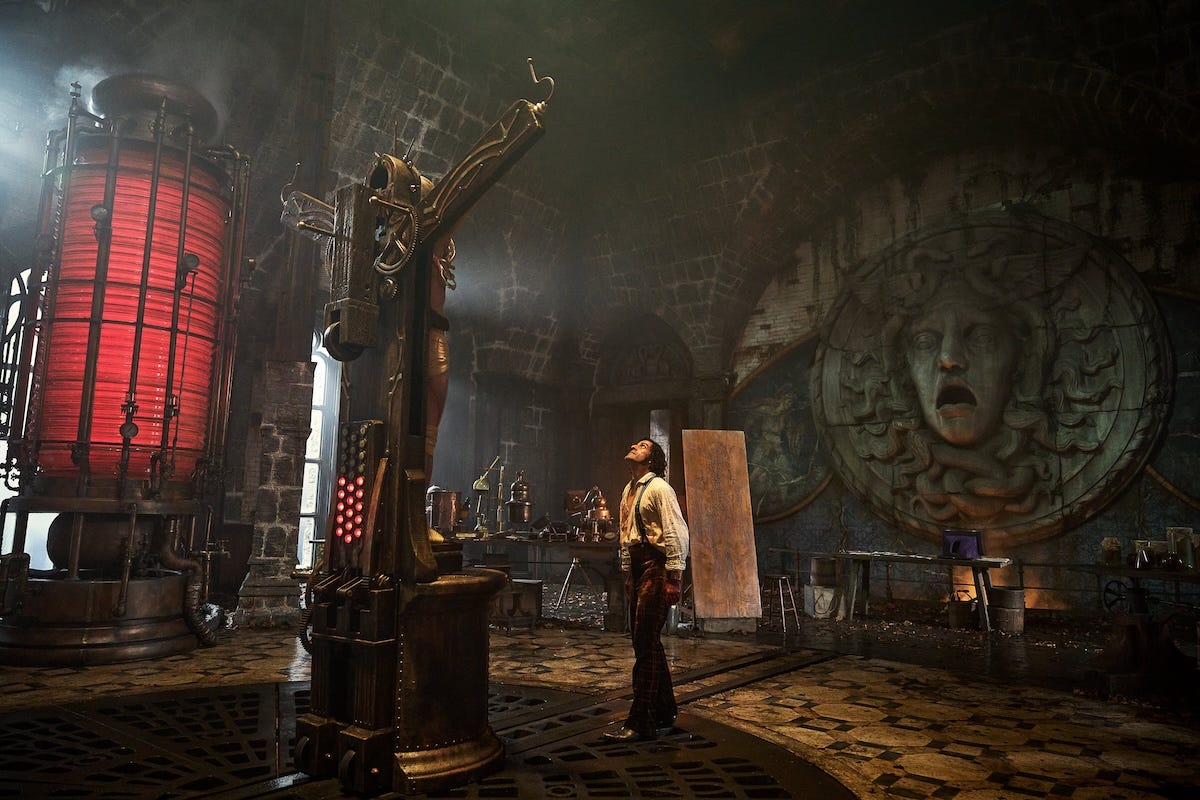
Guillermo del Toro’s Frankenstein hits Netflix today—one might even say it’s alive, it’s alive—and I highly recommend you check it out, if only to marvel at the fantastic production work that del Toro and his team of craftsmen have put into this film. I saw it on 35mm a couple of weeks ago here in Dallas at the Angelika, and I was properly impressed. I have a few quibbles about the look of the film here and there (there needs to be a constitutional amendment banning computer-generated fire, and a handful of background CGI filler shots were very obviously CGI filler shots) but on the whole, the world looks lived in and properly cluttered and ever-so-slightly Gothically insane.
Just as Oscar Isaac, playing Victor Frankenstein, comes across as ever-so-slightly insane in his mad pursuit of science that will result in the creation of his horrifying Monster. Man is, of course, the real monster in Frankenstein; more specifically, man’s boundless pursuit of “progress,” be it in war or science. One of the many alterations del Toro makes is to give Victor Frankenstein a wealthy benefactor (Christoph Waltz) hoping to make use of his ability to spark life from mere body parts; this man of means earns his keep via arms dealing. The monster himself (Jacob Elordi) is gentle and misunderstood, roused to passionate anger only at his mistreatment by the cruel world.
And again, this is partly in keeping with Mary Shelley’s original text. But I do find it odd how often the Monster’s own monstrousness is downplayed in these adaptations. The 1931 classic features the Monster killing, yes, but only in self-defense or out of childlike misunderstanding. Kenneth Branagh’s 1994 adaptation allows for the Monster’s crimes, but frequently obscures them offscreen. Del Toro goes further than both: The Monster is blameless throughout, an almost purely innocent being.
Rereading Shelley’s book this week I was again struck not by the innocence of the creature itself, but by the way man creates evil in his own image. Because the Monster is evil, make no mistake, even if he was driven to it by loneliness and scorn. This is a creature that murders a child and then frames the child’s innocent caretaker for the crime; that innocent woman is executed by the state. And after Victor refuses to give his Monster a partner, a female deformity that can live alongside the hulking beast in the wilds of ice and desert where humanity cannot roam, he kills Victor’s best friend and then Victor’s betrothed.
Indeed, in modern lingo, the Monster seems closer in spirit to an incel than anything else. Here are his thoughts after seeing a portrait of a beautiful woman:
“For a few moments I gazed with delight on her dark eyes . . . but presently my rage returned; I remembered that I was forever deprived of the delights that such beautiful creatures could bestow.”
Later, after Victor reneges on his promise to make the Monster a mate, he roars that he is powerful, that he can make his creator miserable. And then, he whines:
“Shall each man . . . find a wife for his bosom, and each beast have his mate, and I be alone? I had feelings of affection, and they were requited by detestation and scorn.”
Again, one cannot help but think of a mass shooter’s manifesto in these protestations. Indeed, later Victor warns that the Monster’s words can be “eloquent and persuasive”; one practically imagines him going viral with his fellow outcasts. These are the laments of the involuntarily celibate in the face of the world’s cruel indifference to his desires. But we would not excuse our modern monsters for what they’ve done. It seems odd that we would give the Monster a pass.
If I have a criticism of del Toro’s imagining of Frankenstein’s Monster, it’s this: We can understand that the cruelty of the world and self-perceived victimization drives men to evil without excusing that evil, without whitewashing what has been done. It is a lesson, I fear, that we will be forced to relearn time and again in our current, degraded age.
On The Bulwark Goes to Hollywood this week, I discussed Network with Dave Itzkoff, who literally wrote the book on the almost-fifty-year-old movie. It was a fun chat: We dove into the making of the movie and some of its relevance to today. And it really is bizarrely relevant, just a timeless look at the news industry’s interest in destroying itself. I hope you check it out!
The Eternal Relevance of 'Network'

I’m joined by Dave Itzkoff on this week’s episode to discuss Paddy Chayefsky’s classic film, Network. Dave literally wrote the book on Network in his history of the film, Mad As Hell, and had lots to say about the making of the movie, the minds behind it, and its ongoing relevance to our daily lives. I know what you’re thinking, I can practically hear y…
Assigned Viewing: Nightmare Alley (Hulu/Disney+)
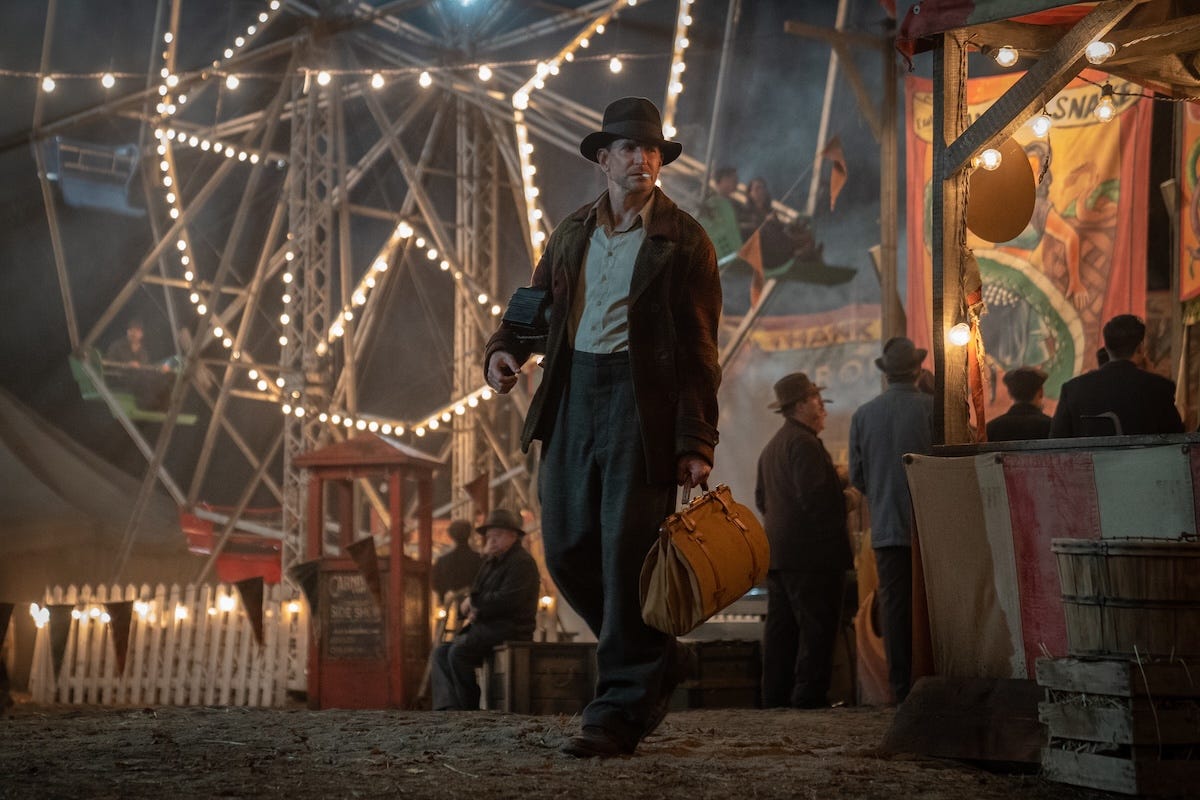
I’m an unabashed Nightmare Alley stan, Guillermo del Toro’s 2021 adaptation of William Lindsay Gresham’s 1946 book about con men and their works. This is, like Network and Frankenstein, a story that remains eternally relevant. I have the Mondo poster in my office and as soon as this email goes out I’m running over to my local Barnes and Noble to pick up a copy of the new Criterion set for half off. That’s how much I believe in this picture. I think you will too. I reviewed it here, but the movie didn’t really click for me until seeing it on the big screen in black and white, an experience I wrote about for the Washington Post back in 2022.
Not surprisingly, I'm very glad that this site has arts coverage, especially work that isn't necessarily tied to publication/release dates. It's a big part of why I subscribe....
Also: not sure if you've ever read the Victor LaValle-penned graphic novel Destroyer, but it does some very interesting things in terms of depicting the Monster as a kind of force of nature in terms of his capacity for violence.
THANK YOU…. Movies have been a gift…. At 89 and going to the movies since I was 3 with my Dad and then, in the 40’s with anyone, sitting thru ‘double features’, sometimes twice at the ROXY in Pacific Beach, California…. Original Great Expectations!, original Gaslight, Lassie, National Velvet, Snow White and The Seven Dwarf’s, Fantasia, White Christmas (I loved! Danny Kaye)…. And for a ‘fun fact’, I was born in Hollywood at a Well Baby Clinic, parents came to Huntington Park from Moosejaw, Sask. Canada, during The Depression.
Not a big fan of scary…. Saw ‘Dr. Calagary’s Cabinet very young and hid under the seat…. And my brother, around 9, after “The Thing” slept in the same room as my parents… he does watch scary…. I do NOT, mostly. Anyway, I Do read you and rejoice! Thank YOU!