How Chris Rufo Stopped Worrying and Learned to Love Cancel Culture
The anti-woke warrior’s authoritarian roots are showing

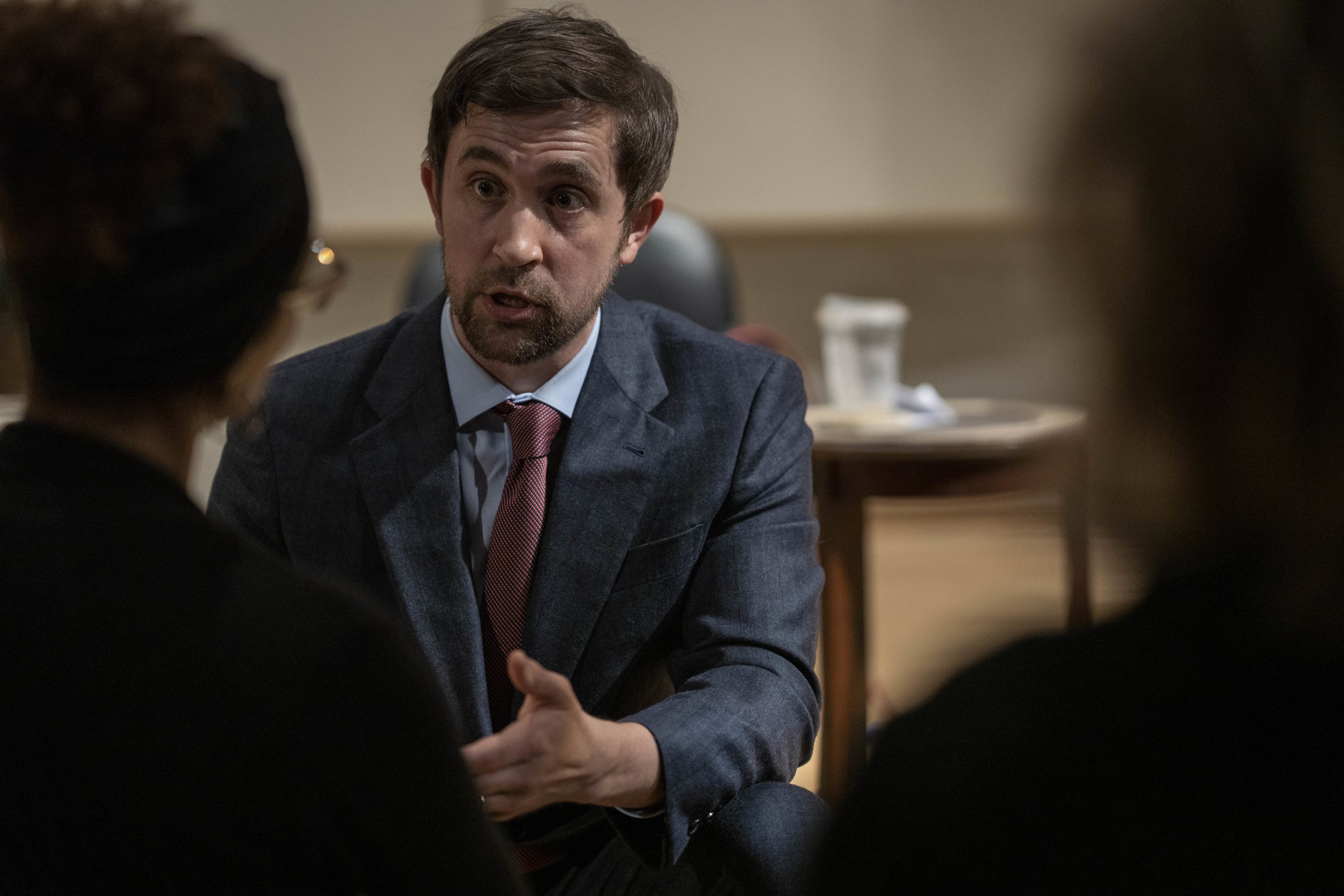
LAST WEEK’S RIGHT-WING FREAKOUT over the Cracker Barrel logo redesign—apparently amounting to white-guy erasure—had more than its share of sublimely ridiculous moments. But none, perhaps, were more emblematic of the current “anti-woke” crusade than the call to action from author, activist, and Manhattan Institute fellow Chris Rufo.

The over-the-top grandiosity (“The Barrel must be broken”!), the Carthago delenda est militancy, the explicit threat of coercion, the exact mirroring of “woke” zealotry seeking to purge any hint of racism or other bigotry: It’s rare to pack so much culture-war toxicity into one short post over something that matters so little. Of course, what also makes it noteworthy is that Rufo isn’t just some random social-media blowhard. In recent months, he has emerged as the unofficial ideologue of the Trumpian assault on the liberal cultural establishment.
BACK WHEN RUFO WAS FIGHTING his anti-woke battles under the Joe Biden presidency, his critics—myself among them—warned that his goal of smashing cultural progressivism, which he explicitly hitched to Donald Trump’s bandwagon, called for thinly veiled authoritarian strategies. Writing in Compact in July 2024, Rufo praised Viktor Orbán’s government in Hungary for its willingness to use its muscle to “disrupt the socialist left’s soft-power hegemony” and “create an enduring conservative counter-hegemony” via “far-reaching reforms in schools, universities, nonprofits, media, and government.” (These reforms included having media organizations taken over either by the government or by Orbán-friendly tycoons.) While Rufo was frank about his view that the Orbánist model offered “a lesson” to American conservatives, he also acknowledged that Hungary’s policies “cannot be exported in toto and do not transpose neatly onto America’s more complex and dynamic society.” Nonetheless, I wondered at the time just what ideas he had for the second Trump presidency.
Well, wonder no more.
Rufo hasn’t simply cheered the administration’s push to strong-arm major universities into submission: He has a more radical plan of action. Last month, under the auspices of the Manhattan Institute, the think tank where he is a senior fellow, he unveiled a manifesto billed as “the Manhattan Statement on Higher Education,” signed by some fifty mostly right-wing and Trump-friendly academics, intellectuals and pundits (among them Jordan Peterson, Victor Davis Hanson, Ayaan Hirsi Ali, Yoram Hazony, and Ben Shapiro). This document urges the coyly unnamed “President of the United States” to carry out a de facto takeover of American universities—specifically, to “draft a new contract with the universities, which should be written into every grant, payment, loan, eligibility, and accreditation, and punishable by revocation of all public benefit.”
Many principles articulated in this “contract” sound superficially noble: “truth over ideology,” “rigorous standards of academic conduct,” race-neutral and merit-based admissions and hiring, freedom of speech and debate, strict measures against violent or intimidating protests, etc. But, as legal scholar Walter Olson has noted (both in the Unpopulist and on a Bulwark podcast), empowering this administration in particular to enforce these vague clauses is a broad invitation to authoritarian diktat. Does freedom of speech and debate extend to critics of Israel and supporters of Palestinian rights, especially if they are not U.S. citizens? (Ask Rumeysa Öztürk, the Tufts Ph.D. student detained for forty-five days over an op-ed.) Could a researcher whose findings irked Trump be canceled for failing to meet “rigorous standards”? (Ask the newly unemployed Bureau of Labor Statistics commissioner.) Olson, himself a longtime critic of the abuses of academic leftism, believes that the “Manhattan Statement” cynically invokes liberal values in order to throw them under the Trumpian bus, sacrificing one of the most hallowed Western liberal traditions: academic independence.
With its call for authoritarian muscle-flexing, the “Manhattan Statement” has drawn criticism from other supporters of academic reform who share some of its ideas, such as the Heterodox Academy. Rufo’s response to such critiques is standard: He says his centrist and liberal critics are weenies who can’t get anything done and “lash out at those of us who have scored real-world wins.” Tellingly, Rufo also makes it clear that he’s not really down with the whole viewpoint diversity thing:

Viewpoint diversity would entail “adding witch doctors to a medical school”? Whatever you say, Chris. (Also: Before you go mocking witch doctors, you should check out the top medical official appointed by the president you cheerlead for, or the surgeon general appointed by the Florida governor who has you on his team.) It’s no less absurd to suggest that viewpoint diversity is somehow at odds with “truth-seeking” and commitment to civil discourse or equality. (The Heterodox Academy “reform agenda” includes “knowledge-seeking,” open inquiry, and disagreement and debate as core academic skills.) It’s almost as if Rufo’s beef with viewpoint diversity as a goal of academic reform was actually about something else. Something, perhaps, like the kind of conservative agenda he praises the Orbán regime for promoting in its coercive reform of cultural institutions—intended, according to his 2024 piece, “to strengthen . . . family life, Christian faith, and historical memory.”
BESIDES HIS POSITION as the Trump administration’s court intellectual, Rufo also doubles as a leader of right-wing social media mobs practicing exactly the kind of “cancel culture” he and his allies have so energetically denounced on the left. Before the Cracker Barrel drama, there was the controversy over New Yorker writer Doreen St. Felix, who offended the right with a fairly anodyne essay analyzing the cultural politics of the American Eagle “Sydney Sweeney has great jeans” ad with its play on “genes/jeans” and its references to Sweeney’s blue eyes and blond hair. While St. Felix’s detractors claimed that she referred to Sweeney as an “Aryan princess,” what she actually wrote—as even the screenshot shared by Rufo showed—was that Sweeney had a legion of adoring fans “the most extreme of whom want to recruit her as an Aryan princess.” The entire point of St. Felix’s piece was that the controversy was meaningless: Some negative voices on the left followed by a splash of right-wing outrage.
In Rufo’s hands, though, the outrage turned against St. Felix when her unearthed old tweets—from 2014 and 2015, when “the Great Awokening” was first taking off and St. Felix was 22–23 years old—led to accusations that she was a militant anti-white racist.1 To be clear: many of those posts are pretty ugly stuff. (St. Felix has now deleted her X account, but screenshots of the offending tweets have been collected in various places.) Some were general comments about “whiteness,” which can at least be explained as referring to white supremacist cultural norms; others, however, not only explicitly bashed white people but repeatedly disparaged discussions of the Holocaust as allowing whites “to step out of their whiteness and slip on fake oppression.”
Bad? Of course. But given that these are a college-age woman’s posts from ten or eleven years ago, airing them smacks of the sort of “offense archeology” that the anti-woke have decried as one of the worst attributes of left-wing “cancel culture”—especially when the airing is accompanied by a mob calling for the offender’s head. Some “cancel culture” critics, including blogger and podcaster Meghan Daum, spoke up to object. Not Rufo, though; he showed up brandishing his pitchfork.

Yet it turns out that Rufo doesn’t have a problem with all race hatred. Remember when it was revealed that a member of Elon Musk’s DOGE team, Marko Elez—previously a SpaceX employee—had posted a string of inflammatory tweets like “Just for the record, I was racist before it was cool,” “You could not pay me to marry outside of my ethnicity” and “Normalize Indian hate”? Those comments were made in the summer and fall of 2024—three to seven months, not ten to eleven years, before they were uncovered. Elez resigned after the Wall Street Journal reported the posts—but quickly found support in the MAGA camp. Vice President JD Vance stepped in to defend him on the very same day. Tech entrepreneur Balaji Srinivasan explained that “giving a single inch to a journo” was unacceptable and that “the entire practice of digging through people’s old posts to find some negative remark should be deprecated.”
And guess who else weighed in!


During the Doreen St. Felix controversy, writer Sam Adler-Bell posted the screenshots of Rufo’s defense of Elez, noting that “‘Cancel culture for thee and not for me’ is @realchrisrufo’s entire worldview and sole contribution to the practice of conservative politics.” One might also add that Rufo has not (so far as I know) said a word about other people with a record of very recent “weapons-grade race hatred” in the social media holding fairly prominent posts in the Trump administration.
But here’s the thing: Calling out Rufo on such hypocrisy has no effect. It bounces right off him. He’s quite open about wanting to help his friends and hurt his enemies. Principles are for the weak and ineffective.
RUFO IS ALSO, BY THE WAY, increasingly masks-off about his authoritarian sympathies.

Leaving aside Argentina’s libertarian president Javier Milei, who shares the Trumpian predilection for norm-breaking but is also in many ways the opposite of MAGA populism, two of the three leaders Rufo admiringly cites are corrupt authoritarians. The Orbán regime’s anti-migrant stance has included a crackdown on nonprofit groups that aid refugees or support immigration. The shocking human rights abuses on which Bukele’s anti-crime drive is founded have recently been in the spotlight because of the lawless deportations of Venezuelan migrants from the United States to El Salvador’s notorious CECOT megaprison. Bukele has also recently scrapped presidential term limits, with a view to becoming president for life.
The other day, Rufo was a guest on Bill Maher’s Real Time on HBO. When Maher voiced concern that the militarization of policing in Washington, D.C. could be intended to pave the way for an authoritarian coup, Rufo was dismissive, asserting that Trump had no motive other than the stated one: to bring crime in the city under control. As for Trump’s open flirting with a third-term run in 2028? Just trolling, said Rufo: “I wouldn’t worry about it.” But given Rufo’s increasingly candid strongman worship, I don’t think it’s too paranoid to ask at this point whether he would see an actual authoritarian coup as something to worry about—or something to cheer.
Correction (August 25, 2025, 6:50 p.m. EDT): As originally published, the second instance of “St. Felix” in this sentence mistakenly read “Sweeney,” due to an error that arose during editing.
A fantastic piece. Beautifully reasoned and written, as your writing always is. Thank you!
I saw that douchebag on Bill Maher the other night.
I had never heard of him before .
Another right wing nut job dressed nicely and speaking in measured words, I don't know where these people come from.
I noticed he had a wedding band on and wondered what woman could tie herself to such a creep.
Where do these young, know it all men come from?