How the GOP Brought Trump Back from the Dead
A new book reveals his surprise that his supposed opponents defended him at a low point in his post-presidency.


Just days after the Pentagon canceled a weapons shipment to Ukraine, President Trump has ordered more weapons to be sent over. “They have to be able to defend themselves,” Trump said, referring to the Ukrainians. “They’re getting hit very hard now.”
The shipment that was canceled last week included missile interceptors that the Ukrainians need to defend their cities and that they can’t get from anywhere else. The new shipment Trump ordered will reportedly be those interceptors, though not as many as initially planned.
Trump made the right call here. But as Gen. Mark Hertling pointed out a few days ago, part of the problem with the initial cancellation was that it was made without any coordinated policy process, apparently on the whim of the Secretary of Defense. Having one whim cancel out another is no way to run a superpower.
Happy Tuesday.
Enthusiastic Surrender
by Sam Stein
Is Donald Trump a stronger and more skilled politician than he was eight years ago—or are the guardrails that once hindered him just weaker?
That question has come up often over the last six months as Trump has enjoyed a series of successes that eluded him during his first term in office. Clearly, he has used the power of the presidency in ways neither he nor any prior president has before. He hasn’t just changed the shape and direction of the executive branch and moved his agenda through Congress, but reshaped entire sectors of American society—from academia, to entertainment, to the law itself.
Yet what has stood out along the way is not how far Trump has pushed the envelope but how little resistance he’s encountered. In yesterday’s newsletter, Bill delved into the crevices of Trump’s mind to imagine the glee he must feel about how frictionless it has all been. Trump hasn’t had to put up much of a fight. He seems totally aware of—and perhaps even liberated by—how subservient everyone around him has been, especially his fellow Republicans.
That subservience wasn’t nearly as prevalent during Trump’s first term. Nor did it sprout up after November 5, 2024. Rather, it took root in between the two Trump administrations, as documented in 2024: How Trump Retook the White House and the Democrats Lost America, a new book out today by Josh Dawsey, Tyler Pager, and Isaac Arnsdorf.
The book is a richly reported look at the three distinct storylines that made up the last election: Joe Biden’s fall, Kamala Harris’s scramble, and Trump’s resurrection. The last of the three may have seemed like the most covered. But there are vignettes in 2024 that are new, and they serve as powerful reminders of just how quickly, fully, and unilaterally the Republican party chose to acquiesce to Trump during a period many took to be his political nadir.
Perhaps the most telling and startling moment recounted in the book happened the day after the January 6th attack on the Capitol, during a meeting between then–RNC Chairwoman Ronna McDaniel and RNC members. While with these lawmakers who had just witnessed the violent mob’s attempt to take over the Capitol, she put Trump on speakerphone “letting him hear them shout, ‘We love you!’”
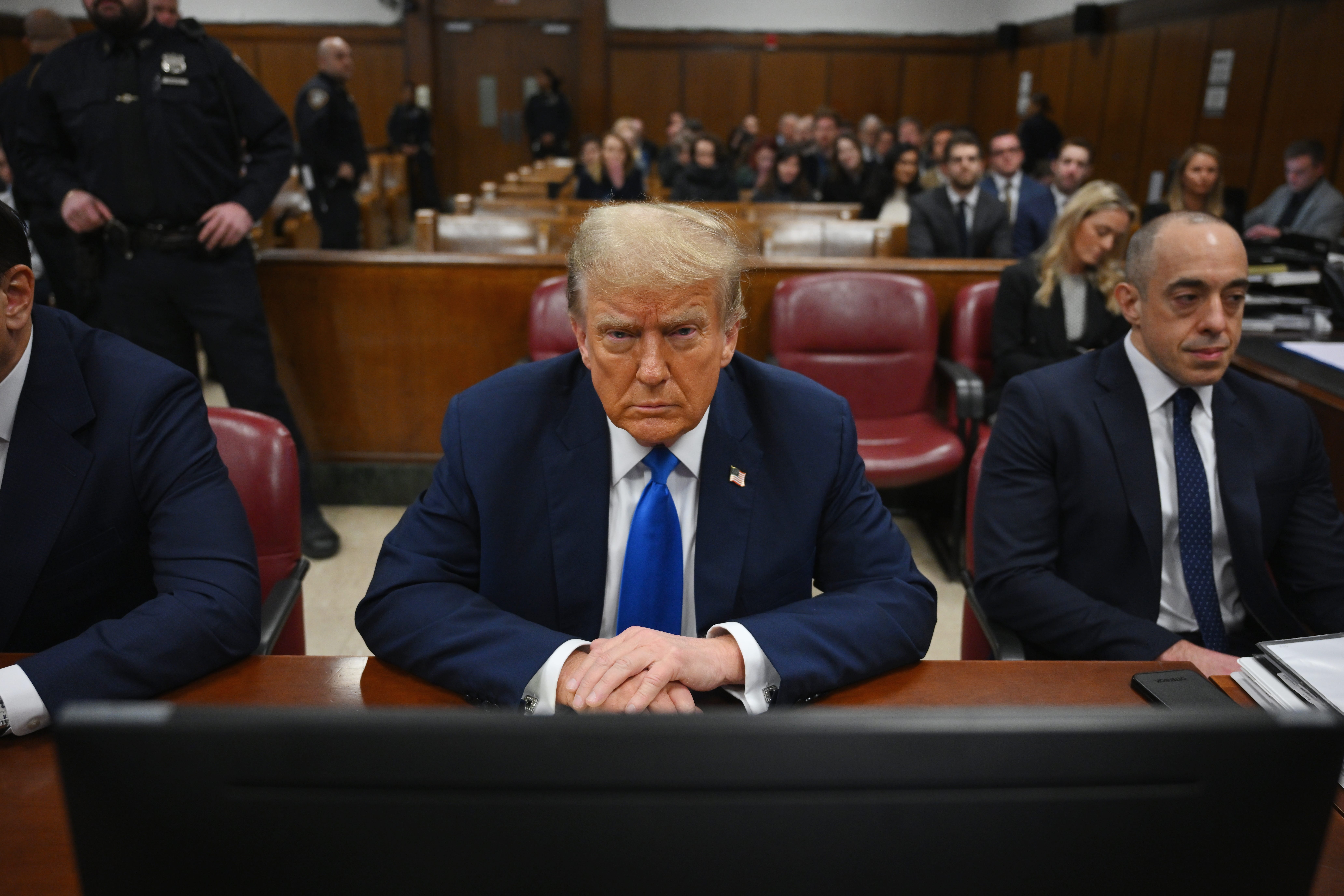
Expressing affection for the man who had inspired the attack on the Capitol and threatened the peaceful transfer of power may seem like an act of ignoble groveling. (And it was.) But such acts would come to define Trump’s period in exile. Two years later, Trump was indicted in the hush-money case in New York. After stewing on the plane ride home to Mar-a-Lago, he woke up the next day to an “outpouring of support from Republicans.” The Trump campaign, the authors report, quickly fielded polls showing that his support in the Republican primary was topping 50 percent and growing.
The more Trump came under fire, the firmer his support would grow among Republicans. The authors report that Sen. Rick Scott (R-Fla.) briefly reconsidered his decision not to run for president as his home state governor, Ron DeSantis, stumbled. But then he saw the results of voter research he commissioned:
In one focus group, when Trump supporters were shown the facts about his shortcomings on building a border wall, one woman explained that Trump must have done that on purpose, in order to funnel the migrants through gaps where they could be apprehended more readily. Scott decided to stay out of the race.
As for DeSantis’s camp, they found it maddening that Trump’s political standing kept getting stronger as his personal standing weakened. Unable to reach Republican voters as Trump’s indictments dominated the news, campaign aides “began to joke that maybe DeSantis should try getting arrested.”
By the time of the first GOP primary debate, several key figures assumed the contest was finished. Every candidate was asked if they’d vote for Trump if he was convicted in a court of law. All but two, former New Jersey Gov. Chris Christie and former Arkansas Gov. Asa Hutchinson, put up their hands. Christie, who eight years earlier was one of the first Republican politicians to endorse Trump, would go on to tell the authors that he was stunned by “the fact that these folks would absolutely prostitute themselves that way.” He would add: “That’s the day the primary ended.”
It was a conclusion McDaniel reached, too. She privately told her team that night, “This is over.”
It’s hard not to wonder how Trump must have felt in these moments. He was not even on the debate stage that night, but nearly all his “opponents” seemed eager to take his side. Years earlier, he was on the precipice of being impeached for the second time, and he got a rousing attaboy from RNC members. The man gets indicted for hiding a hush-money payment to a porn star, and his numbers go up!
Yes, Trump has benefited from the perception that he’s the subject of political prosecution—few play the victim card as aggressively or as skillfully. And yes, he has cultivated immense loyalty among his base over the years—often by putting loyalists in positions of power. But as we marvel at the political powers Trump now possesses, it’s worth noting how infrequently he has been challenged from within his own party, not because they agree with everything he does, but because they simply don’t seem interested in trying. At times, even Trump himself couldn’t quite believe how easy he had it.
“I was a little surprised,” he told the 2024 authors of the fact other Republicans rallied to his defense after the hush money indictment. “I was impressed because they were campaigning against me.”
AROUND THE BULWARK
As the Dalai Lama Turns 90, Dangerous Questions Loom for Tibet… China is planning for the death of the globally admired spiritual leader. The United States should prepare as well, observes ELLEN BORK.
Conspiracy! It was a big weekend for Jeffrey Epstein and Elon Musk news. JVL and SARAH LONGWELL break it all down on The Secret Podcast.
MAGA World’s Mega Meltdown Over Latest Epstein Flop… The online right wants the attorney general fired after being told that the disgraced sex trafficker did not, in fact, have a client list. WILL SOMMER explains at False Flag.
Quick Hits
YOU GET A TARIFF, AND YOU GET A TARIFF: In apparent preparation for the resumption of the “Liberation Day” tariffs, Donald Trump on Monday posted a series of images of nearly identical letters to foreign leaders promising “Tariffs” of various percentages. These new taxes on Americans were in response to “Tariff, and Non Tariff, Policies and Trade Barriers” and aimed supposedly at “balanced, and fair, TRADE.” It’s not immediately clear if these letters, typed up on White House stationery and signed with Trump’s trademark Sharpie, were actually sent to foreign leaders or merely posed on Truth Social with the expectation that the world’s princes and potentates would see them.
On Sunday, Trump had promised that “the UNITED STATES TARIFF Letters, and/or Deals, with various Countries from around the World, will be delivered starting 12:00 P.M. (Eastern), Monday, July 7th.” So maybe this is what he was talking about? Presumably, these are the letters, since the deals appear to be scarce.
The list of countries receiving the posted letters is a bit of a jumble: Bangladesh, Bosnia and Herzegovina, Cambodia, Indonesia, Japan, Kazakhstan, Laos, Malaysia, Myanmar, Serbia, South Africa, South Korea, Thailand, and Tunisia. It could be that Trump had Scott Bessent spin a globe while his son Barron shot a paintball gun at it. If you have a more plausible theory for why or how he came up with this list, please drop it in the comments section.
Naturally, every letter ended with one of Trump’s favorite new phrases: “Thank you for your attention to this matter!” (Presumably, “groceries!” just didn’t hit the right tone.) In any case, Mr. President: You’re welcome, I guess?
CAN’T THEY BOTH LOSE?: Yesterday was the first day of trading since Elon Musk announced that he was going to start his own political party and earned a denunciation from Donald Trump. And wouldn’t you know it: Shares in Tesla fell 7 percent. As a business matter, it’s a bad thing when the boss of the company that depends deeply on federal policy for profitability gets crosswise with an increasingly authoritarian president. But it’s hard to imagine the stock wouldn’t have fallen further save for the fact that some investors probably figured the company would do better if Musk spent his time on other things.
It’s been a run of bad luck for Tesla. The company’s stock price is down more than 30 percent since Trump’s first full day in office, and almost 40 percent from its previous peak in December. Last week, the company reported a 13.5 percent drop in global sales in the second quarter of the year. That followed a 13 percent drop in the first quarter of the year—all as the market for electric vehicles is growing.
There seems to be so little accountability in America for rich, powerful people who do awful things; Tesla’s stock-price falloff is a welcome change in that regard. Now if only it could be just a little more common.
DEPORTATION CAROUSEL: The government wants to deport Kilmar Abrego Garcia, again. Well, maybe. They’re not really sure. That’s the crux of the argument the Justice Department made in court Monday in the latest episode of the drama involving the Trump administration’s most notable deportee. Just to review the timeline: First, the government deported Garcia to a foreign torture prison. Then they said that it was a mistake since there was a court order against sending him to El Salvador—whoops! Then they fired the guy who said it was a mistake and said they actually had meant to do it because he was (they claim) a gang member.1 Then the Supreme Court ordered them to facilitate his return. Then they said they didn’t have the power to bring him back even if they could. Then they did bring him back to the United States—still incarcerated—to stand trial. When a judge ordered that he be released before trial, Abrego Garcia’s lawyer asked that he not be released, because they assumed the government would simply swoop in and deport him once again. Then the government said it was “fake news” that they wanted to deport him again. Now they say maybe they will.
Usually, the Trump administration’s incompetence is slightly reassuring, because it tempers their ambitions to accomplish terrible things. But the handling of deportations has been different. It’s an ongoing gross violation of human rights. With billions of dollars and potentially thousands of new recruits flowing into ICE thanks to the newly enacted Republican budget, what we see in the future might be much, much worse.
SNITCHES AND STITCHES: The Department of Health and Human Services sent an email to its workforce on Monday titled “DEI Whistle-blower Questionnaire.” In it, the department’s leadership asked recipients to rat out the behavior of their colleagues, specifying five separate grounds for doing so: Had they “witnessed any grants, contracts or training materials with discriminatory language?” Did they know of “anyone who was passed over for promotion/hiring due to race, gender, national origin, age, disability, or genetic information?” Did they know of any “former career employees who quit or faced discipline during the previous administration” for not carrying out a DEI order? Could they identify DEI policies that had “caused discrimination against employees, contractors, or members of the general public”? And did they have anything else relevant to add on this matter? To move things along, HHS created a helpful online form to organize the submissions.
The email, sent along by two recipients to The Bulwark, is yet more affirmation that the anti-DEI crusade continues to be one of the leading ideological causes of the Trump administration. And it serves as a reminder that an agency ostensibly devoted to furthering America’s health and well-being remains wildly distracted by secondary culture wars. “They’re breaking out the oldies,” one of the recipients told us, adding that they planned to ignore the questionnaire.
—Sam Stein
Cheap Shots

This accusation is, to say the very least, not proven.
"In one focus group, when Trump supporters were shown the facts about his shortcomings on building a border wall, one woman explained that Trump must have done that on purpose, in order to funnel the migrants through gaps where they could be apprehended more readily. Scott decided to stay out of the race."
In other words, this woman and millions of others like her are simply unreachable. You can't reason with people like this. If anyone still wonders why my views on the electorate and democracy are like H.L. Menken's cranked to 120 dB, it's because of people like this.
The reason this felon is in our lives, ruining our country, and shredding flesh from civic bone is questions like this, questions that genuflect before the absurd premise that he might be gifted at anything beyond spectacle. This isn’t talent. It is demolition by default. A wrecking ball obeys gravity; the press sees the rubble and calls it strategy, then gasps at the dust cloud as if it were deliberate choreography.
He cannot parse a briefing longer than a sandwich wrapper, cannot pronounce half the surnames on the world stage, cannot recall which amendment protects free speech. Still, columns appear praising his “intuitive feel for the electorate.” That intuition looks like a man flipping coin after coin until one lands heads, then proclaiming mastery of probability while the newsroom tallies his “wins.”
He signed checks to silence a porn star, bullied state officials to conjure phantom votes, and spurred a mob to attack his own government. None of it required guile; it required only brazenness and a crowd conditioned to mistake volume for conviction. The true marvel is not his rise but our surrender. A media ecosystem so haunted by accusations of bias that it canonizes failure as innovation, packaging each stumble in velvet language until the public forgets what competence ever looked like.
Call him what he is:
A mediocre con artist fattened on airtime, armored by euphemism, propelled through history by outlets allergic to calling him what he is. Strip away the soft focus, the “both-sides” hedges, the breathless horse-race polling, and the myth shrivels. Leave the cameras running without the commentary, and the nation would see a man lost in his own sentences, bluffing through governance like a gambler who never learned the rules of the game.
Until that unvarnished portrait dominates the front page, the wrecking ball will keep swinging, gravity will keep pulling, and every crushed institution will be mistaken for proof of his might rather than evidence of our collective reluctance to yell “Stop.”