It’s Hard to Believe This Is the Situation We Face
And somehow we are still underestimating the danger.


One of the smartest things Donald Trump’s political team has done this year has been to yank the leash of Health and Human Services Secretary Robert F. Kennedy Jr., because all his anti-vaccine growling and snapping was understandably making Americans jumpy. But as the Wall Street Journal reports today, that strategic shift has left one important person grumpy: Trump himself. He has repeatedly asked Kennedy this year why he hasn’t prioritized finding a connection between vaccines and autism, and has told aides his secretary “will be a failure if he doesn’t make progress on the issue.” Happy Tuesday.
If you’re enjoying Morning Shots, check out the rest of what The Bulwark has to offer. Try a Bulwark+ membership free for two weeks—we think you’ll like it, and we’d love to have you in our community.
Join Bill and Andrew for Morning Shots Live at 10:00 a.m. EDT on Substack and YouTube.
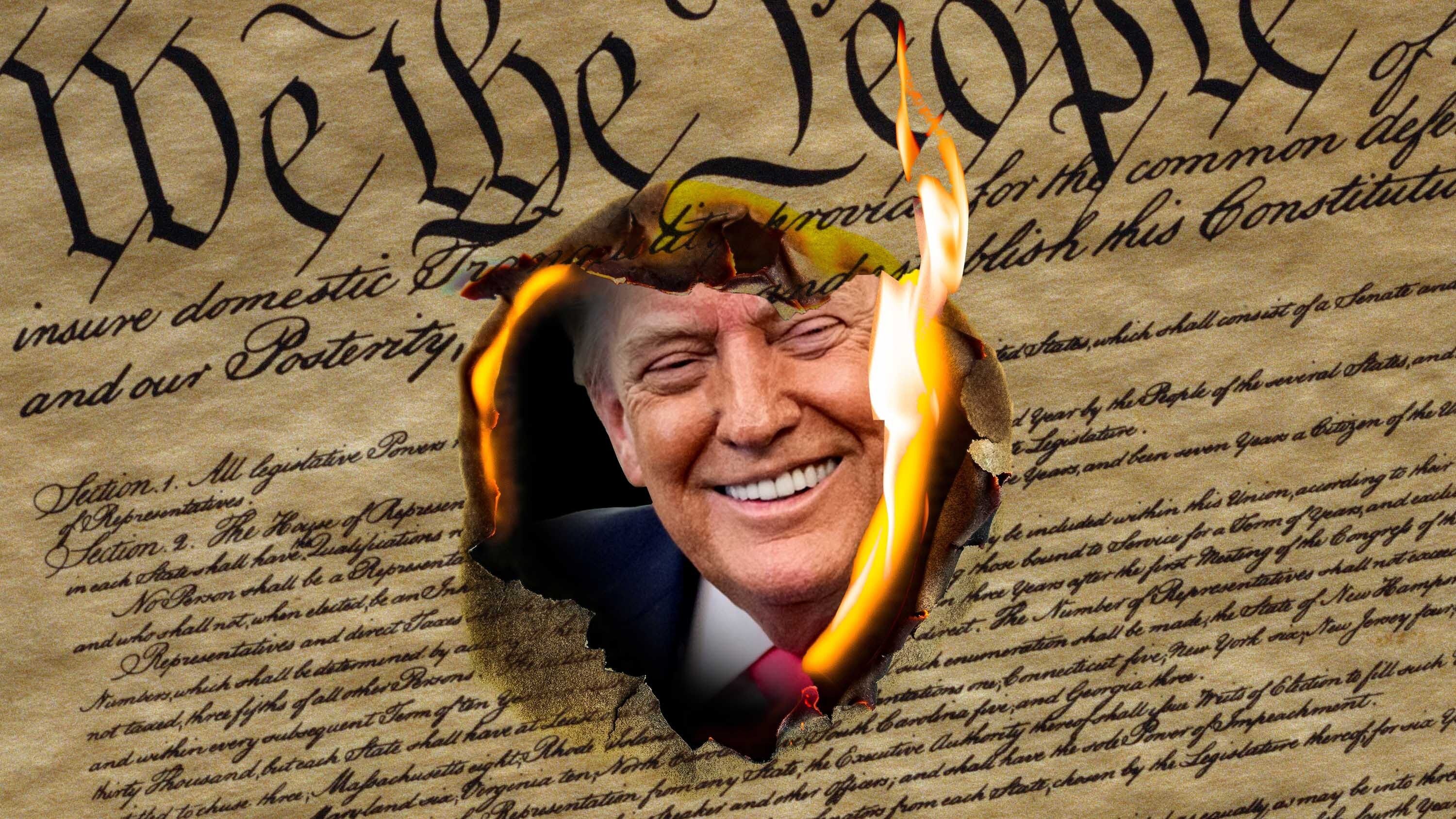
Be Alarmed. Very Alarmed.
by William Kristol
Can you believe it? How many times have we said that—sometimes plaintively, sometimes mockingly, sometimes indignantly, sometimes angrily, sometimes mournfully—over the last decade?
It’s a reasonable sentiment. Incredulity, surprise, shock, horror—these are normal and healthy reactions to Trumpism. In particular, they’re normal American reactions to Trumpism. It wasn’t supposed to happen here or now. Yes, we’ve had problems and challenges and difficulties here, but we’d weathered them, or at least were dealing with them. If you were a conservative, you were confident that America and Americans were still exceptional. If you were a liberal, you were confident that the arc of history bent towards justice. Either way, excessive confidence tended to produce a kind of complacency. It couldn’t really happen here.
Well, it’s happening. The assault on our political liberties and our civic decency, on our polity and on our society, is happening. The pace and degree at which it’s moved is hard to believe. But our surprise is a product of a complacency that we haven’t yet quite shed.
The 28-year-old Abraham Lincoln understood that this might happen, way back in 1838, when he delivered his great address on “The Perpetuation of Our Political Institutions” before the Young Men’s Lyceum of Springfield, Illinois. All seemed well in a free and prosperous and growing America, and Lincoln begins where his audience is, by trying to capture or echo that sentiment.
In the great journal of things happening under the sun, we, the American People, find our account running, under date of the nineteenth century of the Christian era. We find ourselves in the peaceful possession of the fairest portion of the earth, as regards extent of territory, fertility of soil, and salubrity of climate. We find ourselves under the government of a system of political institutions, conducing more essentially to the ends of civil and religious liberty, than any of which the history of former times tells us. We, when mounting the stage of existence, found ourselves the legal inheritors of these fundamental blessings.
It’s great to be an inheritor of blessings. But, Lincoln suggests, blessings can blind us to dangers. And so we need to focus not on our inheritance but on our task.
We toiled not in the acquirement or establishment of them—they are a legacy bequeathed us, by a once hardy, brave, and patriotic, but now lamented and departed race of ancestors. Theirs was the task (and nobly they performed it) to possess themselves, and through themselves, us, of this goodly land; and to uprear upon its hills and its valleys, a political edifice of liberty and equal rights; ’tis ours only, to transmit these, the former, unprofaned by the foot of an invader; the latter, undecayed by the lapse of time and untorn by usurpation, to the latest generation that fate shall permit the world to know. This task of gratitude to our fathers, justice to ourselves, duty to posterity, and love for our species in general, all imperatively require us faithfully to perform.
And, Lincoln suggests in the rest of his speech, his contemporaries weren’t yet sufficiently focused on our task. And he reminded them that they certainly couldn’t take the successful completion of that task for granted. “I hope I am over wary; but if I am not, there is, even now, something of ill-omen, amongst us.” In the relatively calm and peaceful circumstances of 1838, Lincoln saw failure ahead. And failure came.
We’re not in the situation of the young Lincoln. We’re closer to the one he faced two decades later. Our failure is, obviously, far less dramatic than the failure the nation faced in the late 1850s. But our failure is one for which we have less of an excuse. We in the twenty-first century didn’t have to figure out how to deal with the nightmare of slavery. We just had to improve on a reasonably stable and successful order at home and in the world, one bequeathed to us by our ancestors.
We haven’t done that. Quite the contrary. Ten years of Trumpism mark not only a failure to preserve that order, but the infliction of real harm done to it. As we look around at the state of our institutions laboriously built up—a comparatively fair system of justice at home, a relatively honest federal government, an attempt to live up to our heritage as a nation of immigrants, and an international order that was comparatively stable and friendly to the forces of freedom—it’s hard to believe how much damage has been done in the past decade. With a dramatic acceleration, of course, in the past eighteen months.
It is hard for many of us—and I include myself in this number—to believe that this is the situation we face. But it’s time to believe it. Only then might we rise to the occasion.
AROUND THE BULWARK
Elbridge Colby and the Art of Defending the Indefensible… Trump’s impulsive foreign policy of grudges, threats, and contempt for allies is a self-defeating mess. His suave sophist struggles to spin it as strategically sound, writes JOSEPH STIEB.
Taking a Wrecking Ball to the Military… Not only has our lousy commander-in-chief allowed the country’s missile inventory to be dramatically depleted, but Hegseth’s politicized hiring and firing of officers has come home to roost and is doing real damage to the military as an institution. JOHN HEILEMANN joins BILL KRISTOL on the flagship podcast.
Laura Loomer’s About-Face on Ukraine Baffles Allies… “You’ve got to ask yourself what in the name of sweet holy hell is going on here?” WILL SOMMER reports on Loomer’s abrupt reversal.
Mitch McConnell Releases Another “Proof of Life” Photograph… ANDREW EGGER joins JVL on Bulwark Takes to discuss McConnell’s “still working hard” to get back to the Senate claim, but the only proof of life we’ve gotten is two photos and a statement from his physician.
Quick Hits
ONE WEIRD TRICK TO FEDERALIZE ELECTIONS: Donald Trump’s been dealt some stinging losses at the Supreme Court lately, but hope springs eternal. Yesterday, the president asked SCOTUS to lift a lower court’s stay on a sweeping elections executive order he issued in March, which would require states to compile lists of eligible voters based on federal data, forbid the Postal Service from mailing ballots to people not on those lists, and withhold federal funding from states that don’t play ball. WaPo has more:
Nearly two dozen states and the District of Columbia sued the Trump administration soon after the order was issued, arguing that it was unlawful and its true goal was voter suppression. They said the lists were likely to miss many eligible voters.
“The President’s latest attempt to interfere with the States’ administration of their elections is as unprecedented as it is unconstitutional,” the states wrote in their lawsuit. “Under our Constitution, the President has no authority to restrict voter eligibility or mail voting to lists of voters pre-authorized by the federal government.” . . .
The Supreme Court gave the states until Monday to respond to the administration’s appeal. The justices could rule after the administration responds to the states’ filing.
Trump, who continues to view his Save America Act as his highest domestic priority this year, has long viewed this executive order as his fallback option. “There will be Voter I.D. for the Midterm Elections, whether approved by Congress or not!” the president wrote on Truth Social the week the bill passed the House in February. “The people of our Country are insisting on Citizenship, and no Mail-In Ballots. . . . If we can’t get it through Congress, there are legal reasons why this SCAM is not permitted. I will be presenting them shortly, in the form of an Executive Order.”
WHO ARE YOU CALLING AN OGRE?: Michigan’s Democratic Senate primary is shaping up to be one of the ugliest of the year, as the contest between Rep. Haley Stevens and epidemiologist Abdul El-Sayed becomes a proxy war between the old-school Democratic party and its left-wing insurgents, including the Democratic Socialists of America. Yesterday, the fight intensified after Politico obtained audio of El-Sayed using colorful rhetoric while talking about using primaries to push the party to the left: “You put one ogre on a pike, and then everyone else gets the message, and all of a sudden starts to sound a lot different.”
The remark scandalized a number of prominent Democrats (and Stevens supporters), with Rep. Hillary Scholten tutting that “violent, vulgar threats have no place in a democratic electoral contest,” especially at a moment “with political violence on the rise.” Others took a different tack: Center for American Progress President Neera Tanden tweeted that “calling your female opponent an ogre you want to put on a pike is not beating the rap that this race has some serious sexism.”
This is a bit silly: El-Sayed was transparently talking figuratively about primary wins, not threatening violence, and in context it seemed clear that the “ogre” he meant wasn’t Stevens, but Sen. John Fetterman (D?-Pa.). We’re personally a little more concerned about the actual content of the remark and the strategy it lays out for channeling anti-establishment sentiment into shoving the party hard to the left. Seems bad!
CRACKER BARREL BLUES: Faithful Morning Shots readers will recall our coverage last summer of the unfortunate rebrand of the old-timey casual-dining chain Cracker Barrel—a doomed attempt to lure some non-retirees back to the restaurant by simplifying the logo and slapping on a coat of Millennial Gray paint that instead kicked off a giant MAGA backlash over the changes’ supposed “wokeness.” (“We must break the Barrel,” proclaimed activist Chris Rufo, with a typical lack of irony.)
Cracker Barrel immediately backed off the change. And yesterday, the critics got another scalp: The company announced that CEO Julie Masino, who presided over the abortive facelift, will step down next month. The top job now goes to former Bloomin’ Brands executive David Deno, who will inherit the thankless job of trying to find new customers to backfill its dying ones without re-infuriating the rest of their customers by changing anything. It just goes to show: Not all rebrands are as smooth, painless, and universally appreciated as The Bulwark’s has been.1
Cheap Shots
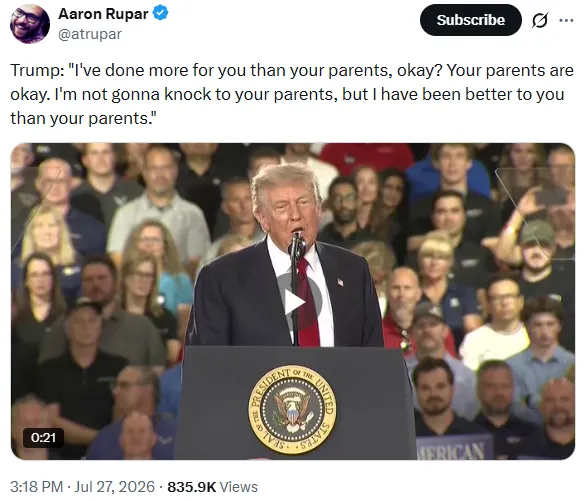
;)
Bill: "The assault on our political liberties and our civic decency, on our polity and on our society, is happening."
The electorate doesn't care about civic decency. If it did, Trump wouldn't have won in 2016 after the "Access Hollywood" story came out. Look how many indecent people the electorate has sent to Congress. Look at how many indecent people that have been elected at the state level. The sooner we admit the electorate is rotten to the core, the better off we'll be in the long term.
I’ve often quoted Lincoln’s Young Men of Lyceum address to show how he had warned of national suicide. And this Morning Shots is completely correct that for far too many people, the concept of it happening was alien as something that “couldn’t happen here.”
It was why, in the run up to the ‘24 election, I warned repeatedly on social media that the claim that it couldn’t happen here was the last words uttered by every nation where it did happen.