John Candy and the Life Well Lived
Plus: South Park and the life poorly lived.

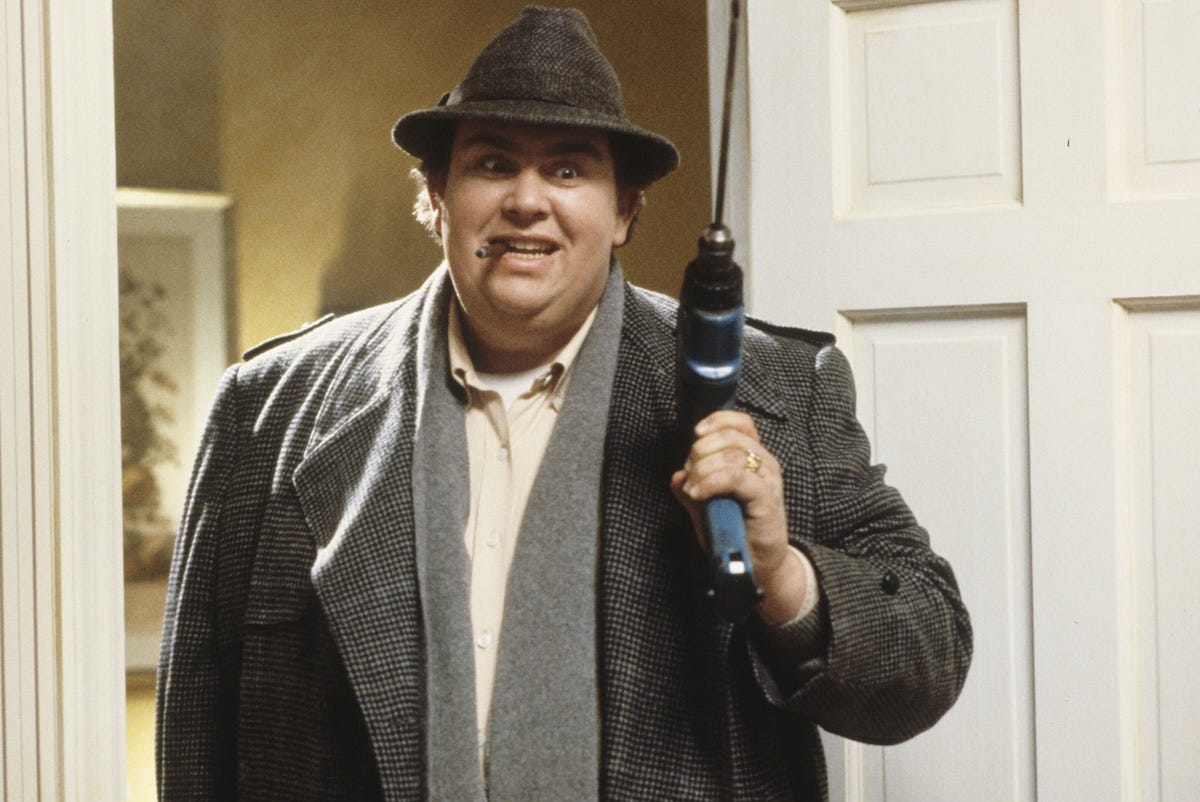
There’s a stylistic choice in John Candy: I Like Me—Amazon’s pretty straightforward talking-heads documentary—that jumped out at me. There’s a timer of sorts, set to a year: 1994. It’s the year that John Candy died, at the age of 43. As we go through the years of his life, this timer spins down from 1994 to whichever year we’re looking at: his birth, in 1950, say. And then at the start of each succeeding sequence, we’re at 1994 and it spins down again, to, say, 1987, when he hooks up with John Hughes for Planes, Trains and Automobiles.
Again, this is a pretty uncomplicated doc, not heavy on stylistic quirks. But this tic is simple and gutting. It’s a countdown, an inexorable march toward tragedy, all the more tragic because Candy himself is so beloved.
John Candy: I Like Me barely feels like a documentary. There’s no dark secret here, there’s no investigation uncovering some profound, hidden truth. It is, frequently, a collection of rich and famous people talking about their rich and famous friend and how great he was. It is directed by a rich and famous guy, Colin Hanks, who calls on his rich and famous dad, Tom, to be one of the people talking about the rich and famous comedian. Normally, this sort of thing would be tedious if not outright insulting.
But the movie works, and the movie works because John Candy is beloved. Not just by us, the viewers of his movies. By his friends and family, who, to a person, can muster up zero bad things to say about the guy. (Indeed, the opening interview with Bill Murray features Murray wishing he could think of something ugly to say about his Stripes costar.) Candy may have been a good Catholic but he wasn’t a literal saint; I’m sure he wronged someone somewhere in his march through the institutions of showbiz. You wouldn’t know it from this documentary, though, and I wouldn’t want to know about it.
What’s your favorite John Candy performance? Share it in the comments. Bonus points for links to old SCTV sketches, as I’m trying to immerse myself in SCTV sketches.
You can tell he’s loved because there’s no reason for this documentary to exist, really, except as a profound statement of affection for a man who has been dead more than 30 years. There’s no franchise being rebooted, no corporate imperative, no real money to be made. It’s just … people talking about their friend. It’s the feel-good feature of the fall. It’s Macaulay Culkin expressing sadness that this big bear of a man—one of the first to see the abuse Culkin was suffering at the hands of his father—wasn’t around when as he grew up for the two to commiserate. It’s Conan O’Brien talking about giving Candy a tour of Harvard and treasuring a pair of pictures the actor snapped of the skinny young redheaded rabble rouser. It’s John Candy’s son talking about the sadness of living with that timer over your head; Candy’s own father died young, in his mid-thirties, when he was a boy of just 5. What a nightmare. What a reminder that life is fleeting, and to live it well.
And that’s what that timer in John Candy: I Like Me is. To all of us, whoever we are and whatever we do. A reminder that life is finite, and that when you reach the end of it, you should hope that people talk about you the way they talk about John Candy. That you were decent in an indecent age; that you treated people with love and affection, even in a grubby business; that you gave what you could to who you could, even if they didn’t entirely appreciate it at the time.
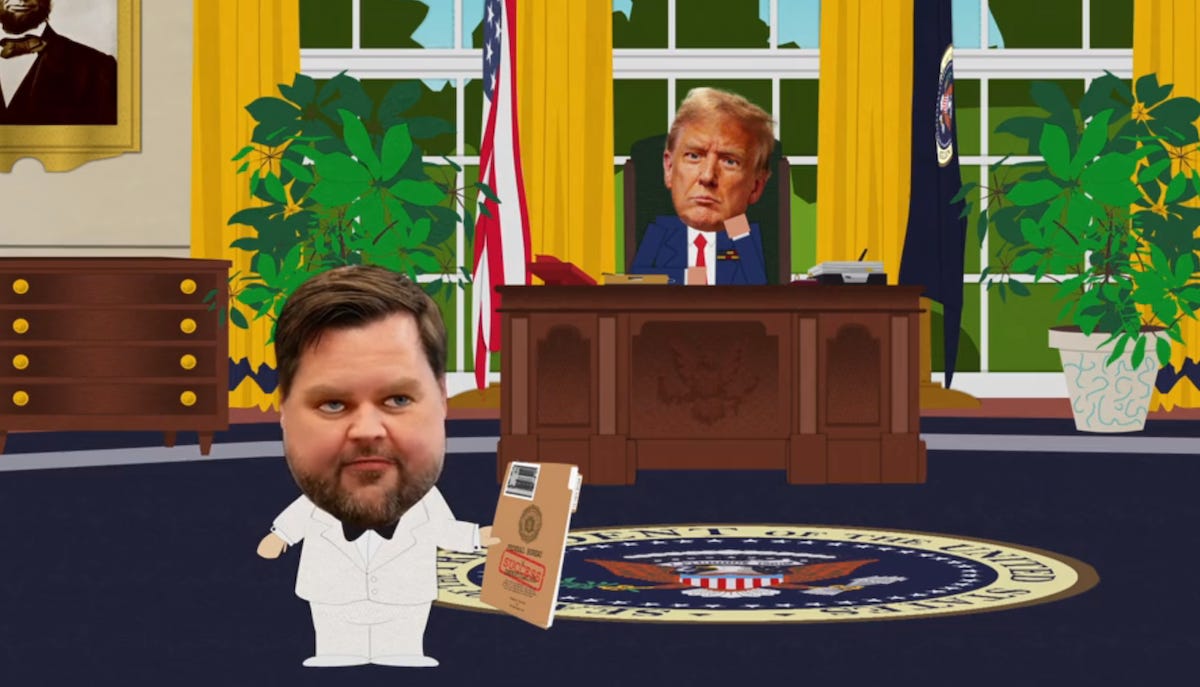
The latest episode of South Park—which has entered its 28th season, much to the consternation of the poor confused Paramount+ website—continued Trey Parker and Matt Stone’s jihad against the Trump administration and its allies. Peter Thiel, Antichrist Expert joined the show’s growing list of Trump-aligned goobers who have come in for a drubbing, alongside Brendan Carr, Kristi Noem, JD Vance, and others.
The Trump-bashing is fun, of course—I like having my priors confirmed as much as the next guy, and Trump and his pals practically define the life poorly lived—but this season of South Park has continued the show’s long tradition of incisively breaking down the absurdities of the moment. Up to the moment, in some cases, as they did this week by riffing on the insane, cult-like reaction to the numbers “six” and “seven” that modern kids have. I have two kids myself, and for some reason “six sehhhhhven” has turned into a catchphrase. I can’t explain it, and neither can Stone or Parker, and so they wrap it into Thiel’s obsessions with the antichrist and invading everyone’s privacy.
That’s all well and good and kind of silly, as was the episode focused on Labubus, another curse of the tween set. But Parker and Stone also broke down the insidious nature of the gambling-like predication market apps that have swept the nation and, in some respects, replaced opinion polling as a way of measuring who is likely to win in upcoming elections. And the show also put together the most incisive dissection of ‘ChatGPT voice’ I’ve ever seen. It wasn’t until I watched Randy Marsh fall in love with ChatGPT and fall down a K-hole that I realized the chipper tone I was hearing from so many PR flacks and customer service representatives was simple, straightforward language ripped right from the prompt screen of AI chatbots.
If I were to try to articulate an overarching theme for this run of episodes, it wouldn’t be Trump Bad. (Or at least wouldn’t only be Trump Bad; that’s all there, of course, and if it’s all you want to take from it, go with God.) Rather, this season reflects a long-running theme of the show: the danger of crowds. Whether it’s the kids of the town getting addicted to Chinpokomon or the townsfolk screaming “dey took errr jerbs!” or celebrities from Tiger Woods to David Duchovny claiming “sex addiction” as a way of getting out of trouble for cheating, South Park has always focused like a laser on outbreaks of social madness leading to bad outcomes.
I understand why some conservatives are mad about this season; no one likes to be told the man they sold their soul for is behaving monstrously and in direct contradiction to nearly everything they previously stood for. But the show’s libertarian bent has always led it to focus on the twin evils of government overreach and social madness. That the social contagion this time is emanating directly from 1600 Pennsylvania isn’t the fault of Parker or Stone.
If you’re not mad at what you’re seeing in this particular social contagion—the people who once decried the “papers, please” society of the Soviet Union suddenly deciding it’s good to have the same in America because dey took errr jerbs—you’re not paying attention. I couldn’t believe the interview with George Retes that Tim Miller published last week. Blood-boiling stuff. Get mad, folks.
If you’re not pissed off, you’re not paying attention.
I’M THE CULTURE GUY AT THE BULWARK—I write about movies; I edit book reviews—and as such I mostly leave the political stuff to my colleagues. You need an obit of Diane Keaton banged out in an hour; I’m your guy. I leave policy and politics to Tim and Sam
Black Phone 2 Review
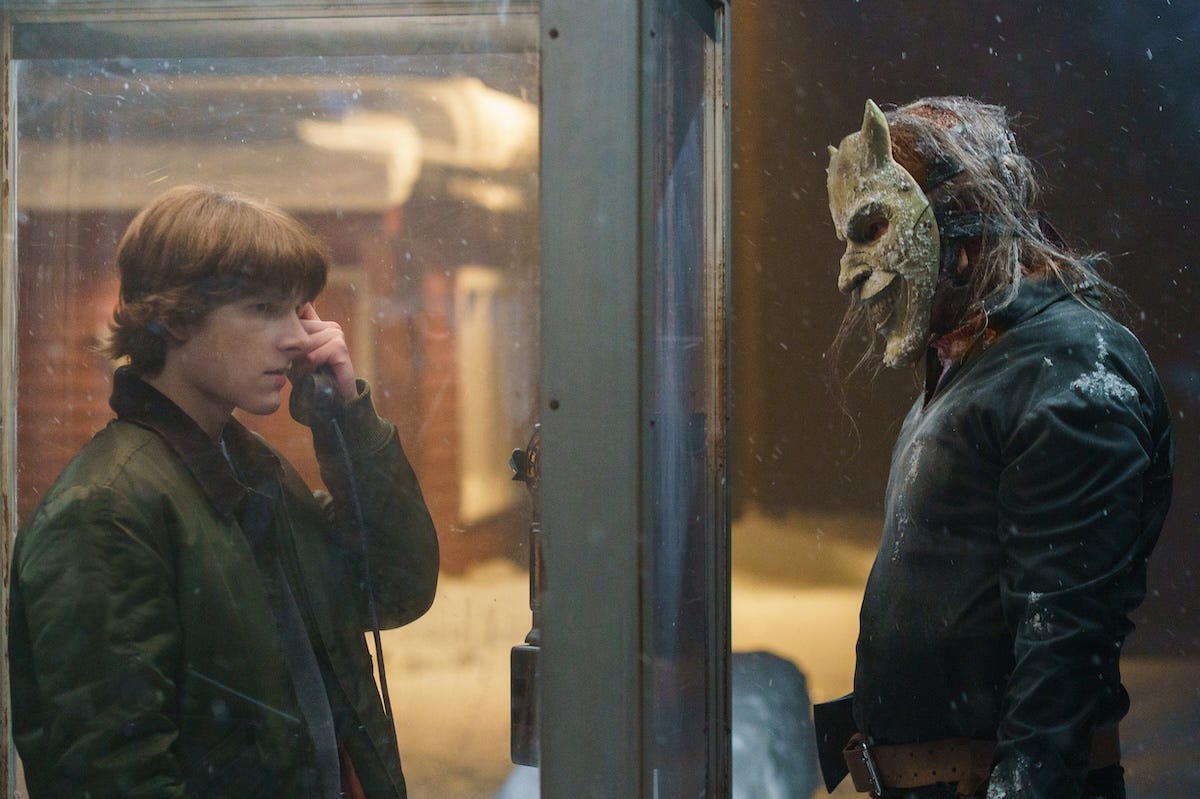
Black Phone 2 isn’t good, exactly, but its release did give me a chance to sing the praises of The Grabber, one of the few modern horror icons:
The movie feints at deeper themes about faith and family, about how people who tell you to avoid bad words and bad thoughts aren’t necessarily good Christians, but that’s not where the series’s strengths rest. These are simple movies about a child killer and his victims’ ghosts. In particular, I’ve always appreciated the idiotic simplicity of the name “The Grabber.” It’s why I keep repeating The Grabber in this review (and hope my henpecking editor will grant me the capital t in “The Grabber,” contrary to our general style). It really cuts to the chase! More of a title than a name. What’s this guy do? Oh, he’s our head grabber. Grabs kids. Grabs ’em and kills ’em. The Grabber! All of the spooky elements from the original film were in service of stopping The Grabber from grabbing kids, and I thought that was great. The unfussiness of the original, though, is complicated by the sequel’s addiction to Grabber lore. We find out all about the kids The Grabber grabbed before and the horrible ways in which The Grabber has secretly changed Finney’s and Gwen’s lives.
I’m not really sure any of this is necessary except as an excuse to bring The Grabber back, but that may be reason enough as The Grabber is one of those great horror villains in that the character features a single fantastic design choice—in this case, the iconic horned mask that detaches at the jawline for extra spooky effect—that can spawn a whole franchise. This is why we’ve been subjected to something like thirty-seven Hellraiser sequels: one character with fifteen minutes of screentime in a dreadful movie had pins stuck in his head, and people loved it.
Read the full thing here. And make sure to check out my interview from 2022 with Jason Baker, who helped design The Grabber’s iconic mask!
Crafting an Iconic Horror Movie Mask

Hey, so, I wanted to pull an episode from the archive this week because it’s relevant to the big movie hitting theaters this weekend: Black Phone 2 follows up the surprise 2022 hit, The Black Phone, resurrecting The Grabber (Ethan Hawke) and his iconic mask. Back before that movie came out, I talked to J…
Planes,Trains and Automobiles. If you kept a dry eye at the end, you may not be human..
Uncle Buck for sure❣️