

Knives Out for the ICE Queen
Senate Republicans might be ready to dump the DHS secretary.



One big primary day down! Last night, Texas state Rep. James Talarico overcame U.S. Rep. Jasmine Crockett in Texas’s Democratic Senate primary, bringing an end to a primary fight that had become a bit of a circus. On the Republican side, Sen. John Cornyn made a stronger-than-expected showing against state Attorney General Ken Paxton, a rising MAGA star—but since neither candidate broke 50 percent of the vote, the two will face off again in a runoff election on May 26.
For Democrats who see Texas as key to their moonshot bid to retake the Senate, it was about the best possible outcome. Republicans had pretty nakedly hoped to see Crockett, a liberal firebrand with a rinky-dink campaign operation and a habit of picking bizarre fights, take the Democratic nomination. They didn’t get that, and they didn’t get what they wanted on the Republican side either: a runoff means two more months of Paxton and Cornyn throwing haymakers at each other before the victor can turn to focus fire on Talarico. Happy Wednesday.
Everybody Hates Kristi
by Andrew Egger
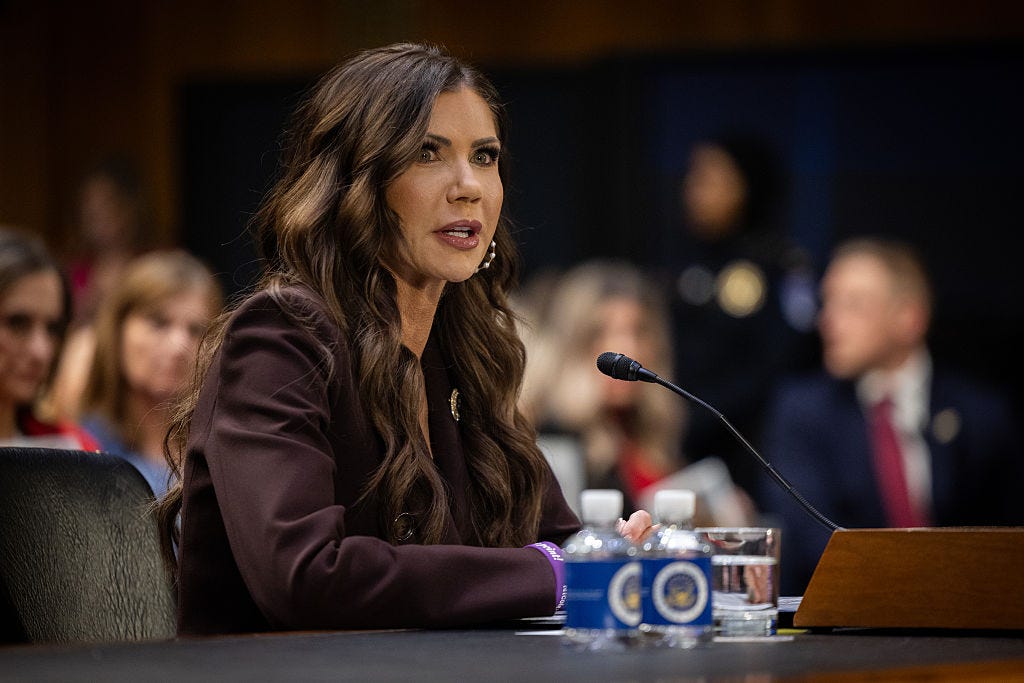
Homeland Security Secretary Kristi Noem has been feeling the heat. After one year running point for Donald Trump’s mass-deportation regime—a year marked by personal scandal, inexplicable management decisions, baroque internal feuds, and a management philosophy of theatrical cruelty that titillated the MAGA base while horrifying the rest of the country, culminating in the disastrous occupation of Minneapolis and the deaths of two U.S. citizens—Noem suddenly seemed to realize weeks ago that Republicans might be looking for a scapegoat for their immigration failures, and that she was a strong candidate. Suddenly, she was fleeing the spotlight she’d sought so aggressively all year and looking for others to take the blame.
It’s hard to imagine Noem’s appearance yesterday before the Senate Judiciary Committee reassured her.
Unsurprisingly, the secretary had no good answers for a barrage of withering questions from Democrats about her indefensible conduct in recent months. A few of these soundbites may leave her still more battered than before, particularly her stony refusal to apologize for accusing Renee Good and Alex Pretti of domestic terrorism. Sen. Amy Klobuchar (D-Minn.) quoted Pretti’s parents. “One of the most hurtful things they could ever imagine was said by you about their son,” Klobuchar said, asking if Noem had anything to say to them.
“I did not call him a domestic terrorist,” Noem said. “I said it appeared to be an incident of . . .” she trailed off rather than finish the sentence with domestic terrorism.
But it was the questioning from a pair of Republican senators that really broke through yesterday. North Carolina Sen. Thom Tillis—who is retiring next year—uncorked a whole Festivus’s worth of grievances on Noem, berating her on everything from her failures in Minneapolis to the fact that she infamously once shot her own dog. “What we’ve seen is a disaster under your leadership, Ms. Noem,” Tillis said.
Meanwhile, Sen. John Kennedy (R-La.) took what seemed to be a more calculated line of attack. His pointed questioning seemed designed to exacerbate tensions between Noem and the White House, as he accused her of sending department funds to political allies, using her perch to burnish her personal brand, and—most hilariously—trying to throw Trump adviser Stephen Miller under the bus for the failures in Minnesota.
“To me,” he said at one point, “it puts the president in a terribly awkward spot.”
It’s plain the, ahem, ice under Noem is getting thinner. And yet it doesn’t matter much how fed up congressional Republicans get with Noem’s leadership, so long as she can retain the backing of the only Republican who matters: Donald Trump, who has continued to give Noem regular votes of confidence.
But there’s something else going on here, too. Democrats actually have a bit of leverage over Noem at the moment: DHS remains unfunded, and they are so far holding firm to demand real reforms to ICE and Border Patrol before they’ll consent to release the money. And as we noted yesterday, there is chatter in Democratic circles of a Republican-floated deal: What if, instead of these reforms the White House doesn’t want to agree to, we just made a deal to get rid of Noem?
If those rumors are true, they cast Kennedy’s remarks in an interesting new light. Maybe there is a coalition of Republican senators who have an interest in driving as hard a wedge between Noem and Trump as they can.
Still, Democrats would be crazy to entertain any such possibility. And, indeed, two Democrats we talked to said there is little chance the party would agree to this.
The reforms they’re seeking from DHS—that immigration-enforcement officials wear badges and uniforms and body cameras, that they lose their masks, that they be transparently investigated for misconduct, and so on—are utterly reasonable asks with broad public appeal. They point to the fact that, for all Noem’s horrible leadership, the problems with the people under her supervision don’t stem from her. They’re systemic, and systemic changes are needed.
Americans don’t like what DHS has been up to, full stop. Democrats should aim a lot higher than just getting a scalp from Noem.
—Sam Stein contributed reporting.
Will Trump ever fire a cabinet secretary again? He used to claim his willingness to fire people was a superpower—but can he now afford to give his critics a win? Share your thoughts in the comments.
The Danger of Hormuz
by Benjamin Parker
Everyone who’s ever studied the possibility of a war between the United States and Iran has agreed that Iran had one significant, inalterable, asymmetric advantage: its geography—specifically, the Strait of Hormuz. The twisty maritime corridor, just 24 miles wide in places, connects the Persian Gulf to the Arabian Sea and is a key transit route for oil. If the Iranians can block the shipping channel, not just the United States but most of the world will suffer.
Since Donald Trump’s attack on Iran, tanker traffic in the strait has dropped to just about zero. In response, Trump announced, “If necessary, the United States Navy will begin escorting tankers through the Strait of Hormuz, as soon as possible.”
Big, and potentially very dangerous, if true.
Escorting ships through the Strait of Hormuz means putting American surface ships—destroyers and cruisers—in harm’s way and hoping that their defenses are sufficient to protect both themselves and the tankers. The major threats they’d be defending against can be divided into three categories:
Iran has some decent anti-ship ballistic and cruise missiles, including some reverse-engineered Chinese models. Arguably more important than the quality, though, are the numbers. Based on how often the Iranian-backed Houthis were shooting them off last year, Iran seems to have a deep arsenal—or at least they did, before last weekend. Numbers matter a lot. For example, if a ship has a 90 percent chance of intercepting one missile, it only has about a 73 percent chance of intercepting three missiles, a 59 percent chance of intercepting five missiles, and so on.
On the other end of the technology spectrum are small, fast boats laden with explosives. Think the USS Cole bombing multiplied many times over. Using that tactic (among others), Lt. Gen. Paul Van Riper “sank” a huge number of Navy ships in a mock exercise about the Strait of Hormuz called Millennium Challenge 2002. His success was so unexpected and overwhelming that he almost ruined a multi-hundred-million-dollar military exercise and caused a scandal.
Then there’s always the possibility of something the Navy doesn’t expect. The Iranians know how important the Strait is, and they’ve thought about it a lot. Their whole navy, small though it is, basically exists for this one mission. Maybe they have some kind of clever, low-tech naval mine. Maybe they have a kind of weapon we’re not even considering.
The logistical implications of such an operation are astounding. The amount of fuel consumption alone required to get ships to and from the Strait of Hormuz and to traverse it back and forth is enormous. And the ships ferrying all that fuel require protection. Which means more escorts. And so on.
If Iran manages to sink a tanker, or even just hit one, oil transport companies—and, more importantly, their insurers—will be out of the Strait for good.
If Iran manages to hit an American ship and kills dozens of Americans—or even to sink an American ship—the effects on our international reputation, our economy, and our domestic politics will be severe. Trump’s reaction will be unpredictable.
At the same time, the ships escorting tankers through the Strait have to come from somewhere. The Navy only has so many destroyers and cruisers, and there’s a lot of ocean out there. Is Trump suggesting we pull ships from the South and East China Seas? From the Sea of Japan? From the coast of Somalia? From the Strait of Malacca—arguably the only strait more important to the global economy than Hormuz?
Trump’s offhand announcement of a major, risky military operation shares the same flaws as all of his other foreign policy endeavors since his return to office. One is a lack of strategy: He seems intellectually incapable of organizing the country’s capabilities and strengths into a plan to achieve realistic goals. The second is, for lack of a better term, grand strategy: He has no sense of priorities, of which problems are big (China and Russia) and which are much smaller (Venezuela and Iran).
That inability has already cost the lives of American service members, and it could be about to cost more. Secretary of Defense Pete Hegseth said this morning, “More and larger waves are coming. We are just getting started. We are accelerating, not decelerating.”
AROUND THE BULWARK
Crockett vs. Talarico! How MAGA Will Texas Go? Join SARAH, JVL, TIM, LAUREN EGAN and more for a recap of our live coverage of the Texas primary elections.
Loose Talk of ‘Fake News’ Is Bad for Democracy… The secretary of defense shouldn’t pit the military against the media, argues MARK HERTLING.
Gen Z Has a Love/Hate Relationship with AI… They use it for everything, but fear what it’s doing to their job prospects, relationships, and brains, observes RACHEL JANFAZA.
Quick Hits
THE AYATOLLAH WHITEWASH THAT WASN’T: Are mainstream media obits giving Ayatollah Ali Khamenei a “glow-up”? That’s the outrage du jour on the right, from “EndWokeness” and “LibsofTikTok” on X to Montana Sen. Tim Sheehy. The Free Press also has a column on Khamenei’s “posthumous makeover.” But the charge rests on out-of-context cherry-picking, including the supposedly too-positive New York Times headline calling Khamenei a “hardline cleric who made Iran a regional power.” (The subhead said he “brutally crushed dissent.”)
The critics are especially triggered by references to the ayatollah’s “avuncular” public persona: “A strange way to describe a man who personally oversaw the massacres of many thousands of his countrymen,” huffs the Free Press’s Maya Sulkin. But in fact, the Times obituary immediately goes on to say that despite this benign “façade,” Khamenei repeatedly endorsed “violent crackdowns” on protests.
Sulkin also zings the Washington Post for “assuring its readers that under Khamenei ‘Iran did not seek to destroy the Jewish state militarily’—he merely sought its ‘dissolution’ through ‘popular referendum.’” Nope: The Post obit presents these as Khamenei’s declarations—and counters them with the fact that “under his leadership, Iran stepped up support” for Hezbollah and Hamas with the apparent goal of precipitating Israel’s violent collapse. Sulkin points out that the ayatollah routinely denounced the Jewish state as a “cancerous tumor.” Guess what: The obit notes that too.
Hypersensitive offense-taking or deliberate smears? Who knows. Either way, it’s media criticism by sleight of hand.
—Cathy Young
FORGET WE SAID ANYTHING: You know who didn’t like all that talk on Monday of Israel pulling Donald Trump along for the bomb-Iran ride? Donald Trump. The president denied yesterday that Israel had “forced his hand,” telling reporters that “based on the way negotiation was going, I think [Iran] was going to attack first, and I didn’t want that to happen.”
“If anything,” he said, “I might’ve forced Israel’s hand.” Defense Secretary Pete Hegseth immediately chimed in: “This is 100% correct.” This, of course, set the president and the secretary of defense 100 percent against the attack rationale laid out a day earlier by both Secretary of State Marco Rubio and House Speaker Mike Johnson, as we noted in yesterday’s newsletter. (After Trump’s comments, Rubio himself walked back that statement.)
What caused the contradiction? Seemingly the need to make different arguments to different audiences. Rubio and Johnson had been making the case that the attack was preemptive, or even—in Johnson’s words—“defensive,” so they could argue that the White House had not overstepped its authorities by attacking Iran without Congress’s approval.
But as we noted yesterday, that argument opened up the White House to a much more politically salient critique: Wait, so you’re just saying America is getting yanked around by Israel? The number of people deeply aggrieved by the executive branch vacuuming up the legislature’s constitutional powers is (unfortunately) small; while on the right, the number inclined to react with hostility to the suggestion that the Israeli tail wags the U.S. dog is large and growing. Thus, a walkback.
WAR IS HELL: America’s and Israel’s weekend attacks on Iran were ruthlessly effective, almost entirely decapitating the country’s regime. But they also seemingly resulted in hundreds of civilian casualties. The Guardian has the best reporting we’ve seen on what we can know about the strike on a girl’s school in southern Iran—next door to a cluster of Islamic Revolutionary Guard Corps buildings—that killed as many as 168 civilians, including many young children1:
Photographs and verified videos from the site, which the Guardian has not published due to their graphic nature, show children’s bodies lying partly buried under the debris. In one video, a very small child’s severed arm is pulled from the rubble. Colourful backpacks covered with blood and concrete dust sit among the ruins. One girl wears a green dress with gingham patches on her pockets and the collar, her form partly obscured by a black body bag. Screams can be heard in the background.
One distraught man stands in the ruins of the school, waving textbooks and worksheets as rescuers dig by hand through the debris. “These are the schoolbooks of the children who are under these ruins, under this rubble here,” he shouts. “You can see the blood of these children on these books. These are civilians, who are not in the military. This was a school and they came to study.”
The Guardian also remarks on the weird, refracted way horrific events like this are processed on social media. “Shortly after the attack, misinformation began to proliferate online,” they write. “Some social media accounts claimed the footage of the school was old footage shot in Pakistan, a claim that has been debunked. Several X accounts also made viral claims that the school had been struck by a misfired IRGC missile, but the photographs of the misfire that they present as evidence were taken about 1,600km (994 miles) away from Minab, in the city of Zanjan.” Read the whole thing.
Cheap Shots
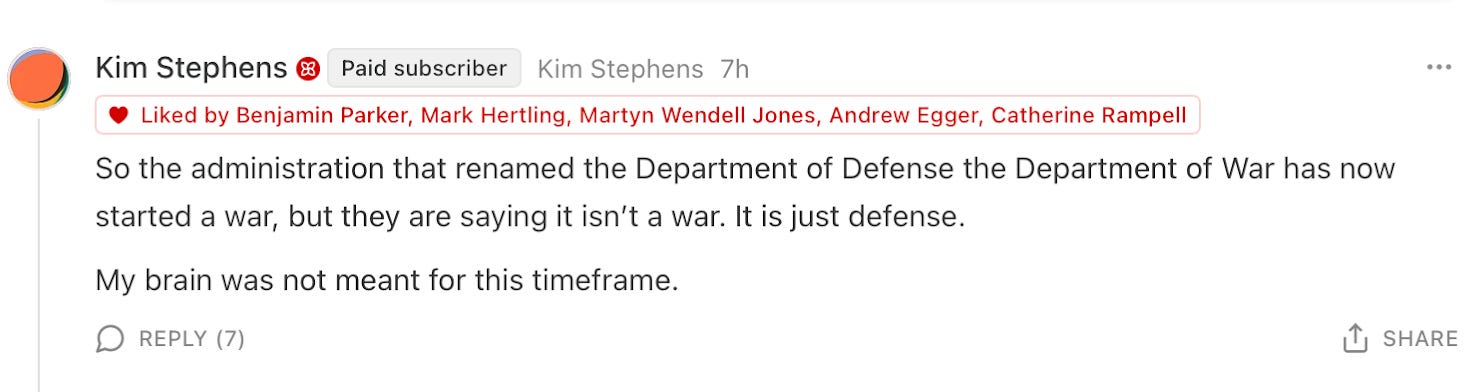
Sometimes you’ve just got to hand it to the comments section.
It’s still not clear if it was the United States or Israel that bombed the school.
As JVL pointed out yesterday, Tillis and Kennedy voted to confirm Noem, so I agree with JVL that they don't get credit now for going after her after all this horrendous shit has happened.
Noem? Vain, self-centered, greedy, ignorant, evasive, manipulative, cruel? What's not to loathe?