MAGA’s Mueller Myths
The 7 lies that Trumpists still cling to.

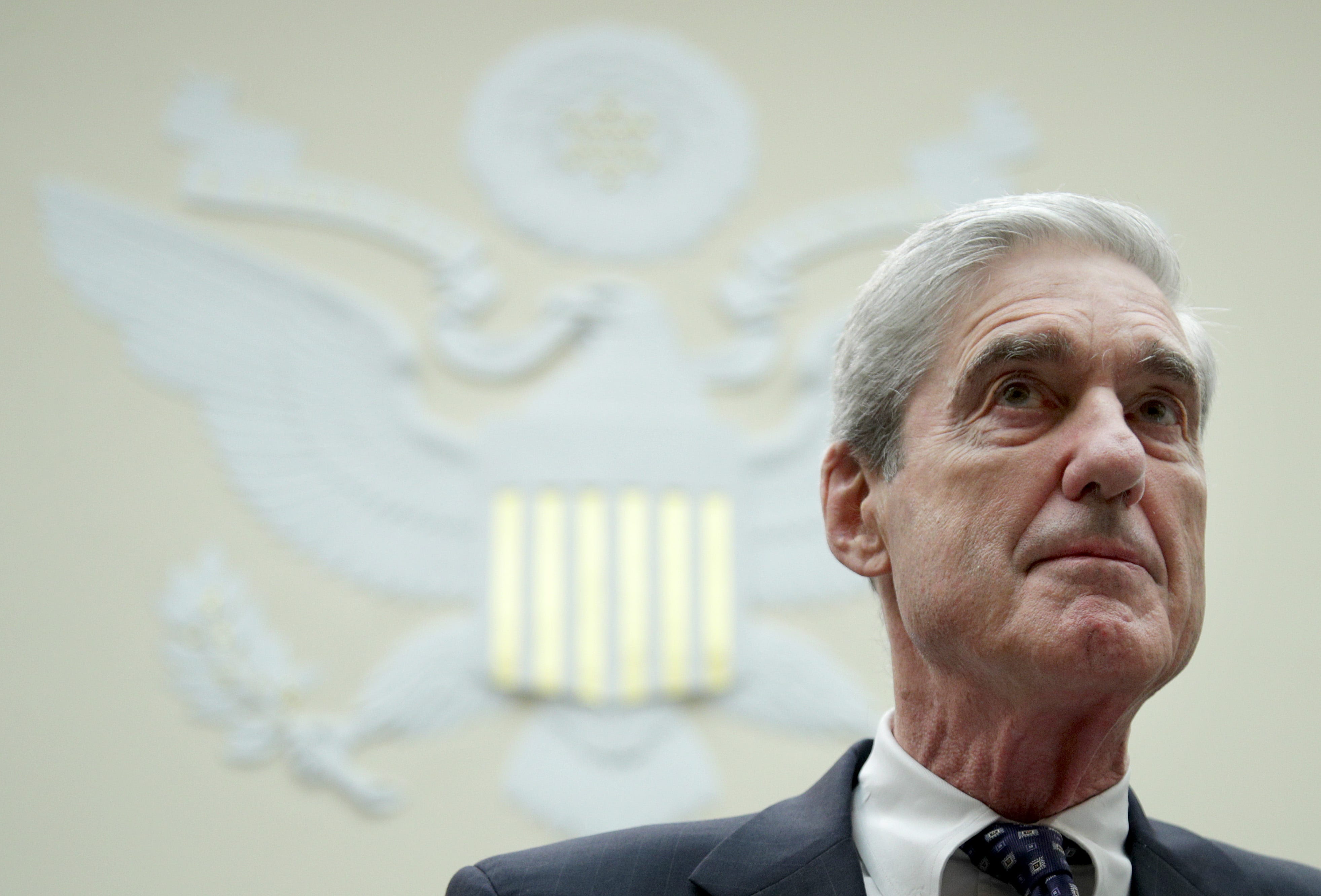
THE DEATH OF ROBERT MUELLER at the age of 81 elicited a predictably graceless reaction from Donald Trump and a torrent of mud from the MAGA swamp—including claims that the veteran prosecutor and former FBI director, picked by the Trump Justice Department in 2017 to lead the “Russiagate” probe as special counsel, had been a “senile” figurehead for the Democrats.

How are we to square the image of Mueller as a deranged Javert hounding a beleaguered Trump and trampling all over innocent people’s lives with the claim that the Mueller report completely exonerated Trump and, in the words of Ohio congressman Mike Turner, “effectively ended the Russia hoax by concluding that there was no collusion between the Trump campaign and Russia”? In fact, neither is correct. Let’s dig in to these and other persistent right-wing myths about the “Russia hoax,” several of which have started popping up again in the days after Mueller’s passing.
Myth #1: The Russiagate probe was a poisoned fruit of the “Steele dossier” and the lurid “pee tape” story.
This is such an old myth, we’ve been rebutting it in The Bulwark for the better part of the last decade. For obvious reasons, the “pee tape” claim included in the report compiled by former British intelligence agent Christopher Steele—supposed Russian kompromat in the form of a secret 2013 video of Trump and Russian prostitutes in his Moscow hotel room—became the most notorious part of the Trump/Russia scandal. But the FBI inquiry into the Trump/Russia connection had been officially opened in late July 2016, about two months before the agency received the Steele dossier. What triggered the investigation was an unsalacious tip: junior Trump campaign staffer George Papadopoulos’s boasts about contacts with Russian operatives. And, while the Steele dossier was mentioned as supplementary evidence in the 2016 intelligence assessment on Russian interference, there is nothing to suggest that it was a substantial source.1 (It’s also worth noting that the Steele report is about a lot more than the “pee tape”: It extensively discusses Trump’s entirely unsexy business ties to Russia, which were quite real and, as Mueller found, were deceptively downplayed by the Trump campaign; Trump’s former personal lawyer Michael Cohen went to prison for lying to Congress about that.)
Ironically, some of the materials declassified last summer by Trump 2.0’s director of national intelligence, Tulsi Gabbard, in attempt to expose the “Russia hoax” actually provided additional proof that there had been very strong reasons to launch an investigation: American intelligence officials had been alerted to Vladimir Putin’s election-subversion plans by a longtime human asset—a Kremlin insider with direct access to Putin himself.2
Myth #2: “Russiagate” was a hoax cooked up by Barack Obama and his intelligence chiefs—and/or by Hillary Clinton—to destroy Trump by framing him for “collusion” with Russia.
Explosive claims about an Obama administration/Deep State conspiracy were aired last July by Gabbard and by Trump’s CIA director John Ratliffe. But both misrepresented the facts. Ratliffe twisted a CIA tradecraft review moderately critical of possible corner-cutting in the 2016 investigation into proof of a plan to “screw” Trump. Gabbard’s allegations that top intelligence officials “manipulated” and “weaponized” intelligence data in an attempted anti-Trump coup relied on even more heavy-handed manipulation. Several intelligence assessments in late 2016 concluded that Russia did not tamper with the voting tallies via “cyberattacks on election infrastructure”; Gabbard used this to argue that subsequent assessments of Russian election interference were fraudulent and politically motivated. But the reports on election interference were never about vote-tampering: They focused on Russian efforts to undermine the election through disinformation campaigns and hack-and-leak operations.
The alleged Clinton plot was the subject of another “revelation” last summer, from FBI director and “Russia hoax” obsessive Kash Patel, who claimed to have found a “smoking gun” of documents buried in an FBI “back room.” But the key documents—two purported emails from a person close to the Clinton campaign discussing a strategy to “smear” Trump by tying him to Russia as a distraction from Clinton’s email problems—had been included in a previously classified annex to the 2023 report by special counsel John Durham. Durham, of course, was appointed by then-attorney general Bill Barr for the express purpose of discrediting the Russiagate investigation. The reason Durham did not include those emails in his official report is that they were obvious and crude Russian forgeries.
Myth #3: Putin and his minions may have interfered in the U.S. election, but the intent was not to help Trump—it was to sow general chaos and mistrust and compromise whoever ended up as the winner.
The alleged leap from facts indicating Russian meddling to the conclusion that the Kremlin’s goal was to help elect Trump has been one of the main criticisms leveled at the 2016 intelligence assessment that gave rise to “Russiagate.” But the fact is that the “active measures” were directed exclusively against Clinton. It is, at the very least, a remarkable coincidence that in October 2016, the WikiLeaks dumps and leaks of hacked Clinton campaign and Democratic National Committee emails started almost immediately after Trump took a seemingly irreparable hit from the Access Hollywood tape.
It may well be that at the time, Putin was far less interested in helping Trump than in damaging Clinton (quite possibly as a vendetta against her support, during her tenure as secretary of state, for the mass protests in Russia at the time of his return to the presidency in 2012). But in a two-person race, that’s a distinction without a difference. And, aside from speculation about Trump’s possible ties to Russia, the Kremlin could have hardly failed to be impressed by his Putin-friendly statements during his campaign.
Also, you know who else besides the intelligence community in 2016 and the Mueller probe in 2019 concluded that the goal of the Russian interference campaign was “to influence the 2016 U.S. presidential election by harming Hillary Clinton’s chances of success and supporting Donald Trump at the direction of the Kremlin”? The Senate Intelligence Committee, in its 2020 report on Russia and the 2016 election. The chairman of that committee when the report was finalized? Current Secretary of State Marco Rubio.
Myth #4: Russia may have interfered in the election, but there was no collusion with the Trump campaign, and Trump in particular has been conclusively exonerated.
In fact, the Mueller report specifically stated that “while this report does not conclude that the President committed a crime, it also does not exonerate him.” The report also said that the investigation “established multiple links between Trump Campaign officials and individuals tied to the Russian government”:
Those links included Russian offers of assistance to the Campaign. In some instances, the Campaign was receptive to the offer, while in other instances the Campaign officials shied away. Ultimately, the investigation did not establish that the Campaign coordinated or conspired with the Russian government in its election-interference activities.
Conspiracy, however, is a high threshold. Both the Mueller probe and the Senate Intelligence Committee inquiry found that some key Trump associates—in particular, Roger Stone—actively sought out kompromat on Clinton via WikiLeaks, by then a notorious conduit for materials obtained by Russian hackers linked to the Kremlin regime. As a result of the Mueller investigation, Stone was convicted in 2019 of making false statements about his contacts with WikiLeaks—but he never served a single day of his forty-month prison sentence, since Trump commuted it and then pardoned Stone in December 2020 shortly before the end of his first term. Notably, by then, the Senate Intelligence Committee had produced evidence that Stone was even more actively mixed up with WikiLeaks than Mueller showed; what’s more, it seems very likely that these activities were approved by senior campaign officials and that Trump himself (despite his denials) discussed Stone’s WikiLeaks access both with Stone himself and with campaign staffers. That Trump repeatedly and gleefully touted the WikiLeaks disclosures on the campaign trail is a matter of public record.
And, of course, there was the time, in early June 2016, when Donald Trump Jr. got an email pitching “documents and information that would incriminate Hillary and her dealings with Russia”—an offer that he was explicitly told was “part of Russia and its government’s support for Mr. Trump.” Don Jr. response? “[I]f it’s what you say I love it especially later in the summer.” On June 9, Don Jr., Trump’s son-in-law Jared Kushner, and campaign adviser Paul Manafort (one of the Russia-linked figures in Trump’s entourage) famously met at Trump Tower with Russian lawyer Natalia Veselnitskaya to discuss the kompromat. It turned out that she had nothing useful and mainly wanted to talk about lifting sanctions on Russia; but while the meeting may have been a dud, it clearly established that people close to Trump were not at all averse to help from the Putin regime. It may not be a coincidence that the DNC was hacked just five days later.3
And that’s before we even get into Trump’s obstruction of the investigation.
Myth #5: Russian interference did not affect the outcome of the election.
The people making this argument often scoff at the idea that a relatively small number of Facebook and Twitter posts—mere drops in the social-media sea—could have made a difference at the polls. A 2023 study from a team of American and European researches appears to corroborate this skepticism, finding “no evidence that the Russian disinformation campaign on social media influenced Americans’ political attitudes or voting patterns.” But this conclusion may miss the forest for the trees: The “active measures” that hurt Clinton the most were the hacking operation and the WikiLeaks disclosures. The steady stream of leaks in October created the impression that the Clinton campaign was embroiled in constant scandals, possibly negating the effect of the Access Hollywood tape. The emails were also spun as showing that Clinton had “stolen” the nomination from Bernie Sanders, likely costing her the votes of many Sanders supporters who either stayed home or voted for a third-party candidate.
The bottom line? It cannot be confidently said that Russian interference either did or did not change the result of the 2016 vote. Some polling data do suggest that the WikiLeaks scandals may have played a role in Clinton’s loss in some battleground states she lost by a very narrow margin.
Myth #6: The Mueller probe and the FBI investigation have been thoroughly debunked and discredited.
Nope—but not for lack of trying, starting right away with the Trump Justice Department under Bill Barr in 2019–20. The December 2019 report by Department of Justice Inspector General Michael Horowitz was harshly critical of the FBI’s “errors and omissions” with regard to the Carter Page wiretap warrants; but, to Barr’s displeasure, Horowitz concluded that the investigation overall was appropriate and not politically biased. Durham, whom Barr tasked with a broad review of “Russiagate”—and to whom he gave special counsel status so that this probe could continue after Trump left office—came to the conclusion Barr had wanted: that the evidence in 2016 merited only a “preliminary inquiry,” not a full counterintelligence operation. (A rather surprising conclusion, given everything we now know about Russian interference.) But Durham was not able to find any evidence of serious criminal activity, and two of the three people he charged with misconduct were acquitted.4 Far more aggressive attempts under the second Trump administration (see above) have provided plenty of grist for the right, but no real evidence of wrongdoing. What’s more, some of the criticisms of the investigation—for instance, that it moved too fast and with too much involvement by senior officials—seem specious when one remembers what was at stake: an adversarial foreign power trying to influence an American presidential election.
Myth #7: Trump is the put-upon victim of a witch-hunt by the Democrats, the media, and Robert Mueller.
One may speculate about the degree of Trump’s complicity in Russian interference. But let’s not forget that he literally did everything humanly possible to make himself a suspect, both before and after the election. Remember the July 27 press conference in Florida where he responded to the news of Russian hacking attacks on the DNC by inviting the Russians to find Clinton’s missing emails? (Literally within hours of his statement, Clinton’s personal and campaign accounts were targeted in phishing attacks originating from Russian officials.) Remember when he kept talking about how much he loves WikiLeaks at campaign events? (In 2018, even the Republican-controlled House Intelligence Committee cautiously criticized “the Trump campaign’s periodic praise for and communications with Wikileaks” as “highly objectionable and inconsistent with U.S. national security interests”—naturally, with no mention of Trump’s own WikiLeaks lovefest.) Remember when, on May 10, 2017—the day after he fired FBI Director James Comey—he bragged about it to Russian foreign minister Sergei Lavrov and the Russian ambassador to the United States, Sergey Kislyak, in an Oval Office meeting, calling Comey “a real nutjob” and adding that the “great pressure” he had faced over Russia was now “taken off”? And remember when, standing next to Putin at the 2018 Helsinki Summit, he said that he believed the Kremlin dictator’s denial of Russian election interference—choosing to trust him over the U.S. intelligence community? If it was a witch hunt, Trump was doing an Oscar-worthy impersonation of a witch.
MAGA may want Mueller to be the villain of the Russiagate story. But in reality, the Trump/Russia investigation was a fitting conclusion to his long career of service to this country—and no amount of MAGA mythmaking will change that.
Some information from the Steele dossier was used to obtain the first of four FISA court surveillance warrants for Trump campaign ex-staffer Carter Page; however, it wasn’t the only basis for those warrants.
In 2017, that person was exfiltrated to the United States because of hardly unreasonable concerns that Trump could expose the asset’s identity.
For all the nitpicking about whether the information the FBI had in the summer of 2016 was sufficient to justify an investigation of the Trump campaign, it’s worth noting that if the agency had known about the Trump Tower meeting, this would have been more than sufficient cause for surveillance and investigation.
His one success was a guilty plea by former FBI lawyer Kevin Clinesmith for tampering with an email that was used to renew the wiretap warrant on Page; Clinesmith inserted several words stating that Page was “not a source” for the CIA. Clinesmith said that he was merely clarifying Page’s status as an “operational contact,” not an official source; the statement was accurate, but doctoring the email (rather than, for instance, attaching a clarifying note) was certainly a wrongful act. Clinesmith was sentenced to one year’s probation and four hundred hours of community service.