The Rorschach Regime Change Test
Republican senators deliver mixed messaging on Trump's Venezuela attack

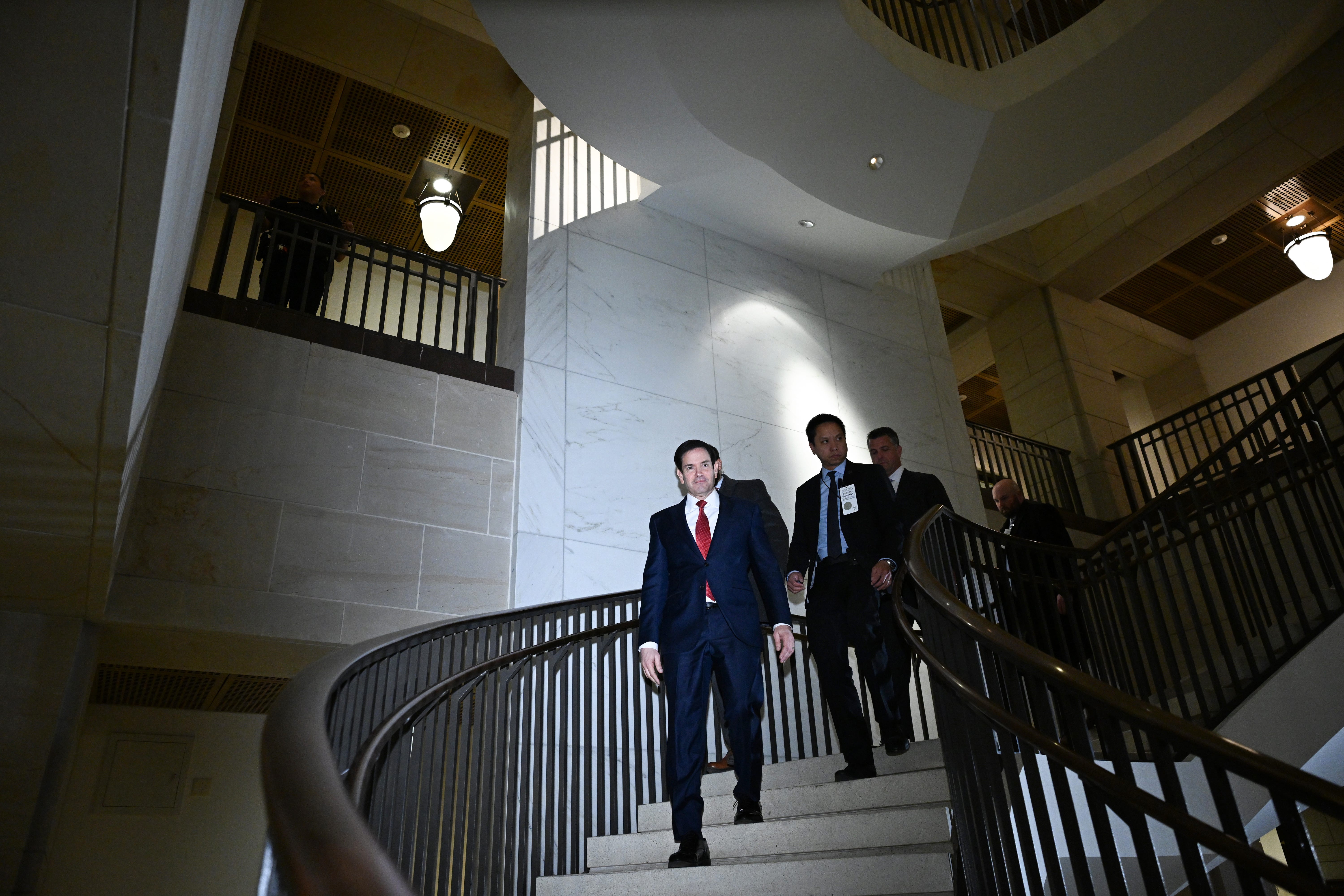
Whose line is it anyway?
The American government has billed the dramatic capture and extradition of Venezuelan President Nicolás Maduro over the weekend as a law enforcement operation carried out with the support of the U.S. military. Now that Maduro is in custody, the United States intends to exert control of the country through (what the administration assumes will be) Maduro’s pliant vice president, whose primary task is to open up Venezuela’s nationalized oil production to American corporations.
That’s the administration’s high-level story, at least. But as more context comes out, it gets less clear whether Maduro’s capture was a law enforcement action, a military operation, or some secret third thing.
Secretary of State Marco Rubio went with the law enforcement framing in comments he made over the weekend. “The Department of War plays a very important role here along with the Department of Justice, for example, because they’ve got—they’re the ones that have to go to court,” he said on NBC’s Meet the Press.
“And I assure you the people left behind in Venezuela now that are in charge of the police and everything else, I assure you they’re going to probably be a lot more compliant than Maduro was as a result of this,” he added later, suggesting the show of force in apprehending Maduro would do much to convince the regime to follow America’s lead going forward without requiring an invading and occupying force.
President Donald Trump apparently hasn’t gotten that memo.
“We are ready to stage a second and much larger attack if we need to do so,” he said. “So we were prepared to do a second wave if we need to do so.”
“We’re not afraid of boots on the ground,” the president added.
If you’re not sure how exactly to square these statements, you’re in good company. Much of Capitol Hill is confused as well.
Accepting the law enforcement framing raises the question of what jurisdiction the United States has beyond its borders. (Among the charges in the indictment are allegations that Maduro and co. violated American firearms laws.) Further, if the goal was merely to arrest Maduro, why is Trump threatening further attacks against Venezuela?
If there is a war effort, however, then the administration will run into other problems: They would lack the authorization to unilaterally invade without congressional approval. White House chief of staff Susie Wiles said as much in December in an interview with Vanity Fair.
Complexities upon complications. I sought out Republican senators to untangle some of these issues and see whether their understanding of the mission aligns more closely with Rubio’s or Trump’s.
It turns out, they want to have it both ways. As Republicans variously told me, it is a military operation—some lawmakers have publicly fantasized about or implied that other countries may be next1—and it is simply making good on the 2020 indictment of the ousted Venezuelan president.
Among lawmakers I caught in the Senate hallways, the law-enforcement angle was more popular.
“Well, first off, he was an indicted narco-trafficker, and so he got arrested, and he’s gonna stand trial, and I assume he’s gonna go to prison,” said Sen. Rick Scott (R-Fla.).
“Well, Marco has been very clear on that . . . Maduro was not the duly elected president of Venezuela, and I think that’s true,” Sen. John Kennedy (R-La.) told me. “He’s also made very clear that Maduro is under indictment, that Maduro was not a dictator—he was a crime boss and he ran the cartel, he participated in illegal gold mining, human trafficking, drugs, and the way I saw Marco explain it was that this was law enforcement action.”
“This was definitely a law enforcement mission, clearly led by the Justice Department and the [Drug Enforcement Administration] and a very successful mission at that,” said Sen. Roger Marshall (R-Kan.).
“It was a legal operation but supported by military forces,” said Sen. Mike Rounds (R-S.D.).
“Oh, obviously it was both,” said Sen. Deb Fischer (R-Neb.).
There are problems with this interpretation of what happened in Caracas, however. If Maduro’s capture had been a Justice Department-led operation, it would be reasonable to expect the Judiciary Committee to receive a full briefing on the attack. But the administration did not brief the committee. Sens. Chuck Grassley (R-Iowa) and Dick Durbin (D-Ill.), the two leaders of the Senate Judiciary Committee, issued a rare joint statement criticizing the White House for excluding the panel tasked with direct oversight of the DOJ in the post-mission briefing.
“There is no legitimate basis for excluding the Senate Judiciary Committee from this briefing,” the joint statement read. “The administration’s refusal to acknowledge our Committee’s indisputable jurisdiction in this matter is unacceptable and we are following up to ensure the Committee receives warranted information regarding Maduro’s arrest.”
After Grassley and Durbin’s statement, Attorney General Pam Bondi briefed the two senators. An all-Senate briefing is set for Wednesday.2
Other lawmakers deflected when asked whether the Judiciary Committee members should have been given a thorough read-out.
“You’d have to ask the folks that gave the briefings,” said Rounds. “I heard about it just a few minutes ago, that they were not [being briefed], so I’ll wait and see what they’ve got.”
In my conversations with lawmakers, I tried to get into some of the other complications of the Venezuela raid. If a DOJ-led operation resulted in the deaths of civilian bystanders (as happened in Caracas), for instance, it would normally warrant an investigation. I asked Kennedy if he thought lawmakers should formally inquire into how many civilians the U.S. government had killed during the operation. Here’s how that conversation went:
Kennedy: How are you going to investigate that?
Me: Well that’s your job, right?
Kennedy: How are you going to investigate that? We arrested a criminal who was under indictment. Some people resisted. They got killed. Are you going to go down to Venezuela and ask them all to come in and testify? That’s a ridiculous question. I’m sorry.
Kennedy’s implicit claim that Congress has no investigative tools to apply to a situation like this is false, of course. Congress has broad investigative powers that it is tasked with using to provide effective oversight of the government’s actions abroad. Recent foreign entanglements have been addressed in routine reports from inspectors general. For example, the Special Inspector General for Afghanistan Reconstruction regularly took stock of the failures of the U.S. occupation and its nation-building efforts during our long involvement there.
The Maduro episode has provided yet another occasion for elected Republicans to twist themselves into knots to support the administration’s shifting, contradictory messaging on a high-stakes issue. If there is a legal case to be made for capturing a foreign leader and installing some kind of advisory board of Americans and oil company executives to preside over the regime’s holdovers, GOP senators did not bother to make that case. Instead, they blithely relinquished more authority to Trump, bending rules and ignoring precedent to avoid any disagreements with the White House.
Calendar calamity
The administration’s capture of Maduro, combined with its desire to “run” the country in partnership with oil companies, is not another flash-in-the-pan story of the kind that has become synonymous with Trump’s presidencies. If the White House goes forward with their plans,3 provisions for long-term oversight, new appropriations for U.S. diplomatic and military operations, and other planning will all become immediate legislative necessities. And these requirements will add new burdens to a congressional calendar already over-encumbered with debates about health insurance subsidies, government funding deadlines, the executive branch’s compliance with the Epstein files disclosure legislation, and the fraught prospect of another reconciliation bill.
That Democrats managed to make health care a top agenda item in an election year was a major win for the party. It has forced more independent-minded4 Republicans to break ranks and push GOP leadership into an uncomfortable corner where they know the party has no consensus or path forward on lingering policy issues. Trump practically begged the party to find a way to act on the matter during a speech to House GOP lawmakers on Tuesday.
In addition, government funding is set to expire (once again) on January 30. When you combine the minuscule Republican majority in the House with the large number of House Republicans seeking office elsewhere, a picture begins to emerge of a legislative agenda being totally overwhelmed.
And it’s just getting hard for Speaker Mike Johnson. In the past 24 hours, Rep. Marjorie Taylor Greene (R-Ga.) formally resigned, House Republican Doug LaMalfa (R-Calif.) died suddenly, and Rep. Jim Baird (R-Ind.) landed in the hospital after a car crash. Baird is expected to recover, but even counting him, the House GOP enjoys a tiny 218–213 majority. That’s a two-vote margin for error.
Securing Republican attendance in the House is going to be both paramount and difficult. But the legislative agenda isn’t going to get any lighter out of respect for that fact.
Overthrowing fits
Here’s the most Press Pass possible angle on the Maduro situation: The online menswear world can’t stop talking about the surprisingly good fits the U.S. government is giving him as he starts his unusual legal odyssey.
The acclaim he’s gotten is all tongue-in-cheek, of course. Maduro is not a menswear icon, and he’s almost certainly not choosing these getups himself. The clothes the government is putting him in are both normal and accessible. But it is also a workaday style that is very much in vogue in 2026.
Upon capture, the U.S. released a photograph of Maduro aboard the U.S.S. Iwo Jima. He was shown wearing—in addition to the accoutrements of physical restraint and sensory deprivation—a matching grey Nike Tech Fleece sweatsuit. For those who are attuned to the online menswear discourse, this style has become the subject of intense debate in recent years.
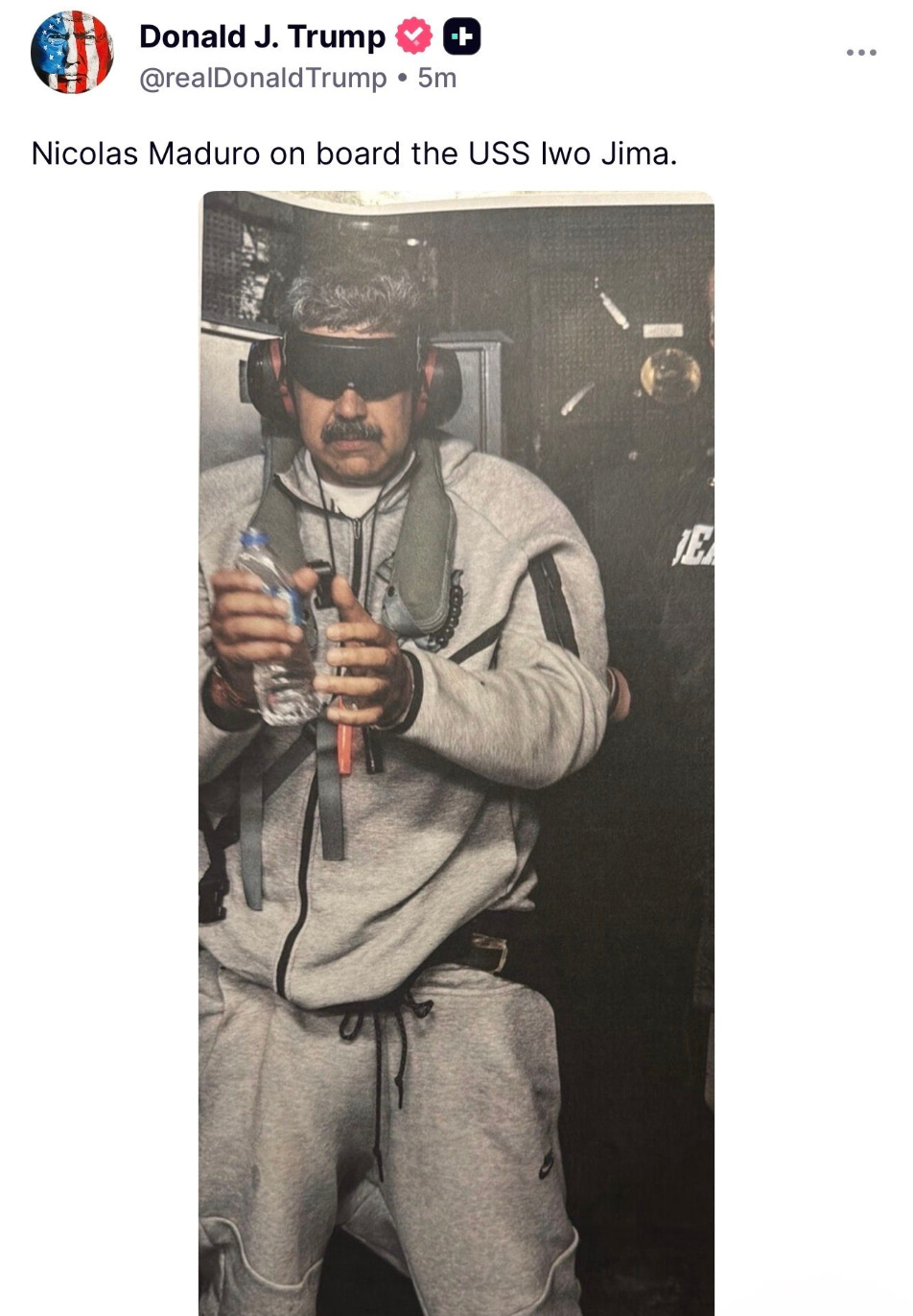
After the picture went viral, Nike sold out of their Tech Fleece sweatsuits.
In another photo, Maduro was seen in a hoodie made by a Maine-based activewear brand, Origin. While it hasn’t gotten the same traction as the other ones, the company has leaned into the moment, actively promoting their products using the ex-dictator’s inadvertent fit pic. (They have claimed the specific hoodie he had on won’t be available again until the spring.)
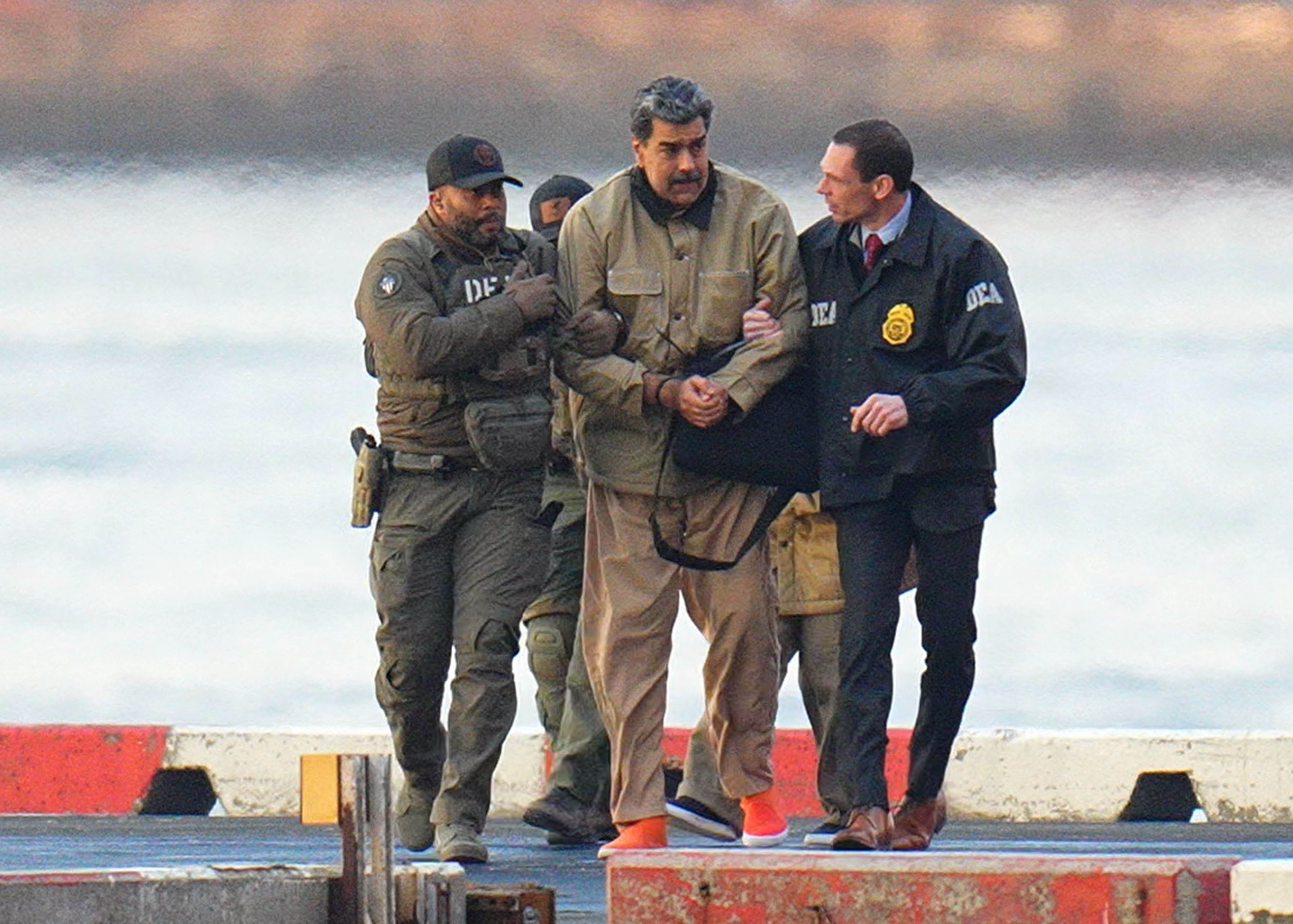
Upon arrival in New York City, where he was arraigned, Maduro could be seen in khaki chinos and a stiff Carhartt work jacket—something of a uniform in contemporary Brooklyn. He was also wearing red sneakers, tacking on a “pop of red” to an otherwise tonal fit.
And if all that wasn’t enough, another addition to the Maduro-board dropped Monday, when the ousted dictator was pictured in all black, from his chinos to his workwear zip-up hoodie, rubber slides, and some type of black skull cap. It was all very Kanye West—specifically his 2019 era, long before the hip-hop artist started selling swastika t-shirts in Super Bowl commercials.

As I mentioned before, Maduro’s fits are not deliberate. But they do speak to the ways in which modern menswear has evolved. His practical, comfortable, and durable clothing would be prized by any person in lockup. It’s part of why dressing like a prisoner from Clint Eastwood’s 1979 thriller Escape from Alcatraz is a surefire way to look, well, fire in 2026.
Maduro’s new U.S. government–issued style sharply contrasts to his prior wardrobe, which consists primarily of revolutionary socialist-nostalgic attire and navy suits. There’s some irony in the way fervent capitalists and consumers in the menswear sphere are celebrating Maduro’s fits. Maybe it’s time for his handlers to prioritize the standard orange jump suit.
Sen. Bernie Moreno (R-Ohio) said in a statement celebrating Maduro’s capture, “Maduro protected Colombia’s narco-terrorists. Let them, and anyone in this hemisphere, be on notice that they are next if they aim to harm our nation.” In an interview Saturday morning as the news about the operation broke, Rep. Mario Diaz-Balart (R-Fla.) said Cuba is next. Sen. Lindsey Graham (R-S.C.) said in a Fox News interview, “I pray and hope that 2026 will be the year that we make Iran great again,” while stone-facedly putting on a hat with the same slogan and an Iranian flag.
Correction (January 6, 2026, 3:45 EST): As originally published, this article incorrectly said Pam Bondi and other cabinet officials briefed the entire Senate Tuesday morning. The all-Senate briefing is instead scheduled for Wednesday morning; Bondi briefed only Sens. Grassley and Durbin after they published their statement.
I’m being generous by saying there are genuine, well-thought-out plans.
Relatively speaking.
Great reporting and insight; you are a valuable, trusted, news source. Thanks
Look at the misguided but heavy weight team W. Bush had when he went to Iraq. At least Cheney and Rumsfeld and those guys had a clue and knew how the wider world works. This Administration is a collection of light weights hanging on by their finger nails and trying to please an unstable Trump from minute to minute, day to day