The Lobster Roll-back: How Susan Collins Gets Trump Carveouts
Her endangered status means the MAGA agenda doesn't hit as hard in Maine

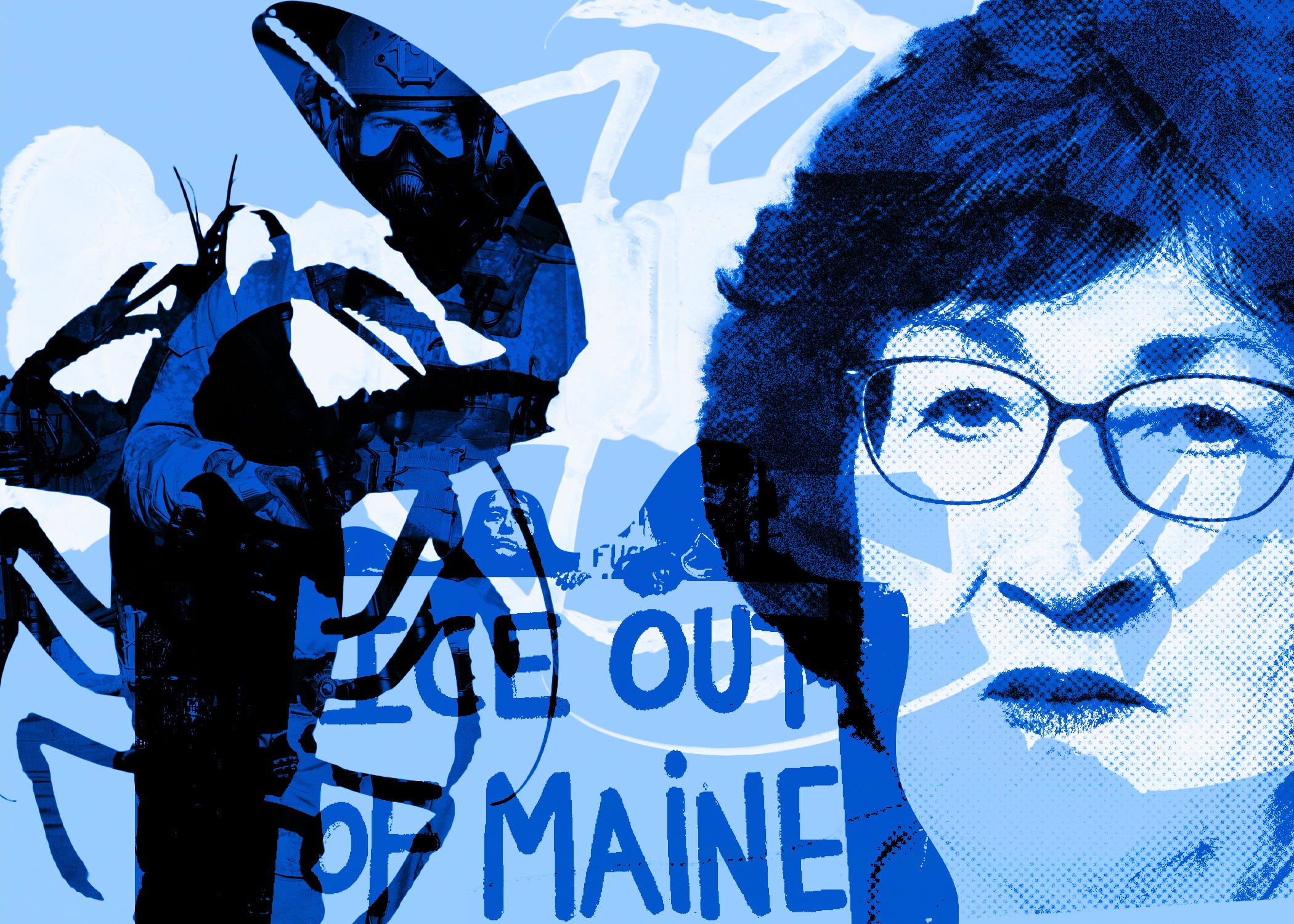
The Lobster Roll-back
Sen. Susan Collins (R-Maine) proudly announced on Thursday that ICE was ceasing special operations in Maine. The Pine Tree State, with its relatively large Somali population, had been targeted by the agency as part of President Donald Trump’s mass deportation effort, which in other states has resulted in harassment of U.S. citizens, family separations, and death. Before Collins intervened, Maine had come in for its share of anxiety and state violence: During the operation, many students stayed home from school out of fear, and in one particularly egregious episode, agents shattered the window of a car with a month-old baby in it. But just days after it began, the operation was over.
ICE’s short Maine stay illustrates a pattern that has emerged since Trump began his second stint in the White House: The administration will implement its signature policies in the state, but only temporarily or provisionally. That seems due to Collins.
The senator appears to consistently win exemptions for Maine—those Lobster Roll-backs—because the administration appears to be intent on preserving her political career.
To wit: Immediately upon entering office last year, Trump initiated a hiring freeze across federal agencies. The Russell Vought–led Office of Personnel Management, DOGE, and others in the administration would soon after begin their work of cutting whatever they could out of the federal workforce, including by offering deferred resignations. A few weeks later, however, Collins joined Sen. Jeanne Shaheen (D-N.H.) in sending a letter to the acting secretary of the Navy requesting that the Portsmouth Naval Shipyard be made exempt from these workforce reduction policies. In March, Collins secured the exemption.
She wasn’t done there. Panic about DOGE’s activities began setting in across Republican circles in the House and Senate within weeks of Trump’s swearing-in. Last March, as Trump started ramping up his campaign of belligerence against prominent universities, the United States Department of Agriculture suspended $30 million in federal funding for the University of Maine. The administration claimed the hold was related to a review to ensure compliance with Title IX policies (in modern GOP parlance, that means keeping MEN out of WOMEN’s sports). A couple of days after the news broke, however, Collins announced the funding had been restored:
This USDA funding is critically important not only to the University of Maine, but to our farmers and loggers, as well as to the many people who work in Maine’s agriculture, aquaculture, and forestry industries. Now that funding has been restored, the work that the University does in partnership with the many people and communities who depend on these programs can continue.
This was a short-lived victory. In April, Agriculture Secretary Brooke Rollins made good on the promise to freeze the USDA funding once again.
“Your defiance of federal law has cost your state, which is bound by Title IX in educational programming,” Rollins wrote to Maine’s Democratic governor, Janet Mills. “Today, I am freezing Maine’s federal funds for certain administrative and technological functions in schools. This is only the beginning, though you are free to end it at any time by protecting women and girls in compliance with federal law.”
This resulted in a back-and-forth that continued throughout the year. In a May hearing, Collins questioned Rollins about the status of USDA funding in Maine, saying the administration’s mixed messaging “creates a lot of uncertainty.” After a legal fight, the administration settled with the state and the funding was restored.
In April, Collins raced to get funding restored for Maine’s Sea Grant program from the National Oceanic and Atmospheric Administration; it had been abruptly canceled the month prior following a hostile interaction between Trump and Mills on the subject of trans athletes. Collins succeeded in getting the money back after pleading with Commerce Secretary Howard Lutnick to “renegotiate” the funding.
Collins has quite the advantage over her Republican Senate colleagues on these fronts. Because she is the most vulnerable GOP incumbent in the Senate, she can get MAGA credit for voting for and actively facilitating the rollout of Trump’s least-popular policies across the country while at the same time being given an exemption from them that protects her own constituents from their effects. It’s discomfiting to imagine what some of her GOP colleagues might do to gain similarly special treatment from Trump.
But while Collins has managed to call in enough favors to soften the blow of Trump 2.0 on her own voters, it hasn’t been without potentially incurring some political damage. Mills, one of Collins’s possible opponents this fall, foregrounded ICE’s presence in her first television campaign ad.
Depending on who you ask, Collins’s ability to protect Maine from ICE, hiring freezes, revoked funding, and DOGE could provide grounds for describing her in multiple contradictory ways: as an invaluable asset to her state; an obstacle to a Democratic majority; or a good, old-fashioned RINO. She’s certainly a political survivor. Will she be in 2026 is the multi-million dollar question.
House Folding Caucus
The Senate closed out last week by passing a funding package for most of the government. Lawmakers paired that with a two-week continuing resolution specifically for the Department of Homeland Security, which is meant to provide them with extra time to negotiate a compromise on new restrictions for the agencies tasked with carrying out the main part of the Trump administration’s mass deportation effort. Naturally, media critics and reporters were skeptical that the House would be able to band together and advance the package in this way without causing a tantrum from conservatives on the floor.
I did not doubt that the package would advance.
“Based on our discussion, we’re moving towards [voting for it],” Rep. Anna Paulina Luna (R-Fla.), one of the initial “holdouts,” told reporters in the Capitol Monday night after a meeting at the White House. “We got assurances on the standing filibuster, which is incredibly important.”
Luna and others had been toying with the prospect of tanking a rule vote today in order to force action on priorities they believe leadership has neglected. In exchange for not sabotaging the rule vote, the rascal caucus wanted a commitment from Senate Majority Leader John Thune that he would utilize the standing filibuster—a rare procedure forcing an objecting senator to literally stand and talk in order to stop consideration of a bill—to bypass the traditional filibuster on Republicans’ voter ID legislation.
“As of right now, we feel very comfortable where we’re at based on what we are discussing,” Luna added.
Feeling somewhat less comfortable, however, was Thune, who told reporters that while he did discuss the standing filibuster with Luna and others, “there weren’t any commitments made.”
Somehow this ambiguity—and, to be clear, it appears unlikely that Thune will change the Senate procedures to implement a standing filibuster—did not prevent the funding package from going ahead. After some arm-twisting by GOP leadership, a handful of angry Republicans folded and the House passed a rule vote to allow consideration for the funding bill by a vote of 217–215 on Tuesday afternoon. An hour or so later, the package passed the full House in a bipartisan vote, 217-214. It now heads to Trump’s desk for signature.
Threatening to tank the rule vote to extract commitments from leadership has become Republicans’ preferred technique in recent years. Given the razor-thin GOP majority (currently a two-vote margin of error!), rule-vote shenanigans are a strong option for doing so, although there are also other methods available to the enterprising in-house bomb-thrower. As of publication time, it was unclear whether the brief holdouts extracted the commitments they were seeking in exchange for their votes, or if they were simply bending the knee.
Best in show
The champion show dogs you see when you watch the Westminster Kennel Club Dog Show1 are not divas. (Thanks to selective breeding techniques, some are no doubt nepo-puppies—but that’s another discussion.)
It turns out that many of these dogs hold important jobs, ones they could presumably be fired from, that require more than just looking pristine on gameday. As Sarah Lyall writes in the New York Times:
In his professional life as a champion show dog, Nick the Tibetan spaniel is meant to embody the particular handsomeness of his breed: the cunning little face, the silken fur, the tail of Seussian floofiness that curls up and cascades down his back. This week he will compete for the second time at the pinnacle of canine contests, the Westminster Kennel Club Dog Show, which is celebrating its 150th anniversary. (Best in show will be decided on Tuesday night at Madison Square Garden.)
But Nick, who is 4 years old and formally known as Ch. Torrey’s The Price Is Right, is not just another egotistical overachiever with a fancy tail. In his private life, he works as a therapy dog at the memory care unit of a Brookdale Senior Living center in Vancouver, Wash. His job there is essentially to be himself, a 14-pound bundle of furry empathy.
With his kind eyes, enthusiastic yet respectful manner and love of being the center of attention, Nick is an excellent volunteer. Mimi Galindo, the program manager of the memory-care unit, said he had an instinct for knowing how to behave with the residents who needed him the most. “He brings joy to them in the moment,” she said. “Dogs don’t see age, just the connection.”
Many dogs are bred to perform specific tasks—retrievers to fetch birds for their owners while hunting, for instance, and Portuguese water dogs to herd fish into nets (yes, that is apparently a thing). But the most serious show dogs, who go to multiple shows a week and compete for the top national spots in their breed rankings, have little time to perform even the jobs they were born to do, let alone take on extra work.
In recent years, I have often found myself following the dog show scene more attentively during Super Bowl week. Mainly, the dog show is an easy thing to take in after the San Francisco 49ers have torn my heart out once again by falling short or succumbing to an (possibly conspiratorial) injury epidemic.
Susan Collins is Lyndsey Graham in a dress. Lyndsey Graham recently did his best impression of Foster Brooks on Fox News.
Old news, but still pertinent. GOP senator Susan Collins defends claim Trump ‘learned his lesson’ after first impeachment. Trump DID LEARN his lesson. He learned that he could get away with anything, thanks to empty vessels like her and many other Republican senators.
Love the Dog Show story. Love Nick the Tibetan. Much better than the shit show in Congress.