The Father, the Don, and the Fed Chair’s Post
Knives out for the banker of Washington and the Bishop of Rome.


America’s quest to put sufficient economic pressure on Iran to buckle the government’s will continues: Threats of genocide are (for now) out, an ever-tightening blockade is in. Central Command announced this morning, per the Wall Street Journal, that “all Iranian vessels, vessels with active [Office of Foreign Assets Control] sanctions, and vessels suspected of carrying contraband, are subject to belligerent right to visit and search.” CENTCOM said yesterday that no ships have yet breached the U.S. blockade. Happy Thursday.
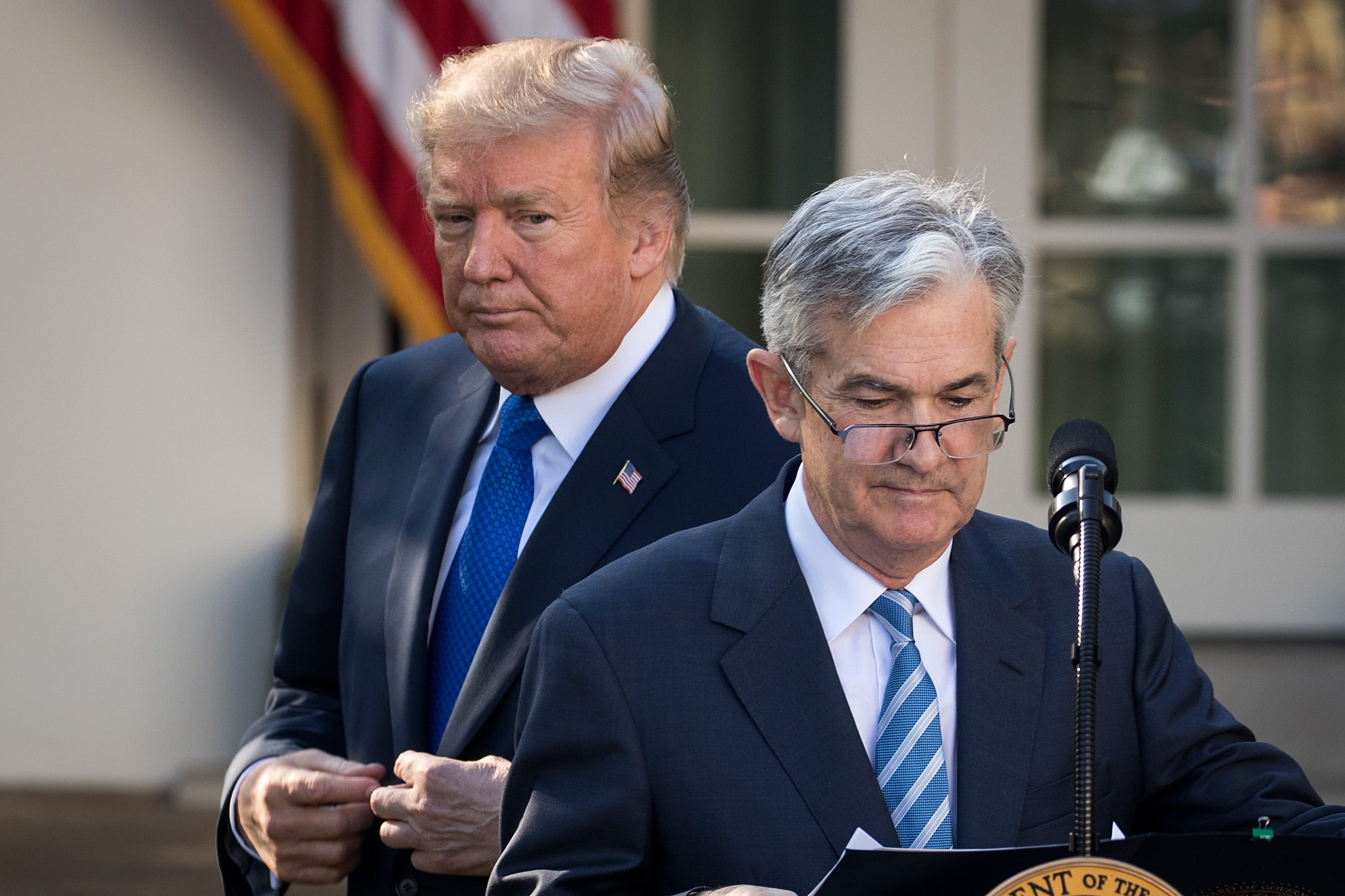
Trump’s Powell Paradox
by Andrew Egger
Well, would you look at that: Donald Trump is threatening Jerome Powell again. The president said yesterday that he plans to fire the Fed chair next month, should he not step down from his post “on time.”
“I’ll have to fire him, okay?” Trump told Fox Business’s Maria Bartiromo. “I’ve held back firing him. I’ve wanted to fire him, but I hate to be controversial.”1
Such threats are nothing new: Trump has long seethed over what he sees as the Federal Reserve chair’s intolerable reluctance to lower interest rates, and has pursued many fruitless strategies to jawbone him into doing so. What is new is how apparent it’s become that here, far from holding all the cards, Trump is caught in yet another negotiating trap of his own making.
Powell’s term is up on May 15. Ordinarily, that would be the end of it: He would hand the role off to his successor without fuss. But right now Powell has no successor. Trump’s nominee for the position, financier Kevin Warsh, has yet to be confirmed by the Senate. By law, Powell will stay in his current role unless and until the Senate confirms Warsh—or someone else.
But why hasn’t Warsh been confirmed? Because of the determined opposition of Sen. Thom Tillis (R-N.C.). Why won’t Tillis advance Warsh’s nomination? Because he has sworn not to allow any Fed nominees to move ahead in the Senate until the Trump administration calls off its ludicrous criminal investigation of Powell over supposed cost overruns during the renovation of the Fed headquarters in D.C.
And why is Powell under investigation in the first place? Because Powell, as head of an independent agency, has legal protection against being fired except for cause. All along, the Fed renovation “investigation” was a transparent attempt to get more leverage on Powell—either to twist his arm a little more on his interest-rates decisions, or to provide the legal predicate for Trump firing him after all. The president has barely tried to deny this: Last year, asked what Powell could do to assuage his concerns about the renovation-cost overruns, Trump replied that “well, I’d love to see him lower interest rates.”
But it didn’t work. Powell refused to be bullied. In January, he publicly accused Trump’s Justice Department of threatening him with criminal indictment over a pretext. “This is about whether the Fed will be able to continue to set interest rates based on evidence and economic conditions,” Powell said in a direct-to-camera video, “or whether instead monetary policy will be directed by political pressure or intimidation.”
Last month, a federal judge agreed, invalidating a pair of subpoenas sent by U.S. Attorney Jeanine Pirro’s office to the Federal Reserve. There was “abundant evidence,” Judge James Boasberg wrote, that the “dominant (if not sole) purpose” of the subpoenas was “to harass and pressure Powell either to yield to the President or to resign and make way for a Fed Chair who will.”
Their legal legs cut from under them, Trump and Pirro have been resorting to sillier, more thuggish tactics: Prosecutors from Pirro’s office made an unannounced visit to the Fed building yesterday, seeking to “check on progress” via a “tour” of the renovations.
The Fed, having declined to buckle under more dangerous pressures, practically laughed this one off. “As you know, Chief Judge Boasberg has concluded that your interest in the Federal Reserve’s renovation project was pretextual,” Robert Hur,2 the Fed’s outside legal counsel, wrote to Pirro’s office after the incident. “Should you wish to challenge that finding, the courts provide an avenue for you; it is not appropriate for you to try to circumvent it.”
Trump, then, is stuck. His investigation was supposed to give him the means either of bending Powell to his will or of getting the irritating Fed chair out of his hair. Instead, it has been completely thwarted—first by Powell’s courage, then by the courts. But the ongoing existence even of such a feeble and impotent investigation is enough to keep Sen. Tillis from giving his permission for the Senate to confirm Kevin Warsh. Far from accelerating Powell’s departure, then, the investigation now seems likely to prolong his stay.
Okay, so: Why not just end the investigation? Many of Trump’s allies, no longer seeing much merit in pretending the Powell investigation is some righteous, apolitical action by Pirro that Trump has nothing to do with, are asking exactly this. “You want Jay Powell out of the way,” Bartiromo said during her interview with Trump yesterday. “Isn’t the easiest way to get him out of the way to end the probe?”
And here we arrive at the most fascinating part of the whole business, at least when it comes to the president’s personal psychology: because Trump does not agree with this assessment. “Does that mean we stop a probe of a building that I would have done for $25 million that’s gonna cost maybe $4 billion?” he blustered. “Don’t you think we have to find out what happened there?”
Trump wants Powell gone. If he dropped his probe, Tillis would drop his objection to Warsh’s confirmation, and Powell would be out as Fed chair in thirty days. But Trump remains dispositionally incapable of such a tactical retreat. Either he has become so high on his own supply that he has genuinely convinced himself Powell has committed vile crimes as part of the Fed renovation, or Powell has simply become so irksome to him that he cannot bear to see him go unpunished, or he just isn’t willing to give Powell the win. For whatever reason, he finds himself unable to make the one move that everyone save him can see would solve his problem immediately.
Trump is a ratchet that turns only one way—toward further threats and more intimidation. Who cares if Powell won’t leave voluntarily or by law? Trump will just fire him, he insists—notwithstanding that his for-cause predicate has gone up in smoke. And who cares that Tillis will gum up the works? “That’s why Thom Tillis is no longer a senator,” Trump scoffed.
Either Tillis will have to blink, or Trump will. Until then, Powell’s not going anywhere.
Why Trump Fears the Pope
by William Kristol
Does might make right?
It’s an age-old question, and there’s no great mystery about the Trump administration’s answer. White House Deputy Chief of Staff Stephen Miller articulated it clearly a few months ago, in the course of defending President Trump’s threats to seize Greenland:
We live in a world in which you can talk all you want about international niceties and everything else, but we live in a world, in the real world, that is governed by strength, that is governed by force, that is governed by power. These are the iron laws of the world since the beginning of time.
According to Miller, in the real world, it’s power—not justice—that matters. The “iron laws of the world since the beginning of time” rule, and the essence of those iron laws is that might makes right.
This is the worldview of the Trump administration, and not just in foreign policy but in domestic policy. It’s also the worldview of the president, and not just for public but for private life (“when you’re a star . . . you can do anything”).
That Trumpist view—that power is to be worshiped, that might makes right—can be dressed up in religious garb, whether through the unctuous sophistry of JD Vance or the grotesque weaponization of faith by Pete Hegseth. But the costume clearly doesn’t fit. The claim that we have no choice but to follow “the iron laws of the world since the beginning of time,” indeed that we should exult in doing so, is fundamentally at odds with a Judeo-Christian world view. After all, if Miller is right, if those iron laws from the beginning of time are unchangeable and unchallengeable, then there is no God of Abraham, Isaac, and Jacob, and Jesus of Nazareth doesn’t matter.
Of course, if the Trumpist claim is right, if those iron laws since the beginning of time are all-powerful, then the Declaration of Independence doesn’t matter either. Whatever human rights we may think we should respect don’t matter. The strong do what they will and the weak suffer what they must.
And that’s why the Trump administration and its surrogates have chosen to pick a fight with Pope Leo XIV. They’re attacking Pope Leo not simply because he’s the pope but because he’s the first American pope. He’s a threat to their ambition to change the meaning of America.
And he’s popular here in America.
A poll last month found that 42 percent of Americans had a positive feeling about the Pope, while only 8 percent had a negative view. Half said they were neutral or not sure. If you’re Trump, and you see a critic with those numbers, a critic who can command attention and who shows no signs of being afraid of you or of shrinking from a fight, you want to weaken him. You want to try to drive up his negatives and to drag him down into the polarized political mud in which all other American public figures exist. So you try to reduce him to just another political actor—to a radical leftist who’s “WEAK on Crime, and terrible for Foreign Policy.”
Trump claimed that Leo only got elected “because he was an American, and they thought that would be the best way to deal with President Donald J. Trump.” Trump may be wrong to ascribe his own kind of political thinking to the College of Cardinals. But he’s not wrong to sense that their choice of Robert Prevost as the first American pope posed a kind of threat to him. After all, the first Polish pope helped liberate his home country from authoritarian rule. Trump and the Trumpists are worried that the first American pope could contribute to such a development here.
And they should be. The view Pope Leo is upholding—that right matters, not just might—is an American one. It’s the view not just of Augustine but of Abraham Lincoln. Lincoln attacked the heresy that might makes right. Lincoln in his great 1860 Cooper Union speech reversed the equation: “Let us have faith that right makes might, and in that faith, let us, to the end, dare to do our duty as we understand it.”
The Trumpists fear Pope Leo not simply because he’s defending the views, and speaking to the communicants, of his church. They fear him because he’s defending the principles, and speaking to the citizens, of his country. Of our country.
AROUND THE BULWARK
Trump Said “Total Blockade”—That’s Not Happening… On the latest Command Post, MARK HERTLING and BEN PARKER examine the growing gap between political messaging and military reality, focusing on how Trump’s public statements often differ from what the military actually executes.
Dumped by Trump… The Riley Gaines side story from this week is just the latest reminder of how casually the president tosses aside allies, reminds PETER ROTHPLETZ.
Trump Is a Wanker… The Irish are protesting in the streets over the price of fuel, Qatar’s GDP is plummeting, and heating bills are skyrocketing in France. All because of Trump’s war of choice in Iran. ALASTAIR CAMPBELL joins TIM MILLER on the flagship pod to break it all down.
Calling all West Coast Bulwark+ members: Today is the final day for the members-only presale for Bulwark Live in San Diego and LA in May. Tickets go on sale for everyone Friday at 9 a.m. PT. Click here to get the members-only presale code and links to the ticketing sites.
Quick Hits
MISSION ACCOMPLISHED?: The New York Times brings a quick vibe check on the ongoing state of things in Iran:
In Mr. Trump’s telling, U.S. victory in Iran is already clear. In the Fox Business interview, reprising his frequent comments of the last two weeks, Mr. Trump asserted that Iran’s navy, air force and antiaircraft equipment had all been wiped out, along with many top officials. If Iran did not rule out nuclear weapons, Mr. Trump said, “we will be living with them for a little while, but I don’t know how much longer they can survive.”
In fact, analysts say, the 40 days of U.S.-Israeli bombardment that ended with last week’s cease-fire appear to have increased the power of the military and hard-liners in the Iranian system. Despite the widespread destruction and the killings of officials by the U.S. and Israeli militaries, the Iranian regime is acting emboldened, having demonstrated that it can wreak havoc in global trade and send U.S. gas prices soaring.
Nevertheless, markets seem to have determined the worst is behind us: The S&P is higher today than it was when the war began, and oil prices—while dramatically higher than before the war—are still well down from their peak-panic highs, despite maritime traffic remaining largely choked in the Strait of Hormuz. Hope springs eternal!
BACK IN THE GOOD BOOKS: She may be totally crosswise from him on the war in Iran, but Director of National Intelligence Tulsi Gabbard knows how to keep the bossman happy. Yesterday, Gabbard sent the Justice Department a criminal referral for two former government officials who played a major role in Trump’s first impeachment in 2019: a whistleblower who revealed the existence of Trump’s efforts to extort Ukrainian President Volodymyr Zelensky for “dirt” on his future presidential rival Joe Biden, and the former intelligence-community watchdog who handled the whistleblower report. CBS News reports:
“I have received information from multiple U.S. Government officials that the President of the United States is using the power of his office to solicit interference from a foreign country in the 2020 U.S. election,” the whistleblower wrote. “This interference includes, among other things, pressuring a foreign country to investigate one of the President’s main domestic political rivals.” . . .
Gabbard alleged in a post on X Monday that “deep state actors” in the intelligence community “concocted a false narrative that Congress used to usurp the will of the American people and impeach duly-elected President @realDonaldTrump in 2019.” She argued that the inspector general relied on “second-hand evidence” in looking into the whistleblower complaint.
The documents, however, do not provide any direct evidence of criminal wrongdoing.
DAILY BREAD: Okay, so it’s not exactly must-read news . . . but you could argue it’s a must-consume story. Caity Weaver’s megasized Atlantic odyssey to find the best free bread in America must be read to be believed:
Here is the promise you and I must cling to across the thousands of words that follow: At some point within this text, I will reveal to you what—after 555 responses, 13,000 miles of travel, and months of monomaniacal research—I have determined to be the best free restaurant bread in America. I will not attempt to slither to the moral high ground, arguing that best is a meaningless measure, or insisting that all bread is dear in its own way. Even if you attempt to betray me—for instance, by merely scanning the text that follows for the phrase Here it is: the best free restaurant bread in America—I will uphold my end of the bargain.
Don’t betray her, or yourself: Read the whole thing.
Cheap Shots

Say what you will about Donald Trump, you can’t deny that he hates to be controversial.
Yes, that’s the same Robert Hur who led the investigation into Joe Biden’s handling of classified documents and found that he was unprosecutable because any jury would find that he wasn’t a criminal but just a doddering old man.
Andrew: "But Trump remains dispositionally incapable of such a tactical retreat."
That's because he's a malignant narcissist, and therefore incapable of admitting error. Doing so would cause an psychic injury from which he'll never recover.
The GOP congress surely knows this and has known it for years. Yet they don't move to remove him from office (and from his handle of our nuclear arsenal).
"According to Miller, in the real world, it’s power—not justice—that matters. The 'iron laws of the world since the beginning of time' rule, and the essence of those iron laws is that might makes right."
Yet even a teenager knows that what sets us apart from all other life forms is our ability to use reasoning and employ logic to solve problems and forge a peaceful coexistence with each other and other life forms. I get it that Miller, among others in this administration, is most impressed with himself every time that he looks in the mirror -- usually the starting point for very bad decision-making. But the disconnect between the way he sees the world around him and the way that it actually works is childlike at best. Miller's "we are in the jungle" approach to problem solving all but concedes that those leading our nation are unwilling and/or unable to outthink our opponents, something that produces a losing hand almost every time it happens. It also ensures a governmental approach of making things up as you go along more than adapting a well-established plan of action in which goals and outcomes are closely aligned and strategically assessed as something more than whims of the moment. It has not worked for us in the past, and it is not working now. What are the odds that it suddenly will start working in the future?
It is discomforting at best to feel like our political leadership is thinking and acting more like tigers and even giraffes than actual human beings. Yet here we are. I don't know how much we paid to ride on this train, but I do know that the price of staying on it is becoming steeper by the day.