‘Tony’ Review
Anthony Bourdain’s first steps to sainthood. Plus: A soggy trip to ‘Camp Miasma.’

I’m rejoining Mona for her book club to discuss the Odyssey in all its forms. From Emily Wilson’s translation to Christopher Nolan’s adaptation, there’s much to go over! We’re livestreaming it Wednesday, September 16; hope to see you there. For more details, click here. If you want to leave us a question, you can do so in the comments. And to comment, you’ll need to be a Bulwark+ member! Do that now if you haven’t already, okay? As a personal favor to me? Thanks, I really appreciate it.
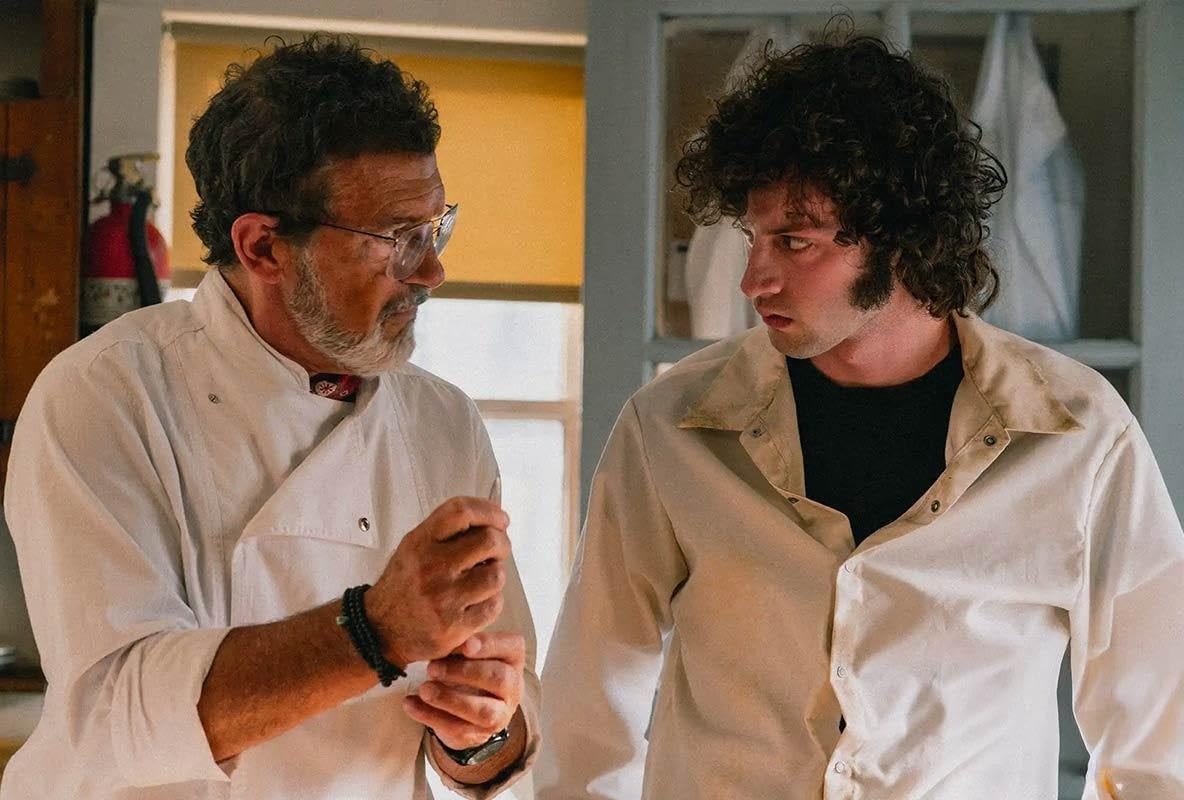
FULL DISCLOSURE: I was kind of nervous to see Matt Johnson’s biopic about Anthony Bourdain, Tony, because I’ve always found something mildly repellent about the cult of Bourdain.
Which is not to say that I don’t enjoy and, on some level, admire the writer-turned-chef-turned-writer. Kitchen Confidential is one of the great popular memoirs of the last twenty-five years and you can feel its influence all over media, while his fiction has a rough-hewn-but-real quality to it. (I particularly enjoyed The Bobby Gold Stories: A Novel.) But I never cared for the travelogue chef identity he picked up when his reality shows took off. And the overstated admiration of his globe-hopping and “bold” “truth-telling” always felt like the college-educated himbo equivalent of “live, laugh, love.” (This is best exemplified by the fake quote often attributed to Bourdain highlighted at the top of a recent New York Times profile on the author-chef’s prolific afterlife.)
Then there’s the biopic as a form, a genre whose conventions are so calcified they remain completely impervious to parody. A novice learns the ways of the world, overindulges, and learns the importance of hard work and humility: These are the beats we expect, these are the motions we crave to go through.
However, I had faith in Johnson, whose BlackBerry was one of the best films of 2023 and whose Nirvanna the Band the Show the Movie unexpectedly knocked my socks off earlier this year. Plus, Bourdain himself is an interesting enough guy to escape the gravity of the cult that has swallowed him. And I’m happy to report that this faith was repaid: Tony may be a pretty standard biopic, yes, but it’s one that’s crafted at the highest level and pierces some of the gauzier images of the patron saint of fine dining. At its heart, Tony is a movie about what it means to be Good.
Capital-g Good, like, the recipient of grace and providence Good. The movie is not particularly subtle about this, as Tony (Dominic Sessa) attempts to flirt with a girl headed to Provincetown for the summer by asking if she knows whence the word providence derives. It’s a recurring question, this idea of providence and its origin; by the end of the film, she has an answer for him. Providence is “the protective attention of God,” Nancy (Emilia Jones) says, and it’s clear that Tony has received some of that attention despite deserving none of it.
He’s a liar, attempting to bluff his way through the summer after failing to obtain a fellowship from Vassar, where he’s going to school, to write a novel. That failure is richly deserved: When meeting with the fellowship committee, he offers up a half-conceived idea of an idea, a “buildings Roman” (sic) in the vein of Kerouac, an effort to become the voice of his generation. He thinks he’s fooled these stodgy professors; they quite obviously see through him, just as we do. Just as his mother does. And that’s why he resents his mother, Gladys (Dagmara Domińczyk), why he flees from her house to Provincetown in search of Nancy when he learns he didn’t get the fellowship, just as we knew he wouldn’t get it.
Tony quickly crashes out in Provincetown, getting hammered in a restaurant before being tossed on his ass by its owner, “Chef” (Antonio Banderas), and his oyster-shucking tough, Sal (Leo Woodall). As Chef is throwing him out, he says something interesting to Tony—that he’ll work on him later—and work on him he does. Here’s where the road to grace begins: Tony learns the importance of hard work, and that he can’t fake his way through life. Chef takes him to church, shuts down Tony’s and coworker Stavros’s (Stavros Halkias) blasphemy. When Sal introduces Tony to cocaine, he grimaces but does not speak up; this is a lesson the boy must learn on his own. And when Sal goes too far and must leave the restaurant’s employ, Chef says, sadly, “But I like you. You’re the sin eater.”
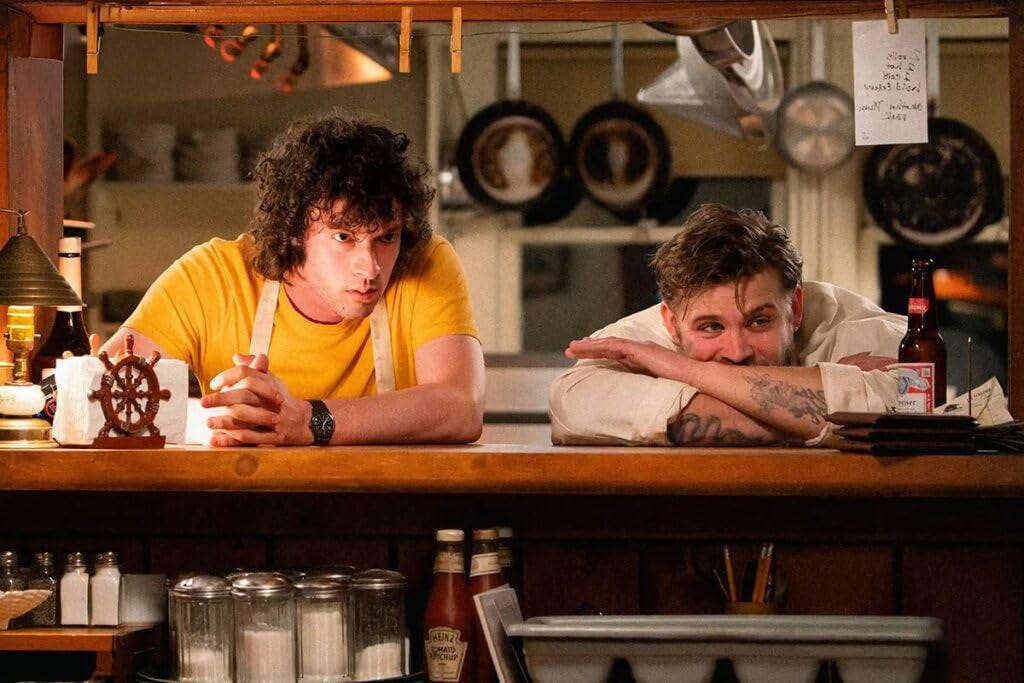
I could go on—every morning, Chef baptizes Tony with water from the ocean to wake him up; at one point, Tony is splayed out on the sidewalk, arms to the side, one foot on top of the other, looking very much like, well—but hopefully you take my point: This is very much a story of redemption, in the sense of deliverance from sin. Tony’s original sin is his lie. His lies. His constant lying. It isn’t until the film’s end, when he can finally speak the truth about himself, that he can begin his ascent.
Even though I am not, as I wrote, a fan of the Cult of Bourdain, this is a film that very much positions him as a religious figure, an icon of our age. It is, also, at least in part about how great art comes from living life rather than simply experiencing other artists’ work. The pitch he delivers at the beginning of the film about his ridiculous idea for a novel is wan, weak. Tony shows how the life Bourdain lived inexorably led to Kitchen Confidential and the rest of his written output. A college kid’s meditation on life through the lens of Kerouac and Salinger is worse than useless: It’s pointless. Kitchen Confidential changed the world. There’s a lesson here.
Between this and The Holdovers, Sessa is really cornering the market on “young, gawky punks who need to learn they’re not quite as smart as they think.” But Banderas and Woodall are the standouts here. Banderas was one of the more underappreciated action stars of the 1990s/2000s—the manic twitchiness in his collaborations with Robert Rodriguez remains great fun to watch today—and he brings a quieter version of that energy to this role. Woodall, meanwhile, has a perfectly calibrated brutish intensity for the sin-eating line cook. It’s a good follow-up to the fantastic work he did in Tuner earlier this year.
Support our growing coverage of movies, books, arts, ideas, and culture—become a Bulwark+ member today.

ON THIS WEEK’S EPISODE of The Bulwark Goes to Hollywood, I talked to Alex Ullom, the writer/director of It Ends. The story of this film’s production and release is really fascinating and just goes to show how film distribution is changing: this is a picture that debuted at SXSW, no one bought it, then it played on Letterboxd’s video-rental service to raves from users there, only to get picked up by Neon for national distribution. It’s in NYC and LA this weekend and expanding wider next weekend. If you’re reading this, it’ll probably be playing near you. I hope you check it out:
Life Is a Highway: The Terror of ‘It Ends’

This week’s episode is a real treat: I’m joined by Alex Ullom, the 28-year-old writer/director of It Ends, and he provided a real window into the process of getting a low-budget indie movie made. His story has everything: fundraising from professional magicians; a first cut that didn’t work at all; acceptance into SXSW followed by no off…
Memories of Miasma
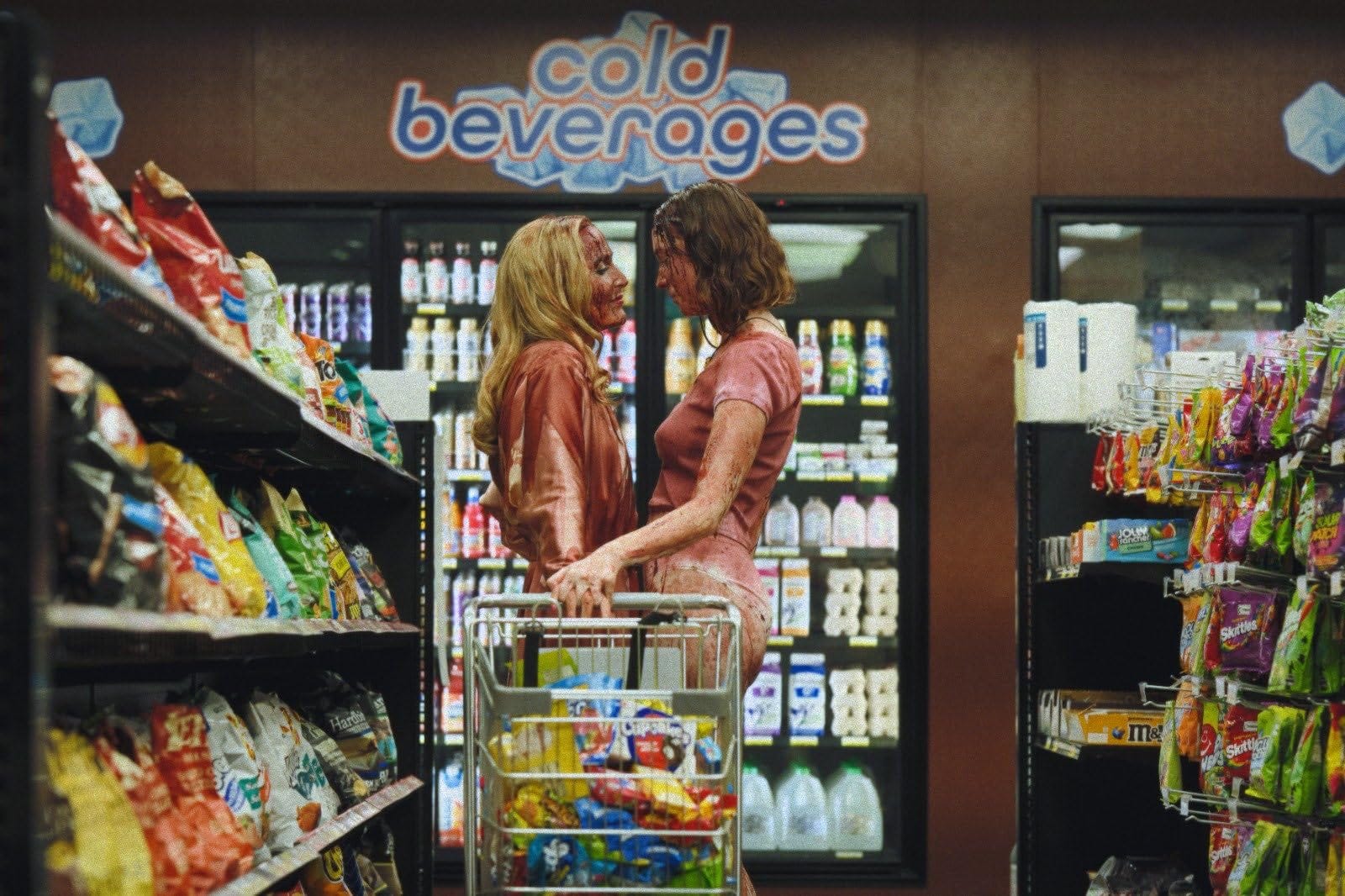
THERE’S A MOMENT in Teenage Sex and Death at Camp Miasma that’s getting raves, a longish not-quite-single take in which the film’s killer—whose name is “Little Death” and who has a vent for a head and a rusty spear for a weapon—engages in a bloody rampage for our amusement set to the dulcet tones of “A Long December” by Counting Crows.
It would take too much time to explain the metatextual layers of this sequence fully; suffice to say that what we’re watching is, supposedly, a scene from a Friday the 13th-like slasher that exists within the universe of this film. Critics and audiences alike have been amused by the juxtaposition of the prancing killer and the fountains of blood and the maudlin vocal stylings of Adam Duritz. It’s a neat little scene. The only problem is that it doesn’t make sense.
I don’t mean in the grand sense that slasher movies never make sense: What, precisely, are Jason Voorhees or Michael Myers at this point, anyway—demons, immortal ghouls, what, explain it, you can’t. I mean, within the film itself, this sequence doesn’t make sense, because the point of view is all wrong. Up to this point, the film-within-a-film we’re watching is shot like a pretty standard ’80s slasher with film stock simulating a film from that era. It’s stilted and awkwardly cut. There have also been a handful of sequences from the POV of “Little Death” shot in a hazier way. But this sequence is shot like something out of the 2020s in that it’s a stitched-together single take, on a different film stock, and pointedly not from the POV of “Little Death” or any of the other characters.
It has a view from nowhere, in other words, just image vomit with an ironic musical juxtaposition. And this is the problem with the film writ large, which is that it is a riff on slasher films that tries to be parody and homage and critique and is therefore nothing. The whole movie—which is about an indie director (Hannah Einbinder) who is tasked with rebooting a moribund slasher franchise with a reclusive star (Gillian Anderson)—feels like a brain dump from writer/director Jane Schoenbrun’s movie journal. Indeed, it’s practically a manifestation of young Tony Bourdain’s bullshit pitch to the stiffs at Vassar; just sub in Sleepaway Camp and Friday the 13th for On the Road and Catcher in the Rye. It’s a work of “art” cobbled together from component pieces of other, superior works of art. I will happily grant that the film has a neat look and some cool visual cues, but it is ultimately confused, at war with itself, warped by the very media it is trying to celebrate.
I never understood the adoration for Anthony Bourdain. I watched a few episodes of his "reality" series, but never understood the attraction. And I used to watch a lot of Food Network because I like to cook. That said, since I live in the same city you do, I'll have to wait for it to "expand outward" from NYC or LA.
And I also couldn't agree more with your take on slasher movies. They never make sense because you can't really describe exactly what either Jason or Michael ARE. Although, in the original he wasn't real, but an memory of his mother who was the actual killer. What I never understood was how she could get in the situations needed to actually kill the camp counselors. Regardless, the fact that neither one can be accurately categorized stands.
....I really need to see Tuner.
My read on the Counting Crows sequence in 'Camp Miasma' was that, by that point at the film-within-the-film, what we were seeing was Einbinder's character's vision of what her remake might become as opposed to the original version seen in the clips earlier. (Also, the massive amounts of weed the two central characters are smoking.) Two of Schonbrun's three films have been about how subjective an experience watching something is (and 'We're All Going to the World's Fair' is, IMHO, kind of about the opposite of that), which is where I'm getting this from.
Plus: I am never not going to be happy to see Zach Cherry on screen, and him being the guy in the horror film who delivers exposition is a great bit of casting.