


Donald Trump posts a lot of election conspiracy theories online, and he posts a lot of racist memes, too. But it’s not every day that he makes an elections-conspiracy-theory post that is also insanely racist. Yesterday, he shared a one-minute video alleging that mysterious “4G wireless chips” were discovered “embedded” in a 2020 Michigan voting machine, leading to the “transmission of electronic data” and the manufacture of votes for Joe Biden. The video ends with a hard cut to a totally unrelated clip: two seconds of Barack and Michelle Obama’s grinning heads AI-superimposed onto the bodies of dancing apes.
There’s no political benefit to this, and there will be no political price. It’s just the stuff he likes.
Programming note: JVL is off again today, so no Triad this afternoon, but there will be a Secret Pod. The Triad will be back Monday. Happy Friday.
The President and His Ministers
by Andrew Egger
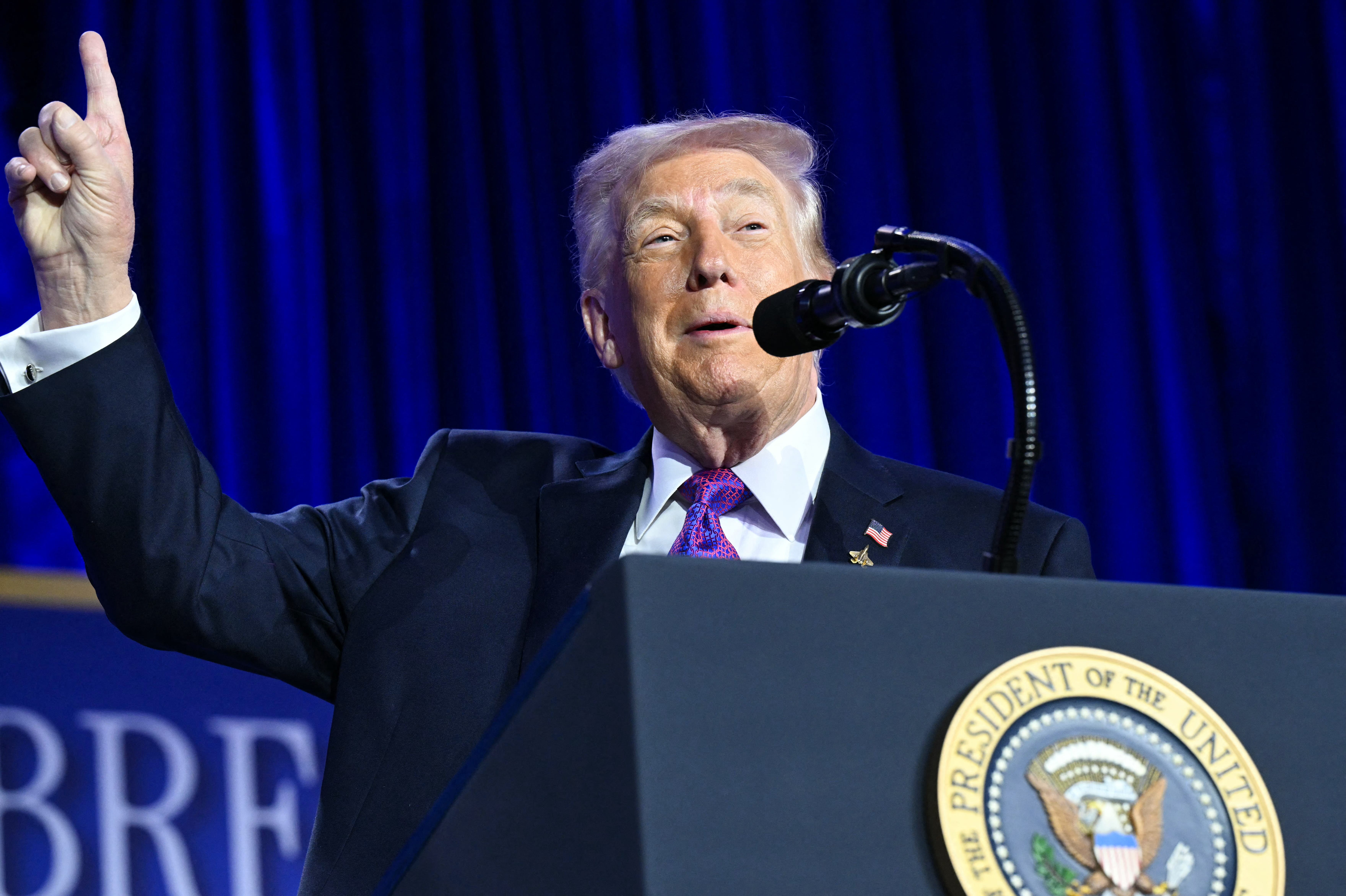
For American Christians not all-in on MAGA, yesterday’s National Prayer Breakfast was one long parade of bleakness and despair. There was the outrageous presence of Salvadoran President Nayib Bukele, who cast his authoritarianism and barbarity as a God-blessed spiritual struggle against his country’s Satanist gangs. There was the full-service tongue-bath for Donald Trump from speaker after speaker: Televangelist Trump ally Paula White called him “the greatest champion of faith that we have ever had,” a man who has “brought religion back to this nation and beyond.” And there was Trump’s own ordinary barrage of tasteless, cruel obscenity, including in his mockery of the very idea that Democrats would attend the event: “I don’t know how a person of faith can vote for a Democrat, I really don’t,” he said.
But the most interesting moment of the breakfast came when Trump turned briefly to another topic: the contemplation of his own soul.
Unsurprisingly, at his age, Trump has the afterlife on his mind a lot. It pops up at odd times: He’ll be mid-rant about criminal illegals, or the dastardly fake news, or America’s Dawning Golden Age, and suddenly he’ll be giving himself a spiritual scorecard: “I want to try and get to heaven, if possible,” he’ll muse; or “I don’t think there’s anything that’s going to get me into heaven. I think I’m not maybe heaven-bound.”
But yesterday, surrounded by spiritual leaders, political sycophants, and the spiritual leaders who are his biggest political sycophants, Trump offered the clearest formulation yet of his own bespoke soteriology. Don’t worry, he reassured the audience: He’d been mostly kidding when he said he wasn’t heaven-bound. “I really think I probably should make it,” he said. “I mean, I’m not a perfect candidate, but I did a hell of a lot of good for perfect people.”
Hey, you can’t deny the guy’s got a way with words. It’d be hard to come up with a better formulation of Trump’s attitude toward American evangelicalism, its attitude toward him, and why their partnership has become so dangerous for the country.
Trump, whose ignorance of Christianity led to a series of memorable gaffes when he arrived on the political scene a decade ago—citing “Two Corinthians” and dodging questions about his favorite Bible verse—hasn’t seemed to make much spiritual progress in the intervening years. Here he was yesterday, talking about the speaker of the House: “Mike Johnson is a very religious person. He does not hide it. He’ll sometimes say to me at lunch, ‘Sir, may we pray?’ I’ll say, ‘Excuse me? We’re having lunch.’”
In Trump’s view, guys like Johnson are inside the church in a way he is not. But it’s the very fact that he’s outside—unconstrained by the moral scruples that guys like Johnson have1—that makes his particular service to the church valuable. He sees himself as Christianity’s Punisher, the guy who will blacken his own soul to do what must be done to protect the righteous. Yesterday, while discussing his ongoing military campaign against Islamists in Nigeria, he summed it up this way: “When Christians come under attack, they know [their attackers] are going to be attacked violently and viciously by President Trump. I know it’s not a nice thing to say, but that’s the way it is.”
That violently and viciously isn’t just rhetorical window-dressing. This is the service Trump explicitly offers to conservative Christians: There’s dirty work that needs doing. Let me be the one to do it for you. And it isn’t just a political pitch. Trump sincerely seems to believe he has reached a moral accommodation with God for his unique services rendered. “I’m not a perfect candidate, but I did a hell of a lot of good for perfect people.”
This is part of what makes Trump-brand Christianity as a cultural and political force so dangerous. Trump’s political project is seen by the MAGA faithful as utterly righteous, the work of God on earth against the forces of Satan. But he has broad license to transgress all moral boundaries as he does that work. When he does so, it doesn’t cause MAGA Christians to reevaluate whether he’s actually on the side of the angels. Instead, it makes them perversely grateful that he’s doing it so their hands can be clean.
None of this, it should probably go without saying, is compatible in the slightest with the teachings of actual Christianity. Sin is sin, the faith teaches, no matter whom it’s directed against: “Whatever you do to the least of these,” Jesus taught, “you do to me.” The world isn’t divided into “perfect people” on one (political) side and agents of Satan on the other: “All have sinned,” Paul wrote, “and fall short of the glory of God.” Everyone, presidents included, is called to see their own sin with an unsparing eye, feel it in their bones, fall to their knees for forgiveness, spend their lives struggling to turn from it.
Trump doesn’t do this. He doesn’t think he’s obliged to. And why would he? None of the “spiritual leaders” that surround him seem particularly uncomfortable with their arrangement. The loudest Christians in his life have nothing but praise for the way he conducts his business: “the greatest champion of faith that we have ever had.”2
Many of these advisers, it should be said, do not actually believe this is a real pathway to paradise. In her personal time, Paula White has a more traditional view: “Heaven and hell . . . it’s real whether you believe in it or not,” she recently reminded her followers. So what must one do? “Open up your heart for God to come in through his son Jesus Christ. Say, Father God, forgive me for my sin. . . . I receive Jesus Christ as my personal Lord and Savior.”
Trump plainly thinks he’s going to heaven. I wonder: Does Paula White agree?
Thanks for reading Morning Shots. At The Bulwark, we’re not beholden to billionaire oligarchs or parent conglomerates. Instead, we have you. If you’re not a Bulwark+ member yet, join us now with this special offer.

Let’s be together: Join us March 19 in Austin, Texas at the Paramount Theatre for a night of politics among friends.
Don’t Forget Epstein
by William Kristol
There are so many outrages, it’s hard to keep up with them all. For my part, I’ve been focused this week on the depredations of ICE and the Border Patrol, and on the Trump administration’s plans for election interference. These are important topics. But I did want to write this morning just to remind us all, including myself: Don’t forget Epstein!
This morning’s New York Times has a useful prompt against forgetting. The carefully reported article, “‘Gang Stuff’ and ‘Illicit Trysts’: How Epstein Sought Leverage With the Wealthy,” primarily explores the implications of one document from the Epstein files. It’s a draft letter from Epstein to Leslie Wexner, a billionaire who was both a financial benefactor of Epstein and an apparent beneficiary of Epstein’s sexual predations.
Around 2014, Epstein was contemplating renewing their relationship, which had broken off when Epstein was first indicted in 2007, and when others in the Wexner family had looked into Epstein’s financial dealings with Wexner. In the draft letter, Epstein reminded Wexner, “You and I had ‘gang stuff’ for over 15 years,” and that “I owe a great debt to you, as frankly you owe to me.” And Epstein wrote, with more than an implication of menace beneath a surface tone of reassurance, that he had “no intention of divulging any confidence of ours.”
As the Times article points out, “the letter fit into a broad pattern in which Mr. Epstein toyed with the idea of telling his past, present and potential financial sponsors that he knew—and was keeping quiet about—their supposed secrets.”
Read the piece for the whole sordid story. You’ll also get brief accounts of Epstein’s relationship with billionaires Bill Gates and Leon Black. And of course there were so many more cases, so many more relationships.
But the Trump Justice Department isn’t interested. On Sunday, Deputy Attorney General Todd Blanche said that prosecutors’ review of the Epstein sex-trafficking case “is over.” There’s nothing more worth investigating here, he tried to assure us. And on Monday, he added a little lecture for us rubes who didn’t practice criminal defense at elite law firms: “The American people need to understand that it isn’t a crime to party with Mr. Epstein.”
Then on Tuesday, President Trump refused to answer questions from CNN’s Kaitlan Collins about whether there had been a failure to secure justice for Epstein’s victims, and of course expressed no concern or compassion for those victims. Instead, he told Collins to smile more, and declared it was “really time for the country to get onto something else.”
It’s blindingly obvious that the Trump administration has no interest in our learning more about Epstein. It’s also blindingly obvious that the web of corruption and complicity around Epstein was large and intricate, and that there is much more that we deserve to know about Epstein’s world.
Trump was part of that world. So were many other important men. The Trump administration’s handling of the Epstein files has been a scandal. But the collusion and complicity of a swath of America’s elite over a quarter century in Epstein’s behavior is an even deeper scandal and outrage.
And the continuing lack of interest among many in elite circles in exposing what took place is a further outrage. It would be unfair to say large swathes of American elites are pro-Epstein. But they are effectively anti-anti-Epstein. They’re certainly not interested in doing much of anything to push for the truth to come out about Epstein.
So all honor to those—especially the courageous victims, but also the intrepid journalists and investigators and truth-seekers—who have pursued the truth about Epstein and his world so diligently. They have done so against obstacles of indifference to—even disdain for—their efforts. What will it say about us as a nation if we are not willing to do our best, at long last, to drain this fetid swamp?
AROUND THE BULWARK
Jeff Bezos Must Sell the Washington Post… Mass layoffs undermine his promises to protect a great American institution, argues CAMERON BARR, former No. 2 editor at the Post.
How Big Is MAGA, Really? Trump is governing like he has a huge mandate. The numbers disagree, observes MONA CHAREN.
Trump Is Treating Elections Like Crimes… On The Illegal News, SARAH LONGWELL and CNN legal analyst ELLIOTT WILLIAMS walk through a stunning week of norm-breaking: the arrest of journalists after a Minnesota protest, Trump hovering over federal law enforcement, an FBI raid on a Georgia election office, and open talk of “nationalizing” U.S. elections.
Let’s Not Sportswash Trump’s Authoritarianism… The Olympics, the World Cup, and cheering for our nation’s athletes but not the current administration—thoughts from JON STEINMAN and MICHAEL ANGELONI.
The Trad Right’s Freakiest Scandal Yet…Tim Miller, Sam Stein, and Will Sommer give their takes on the chaotic scandal surrounding far-right influencer Elijah Schaefer, who returned to his web show with a black eye, paranoid Rumble rants, and a series of increasingly bizarre videos.
Quick Hits
SCHEDULE F ARRIVES: The federal workforce hasn’t been much in the news lately—certainly not like during the heyday of DOGE—but that may be about to change. Yesterday, the White House finalized a long-planned policy rule removing civil-service protections from around 50,000 career federal employees working in what the White House considers “policy-related” roles. Such employees will now serve, like the government’s 4,000-odd political appointees, at the will of the president.
The new rule also reorganizes the whistleblower process for the employees in question, whose complaints will no longer be handled by an external office—the independent Office of Special Counsel—but by their own agencies. The New York Times has more:
In a statement announcing the final rule, the Office of Personnel Management said that political patronage, loyalty tests and political discrimination in the federal work force were “explicitly” prohibited. The rule, which is expected to be published in the Federal Register on Friday, describes the new job category as “career jobs filled on a nonpartisan basis. Yet they will be at-will positions excepted from adverse action procedures or appeals.” . . .
But critics question whether the government can be taken at its word after a year of retributive firings, including the dismissal of several whistle-blowers.
The rule amounts to “a huge increase of at-will employment with an administration that has demonstrated a contempt for nonpartisan expertise,” said Max Stier, the chief executive of the Partnership for Public Service, a nonprofit group that promotes an effective federal work force. “Their track record does not justify trust, and our history as a country demonstrates that these kind of changes lead to worse government results, not better.”
SEE TULSI RAID: The White House just can’t seem to keep its story straight about why Director of National Intelligence Tulsi Gabbard was hanging around during the FBI’s raid last week of an election office in Fulton County, Georgia. As we noted yesterday, Trump told NBC News in an interview Wednesday night that he didn’t know why Gabbard had attended the raid. But Gabbard herself contradicted that claim in a letter to Senate Democrats this week, in which she wrote that Trump had “specifically directed my observance of the execution of the Fulton County search warrant.”
During his free-associative speech at yesterday’s National Prayer Breakfast, Trump changed his story again—although his new story no more aligns with Gabbard’s claims than his old one did. In his latest telling, it was Attorney General Pam Bondi who told Gabbard to attend: Gabbard “took a lot of heat . . . because she went in at Pam’s insistence,” Trump said. “Pam wanted her to do it.”
WATCH YOUR BACK, KEVIN: Donald Trump may have picked his guy to be the next Fed chair, but it’s plain he’s keeping Kevin Warsh on a short leash. During a swanky dinner at the Alfalfa Club last Saturday, Trump said he expected Warsh to lower interest rates—and joked that he’d sue him if he didn’t.
At least, it was probably a joke. But Treasury Secretary Scott Bessent didn’t seem confident enough to rule a lawsuit out during testimony before the Senate Banking Committee yesterday.
During the hearing, Sen. Elizabeth Warren asked Bessent if he could rule out that Warsh would be sued or investigated by the Department of Justice if he failed to cut interest rates. “That is up to the president,” Bessent said.
Cheap Shots

Well, are alleged to have.
"Instead, it makes them perversely grateful that he’s doing it so their hands can be clean."
But they aren't clean. They seem to think that voting has no moral consequence. They are wrong. If you vote for a liar, you have committed an act of falsehood. If you vote for a racist, you have committed an act of racism. If you vote for someone who promises violence, you have committed and act of violence. If you for vote for a corrupt person, you have committed an act of corruption. If you vote for an immoral person, you have committed and act of immorality. Especially if you vote for them BECAUSE they are these things.
MAGA Americans aren't really into self-awareness, especially the ones who are into performative Christianity. But the rest of us see them for who they are.
Bukele at a prayer breakfast feels like a prelude to burning witches at the stake.