Trump to Hill Republicans: I Will Make Your Summer Hell
It's Demoralized White Boy Summer on Capitol Hill.

Summertime Sadness
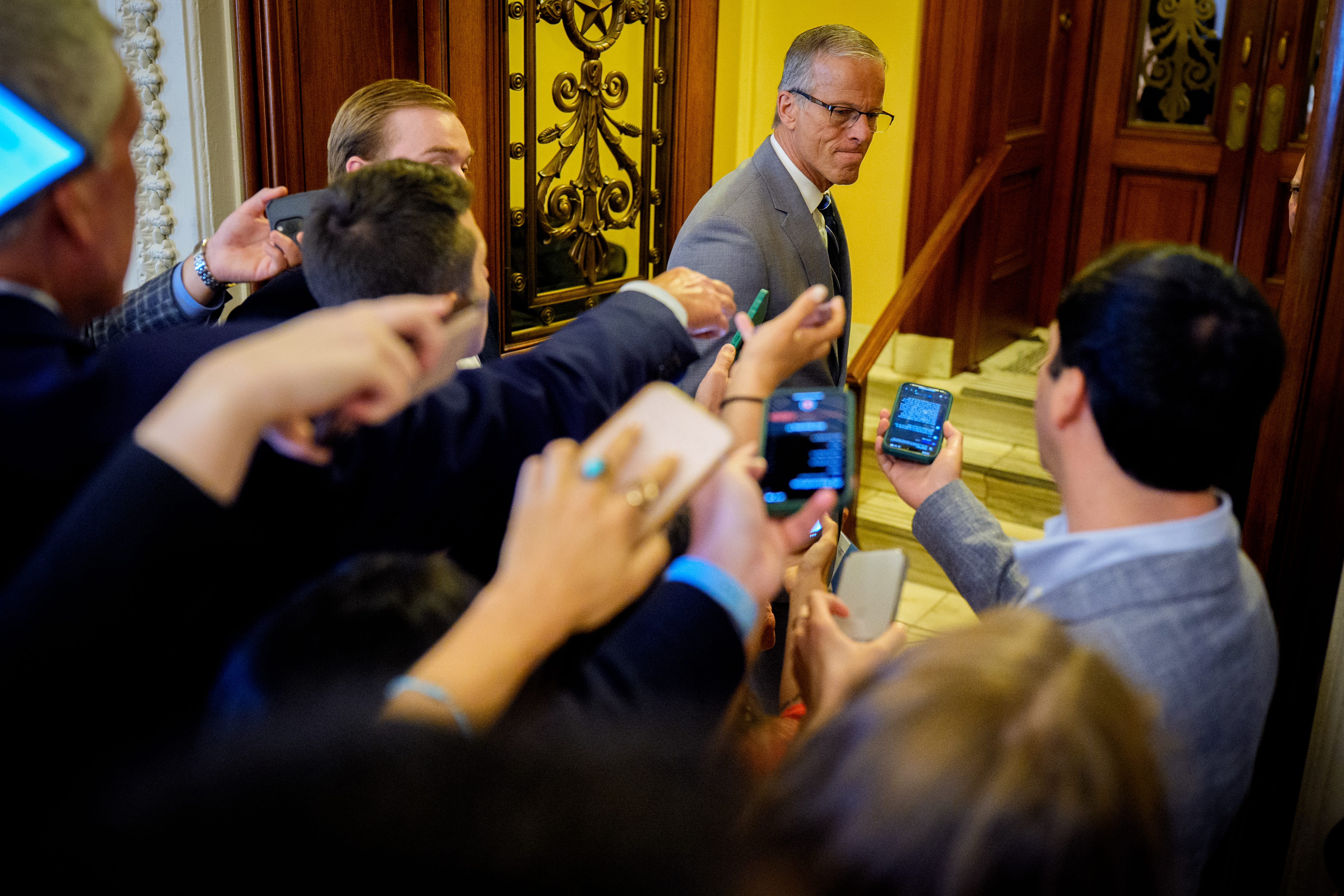
President Donald Trump wants Senate Republicans to cancel their scheduled August recess this year. The recess might seem like an unimportant feature of the congressional calendar, but it provides legislators with an extended state and district work period, which actually matters a great deal to lawmakers and their political prospects—especially if they’re trying to do emergency PR for a horribly unpopular law they just rushed through.
Congress’s reputation for idling in gridlock notwithstanding, the Senate has actually upped its workload a great deal since Trump took office. Members of the upper chamber have worked many Fridays, taken fewer recesses than normal, and even held several grueling vote-a-ramas.1 But despite their longer weeks this year, Congress is still behind on important lawmaking priorities. For example, Republicans need to finish work on a number of appropriations bills to avoid a government shutdown on September 30.
But that’s not the reason Trump wants them to cancel the August recess. He wants the Senate to stay in session so they can confirm more of his judicial nominees.
“Hopefully the very talented John Thune, fresh off our many victories over the past two weeks and, indeed, 6 months, will cancel August recess (and long weekends!), in order to get my incredible nominees confirmed,” Trump posted on Truth Social. “We need them badly!!!”
The last time this happened was in 2018, when then-Majority Leader Mitch McConnell canceled the August recess to accommodate the lagging appropriations process. McConnell pulled a similar maneuver in 2017 as well, but that time he only cut the recess in half.
Needless to say, some Republicans are less than thrilled about the prospect of being stuck in D.C. all summer.
“I hope to be in Kansas with my constituents and my family,” said Republican Sen. Jerry Moran when I asked about his plans for August. He wondered if the threat of working all August might prompt Democrats to stop slow-rolling Trump’s nominees, and he added that he hopes “we can utilize this to speed up the process by which we get more confirmations done, and not everything is dragged out as it is currently.”
I wouldn’t bet on that. Senate Democrats have dug in on not approving—or at least not allowing a smooth process for approving—the president’s nominees. Giving up this position so that they too can head back home would be the type of move that would enrage the Democratic party base.
As I mentioned at the top, Republicans in particular need the customary August visit to their home states this year. For some, their political lives may depend on pressing the flesh, hitting the local news circuits, and hammering in the message that actually, the bill we just passed is good, regardless of what they say. Winning the messaging fight is the most important task for lawmakers when it comes to most controversial legislation, especially when that legislation is predicated on reducing government services and adjusting tax liabilities to better suit the highest earners.
“Delivering the message about our accomplishments is something that our members are anxious to get out there and do,” Senate Majority Leader John Thune told reporters.
But Thune added that he’s “thinking about” cutting down the August recess, noting, “We’re going to be looking at all the options in the next weeks to try and get as many of those [nominees] across the finish line as we can.” That could mean canceling the whole recess outright or just shortening it the way McConnell did in 2017.
Thune surely knows that he is in a bind. He can either let his colleagues take a break to sell Trump’s budget legislation to a public that hates it or bend to Trump’s current demands. Always bet on the latter.
What is dead may never die
Back in January, when Trump announced the government was going to come clean on all things related to the JFK assassination, Republican senators were very enthusiastic about the feds also throwing open the file on Jeffrey Epstein. Some Republicans even told me they would take the request directly to Trump if given the chance.
“I’d like to see them,” said Sen. John Kennedy (R-La.). When I asked Kennedy why he thinks Trump didn’t include Epstein, he said, “I don’t know. If I talk to him, I’ll ask him, but I’d like to see them. I’ll be the first in line.”
“I don’t care if he’s named in them,” Kennedy added of the possibility of a Trump cameo in the files. “The American people are entitled to know the truth. The man’s dead as Jimmy Hoffa—he’s gone—and his sidekick’s in jail. We’re entitled to know what he did, who he did it with, and whether he broke any laws.”
But that was before the president declared the Epstein investigation to be a “hoax.” Now, Senate Republicans will not even consent to approving an anodyne resolution calling on the Justice Department to clarify the extent of its Epstein-related materials and release any that are appropriate to be made public. In the House, it’s a similar story, with Republican leaders refusing to entertain a vote on a resolution calling for the government to release the Epstein files even though a bipartisan coalition could force one sometime around Labor Day without the consent of GOP leadership.
“My belief is we need the administration to have the space to do what it is doing, and if further congressional action is necessary or appropriate, then we’ll look at that,” House Speaker Mike Johnson told reporters in a brief gaggle Monday. “But I don’t think we’re at that point right now because we agree with the president.”
Not all of his colleagues are satisfied with that. Rep. Thomas Massie (R-Ky.), the Republican leading the charge on the bipartisan House resolution Johnson et al. are trying to circumvent, exited the Capitol Monday evening carrying a prop binder labeled “The Epstein Files: Phase 2.” This was an apparent jab at the Trump administration’s attempt, back in February, to satiate popular far-right influencers by inviting them to the White House and putting binders of already long-public material in their hands, each labeled “The Epstein Files: Phase 1.”

Massie downplayed the need to hold a vote right away and said extra time would allow his discharge petition to ripen before the House returns from August recess.2 He also suggested that a few weeks of pressure from constituents will light a fire under the GOP leadership’s feet and “momentum will build for transparency.”
“I don’t think this is going to go away,” Massie added. “This transcends all other issues. This is about whether there’s an elite and powerful group of people who are above the law, or whether they answer to the law. That’s what this is about. Right now, anybody who wants to subvert or keep the Epstein files secret, they are on the wrong side.”
Today, Rep. Tim Burchett (R-Tenn.), a man who regularly makes himself a thorn in leadership’s side (only to then fold), proposed that the House subpoena Epstein confidante and girlfriend Ghislaine Maxwell to appear for a deposition with the House Oversight Committee. It passed by a voice vote.
The Epstein story’s power is paralyzing House Republicans, many of whom are or were longtime proponents of conspiracy theories surrounding the circumstances of the disgraced financier’s crimes and death. Members of the House Rules Committee said they wouldn’t be reporting any rules this week out of fear that Democrats will introduce amendments related to releasing the government’s Epstein documents. This meant that nothing would be allowed to make it to the floor apart from suspensions, which are votes to suspend the rules to vote on (typically) inconsequential legislation, such as the establishment of new zip codes for the United States Postal Service.
With all this friction, the engine finally seized. Republican leadership informed their colleagues today that Wednesday would be the final day of votes for the House until September 2. While the Senate may be sticking around for August, the House is fully gone.
Interview with a vampire
I admit to being fascinated by Bryan Johnson, the millionaire tech mogul whose apparent life purpose is to convince the world his bit about becoming immortal is not a bit. (I mean, come on, it’s very serious. Why are you smiling? Is it just because the man is de-aging his penis?)
Johnson, who is quite active on the earned-media front, did an interview with Wired’s Katie Drummond, and I feel the need to share it.
Johnson begins with his usual shtick about how he’s never going to die,3 but Drummond soon pivots the conversation to Health and Human Services Secretary Robert F. Kennedy Jr. She wants to get Johnson’s take on what Kennedy is doing to the American health system and guidance for a healthy lifestyle.
I want to ask you about MAHA. When President Trump won the election, you congratulated him on social media. You were photographed with RFK Jr. What is your assessment of RFK Jr. and the Trump administration vis-à-vis American health? How do you rate the administration so far?
RFK is certainly not a status quo person.
You could say that.
The status quo in the US is not working. If you look at the data around the health of our citizenry, it’s embarrassingly bad. I think we spend 1.8 times our peer countries in health care: $13,000 per person versus $7,000 or so in the other developed countries. We spend more and we get less. Whether RFK is the solution or not, what we’re doing is not working, so I’m open to change, and I’m open to a variety of possibilities. It’s not to say that everything he’s doing is correct, but I do support the idea that we definitely need to change.
Do you worry about medical research being delayed by years or decades if it’s curtailed right now?
Oftentimes, when one path is discontinued, everybody thinks it’s an end of something; but actually, that change produces a new path that people didn’t anticipate. So no, I support the creative destruction. I think it could have some positive outcomes. Clearly, there could be some drawbacks. When you break things like this, it goes both ways. It’s not a clean win or loss.
I think what would be cool is if we as a country said, “We want to be number one in the entire world for life expectancy.” That is a very clear goal.
Here, Johnson offers the old Silicon Valley chestnut that “disruption” for its own sake is objectively good. When it comes to well-formed scientific consensus, however, “disruption” could very well be objectively bad. And “creative destruction” could be objectively very bad indeed.
A vote-a-rama is a marathon-style vote series in which everyone involved is deprived of sleep. The latest vote-a-rama occurred during the day, which was highly irregular. They’re typically held all through the night. Needless to say, I’m not a fan, and I don’t expect the senators are, either.
The House’s extended recess is still moving ahead as scheduled. Representatives will take all of August off despite the tall piles of work on their desks. How European of them.
The average Sicilian nonna who smokes a pack of cigarettes and drinks a carafe of wine per day will outlive this man by a minimum of two decades.
All these delaying tactics just allow more time for the files to be sanitized. There’s no reason to believe that anything released will be the actual truth.
Nice deep pull from GOT. Do you watch the Bulwark’s Cam Kaskey talk theory with David Lightbringer on YouTube? It’s interesting.
And of course Johnson is both a lunatic and without empathy for his fellow man. “De-aging his penis”—what a selfish toad. He could spend a tenth of that amount buying up medical debt and be a hero to those people for generations. He chose to be a ghoul, instead.