


Andrew bought a Toyota hybrid a couple months ago, and at one point the thought occurred to him: You know, this gas mileage would be even sweeter if gas weren’t pretty cheap right now. So he can’t help but feel like, at some cosmic level, he might be a little bit responsible for all this. If so, you know—he’s sorry. Happy Monday.
Why Would There Be a War?
by Andrew Egger
What did the White House think it was getting into in Iran? A strike against Iran’s oppressive and fanatical regime, sure. A display of America’s awesome military might, definitely. But it’s become increasingly, painfully clear: They didn’t think there was going to be a war.
The Trump administration developed no real theory of the objectives of the Iran war, because they didn’t think there was going to be a war. Instead, the administration has backfilled a dizzying array of post-hoc goals for the strikes against Iran. Judd Legum counts seventeen different rationales offered by many different officials, from the president’s “feeling, based on fact” that Iran was about to strike the United States to a desire to free the Iranian people to a need to destroy a nuclear program the White House had claimed was already “obliterated.”
The Trump administration made no effort to get the American people on board with war, because they didn’t think there was going to be a war. A majority of the public is already opposed to war with Iran, and what support the war does have seems to be based on the questionable assumption that the conflict will be shortly resolved: 44 percent of Americans support the strikes so far, but only 12 percent would be in favor of sending U.S. ground troops into the country. But the White House has made no broad effort to convince the public on a bipartisan basis that they should be prepared for a long-haul conflict.
They didn’t think there was going to be a war, and so the White House seemingly gave no thought to what the economic ramifications of war would be. After several days of strikes on Iran, President Trump seemed suddenly to realize last week that the ongoing conflict was going to be terrible for energy prices. He tried to slap a band-aid on the problem by announcing risk insurance and military escorts for all oil tankers through the Strait of Hormuz, but it wasn’t enough: Suddenly, oil prices went through the roof, and the White House was scrambling to contain the damage—rushing to reassure consumers that the price hikes would be temporary and even waiving some sanctions on Russian oil to try to ease pressures on global supply. “Short term oil prices, which will drop rapidly when the destruction of the Iran nuclear threat is over, is a very small price to pay for U.S.A, and World, Safety and Peace,” Trump posted on Truth Social yesterday. “ONLY FOOLS WOULD THINK DIFFERENTLY!”
They didn’t think there was going to be a war, and so the president assumed he’d be in charge of picking Iran’s next political leadership. This plan, admittedly, hit an unexpected snag early on: The initial round of strikes that took out Iran’s top leaders also killed a number of lower-ranking regime figures that the White House had identified as pragmatists who might be willing to negotiate. “The attack was so successful it knocked out most of the candidates,” Trump said a day after the strikes began. “It’s not going to be anybody that we were thinking of because they’re all dead. Second or third place is dead.” Still, Trump made it clear he expected to be involved in picking Iran’s next supreme leader, and absolutely ruled out Mojtaba Khamenei, the son of the slain ayatollah: “They are wasting their time . . . Khamenei’s son is unacceptable to me.” But this morning, Iran went ahead and proclaimed Mojtaba Khamenei their next supreme leader anyway.
Somehow, the president seems to remain so confident Iran will be buttoned up in no time that he’s already openly licking his chops over the next triumphant blitzkrieg. “Cuba is gonna fall pretty soon, by the way,” Trump told CNN Friday. “I’m going to put Marco over there and we’ll see how that works out. We’re really focused on this one right now.”
Others in the administration, however, are starting to wake up to the fact that they have plunged into a morass with no easy way out. The success of last year’s strikes on Iran’s nuclear program and the capture of Venezuela’s Nicolás Maduro had pumped them full to bursting with the purest hubris: The United States could simply impose its will on smaller countries, getting in and out with little cost. But this conflict couldn’t look more different: no end in sight, no end even conceptualized, no base of popular support, Americans suffering economically at home and militarily abroad, Iran bloodied but determined to keep on fighting.
They didn’t think there was going to be a war. But now they’ve got one, and they don’t have the faintest idea how to end it.
Tell us how this ends. What do you think is the most likely outcome of the Iran war? And what are the best- and worst-case scenarios?
In case you missed the news, Sarah Longwell’s book is now available for pre-order! How to Eat an Elephant is the story of Sarah’s crusade against Trumpism and her plan to break it—plus a foreword by one Jonathan V. Last.
Order yours here.
Why Would Ukraine Want to Help Us?
by Benjamin Parker
Ukrainian President Volodymyr Zelensky announced this weekend that his country’s armed forces have sent interceptor drones and a team of specialists to U.S. military bases in Jordan to help protect American forces against Iranian drone attacks. It’s probably not a coincidence that Jordan is reportedly the site of an American Terminal High Altitude Area Defense (THAAD) system that the Iranians reportedly damaged or destroyed.
It’s a remarkable reversal. The United States still has (probably) the mightiest military in the world—but Ukraine’s has all the recent experience.
For years, the American government has been telling Ukraine how to fight its war against Russia—what equipment it needs and doesn’t need, how to plan its operations, how to organize its forces, and on and on. Some of that advice was probably apt, but much of it appears to have been outdated.
Which shouldn’t be surprising. The United States hasn’t fought a conventional war against a serious competitor since Saddam Hussein’s Iraq in 1991. And if you don’t consider what was then the world’s fourth-largest military a serious competitor, then you have to go back to the Korean War 75 years ago. To put it shortly, our experience fighting the kind of war Ukraine is fighting is pretty close to nil.
We haven’t fought a war in the drone age. Ukraine has. Right now, the most modern military in the world, the one with the most experience with state-of-the-art technology, is not the United States, which still mostly relies on planes, ships, and ground vehicles from the Reagan-era defense buildup. It’s Ukraine.
Under the Biden administration, American officials claimed to know better than the Ukrainians how to fight Ukraine’s war. Under the Trump administration, the United States is now also trying (but so far failing) to dictate to Ukraine how it should end the war.
And yet, despite all this, Ukraine is still offering to teach us how to protect our sophisticated, expensive, high-demand-low-supply missile defense systems against Iranian drone and missile attacks. As their population has endured endless barrages of such attacks by Russia, using Iranian-designed and in many cases Iranian-manufactured drones, the Ukrainians have become the world’s leading experts in counter-drone warfare. We need their expertise. Maybe we should have been learning from them this whole time.
It’s hard to judge if the decision to lend us a hand is a smart one for the Ukrainians. It cements their reputation as military experts, which is good marketing for their domestic arms industry, which will be key to the country’s future security. And maybe it wins some good will among Americans. And maybe it subtly changes the power dynamic between Washington and Kyiv.
After withstanding more than a year of American diplomatic pressure to accede to Russia’s demands and essentially surrender, it’s not obvious that Ukraine would still want to help us. We’re grateful that they still do.
A MESSAGE FROM UNITEDHEALTH GROUP
Providing a clearer view of care

UnitedHealth Group is making care easier to navigate by investing in tools that help patients find providers near them and compare costs.
“More transparent pricing benefits everyone.” - Dr. Kailey G., Pediatrician
AROUND THE BULWARK
Iran’s Regional War Strategy is Failing… On Shield of the Republic, ERIC EDELMAN and ELIOT COHEN welcome NORMAN T. ROULE to discuss Trump’s attempt to replicate his Venezuela playbook in Iran, the search for an Iranian Delcy Rodríguez, the complexities of succession in Tehran, and whether the regular army (Artesh) could ultimately seize power.
RFK Jr.’s Junk Science Diet… His MAHA ideas about food are built on some of the same lies as his antivax campaign, observes MICHAEL GRUNWALD.
Living With Stage 4 Cancer for Five Years… On How to Fix It, ANNABELLE GURWITCH joins JOHN AVLON about surviving stage 4 lung cancer—and what her experience reveals about America’s broken health system.
Is This War Legal? On The Illegal News, SARAH LONGWELL talks with Just Security’s TESS BRIDGEMAN about whether the Iran war is legal under the Constitution, the War Powers Act, and international law.
Quick Hits
WHO BOMBED THE SCHOOL? For days, White House officials had avoided taking a public stance on whether America was responsible for the February 28 strike that destroyed a girl’s school in southern Iran, killing more than a hundred civilians, many of them children. But on Saturday, Donald Trump weighed in with an unexpectedly strong claim: “In my opinion, based on what I’ve seen, that was done by Iran.”
Immediately, reporters asked Defense Secretary Pete Hegseth, who was standing behind Trump, whether he shared that assessment. Hegseth wasn’t willing to go as far, but also seemed unwilling to contradict the president to his face: The government, he said, was “investigating” the strike, but “the only side that targets civilians is Iran.”
Trump then repeated: “It was done by Iran.”
Iran’s government has flatly denied that it targeted its own civilians in the strike. And while the Iranian regime has a wretched human-rights record and has been perfectly happy to butcher their own citizens in even the extremely recent past, the idea that this particular tragedy was some sort of friendly-fire strike is contradicted by available evidence. This morning, the New York Times published video analysis confirming that the IRGC base adjacent to the school was hit by a Tomahawk missile—which no belligerent in the war uses except for the United States—and that the school was damaged at around the same time. Ergo: We bombed the school. It seems in all likelihood that this wasn’t a case of Iran intentionally targeting civilians, but of the United States accidentally killing civilians.
Trump, one imagines (or perhaps hopes?), has been briefed on all this. But he’s never been one to let uncomfortable facts get in the way of more comfortable ones he dreamed up himself. Thus: “It was done by Iran.”
THE JUSTICE DEPARTMENT VS. THE PEOPLE: We’ve written for months about this White House’s habit of slandering protesters and other perceived “enemies” as violent agitators, rioters, and even domestic terrorists, but sometimes it’s difficult to get a sense of scale. The Wall Street Journal has a great new investigative report into the 279 people whom government officials accused over the past year of attacking federal officers—181 of whom were American citizens, only about half of whom were ever charged with a crime, and precisely zero of whom have been convicted at trial:
Names, mug shots and other identifying details posted by the government put a bulls-eye on them. They had to explain the accusations to family, friends and employers. In a few cases, their home and workplace addresses were leaked online, drawing death threats. Some shouldered the costs of posting bail, securing defense attorneys and taking days off from work to appear in court, including cases where videos debunked the assault claims. When citizens were exonerated, government accounts fell silent about the outcome of their cases, the Journal found. . . .
Federal prosecutors in cities with high-profile immigration operations said they have been pressured by Justice Department leaders to aggressively pursue assault charges, even in cases undermined by contradictory evidence or ones that fail to appear worthy of prosecution. Some have quit in response. . . .
So far, 15 Americans accused of assault by the U.S. government on social media have pleaded guilty—10 to lesser charges. . . Another 51 cases are pending.
FRIENDSHIP OVER EVERYTHING. The reports that Russia is giving Iran intelligence on the positions of American troops should be a pretty big deal, especially when Donald Trump evidently still hopes for some sort of partnership with Vladimir Putin. Yet administration officials have been hand-waving it. In his 60 Minutes interview, Secretary of Defense Pete Hegseth asserted that Russia’s assistance to Iran in targeting Americans doesn’t matter because it’s all factored in by U.S. forces; also, “the president has an incredible knack at knowing how to mitigate those risks.” So would there be conversations with Russia about stopping it? Well, Hegseth said, Trump has a “unique relationship with a lot of world leaders” that lets him resolve such problems in a way Joe Biden never could have done.
That’s comforting.
Meanwhile, aboard Air Force One, Steve Witkoff, Trump’s Putin-friendly envoy, assured reporters he had “strongly” asked the Russians to knock it off, and Trump himself, like Hegseth, dismissed the reported intelligence-sharing as unimportant: “If they’re getting information, it’s not helping them much.” Surely helping target American soldiers is very bad even if it’s not very effective. But Trump shrugs it off: “Wouldn’t they say that we do it against them?”
Yes, the president of the United States apparently thinks that giving intelligence to our enemy—in what he says is a just war against a terrorist regime—is comparable to U.S. intelligence-sharing with a democratic ally resisting an invasion. Nothing to see here.
—Cathy Young
Cheap Shots
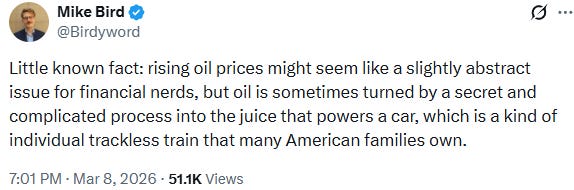
It's OK Andrew. I bought a Chevy Bolt last summer and am currently insufferable.
An illegal war fomented by a lawless regime led by the stoopidest, most arrogant bunch of losers the world has ever seen. #ettd