



Defending his war of choice in Iran, President Trump told CNBC this morning: “They want it to be over immediately, and I just looked at a little chart: WWI, four years, three months. WWII, six years. Korean War, three years. Vietnam, nineteen years. Iraq, eight years. I’m five months. Five months. I would have won Vietnam very quickly.” We have a lot of questions, but paramount among them: Where did he get “five months” from?
Programming note: Join Bill and Andrew for Morning Shots Live at 10 a.m. EDT. Watch on Substack or YouTube. Happy Tuesday.
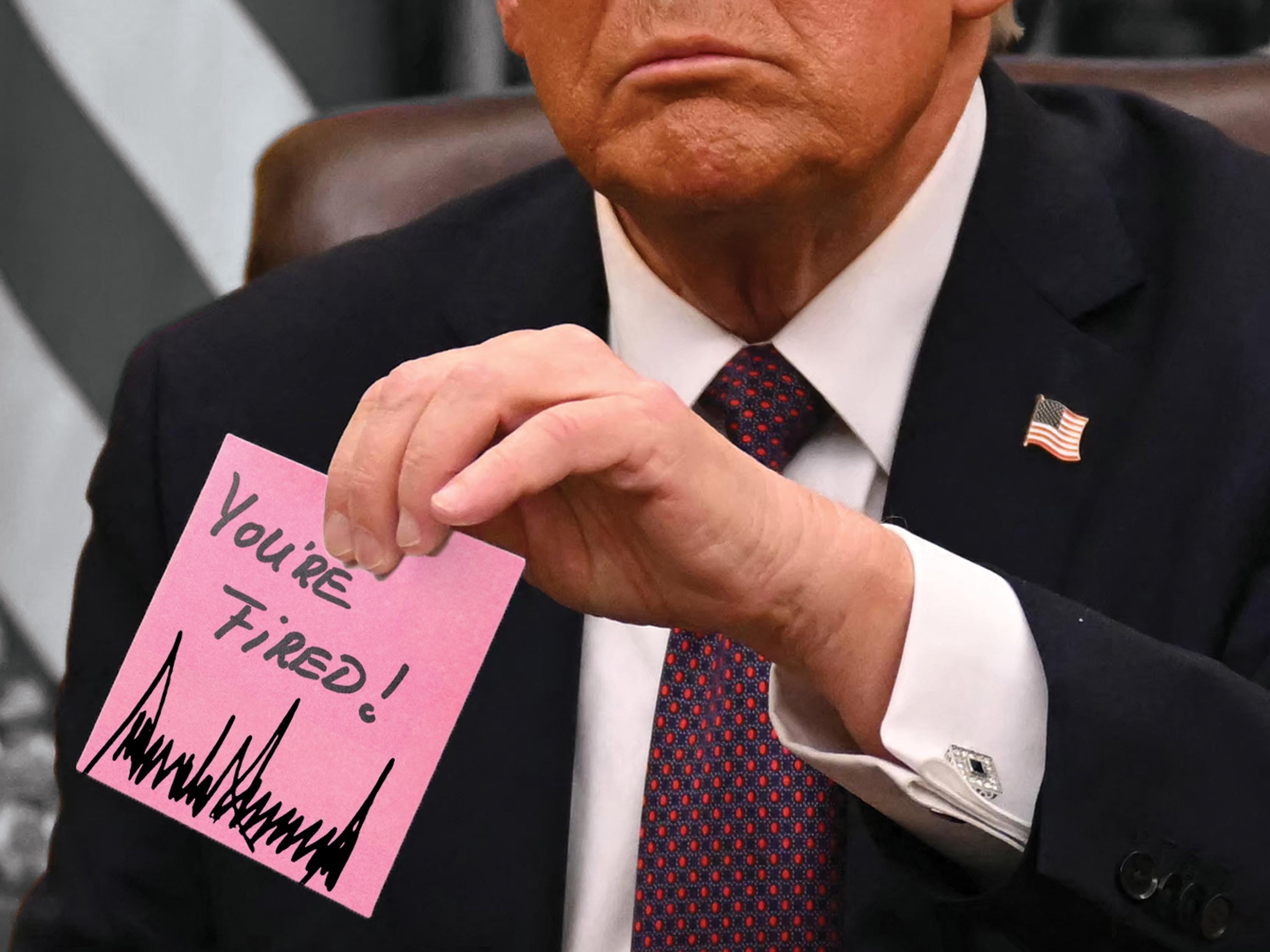
The Scandal Is the Men Trump Hasn’t Fired
by William Kristol
It wasn’t the biggest story of the news cycle, but you might have noticed that another cabinet secretary put in her notice yesterday. “Labor Secretary Lori Chavez-DeRemer will be leaving the Administration to take a position in the private sector,” White House spokesman Steven Cheung posted on social media, not even allowing Chavez-DeRemer the dignity of announcing her own departure.
Chavez-DeRemer is the third cabinet secretary to be forced out by Donald Trump in the last seven weeks. She follows in the footsteps of Kristi Noem, who departed the Department of Homeland Security on March 24,1 and Pam Bondi, who exited the Department of Justice on April 2.
Needless to say, none of these departures should be lamented by anyone who values competence, integrity, or honesty in government.
Still, does anyone see a . . . pattern here? As the eponymous villain of Ian Fleming’s 1959 James Bond novel, Goldfinger, says: “Mr. Bond, they have a saying in Chicago: ‘Once is happenstance. Twice is coincidence. The third time it’s enemy action.’” I suppose it’s too strong to call this gender-inflected pattern “enemy action.” But when it comes to finding someone to fire, the Trump White House does seem to chercher la femme.
After all, Secretary of Defense Pete Hegseth has surely done as much damage to his department and to the nation as Kristi Noem did. But Pete’s still on the job, strutting around and displaying his machismo at the Pentagon. Commerce Secretary Howard Lutnick has profited on a larger scale from the Trump administration than Chavez-DeRemer did. But Lutnick is still there, grifting as men in the Trump orbit do. Robert F. Kennedy Jr. is more of a crackpot than Pam Bondi was, but Kennedy remains in place, working out in his manly, denim-clad way as secretary of health and human services. And for that matter, Kash Patel still presides in all his male adolescent glory as director of the FBI (about which more below).
Maybe the president will soon rectify what might be an appearance of reverse DEI discrimination, and fire one of these men soon? Or some other male head could end up on the chopping block. Energy Secretary Chris Wright told CNN on Sunday that gas prices might not drop below $3 until next year. President Trump told the Hill Monday that Wright is “wrong on that. Totally wrong,” and that gas prices will drop as soon as the Iran war ends. One might think Trump would be annoyed at Wright for calling into question his happy talk. But for now Wright still has his job.
Gender bias in firing incompetent cabinet secretaries is not the most important indictment of the Trump administration. But it’s worth noting. And it’s also worth stressing that the problem isn’t that he’s fired the women. The problem is that he hasn’t fired the men.
Needless to say, Trump doesn’t want to be held accountable for his own appointments. But you know whose actions he wants to take credit for, and in whose embrace he wants to wrap himself? The military.
For example, yesterday Trump attacked Democrats as “TRAITORS” who “belittle the accomplishments of our Military and the Trump Administration.” Trump wants to conflate the U.S. military and his administration. But the military that is achieving those accomplishments is a military Trump inherited. Every one involved in the disciplined and well-executed military operations we’re seeing was trained and promoted under his predecessors. The servicemen and women who organized and executed the rescue of the pilots in Iran—while Trump was kept out of the room so military officers could get their work done free of his ranting—rose through the ranks under Bush and Obama and Biden. And yes, under Trump in his first term, when his secretaries of defense were James Mattis and Mark Esper, who refused to let Trump damage the military as Hegseth is now trying to do.
The contrast between how Trump treats the men and the women in his cabinet is notable. But even more striking is the contrast between the professionalism and expertise of a military that was shaped prior to this administration, and the buffoonery and incompetence of the cabinet members of this administration.
Good for the Goose, Good for the Gerrymander?
by Andrew Egger
It’s decision day in your Morning Shots correspondents’ home state of Virginia, where Democrats have used their shiny new governing trifecta to go all-in on a controversial measure: a proposed constitutional amendment that would—let’s not get cute about it—temporarily gerrymander the hell out of the state. The current congressional maps in Virginia, a bluish-purple state that hadn’t previously given either party a trifecta since 2012, are admirably representative, thanks in part to years of good-government advocacy work that led to the establishment of a bipartisan redistricting commission in 2020. But Democrats want to throw out the current map, which favors Democrats 6–5, for a breathtakingly audacious one: a likely 10–1 gerrymander in their own favor.
This isn’t happening in a vacuum, of course. It’s one of the last punches in an all-out mid-cycle redistricting war that Republicans kicked off last year in Texas, redrawing their maps to move the Lone Star State House delegation from a 25–13 GOP advantage to a 30–8 split. Led by ferocious exhortations from President Donald Trump, Republicans nationwide went scrounging through the couch cushions to find gerrymanderable districts, producing maps designed to eke out new seats in Missouri, North Carolina, and Indiana.2
Democrats, who for years have been likelier than Republicans to support anti-gerrymandering reforms in their home states, ultimately decided to fight fire with fire. California voters approved a mid-cycle gerrymander to tip their own maps approximately five seats in Democrats’ favor. The second major battlefield has been Virginia, where Democrats are asking voters to suspend the normal redistricting rules temporarily to give them a massive advantage in this year’s midterms. The ballot language is, basically, ludicrous: Should the state Constitution be amended, it asks, to “restore fairness in the upcoming elections”?3
Is this just? On a national level, Democrats can still reasonably make the argument that all they’re trying to do is to neuter unfair advantages Republicans are trying to pick up elsewhere. If Virginia’s redistricting measure passes (and if it survives the courts), the GOP is still likely to come out ahead in the House of Representatives, thanks to a special redistricting session Gov. Ron DeSantis just convened in Florida. This is the basic argument: Republicans have dropped all pretense of fairness in redistricting, and for us to do anything less now amounts to unilateral disarmament. Against charges of anti-democratic hypocrisy, Democrats have argued that they are breaking no laws and that it would be grievously short-sighted to set aside their best chance of constraining Trump legislatively next year over good-government scruples.
All this is compelling on a certain level. Yesterday on the Bulwark podcast, Bill laid out his reasons for supporting the gerrymander; today I’m pretty sure4 I’m going to vote for it, too. For better or worse (worse), practically the entire role of our desiccated federal legislature today is to rubber-stamp stuff our imperial president wants, or else to refuse to do so. I want more people in there who will refuse to do so, and, well, here’s a legal way to get them.
But there’s a lot of fear and trembling involved—as there should be any time a movement deliberately sets aside a supposedly dear principle, like the importance of fair maps, in order to accrue for itself political power. The justification for this is ever and always the same: Just think of all the good we’ll be able to do with that power if we get it and all the harm THEY’LL do if we don’t! But I’m old enough to remember when, a decade ago, the Republican party made a bargain like that, embracing a ludicrous outsider candidate named Donald Trump on the Flight-93-election theory that a Hillary Clinton presidency would blow up the country and at least Trump would prevent that.
Obviously, a decade ago, that argument was not only stupid but wrong: Clinton wouldn’t have blown up the country, while Trump, who within a few short years had utterly remade the GOP in his image, seems well on his own way to doing so. But the fact that so many people talked themselves onto that path with the same rhetorical justifications as Democrats are making for their maps today should give us all pause. Momentary unscrupulous strategic decisions—just a little taste of the offerings of the devil, and then we’ll get back on the side of the angels—have an unfortunate tendency to turn into bad habits.
AROUND THE BULWARK
The Return of Communism Chic… A new generation discovers the workers’ paradise, observes CATHY YOUNG.
Will Wins Wars. We’re Forgetting That… MARK HERTLING reminds that Power = Will × Resources.
The Tough Guy Really, Really Means It This Time… On the flagship pod, BILL KRISTOL joins TIM MILLER to talk about Trump’s failures in Iran and his hollow attempts to save face.
Is Mike Waltz Saying We Should Bomb Hospitals? On Bulwark+ Takes, WILL SALETAN takes on Trump’s threats to destroy Iran’s infrastructure—and the chilling defense from top officials who say “all options” includes targets that blur into civilian life.

The gang returns to California for two live shows in May. Join Sarah, Tim, and Sam in San Diego on May 20 or in L.A. on May 21 for a night of politics and laughs, and a community built on good faith. Bulwark Live: California is sure to sell out—don’t delay.

Quick Hits
KASH FILES LAWSUITS ALL AROUND ME: Kash Patel’s promised lawsuit against the Atlantic for reporting he’s been binge-drinking on the job is as silly as advertised. Its $250 million argument: If the FBI director is as bad as all that, why is crime down? CNN has more:
The defamation suit says statements in Fitzpatrick’s article “falsely assert” that Patel “is a habitual drunk, unable to perform the duties of his office, is a threat to public safety, is vulnerable to foreign coercion, has violated DOJ ethics rules, is unreachable in emergencies, has required the deployment of ‘breaching equipment’ to extract him from locked rooms, allows alcohol to influence his public statements about criminal investigations, and behaves erratically in a manner that compromises national security.” . . .
The lawsuit says The Atlantic sent the FBI a “request for comment” and asked for a response in less than two hours, then “refused to honor” a request for more time. The magazine published the article online later the same afternoon.
Patel’s goal, of course, isn’t actually to win in court. He’d face an extraordinarily high bar in doing so—needing not only to prove that the Atlantic’s allegations were false, but that the publication had known they were so when they published them, or at least didn’t care if they were true or not. Patel’s real goal appears to be to punish a publication that offended him with a nuisance suit—and to demonstrate to an audience of one that he’s fighting the lying lib media.
BROTHER, MAY I HAVE SOME LITHIUM?: For countries around the world, the closure of the Strait of Hormuz during the war in Iran is a wake-up call that fossil fuels shipped from afar can prove an unreliable source of energy in times of global instability. Many governments are working to accelerate their rollout of clean-energy infrastructure that can be generated at home as a result. This may be good for the climate, but there’s one obvious drawback: It risks tying more countries more tightly than ever to China. Politico reports:
Governments see clean, domestic energy sources, such as renewables and nuclear power, as the obvious long-term solution to protect their economies from the ups and downs of global fossil fuel markets.
But there’s also an obvious catch: The faster they move to decarbonize, the more they will have to rely on China to supply the necessary materials. After all, Beijing controls the overwhelming majority of the world’s clean technology and critical mineral supply.
Governments, uneasy about the idea of swapping one dependence for another, are keenly aware of that fact. The question now is whether they’ll put those reservations aside in favor of bolstering their energy security or continue taking measures to protect their economies from China’s dominance.
A TOURNIQUET ON SCIENCE: DOGE didn’t kill American science, but it roughed it up pretty bad. A year out from Donald Trump’s and Elon Musk’s cockamamie campaign to balance the federal budget by going on a grant-purging bender, gross federal spending hasn’t ticked down in the slightest. But some small but crucial sectors, like scientific research, aren’t even close to recovery, as a Washington Post analysis finds:
Halfway through this fiscal year, the number of competitive grants awarded by the National Institutes of Health is down by more than half compared with the same period last year. Biomedical funding has also undergone a shift, the analysis found, cutting the U.S. research footprint across nearly every major disease area—including fewer grants focused on women’s health, cancer and mental health.
Overall, the NIH supported over 2,700 fewer scientific projects in fiscal 2025, about a 15 percent cut in the number of competitive grants compared with the previous fiscal year. In [endometriosis researcher Katherine] Burns’s field, women’s health, there was a 31 percent drop in the number of projects funded in 2025 that included the word “women,” after years of steady growth in competitive awards.
Cheap Shots

In the lattermost state, a crucial bloc of Republican lawmakers banded together to frustrate Trump’s plans and block the new map—an act of courage for which the president has never forgiven them, carving time out to cultivate, endorse, and support primary challengers for each.
The ballot measure includes a provision that Virginia will revert back to its nonpartisan “standard redistricting process . . . for all future redistricting after the 2030 census.”
But still, if I’m honest, not totally sure!
"I would have won Vietnam very quickly."
Those who fought the V.C. while Trump was fighting V.D. would like a word . . . .
Gerrymandering is wrong. No one should do it.
With that being said, one side has completely shamelessly weaponised the tactic. So far, the other side "going high" has just shown the Gerrymander folks that they can act with impunity.
The only way Gerrymandering stops is when Republicans stop seeing an advantage in it. The reason Democrats should Gerrymander as aggressively as possible is to show the Republicans that Democrats fight, too.
You don't stop a bully by giving away more of your lunch money and setting a good example. You stop the bully by punching back.