Trump to America: Thank Me for Your Gas Bill
Higher prices = more money, according to the president.


At today’s Pentagon press briefing on the ongoing war in Iran, Defense Secretary Pete Hegseth started the show laser-focused on what really matters: not that more American service members had lost their lives in the Middle East, but how unfair the big bad media’s being to the administration.
“People look up at the TV and they see banners, they see headlines . . . ‘Mideast War Intensifies,’ splashing on the screen the last couple days,” Hegseth fumed. “What should the banner read instead? How about ‘Iran Increasingly Desperate.’ Because they are.”
Not to worry, though: Trump’s billionaire pals are buying up more and more of the media every day!
“More fake news from CNN—reports that the Trump administration underestimated the Iran war’s impact on the Strait of Hormuz,” Hegseth said. “It’s a fundamentally unserious report. The sooner David Ellison takes over that network, the better.” Happy Friday.
Magical Thinking
by Andrew Egger
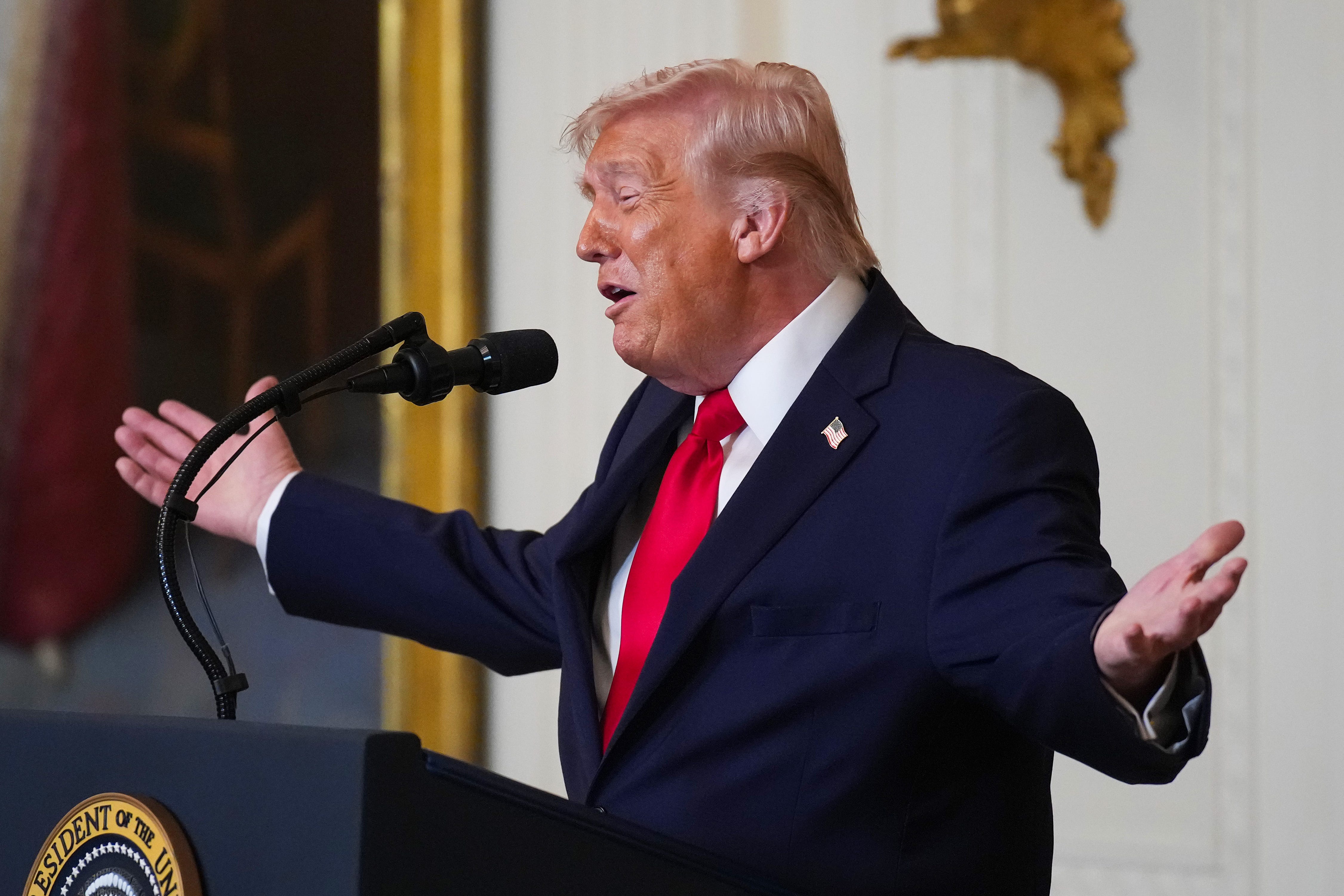
Wake up, babe: Donald Trump is field-testing a new Iran-war messaging strategy. Spiking oil prices, he informed us by tweet yesterday, are good, actually: “The United States is the largest Oil Producer in the World, so when oil prices go up, we make a lot of money.”
If this sounds like a flailing attempt to stanch a massive political wound—well, that’s because it is. But it’s also an illustration of the exact mindset that led Trump to do so much damage to the U.S. economy even before the war: his insistence that tuning the economy to the benefit of a few favored producers is a victory, even if it harms the vast majority of consumers.
A spike in oil prices distributes strain across the economy. Consumers feel it directly in higher prices at the pump, but the costs to them don’t end there: more costly gas makes moving all people and goods around more expensive, pushing up prices on pretty much everything. U.S. oil producers do well (provided they’re not themselves too exposed to the Strait-of-Hormuz woes); everybody else suffers.
Trump didn’t set out to make this happen, of course. But what he’s done to oil by accident is pretty much exactly what he’s spent a year doing to commodities like steel and aluminum and derivative products like copper pipes on purpose. This is the whole point, after all, of commodity tariffs: to artificially raise the costs of stuff out there coming in here to let the people making and selling the same stuff here charge more.
And although the costs may not be quite as screamingly obvious as more expensive oil equals more expensive gas, the ripple effects are the same. More expensive metal commodities means more expensive metal goods—cars, housing, electronics, the four cans of La Croix I drank while writing this. It also means more strain on the manufacturers that turn those commodities into those goods, who are forced to be the bearers of economic bad news.
Trump is far from the first politician to embrace tariffs for political ends. But he may well be the first to treat them not as a porky handout to a favored constituency, but as a no-downside win for the entire economy. For past politicians, tariffs were a hacky political trick: trumpet the concentrated benefit to a favored class while quietly ignoring the distributed cost to everybody else. But it takes a mind as unique as Trump’s to suggest: Why not just fix the WHOLE economy by putting tariffs on EVERYTHING?
In some respects, reality has begun to intrude. The tariffs have intensified consumer anxieties about affordability while also hammering American manufacturing broadly. As our Catherine Rampell put it last month, downstream manufacturers—firms that make machinery, computer parts, or transportation equipment—are “screwed and shedding workers.” It’s gotten so bad, in fact, that the White House has quietly begun looking for ways to roll back certain metal tariffs. The Financial Times reported last month that “trade officials in the commerce department and US trade representative’s office believed the tariffs were hurting consumers by raising prices for goods such as pie tins and food and drink cans.”
But don’t think for a moment that Trump’s magical thinking has changed. He retains his unique economic perspective—the kind that looks out over a global spike in oil prices and thinks, Okay, so what’s the bad news?
Will rising prices be as big a political issue for Donald Trump as they were for Joe Biden? Tell us what you think and why.
Trump’s Iran ‘Excursion’
by William Kristol
Donald Trump has been mocked for calling the Iran war an “excursion,” indeed a “little excursion.” And deservedly so.
For one thing, it’s wildly inappropriate to use that term when people are getting killed in this conflict—lots of people, from American service members to Iranian schoolgirls. In fact, it’s more than inappropriate. It’s grotesque. If you’re president of the United States and you start a war, you should have enough of a sense of decency and dignity to treat it as a serious matter.
To make this obvious point isn’t to be woke or even antiwar. It’s to be adult and civilized. And however much Trump has degraded our civic culture, I think it’s a point with which most Americans would agree.
Now it’s probably the case that Trump stumbled into the term “excursion.” It surely wasn’t the word that Trump was meant to use. As part of their effort to avoid the word “war,” his aides must have advised Trump to call it an “incursion.”
But they failed on both counts. They didn’t talk him out of using “war.” Trump’s vanity makes him want to be a war president, so he won’t avoid boasting about his “war.” And Trump’s deficient grasp of the English language led “incursion” to become “excursion.”
Or did Trump—perhaps subconsciously—shy away from the word “incursion” because he vaguely remembered hearing about Richard Nixon’s politically disastrous and ultimately unsuccessful 1970 Cambodian “incursion”?
Anyway, Trump landed on the term “excursion.” He seems to like it. He’s embraced it. As Will Saletan points out, he’s used it at least sixteen times in the past week.
It’s irresponsible. It’s distasteful. It’s grotesque.
But couldn’t it be something of a political opportunity? Trump has taken us to war. The damage of his unilateral and irresponsible decision to do so is mounting, in terms of death and destruction in the Middle East, American casualties, and economic damage globally and at home. And it doesn’t look as if there’ll even be regime change in Iran. Trump’s war is a mistake heading towards disaster.
And Trump’s enjoying it all. For him, it’s exciting! It’s fun! It’s an excursion!
Consider George W. Bush and Iraq. Bush didn’t revel in the Iraq war and didn’t deny it was a war. And of course he had congressional approval for it. But he paid a great political price when it didn’t go well, and that price was exacerbated by his seeming to claim, a few weeks in, that it was a “mission accomplished.”
Couldn’t Trump’s “little excursion” into Iran be his “mission accomplished”? Couldn’t the expression be wrapped around Trump’s neck by his opponents as a term of well-deserved ridicule and opprobrium? Why shouldn’t “Trump’s Excursion” become an important signpost in the downward trajectory of a failed presidency?
A MESSAGE FROM UNITEDHEALTH GROUP
Providing a clearer view of care

UnitedHealth Group is making care easier to navigate by investing in tools that help patients find providers near them and compare costs.
“More transparent pricing benefits everyone.” - Dr. Kailey G., Pediatrician
AROUND THE BULWARK
The Trump War Glossary: What He *Really* Means About Iran… WILL SALETAN tries keeping up with Mr. ‘I Have the Best Words’ as he twists the English language during his no war presidency.
Can Every Movie Make Money? On The Bulwark Goes to Hollywood, KEVIN GOETZ joins SONNY BUNCH to discuss his latest book, How to Score in Hollywood.
What the Hell’s Going On… On Bulwark+ Takes, KATIE COURIC joined TIM MILLER and JVL to take on some of the biggest and most interesting stories of the week.
Quick Hits
MASS DEPORTATION VIBE CHECK: After his disaster in Minneapolis, Donald Trump publicly signaled he was tapping the brakes on his max-carnage mass-deportation strategy. Many reasonably wondered: Did this signal a real policy change, or was Trump just trying to weather a hard political moment before stomping the gas again?
Now signs are emerging that the Department of Homeland Security really has pulled back its enforcement operations. Politico reports that “the torrent of emergency lawsuits mounted by ICE detainees” has begun to slow:
Courts have been flooded for months with petitions for habeas corpus—requests by ICE detainees to be released from custody or at least to have a chance to plead their cases. Habeas petitions are still arriving at astonishing levels, but have noticeably declined since the administration pulled back from its mega-enforcement operation in Minnesota. . . .
Habeas petitions peaked at more than 400 on Feb. 6 but have since steadily declined, dipping below 300 per day late last month and approaching 200 per day by early March.
Not everyone is thrilled. An assortment of immigration hardliners launched a new lobbying effort this week, the “Mass Deportation Coalition,” to try to talk Trump out of his newfound skittishness on the topic. “Overwhelmingly, Trump voters expect this from the administration,” said Chris Chmielenski, president of the hawkish Immigration Accountability Project. “They don’t just support it, they expect it.”
Meanwhile, DHS remains in a turbulent state, amidst an expected leadership transition from Secretary Kristi Noem to Trump’s new nominee, Sen. Markwayne Mullin. And the department is still unfunded, with many employees on furlough. Earlier this week, Senate Democrats repeatedly attempted to pass a measure that would fund everything in DHS except ICE and the Border Patrol, which they have pledged not to fund until Republicans agree to various civil-rights reforms. Republicans blocked them every time.
THE HOUSING SQUEEZE: It’s one of the strongest political throughlines of our era: Even when the economy’s been good, people still feel oddly bad about it. One reason is the housing crunch. America just doesn’t have enough homes, and competition for our limited stock has pushed prices sky-high for buyers and renters alike.
Both parties have pledged to tackle the issue. But increasingly, they’re both looking to do it through an empty-calorie fad idea: blaming the crunch on private-equity firms that they accuse of buying up housing to drive up prices. In reality, such purchases are barely a blip in the overall housing picture, and the narrative gets the causality backwards: Housing has become an attractive purchase for large investors because supply constraints are putting so much upward pressure on prices, not the other way around. But the idea has excited voters, and everyone from Donald Trump to Elizabeth Warren has rushed to the slopulist trough to feast.
The unfortunate result is a housing policy change that may actually make the situation worse. Yesterday, the Senate passed the bipartisan ROAD to Housing Act, a housing-supply bill with many good provisions—and one big mistake. The bill would ban large companies (defined as any company that manages more than 350 units) from building new single-family homes for the purpose of bringing them to market as long-term rentals. Under the bill, the company would be required to sell such homes after seven years.
This is a totally different scenario than the panic about private-equity homebuying. That narrative imagines that big companies are squeezing the housing stock—but build-to-rent companies are expanding it. (Such companies are currently building about 8 percent of America’s new housing stock.) Many housing groups have warned that this provision would ruin the financials of such businesses, leading to less new housing overall—the exact opposite of the desired policy aim. But for most of the Senate, from Sen. Warren on down, notching an empty political win against “private equity” outweighs the policy imperative of easing the housing squeeze. Despite a last-minute push from Sen. Brian Schatz, the provision stayed in. The bill now heads to the House.
Trump to CBS: Roll Over: There’s trouble in the MAGA-friendly paradise of the David Ellison/Bari Weiss CBS News. White House officials, reports Axios, are “outraged” over the hiring of Jeremy Adler, a communications executive and former staffer to Rep. Liz Cheney—or “Liz Cheney’s flack who has worked to jail President Trump,” as a White House staffer put it, asking, “What the hell is Bari Weiss thinking?”
CBS had no comment, but you could see the glass as either half empty or half full. The good news: Ellison and Weiss are willing to antagonize the Trump White House and even the vindictive president himself. The bad news: Some Trump underlings feel entitled to vent about a CBS News hire that rubs the president the wrong way.
Recall that because of Trump’s absurd “voter interference” complaints against CBS News, the network is under an unprecedented FCC order requiring special oversight of bias allegations. Critics have said this amounts to a directive not to offend Trump. Clearly, some White House officials agree with that characterization.
This situation puts Ellison and Weiss in a bind. Go full sycophant, and risk further alienating audiences and talent. Act too independent, and Trump gets mad. They painted themselves into this corner, so good luck.
But what about the broader implications? Obviously, we’re nowhere near Vladimir Putin-level media controls (yet). But given that Ellison’s empire is also likely to absorb CNN, it’s a worrying picture.
—Cathy Young
Cheap Shots

I’ve never been more completely sure that this administration has absolutely NO IDEA what it is doing in any area of governance than I have this week.
Watching this Iran DEBACLE (there’s another word for Donald to look up) is not only embarrassing, it’s genuinely terrifying.
I hate it here.
I take issue with the second part of this -- Trump didn’t set out to make this happen, of course. But what he’s done to oil by accident...
It's no accident when one of the most likely outcomes of his unnecessary war on Iran was to roil oil markets and spike oil and gas prices.
Everyone who has ever studied a potential war with Iran would highlight Iran's control of the Strait of Hormuz and the negative impacts on global oil production, transportion, and prices.