



With Republican candidates going down in flames all around him, Donald Trump spent last night flaming out on Truth Social. “REPUBLICANS, TERMINATE THE FILIBUSTER! GET BACK TO PASSING LEGISLATION AND VOTER REFORM!” he wrote, adding that the time had come to “Pass Voter Reform, Voter ID, No Mail-In Ballots.”
Speaking to Senate Republicans this morning, he continued to make the case for them scrapping the filibuster. But he also admitted they may not do it and sounded a bit more introspective about it all. “I thought we would have a discussion after the press leaves about what last night represented and what we should do about it,” Trump said, noting that “the shutdown was a big factor, negative, for Republicans.” (emphasis, ours)
Trump wants Republicans to kill the filibuster to move on from the shutdown. Senate Republicans want to keep the filibuster and keep pressuring Senate Democrats to cave. But after last night, Senate Democrats think they have a stronger political hand than ever, so such a cave seems unlikely. Happy Wednesday.
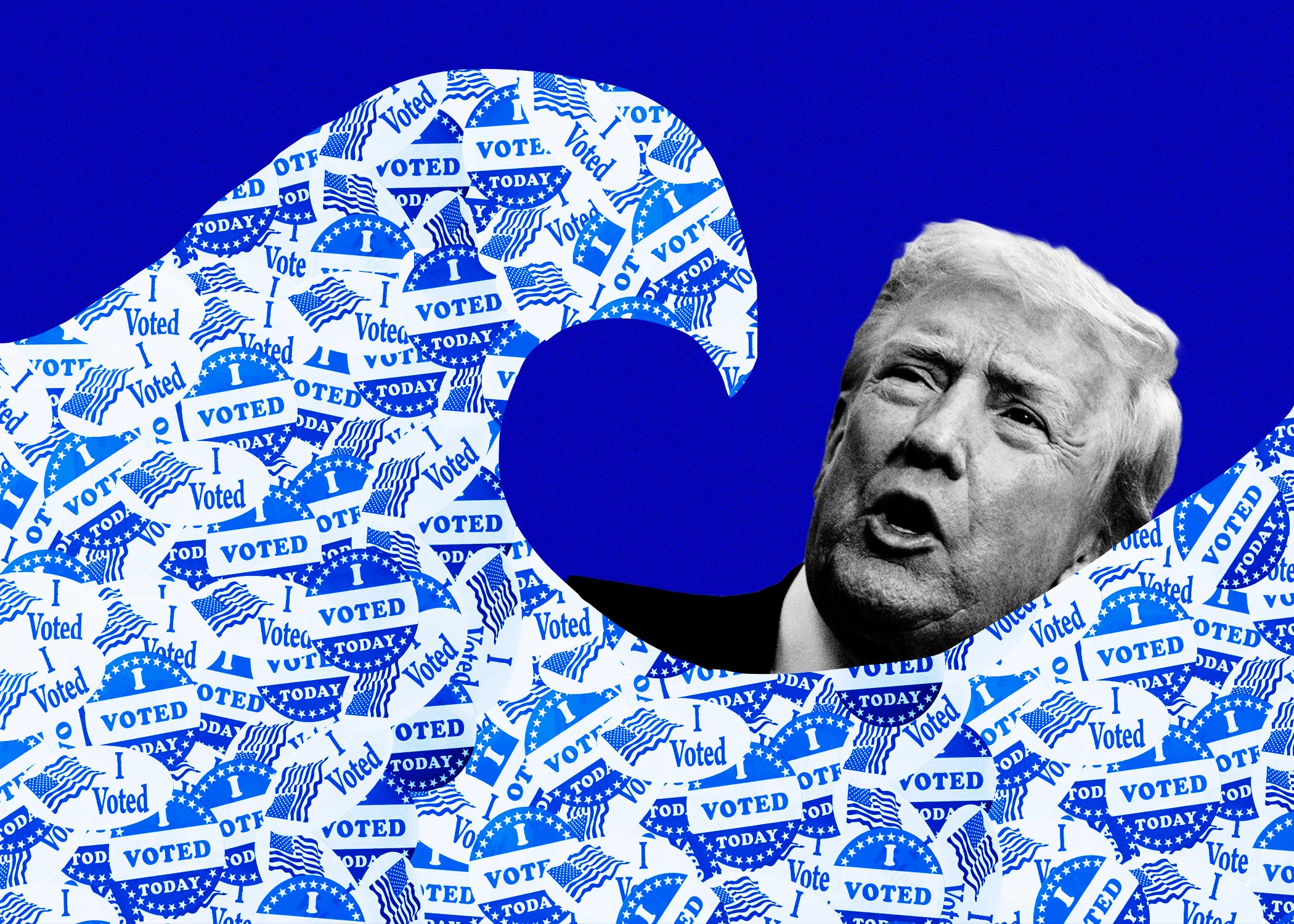
Happy Days Are Here Again
by William Kristol
Happy days are here again
The skies above are clear again
So let’s sing a song of cheer again
Happy days are here again.
“Happy Days Are Here Again” was Franklin D. Roosevelt’s campaign jingle in 1932 and became the unofficial ballad of the Democratic party for the next several decades, until it was quietly retired as too old-school at the party’s 1992 convention.
Maybe it’s time to bring it back.
Okay, okay. My inner Joe Btfsplk is telling me: No so fast. Don’t get carried away. Happy days aren’t yet here again. Donald Trump will be president for the next three years. Republicans will still control Congress, at least for the next year. Many things will continue to get worse, before they get better.
But last night was a good night for the Democratic party and for democracy. Good enough that even I have a spring in my step this morning.
My steps may be particularly spring-ish because I’m in Virginia, the epicenter of yesterday’s blue wave. The Democratic gubernatorial nominee, Abigail Spanberger, won with 57.5 percent of the vote, the best showing for a Democrat in a governor’s race here since 1961—and the best showing for any gubernatorial candidate since 2009. And her 15-point victory is not only an improvement on Kamala Harris’s six-point win in the state in 2024. It outpaces Joe Biden’s ten-point victory in 2020.
But Spanberger’s victory was merely the crest of a remarkable Democratic wave. The Democratic lieutenant governor won comfortably. The deeply flawed Democratic attorney general candidate even defeated a reasonably popular Republican incumbent by five points. More striking still was that the Democrats, who currently enjoy a 51–49 margin in the House of Delegates, picked up at least 13 seats in the chamber. In the modern party era, since 1994, Democrats have never had more than 55 members in Virginia’s lower house. Now it looks as if they’ll have at least 64.
One notable footnote to the Democrats’ victory here in Virginia: Remember the set of issues around transgender individuals that are widely, and maybe correctly, thought to have hurt Democrats in 2024? This year, more than half of the Republican spending on ads in the governors’ race was devoted to anti-trans messaging. Spanberger rebutted the attacks skillfully, and indeed framed the issue as one of bigotry and turned it against her opponent. And in House District 22, a Democrat, Elizabeth Guzman, who’d authored pro-trans legislation in the legislature in 2022, defeated a Republican incumbent who made this issue the center of his campaign.
Some Democrats have learned how to fight back more successfully against Republican culture-war demagoguery. Perhaps Democrats elsewhere can learn the same.
In New Jersey, Mikie Sherrill prevailed by 13 points over a Republican candidate who’d come within three-and-a-half points of defeating the Democratic incumbent four years ago. And in New York City, Zohran Mamdani completed the Democratic big-race trifecta by defeating former governor Andrew Cuomo, who was running as an independent, by nine points. All three of these races featured strikingly high turnouts.
Meanwhile, in California, the referendum permitting congressional redistricting is winning easily. And in a variety of other statewide and local races, from Pennsylvania to Georgia and even in Mississippi (where the party broke the Republican’s supermajority), Democrats won significant races and exceeded their recent showings.
So yesterday showed us what a wave election looks like. And what was the best predictor of the vote, and the probable source of the wave? Donald Trump. Take a look at the correlation of his approval rating in the exit polls in these states and the actual vote. In Virginia, Trump’s approval rating was 41%; his disapproval was 56%. The GOP candidate lost by 42–57%. In New Jersey, Trump’s approval/disapproval was at 43–55%; the GOP candidate was defeated by 43–56%. In California, Trump’s approval/disapproval was 34–63%; the anti-Republican referendum was winning 64% to 36%.
2025’s off-year elections were, to a remarkable degree, a referendum on Trump. And this bodes well for 2026. Mid-term elections are almost always a referendum on the incumbent president, especially if his party controls the Congress. And Trump is clearly unpopular enough to produce, all else being equal, a good Democratic year.
But of course, all else is never equal. There are many reasons for caution in extrapolating too much from a few state and local results this year. Things could change. Next year is . . . a year away. That’s a long time in politics, especially in today’s politics.
Still, we can look ahead, for just a minute, over the horizon to not just 2026 but 2028. We can see a Democratic convention that will have nominated a ticket of Spanberger and Sherrill (or will it be Sherill and Spanberger?—they’ll have to work that out!). The nominees will have insisted on restoring to its rightful place at the convention the old anthem that Democrats sang when they were a majority party.
And so one can imagine Josh Shapiro and Zohran Mamdani clasping hands and Pete Buttigieg and Amy Klobuchar dancing in the aisles, as thousands of diverse and patriotic delegates celebrate, and all join together to “sing a song of cheer again / Happy days are here again!”
The End of One Post-Trump Future
by Andrew Egger
In his rush to shift blame for his party’s shellacking last night, Donald Trump said something true on Truth Social: Republicans struggled because “TRUMP WASN’T ON THE BALLOT.”
Republicans have indeed struggled recently when Trump isn’t atop the ticket, as the voters he repels turn out in force while his low-propensity coalition stays home. But there was one Republican in recent years who very notably bucked that trend, whose dramatic upset victory in a statewide race opened interesting questions about the sort of GOP coalition that might be able to thrive after Trump.
The year was 2021. The Republican was Glenn Youngkin. And last night’s Democratic rout in Youngkin’s state of Virginia slammed the door—at least for now—on the future Republican party he represented.
It’s easy to forget how much of a revelation Youngkin seemed to be for Republicans four years ago. The GOP was seemingly at its nadir—swept out of power the previous year, still reeling from the shock and the shame of Trump’s attempt to steal the 2020 election, lost and unsure how to get back on the path to relevance. The answer seemed to arrive in a goofy red fleece vest. Youngkin, a venture capital guy by trade, exuded a cheerful gentility and a chamber-of-commerce competence on good government and fiscal issues that lured back many Virginia suburbanites who had fled the party under Trump. But he also leaned in sharply on social issues like trans policy and parental rights in a way that kept the GOP base enthusiastic. Less than 10 months after MAGA stormed the U.S. Capitol, Youngkin won Virginia by two points.
It was pretty clear that Winsome Earle-Sears, Youngkin’s would-be successor, would struggle to hold his coalition together entirely. She was his lieutenant governor, someone he campaigned hard for all year. But she was a less polished speaker, more prone to odd gaffes. And while Youngkin was a business guy seasoned by a pinch of hard-charging social conservatism, Earle-Sears made social conservatism the main dish.
But while some evaporation seemed likely, the spectacular fashion in which the Youngkin coalition disintegrated last night was still a surprise. In CNN exit polls, fully a quarter of those who said they approved of the job Youngkin was doing as governor pulled the lever for Abigail Spanberger instead. In the end, Spanberger’s 15-point victory was the largest in the Virginia gubernatorial since Republican Bob McDonnell’s blowout win in 2009—a win that presaged a huge national red wave the following year.
That 17-point swing from Youngkin to Earle-Sears was far too large to chalk up to candidate quality alone. It was also a signal that Youngkin’s pitch—an implicitly post-Trump one that invited Trump-hostile suburbanites to turn the page—could never thrive in an environment where Trump has resumed his role as national main character.
Republicans are waking up this morning in the cold light of a new reality. Donald Trump is a lame duck who cannot run again, although he may well try. Which means their strategy for winning in the Trump era—holding their breath and riding his coattails however far he can drag them—can never carry them through another election. But neither can they try to run the post-Trump playbook that carried Youngkin to success in 2021—not so long as he sits atop the party in the White House. They’re paralyzed, trapped in electoral no-man’s-land, with midterm elections one short year away. Time for Democrats to press the advantage.

It’s Zohran’s City Now
by Adrian Carrasquillo
Brooklyn, New York—The scale of New York City Mayor-elect Zohran Mamdani’s victory won’t just be measured in the numbers: a win of over 50 percent, netting more than a million voters for the youngest mayor since the five boroughs were bound together.
Nor will you get the full story from the campaign statistics rattled off by field director Tascha Van Auken, who spoke of 104,000 volunteers making 4.4 million calls and knocking on 3 million doors before she introduced Mamdani at his victory party at the Brooklyn Paramount theater Tuesday night.
Mamdani’s own lyrical description of the coalition he stitched together included immigrants he said have often been forgotten by the city’s politics: “Yemeni bodega owners and Mexican abuelas, Senegalese taxi drivers and Uzbek nurses, Trinidadian line cooks and Ethiopian aunties.”
Standing in the front row before his speech, I saw the disparate threads of this coalition. They included Ernest Skinner, 82, clad in a red jacket with FLATBUSH across the back in yellow lettering, who has lived in Flatbush, Brooklyn for fifty years. Hailing from Trinidad, he got a kick out of remark, and told me he was receiving messages of congratulations from his home country.
“Mamdani represents the transition from the old guard to the new guard,” Skinner told me, standing dutifully for hours with his cane resting nearby. “He’s a young guy with brilliant ideas and just what we need at this time.”
Then there was Angelica Batista, 18, from Manhattan, who proudly told me this was her first time voting as she pointed to her “I Voted” sticker. The flailing attacks depicting Mamdani as a bogeyman only made her embrace him more. And besides, Cuomo gave her the ick.
“With Cuomo I really didn’t like the accusations with women,” she said, referring to the sexual harassment allegations that led to his ouster as governor. “This guy is no good.”
Mohammed Islam Deowar, 45, was next to me with his buddies, and he said he was part of a Jamaica, Queens for Zohran group. I asked him why he supported Mamdani, and he thundered in response: “He was with us in our every struggle and every movement. He knows New York City, he knows the issues of New York City, he doesn’t have to learn them. He’s not going to work for some special interest group or some small percentage of the city.”
Behind me was Lizette Colon, 69, bouncing around and full of energy. A Puerto Rican who lives in Chelsea in Manhattan, she said she canvassed up and down the city for Mamdani because she believes it’s time for change.
“I’m so excited to see young people of all ethnicities and generations together, everyone hoping for a city better for everybody,” she said, tightening her grip on my arm as she spoke like a blood-pressure monitor.
Mamdani’s election will be interpreted in myriad ways. And it will be used, undoubtedly, by Republicans to scare voters into thinking that immigrants and socialism are coming to their doorstep. But his win should also be understood as historic. It is the fulfillment of the argument that many candidates have made in the past—think Jesse Jackson’s Rainbow Coalition in 1984—but largely failed to execute: that people of different ethnicities, colors, and lived experiences can be bound together by the cause of economic justice.
It’s why the most memorable line from Mamdani’s victory speech last night, the one that got the loudest cheers, was this: “New York will remain a city of immigrants, a city built by immigrants, powered by immigrants—and, as of tonight, led by an immigrant.”
AROUND THE BULWARK
Election-Night Coverage: A Democratic Sweep…The Bulwark’s Sarah Longwell, Tim Miller, JVL, Sam Stein, Bill Kristol, Catherine Rampell, Will Saletan, and Andrew Egger were joined by special guests Rep. Hakeem Jeffries, Lis Smith, and Katie Couric for their Tuesday-night livestream discussing the election returns from New Jersey, Virginia, New York City, California, and elsewhere.
A White House Ballroom Fit for a Bribe… GOP lawmakers don’t mind that the full list of donors and amounts given is under wraps, writes JOE PERTICONE in Press Pass.
The Power of Normal People… On the flagship pod, GOV. ANDY BESHEAR and TERRY MORAN join TIM MILLER to talk about Trump slashing SNAP benefits, the toll of tariffs and healthcare cuts on rural America, Chicago’s defiant spirit in the face of authoritarian overreach.
‘Predator: Badlands’ Review… The original is perfect. The new one is a pretty good creature feature, writes SONNY BUNCH.
Quick Hits
JUST KIDDING: If you’re nursing a crick in your neck this morning, it may be because you—like us—spent yesterday following along with the White House’s remarkable whipsaw rhetoric about SNAP benefits.
One of the federal programs now unfunded thanks to the lengthy government shutdown is the Supplemental Nutrition Assistance Program, better known as food stamps or SNAP. Right before SNAP was set to run dry on November 1, two judges ordered the White House to bridge the gap temporarily by tapping an Agriculture Department emergency fund. Yesterday, the administration said it was complying with that order, but that payments to SNAP recipients would be reduced and likely delayed. Yesterday morning, Agriculture Secretary Brooke Rollins said her department was working to get those funds out the door, coordinating with state agencies on the complicated partial benefit rollout.
Then, an hour later, Trump threw a wrench into the works. “SNAP BENEFITS,” he wrote on Truth Social, “will be given only when the Radical Left Democrats open up government, which they can easily do, and not before! Thank you for your attention to this matter.”
It seemed that the president was openly saying he would defy the judges’ order to disburse money from the SNAP bridge fund. But was he? Just hours after that, White House press secretary Karoline Leavitt claimed Trump hadn’t meant anything of the sort. “The administration is fully complying with the court order,” she told reporters at the White House press briefing. “I just spoke with the president about it.” Trump, Leavitt insisted, had been talking about future payments: “He does not want to have to keep tapping into an emergency fund and depleting it.”
As an explanation of what Trump had intended to communicate via his post, Leavitt’s comments beggared belief. The contingency fund at issue, with enough cash in it to cover SNAP’s costs for only a few weeks, was never going to be more than a short-term fix. And the unambiguous plain meaning of Trump’s post was that no further SNAP benefits would be paid out during the shutdown.
Nevertheless, whatever Rubicon Trump meant to launch the country across with his post, it appears he is now quietly moving back the other way across it.
HOW LONG CAN THEY GO?: Are we starting to see the first steps towards a congressional spending deal? After more than a month of a shutdown fight that saw practically zero across-the-aisle conversation, a bipartisan group of four House lawmakers on Monday released what they called a “statement of principles” for a deal that would extend the expiring Obamacare subsidies for two years while adding a new income cap for eligibility.
But House Minority Leader Hakeem Jeffries sounded skeptical yesterday that such talks would lead to a breakthrough anytime soon—at least in the lower chamber. “It seems to me more likely that if there’s a bipartisan agreement to emerge, it will emerge from the Senate, not the House,” he told reporters.
Meanwhile, chaos from the shutdown continues to grow steadily worse. Staffing delays at airports are causing spiraling flight delays around the country, and Transportation Secretary Sean Duffy said yesterday that these are nothing compared to what may be coming within as little as a week. “You will see mass flight delays. You will see mass cancellations,” Duffy said. “And you may see us close certain parts of the airspace because we just cannot manage it because we don’t have the air traffic controllers.”
Cheap Shots
Today is the first day in a long time I didn’t get up completely depressed with the weight on the world on me. Hope is a wonderful thing and my fellow Americans truly reminded me we are not alone
There are many takeaways from what happened last night. But let's focus upon the one that matters most of all.
The White House and the GOP will look at the results and find many people and institutions to blame. None of them will be within their own midst. They will throw ketchup against the wall and do what comes naturally to them -- double down on their agenda and their approach, as no weakness or admission of wrongdoing is allowed. And they will triple down on their efforts to steal next year's midterm elections so that last night's results cannot happen again. Bank on it.
The 2026 electoral campaign begins today. Reenergized somewhat by last night, fight more and harder, beginning today, for democracy as if your life depended on it. Perhaps it does. The forces of evil will not give up until there are enough people to take control away from them and send them back to where they belong.