

What Mamdani Gets About Trump
When New York’s mayor-elect met with the authoritarian president, he didn’t waste time with denunciations. But he didn’t exactly hold back.

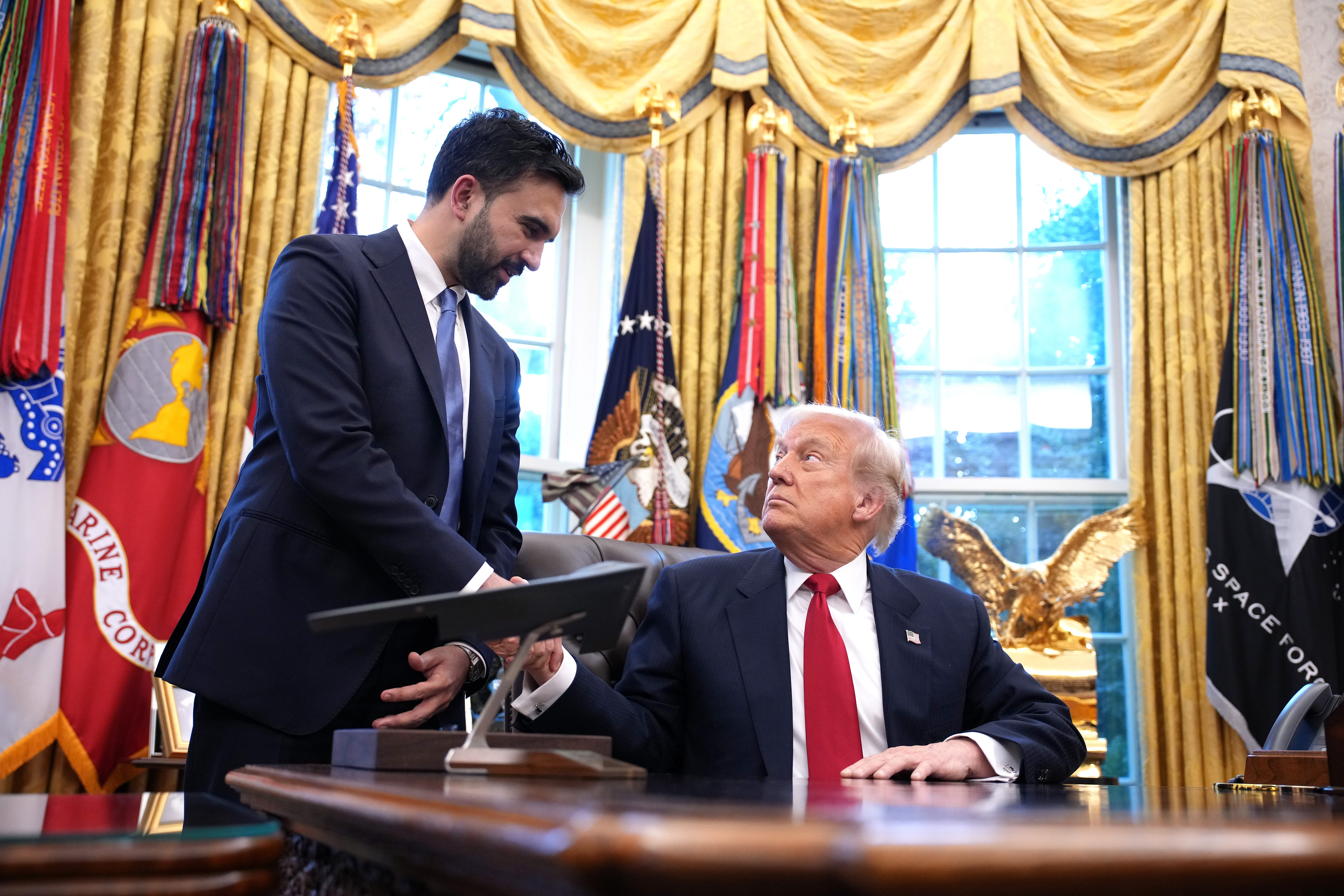
DONALD TRUMP’S CHUMMY MEETING last Friday with Zohran Mamdani has roiled the political world. On the right, Trump’s embrace of Mamdani has complicated Republican plans to vilify New York City’s mayor-elect. But among Trump’s critics, the meeting has triggered a different concern: How can Mamdani collaborate genially with a president he admits is a fascist? Isn’t this a kind of surrender? Is Mamdani normalizing Trump?
For years, Democrats and Never Trumpers have assailed the president’s authoritarianism. But Mamdani has a different idea. He’s betting that the best way to disarm Trump and his lieutenants isn’t to focus on their fascism. It’s to take away many of their voters by addressing kitchen-table issues.
In Trump’s conciliatory reception of Mamdani, there are signs that this strategy might work.
Mamdani is no suckup. As a candidate, he routinely denounced Trump’s deportations, economic policies, and persecution of political opponents. If Trump “wants to come for New Yorkers,” Mamdani vowed in a debate on October 16, “he’s going to have to get through me.”
Since his victory, the mayor-elect has continued to sound the alarm. In a November 16 interview with New York’s local ABC affiliate, he warned, “We’re facing a crisis of authoritarianism coming out of Washington, D.C.”
But Mamdani’s approach to this crisis is primarily indirect. “We can respond to oligarchy and authoritarianism with the strength it fears, not the appeasement it craves,” he declared in his victory speech on November 4. He continued: “If there is any way to terrify a despot, it is by dismantling the very conditions that allowed him to accumulate power.”
To understand Mamdani, you have to understand those two sentences. He believes that the alternative to appeasement can’t just be resolve; it has to be strength. And he believes that this strength comes from connecting with voters, persuading them that you can improve their lives, and drawing them away from the despot.
In his mayoral campaign, Mamdani scorned Andrew Cuomo as Trump’s “puppet,” and he flaunted his own ability to attract voters independently. In their debate on October 16, Mamdani derided Cuomo for seeking Trump’s help to win the election. “That’s something I can do myself,” said Mamdani. “I don’t need the president’s assistance.”
On Election Day, Mamdani proved it. He got more votes than any New York mayoral candidate since 1965. According to the exit poll of voters in the November 4 election, 10 percent of those who had cast ballots for Trump in 2024 crossed over to support Mamdani.
In the days leading up to his meeting with the president, Mamdani talked about his outreach to Trump voters. First he went on MS NOW and bragged about a man who had come to one of his rallies wearing a “MAGA for MAMDANI” hat and shirt. Then, in a press conference a day before the meeting, the mayor-elect underscored his connection to Trump’s supporters. “For tens of thousands of New Yorkers,” he said, “this meeting is between two very different candidates who they voted for for the same reason: They wanted a leader who would take on the cost-of-living crisis.”
The message was twofold. Mamdani was pointing out that he and Trump had a lot in common. But he was also advertising an unusual talent: He had the power, from a very different position on the political spectrum, to attract and mobilize Trump’s voters.
This is a big reason why Trump fawned over Mamdani when they spoke to reporters in the Oval Office last Friday. Trump opened the session by lauding Mamdani’s victory. “He really ran an incredible race against, you know, a lot of smart people,” said Trump. “He beat ’em easily.” The president seemed to see in Mamdani an image of himself. “He came out of nowhere,” Trump marveled. “And then all of a sudden he wins a primary that nobody expected he was going to win. . . . It’s an amazing thing that he did.”
In their meeting, which took place before the press arrived, Mamdani talked about specific neighborhoods that had shifted toward Trump in 2024. He conveyed respect for the president and his supporters. “I actually shared this with the president” during the meeting, Mamdani recalled two days later on Meet the Press—“that the very constituencies that he had won over, that were a critical part of his increased vote share in New York City, were the ones that we then looked at as who we should focus on.” Mamdani said he had listened and spoken to these voters “with the same respect you’d speak to any other” constituency.
Trump clearly felt flattered. In their session with reporters, as Mamdani talked about New Yorkers who had cast ballots for Trump, the president gloated that he had “got a lot of votes” there.
It’s reasonable to wonder why Trump didn’t attack this charismatic upstart, since that’s what autocrats do in other countries. But apparently, Trump doesn’t see Mamdani as a rival. In fact, he seems to have bonded with Mamdani over their shared unhappiness with life under Joe Biden’s presidency.
In his press conference before he flew to Washington, Mamdani described what Trump voters had told him about the Biden years: “They said that they remembered being able to afford their rent, their child care, their Con Ed, their public transit more four years ago”—i.e., in Trump’s first term—than they could by the time of the 2024 election. And in the Oval Office session with reporters, Mamdani admitted that Democratic politicians had often failed New Yorkers. “There are many things in our city where we have to own the responsibility [for] it,” he conceded—“things that existed long before the president was the president.”
Trump welcomed these remarks. He cast himself and Mamdani as fellow victims of the Biden years. “We had, both of us, we had the highest inflation in the history of our country the last four years under the Biden administration,” said the president.
That kind of synergy between the president and the mayor-elect can be exasperating if you’re trying to build a united front against Trump. And on several issues—crime, business regulation, construction of new housing—Mamdani signaled agreement with the president. But when a reporter asked Mamdani about his characterizations of Trump as a despot and a fascist—“Are you planning to retract any of these remarks in order to improve your relationship?”—Mamdani retracted nothing. “Both President Trump and I, we are very clear about our positions and our views,” said Mamdani. “What I really appreciate about the president,” he continued, was that their meeting had focused on helping New Yorkers, “not on places of disagreement.”
“Places of disagreement”? That was a bizarre understatement of Trump’s serial abuse of power. But what came next was instructive: Trump shrugged off the accusations of fascism and despotism. “I’ve been called much worse than a despot,” he joked. “It’s not that insulting.” And minutes later, when another reporter asked Mamdani whether he was “affirming that you think President Trump is a fascist,” Trump intervened with a smile. “You can just say yes,” he told Mamdani. “I don’t mind,” he added, patting the mayor-elect on the arm.
Why did Trump laugh off these words? Because to him words mean nothing. The only thing he respects is power.
Mamdani understands this. When he appeared on Meet the Press two days later, Kristen Welker repeated the question: “Do you think that President Trump is a fascist?” Mamdani said his answer was yes. But he added, “I’m not coming into the Oval Office to make a point or make a stand. I’m coming in there to deliver for New Yorkers.”
That might sound cold-blooded. But if Mamdani is right about the big picture—if the best way to disarm a despot is to dismantle the conditions that brought him to power—then calling out Trump’s fascism won’t do the job. What will do the job is proving to Americans that an anti-fascist government can make their lives more affordable.
I’ve long said that you should be the columnist about the Democrats. This is a brilliant column, very helpful and very astute.
Mamdani is a brilliant politician who also seems to have a strong moral compass. I wish him all the best in improving the economic lives of all in our fair city