
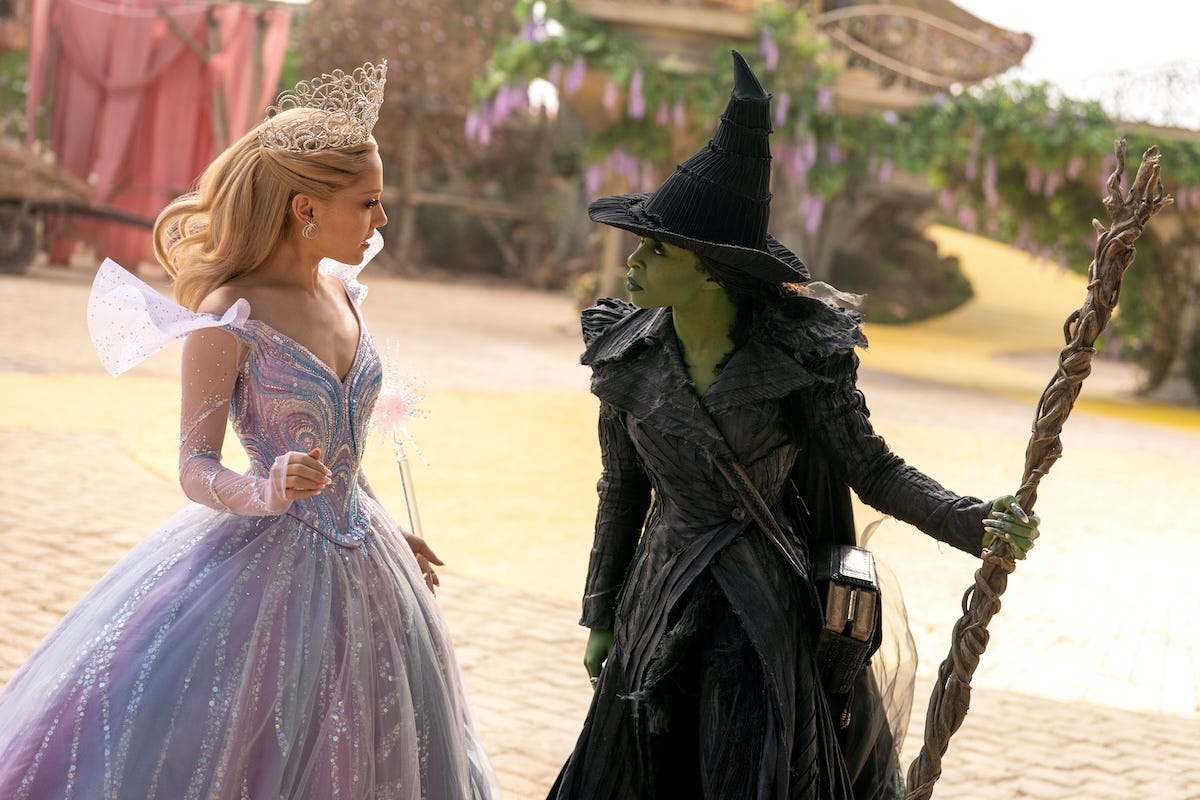
CARDS ON THE TABLE: Wicked: Part One wasn’t really for me, as I noted in my review, but it had some charming moments and an undeniably infectious and energetic performance from Ariana Grande, who bubbled and blustered her way through the role of Glinda with a sort of catastrophic naïveté. Plus it had some showstopping songs and a couple of delightfully choreographed dance scenes (albeit ones that were overedited in a way that really stripped them of their jaunty power). I didn’t dig it, but I could see why people inclined to dig that sort of thing would.
Wicked: For Good, on the other hand, is a sodden, soggy mess. There’s a hint of an interesting movie just beneath the surface—one that focuses more tightly on the Tin Man, Cowardly Lion, and Scarecrow; a politically minded body horror film reflecting shades of Tetsuo: The Iron Man and David Lynch’s interest in the morbid ugliness beneath the glossier things—but that hint is buried under endless, lifeless songs, an overly dark color palette, and a ham-handed Nazi metaphor that’s tossed in almost as an afterthought.
Picking up a few years after the first film, Wicked: For Good quickly sets the stage. Elphaba (Cynthia Erivo), who has been rebranded the Wicked Witch of the West by the Wizard of Oz (Jeff Goldblum) and his mouthpiece Madame Morrible (Michelle Yeoh), is on the run, doing what she can to aid the oppressed animals of Oz. Glinda (Ariana Grande) nears marriage with Fiyero (Jonathan Bailey), a prince who is still harboring feelings for Elphaba and is distressed that Glinda has gone along with the Wizard and Morrible’s campaign of character assassination. Elphaba’s sister, Nessarose (Marissa Bode), is now in charge of Munchkinland, their father having died of shame at Elphaba’s evil turn; she yearns for the affection of Boq (Ethan Slater), who in turn pines for Glinda.
There are interesting threads to pull here about the nature of the information economy and the sad fact that, ultimately, people want something they can believe in rather than more difficult truths. But the film’s theses can never really gain traction because it is, ultimately, an exercise in box-checking. Here’s where the flying monkeys come from, here’s why the Lion is so cowardly, here’s why the Tin Man has no heart, here’s the horrifying way the Scarecrow gained sentience. And here too there’s a nugget of an idea, the way tragedy can twist people. But this isn’t a movie about Dorothy’s trio of helpers and their understandable rage at the world in which they’ve been trapped by Elphaba.
No, it’s a movie about how Glinda and Elphaba need to be allowed to feel good about themselves no matter how much harm they do to everyone around them.
That solipsism would be fine if the songs that dot the picture were catchy in the slightest (they aren’t; I couldn’t hum a bar of a single tune I heard just hours ago) or if there was some impressive choreography to the showtunes (there isn’t; it’s a weirdly empty movie after the overstuffed aspirations of last year’s Part One, almost as if they blew their whole extras budget on the first film). And you get the sense that director Jon M. Chu and writers Winnie Holzman and Dana Fox know the emotional pull is lacking, hence the bizarrely undercooked subplot about talking animals being like Jews in Nazi Germany that’s tied to nothing in the rest of this movie. It’s just an idea floating in the wind like a bubble carrying a powerless witch.
Unlike the first installment, this movie doesn’t manage to be fun. The whole thing is just a dreary, pointless slog. Again: these movies aren’t really for me. And maybe it’ll be fine fodder for those more inclined to enjoy it; you know who you are. But I didn’t care for it much at all.
I didn’t wind up reviewing The Running Man, much to my editor’s chagrin, but we did discuss it on Across the Movie Aisle this week, which you can listen to right here:

And Now for a Different Kind of Wizard …
I WAS LUCKY ENOUGH to be invited to join my colleagues Sarah Longwell and Will Sommer at Indyfest last week for a panel hosted by the indispensable Jon Ralston, the man who knows Nevada politics better than anyone. (You can watch the panel in full here; please feel free to yell at me for wearing those kick-ass sneakers on a stage, I have no regrets.) As discussed in the Movie Club episode about Rounders, I love going to Vegas because I do enjoy just sitting at a poker table for six to eight hours and watching the ebb and flow of the game. (I left down about $50 this time around; I’ll get it back next year if Jon has us back.)
But gambling is no longer Vegas’s biggest draw for me. Nor is the dining (though it’s exquisite, if pricey), as I can eat well just about anywhere these days. There really isn’t much unique about Vegas any longer. There’s nothing that Vegas and only Vegas has: magic shows, Cirque du Soleil, concerts … these are available all over.
Except for one thing. There’s one shining monument to human greatness that dwarfs all others on the Las Vegas Strip, one last reminder that we can, if we set our minds to it, do great things.
I speak, of course, of the Sphere.
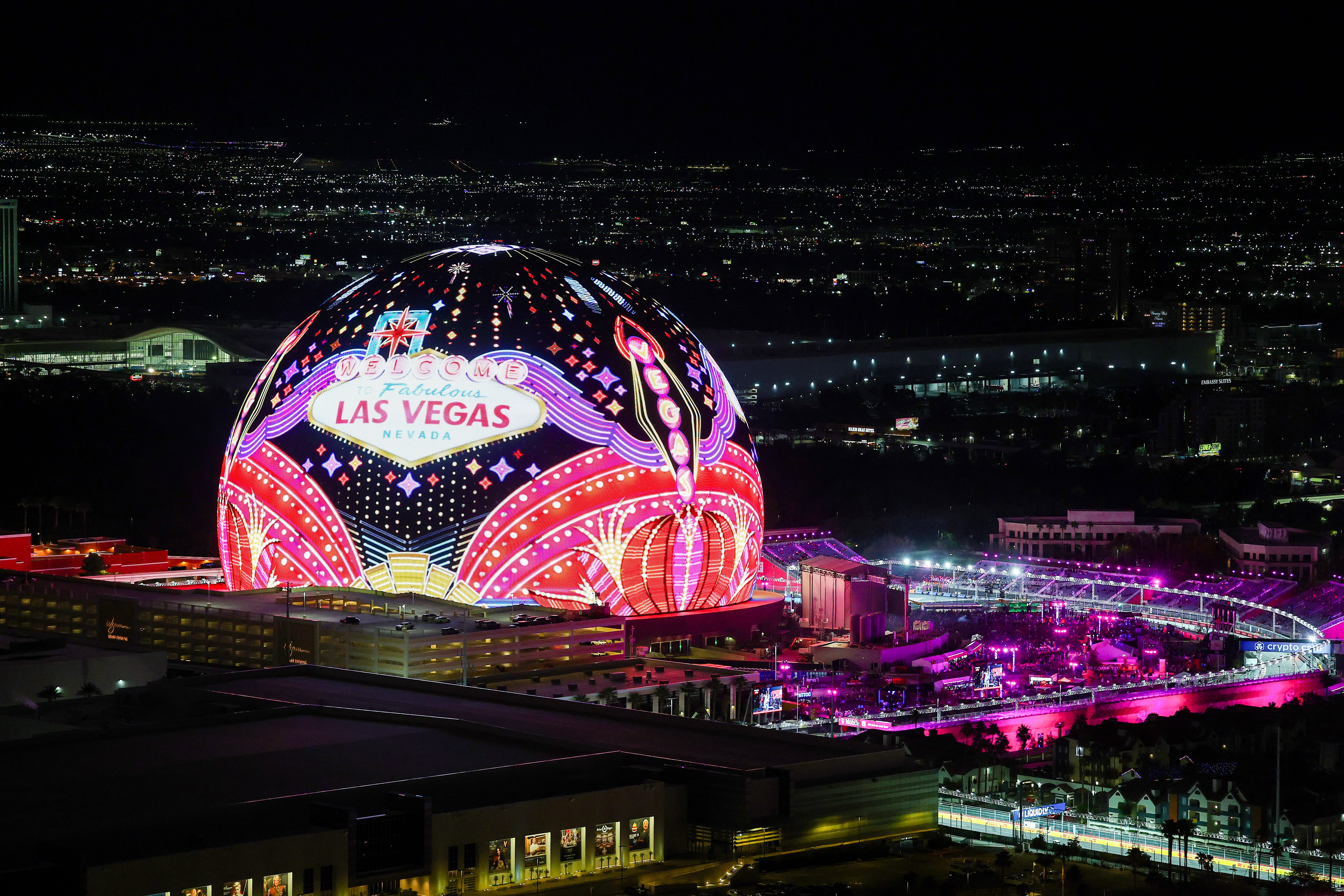
I wrote earlier this week about Pope Leo’s command for everyone to go to the theaters and how the cinema is a church-like sanctuary from the world, a place where everyone can unplug and immerse themselves in a different world, a different point of view. If a movie theater is a church and our movie palaces like the El Capitan in Los Angeles or the AFI Silver in Silver Spring, Maryland are cinematic cathedrals, then the Sphere is something like a megachurch run by a demented offshoot of the Gemstone clan. Garish, yes, but still filled with the holy spirit and serving a grand purpose: getting people back to the movies.
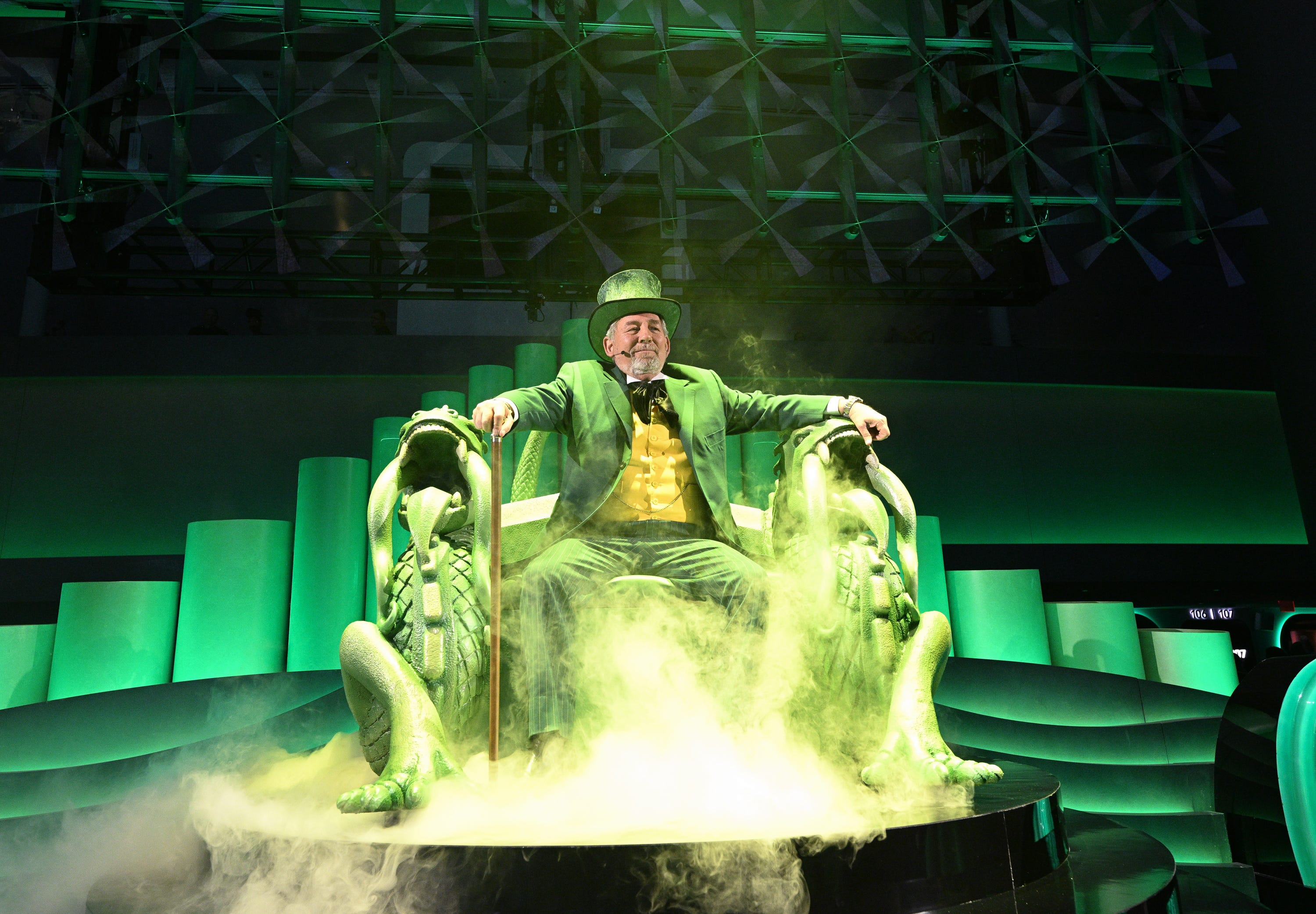
And The Wizard of Oz at Sphere—distinguished, importantly, from The Wizard of Oz, proper, as these are two very different things—is, by all accounts, an enormous success on that front. People are showing up despite the $200-per-ticket price tag in droves; the show we went to was probably 90 percent full, a handful of those in attendance dolled up as Dorothy or Glinda or the Scarecrow.
Seeing The Wizard of Oz at Sphere is fascinating because it’s like watching two different movies grafted onto each other. There are whole making-of featurettes out there, I’m sure, that could run you through the process of how they actually upgraded the film on which The Wizard of Oz was shot to make it compatible with the Sphere’s 16K screen. But what it looks like they did is rotoscope out the actual actors, run them through an AI de-aging filter to smooth anything resembling a trace of humanity out of their faces, and then reinsert them onto a 16K background created and designed specifically to be seen within the Sphere itself.
The result is a baffling combination of technical virtuosity and slapdash mediocrity. I want to be very clear on this: Everything that was crafted for the Sphere in this amalgamated production is impeccable. Truly beautiful, in fact. We see mountains Victor Fleming never could have imagined, trees that look as though they go on for leagues, flowers with colors never before perceived. And then the characters we know and love, Dorothy, the Tin Man, all the rest, show up and it’s … unsettling. Not just because they’ve been upscaled into something not-quite-real. They move in odd parallax to the action on the back of the screen, as if they are all actors in front of a misplaced green screen.
I cannot emphasize enough that whatever AI trickery has been done to their faces, particularly in the sepia-toned prologue and finale, is deeply unsettling. This is especially true for the older actors, like Clara Blandick: it’s as though someone was trying to rebuild Auntie Em’s appearance from memory, resulting in something like the botched restoration of Ecce Homo.
And yet. And yet. As long as you understand that this is not The Wizard of Oz—as long as you can accept that it has been truncated by some thirty minutes, as long as you can allow for the technological tinkering that is needed to bring this show inside James Dolan’s shimmering LED ball—I think you might have fun with it. Because it is a truly immersive experience, one in which the most realistic screen ever created combines with wind machines, fog generators, and in-seat haptics to make it feel as though you’re inside the movie, at times. Half movie, half theme park attraction, The Wizard of Oz at Sphere is truly sui generis; there’s nothing like it in the rest of the world.
Look, I’m the sap who paid more than a hundred bucks, twice, to see Darren Aronofsky’s anti-human nature documentary, Postcard from Earth, in the Sphere. So take all this with a grain of salt. But there’s something genuinely awe-inspiring about the venue, awe that is magnified by the gasps and the titters and the cheers from those who have also embarked on this journey. I can get a good steak or piece of sushi anywhere. I can stand up from my desk and sit down at a blackjack table in ninety minutes, traffic willing. No need to go to Vegas for that.
But the Sphere? That’s something worth traveling for.
Having seen the musical 5 times but not the second movie yet, I can say the animal thing is... weird. It absolutely comes out of left field and just serves as the motivation for Elphaba to turn against the vaunted "Oz." Beyond the initial realization that Wizard might not be a really upstanding guy, the entire subplot is jarringly disjointed from the rest of the story. However, you have to blame the book and play for this, not the movie writers. Had they changed it, musical fans would have revolted, and ultimately this movie was made for those fans.
I loved the first one specifically because it was so faithful to the source material, and I expect I'll enjoy For Good equally; "No Good Deed," "As Long as You're Mine" and "For Good" are some of my favorite songs from the whole soundtrack. However, if you're not a fan of the original, I could certainly see why you might not enjoy it.
So well put. I have been a screen-resolution punk since the Atari 2600 days -- multiple screens, highest resolution, crisp displays like the old XBR series (really expensive then, put to shame by a $399 65 inch TV today), and every smartphone that adds more pixels. I am also a software guy who has written graphics software and love watching my extended family of graphics-geeks do wonders (Pixar, anyone?) on digital screens.
And so I am obsessed with the Sphere's 16K screen, bigger than a football field in area. And the 164,000 speakers that for some reason help you believe the screen is even higher resolution. If the software and the imagery are creative and doing the most they can, count me impressed. This has led to my obsession, having attended at least one of every performance at the Sphere offered to the public. I will head back to see WOZ for a second time in a couple of weeks.
BTW, the most impressive (from a software perspective) thing about the WOZ creation is the cold open -- A Radio City Music Hall simulacrum to die for. Many, many people do not realize the proscenium is entirely an on-screen construct, especially if it is their first Sphere experience. As the software has improved, the greatest Sphere trick is to simulate that the space inside is much larger than it is (BSB opening did a very nice job at this). It is one thing to do helicopter ride thrills, but the Eagles opening with the Sunset Blvd/LA scene and the WOZ empty stage are masterpieces in realizing the Sphere's potential. Playing with space is time-honored for architects and now can be done virtually in amazing ways. Enjoy.