A Religious Rebellion Against Mass Deportation
American Christians are showing increasing discomfort with Trump’s signature policy.


Donald Trump posted a new “tariff letter” yesterday, and this one was notable because it didn’t follow the template of the others. Yes, it included the standard complaints about “Brazil’s Tariff, and Non-Tariff, Policies and Trade Barriers” as it threatened/announced a 50 percent tax on all imports to the United States from Brazil (sorry, fellow coffee drinkers). But half the letter was a specific complaint about the supposed mistreatment of former Brazilian President Jair Bolsonaro, whom Trump says he “respected greatly.”
Bolsonaro was a Trumpian populist strongman who encouraged his supporters to storm the Brazilian legislature after he lost re-election. No wonder Trump was a fan.
Happy Thursday.
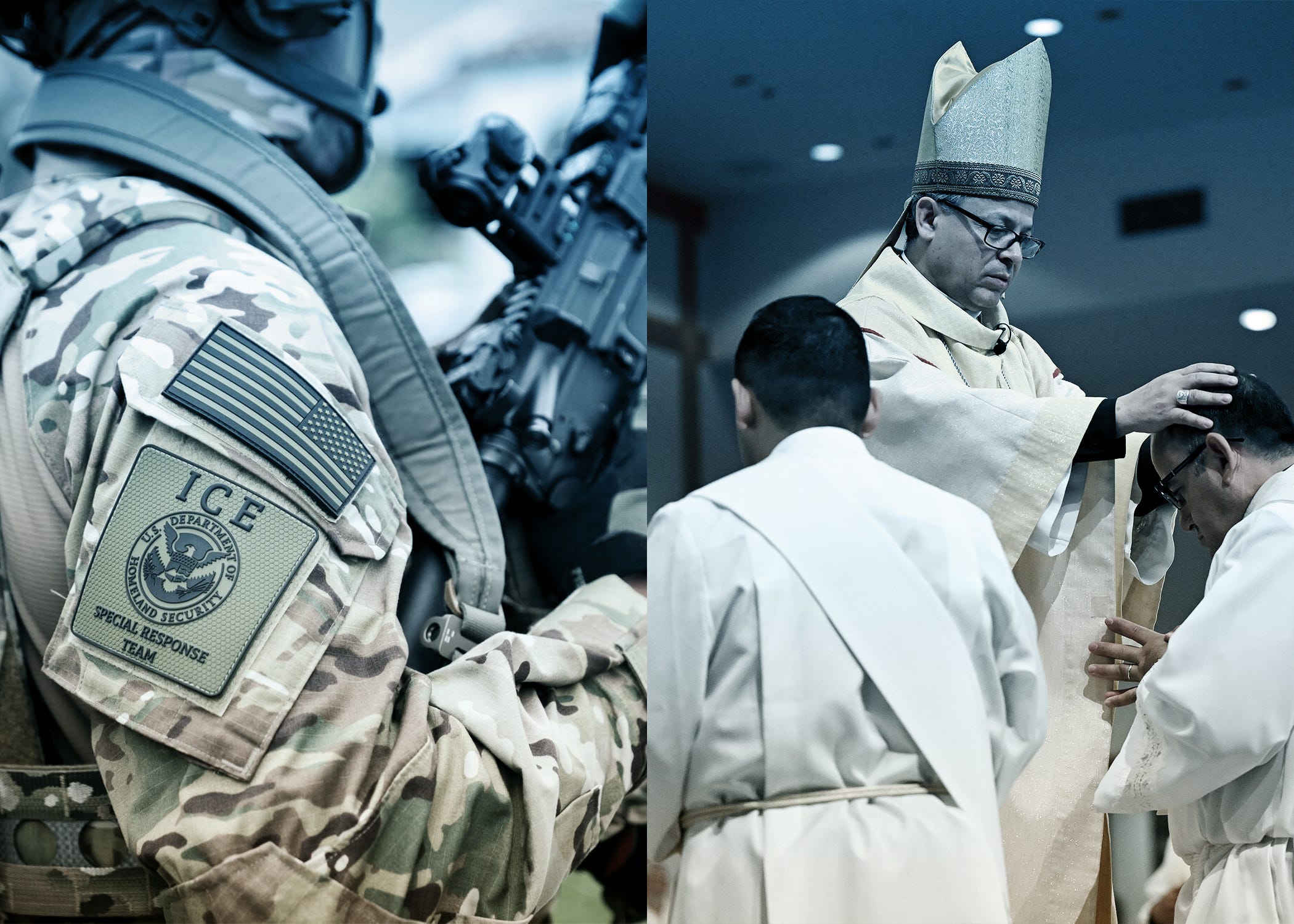
Church Leaders Denounce Deportations
by William Kristol
Donald Trump rode the issue of immigration to the presidency twice. What that issue primarily meant to Trump and his supporters, in both 2016 and 2024, was fixing a porous southern border, and preventing the kinds of crimes allegedly committed by immigrants who had come across that border.
But the center of gravity of the immigration issue has changed. It’s now Trump’s mass-deportation agenda. And it’s becoming pretty clear that the politics of mass deportation could turn out to be very different from the politics of controlling the border. Could the spectacle of a mass-deportation campaign become a political vulnerability for Trump?
I think so. But what’s newly interesting is the possibility that mass deportation could be creating particular problems for Trump among churchgoing Catholics and Protestants, groups that have disproportionately supported him in the past. There appears to be growing unease in the churches with Trump’s signature policy. We don’t know yet how widespread the discomfort is. We certainly don’t know how widespread it could become. And we don’t know whether discomfort will turn into active disapproval. But we may have seen a couple of leading indicators this week.
In California, Bishop Alberto Rojas leads more than 1.5 million Catholics in the Diocese of San Bernardino, east of Los Angeles.1 It’s the nation’s sixth-largest Catholic diocese. And this week, Bishop Rojas took the extraordinary step of formally excusing parishioners in his diocese from the obligation of attending mass weekly, because of the possibility immigration officers would seize people coming to or from church.
“There is a real fear gripping many in our parish communities that if they venture out into any kind of public setting they will be arrested by immigration officers,” Rojas explained.
Sadly, that includes attending Mass. The recent apprehension of individuals at two of our Catholic parishes has only intensified that fear. I want our immigrant communities to know that their Church stands with them and walks with them through this trying time.
Now it’s fair to point out that San Bernardino is more heavily Hispanic than most areas, and that Rojas’s action is for now an outlier, and may remain so. (One other bishop, in Nashville, has taken a similar step.) On the other hand, it’s still a striking action, and one wonders what ripple effects it will have in the Church and among churchgoers. Especially because Pope Leo XIV—who is, after all, the first American pope—has also indicated that he is sympathetic to the plight of immigrants here in the United States and is critical of mass-deportation efforts. (For more on this, read Joe Perticone’s excellent piece on the collision course that the Church and Trump seem to be on.)
Will this ultimately affect the voting of American Catholics, who supported Trump by 14 points over Kamala Harris in 2024, a marked increase from Trump’s 5-point margin over Biden in 2020? It could. Trump doesn’t seem at all inclined to let up on his mass-deportation efforts. Nor is the Church likely to become less critical of those efforts over the next year. How many masses will there be against mass deportation?
At the same time, the administration appears to be trying to marry its deportation campaign to the teachings of the Church—though in typically clumsy fashion. The Department of Homeland Security tried to enlist the Bible in its efforts, tweeting out a video with grainy footage of immigration agents on boats and helicopters carrying out their missions under cover of darkness, while featuring a voiceover of a Border Patrol agent:
There’s a Bible verse I think about sometimes. Many times. It goes, “Then I heard the voice of the Lord saying, ‘Whom shall I send? And who will go for us?’ And I said, ‘Here am I. Send me.’”
As Austin, Texas pastor Zach Lambert pointed out, in a much-retweeted post, that Bible verse is Isaiah 6:8—and the context in Isaiah cuts against DHS’s message.
“Here am I, send me” was the prophet Isaiah’s response after being called by God to deliver a message to the people of Israel. And what was that message? . . . “Your leaders are rebels, the companions of thieves. All of them love bribes and demand payoffs, but they refuse to defend the cause of orphans or fight for the rights of widows.” Isaiah 1:23
Pastor Lambert also pointed to Isaiah 10:1–3:
Woe to those who make unjust laws, to those who issue oppressive decrees, to deprive the poor of their rights and withhold justice from the oppressed of my people, making widows their prey and robbing the fatherless.
Pastor Lambert’s post, and others in the same vein, have gotten a lot of pickup and support on social media. Maybe the flacks at DHS should leave the prophet Isaiah alone, and go about their sordid business without seeking Biblical blessing? But they’ll presumably continue to claim the moral high ground for their efforts. Could that lead to a further backlash?
In any case, the reactions of Bishop Rojas and Pastor Lambert to mass deportations seem notable to me. Are they important leading indicators of resistance to Trump in their communities? I wouldn’t claim to know. But sometimes politics, like the good Lord, moves in mysterious ways.
‘I’ll Still Be Here’
by Sam Stein
The Senate will soon consider a package of spending cuts known as rescissions, that was introduced by the White House and passed by the House of Representatives. Early indications are that Republican senators want changes. That’s partially because the package contains deep cuts to global health, including a $400 million reduction in PEPFAR funds and a $500 million reduction in programs to combat malaria and tuberculosis, among other items.
Those initiatives have already been hit hard by the massive cutbacks the administration made to USAID. Additional funding restrictions would be absolutely disastrous. A Bulwark reader who does HIV prevention work in Africa—work that relies, in part, on USAID and PEPFAR funds—described a bleak situation. His email has been edited for length and to protect his identity.
Our clinic is still open, but a lot has changed. Our PEPFAR funding, which was previously administered by USAID, is still coming. It will likely end around September 2026. I have found a metaphor that helps describe how I feel about the closure of USAID. My job is to catch the kids who fall through the cracks. USAID’s job was to make the cracks smaller. Now, a lot of work is still happening, but it feels unsteady. You can really feel the cracks getting bigger. For example, all of the HIV medicine for children that we have at our clinic is expiring in a few weeks. We have been waiting for months for a resupply, and it’s not just us. It’s every clinic in the country. Last week, we finally got word that a shipment had arrived in the country. I can’t say for certain that this has anything to do with USAID cuts, but I can tell you that nothing like this has happened in years. Before six months ago, I never checked a medication delivery. Now I check every one. This is what I see on the ground. USAID was an organization that provided stability. Now that stability is gone and everything feels tenuous. STI medications have become scarce. Nutrition supplements are still available, but there’s no funding for delivery. I even heard that the tubing to give oxygen to newborns was in low supply. It’s not even expensive.
Testing is down, new treatment initiations are down, viral-load monitoring coverage is down. Things might bounce back, but remember that a lot of these numbers represent lives already lost. I see the same at the hospital next to our clinic. The testing coverage has really fallen dramatically. The majority of the missed diagnoses will not live another year. Adults can live a long time without HIV treatment, but children die quickly. We can’t miss any of them.
Just remember that it will be the children who pay the price for these cuts. Who dies from malnutrition? Children. Who dies from malaria? Children. Who dies from untreated HIV? Children. I love my job, but it can be really hard sometimes. How do I get out of bed every morning after seeing the things that I see? One thing that has kept me going is reflecting on the tremendous progress that has been made. At least things were getting better. Now decisions have been made that will make my job more difficult. I’ll still be here, but instead of drawing strength from progress, I’m afraid. I will stay as long as I can.
—Sam Stein
AROUND THE BULWARK
What’s Left of William F. Buckley Jr.… The conservative movement he built is now besotted with the kinds of characters and urges he repudiated, writes BRIAN STEWART in a review of the big new biography of the conservative icon.
Grok Declares Itself MechaHitler?! It was a big day for Twitter/X, as its CEO departed as Grok, the AI function of the service mysteriously became a digital Nazi. At Bulwark+ Takes, SONNY BUNCH and WILL SOMMER break it all down, and on The Next Level, SAM STEIN, SARAH LONGWELL, and JVL cover Grok, along with the forever tariff war and the Epstein files.
Why Trump’s Bill Might Not Be the Elixir Dems Imagined… Democrats’ initial optimism is fading as the bill’s political reality sets in, writes LAUREN EGAN at The Opposition.
Quick Hits
TRUMP 💔 PUTIN, BUT TRUMP ❤️ POWER: Congress, when it remembers that it’s allowed to to have ideas of its own that aren’t dictated by Donald Trump, sometimes recalls that it’s not so fond of the Russian government and Vladimir Putin.
There’s been a bill kicking around quietly in the Senate for months that would impose secondary sanctions on countries that buy Russian oil. The original sponsors are Sens. Lindsey Graham (R-S.C.) and Richard Blumenthal (D-Conn.) and it has 83 cosponsors in all. Now, fresh off a spat with Putin, Trump said he’s “very strongly” “looking at” the bill. But more recently he has given hints that he may actually not be in love with it. At a cabinet meeting, he said he wanted to ensure whether and how to enforce sanctions was “totally at my option.” More recently, it was reported that the administration is worried about “micromanaging” by Congress. (Some call that lawmaking; tomato/tomahto.)
Still, absent a veto threat, Majority Leader John Thune says a vote on the bill could happen by August 1.
There are serious arguments for and against so-called secondary sanctions. On the one hand, oil exports are a major source of revenue for the Russian government, and without revenue it’s really hard to fight a war. On the other hand, sanctioning a bunch of countries we should really be cooperating with—like, say, India—and raising the global price of oil might not be a diplomatic masterstroke.
But Trump is probably thinking about this differently. If he has the authority to impose or remove sanctions at whim, just imagine how much extortion he can do! Maybe he could even build Trump Tower Moscow after all.
IT’S JUST ONE MEASLY SHOT: The number of measles cases in the United States is now at a three-decade high. As of this week, nearly 1,300 people around the country have the disease—up from 285 in all of last year and 59 the year before. According to the CDC, 90 percent of the people who have contracted the highly infectious virus either were unvaccinated or had an unknown vaccination status.
Some of those people have no one to blame but themselves (or their parents), and we hope they make full recoveries and learn from their mistakes, both for their own sake as well as for that of others. Because some people can’t get the measles vaccine for a variety of health-related reasons. Imagine being one of those people and then getting measles because the parents of some kid in your kid’s class decided they wanted to be “natural.” It’s infuriating, for sure. And scary.
Measles is among the most contagious diseases in the world, with each case leading to between 12 and 18 other cases. Each COVID case, by contrast, was estimated to cause between one and three additional cases.
Measles may be less deadly than COVID: The observed case-fatality rate for COVID in the United States was about 1.1 percent; for measles it’s closer to 0.3 percent. But measles has a nasty trick: In addition to attacking the nervous system, which causes permanent deafness in some patients, the virus also attacks the immune system. Specifically, it attacks the T and B cells, which are the cells that “learn” how to fight previously encountered infections. So a measles infection can leave a person almost defenseless against a host of other infections.
Luckily, the measles vaccine appears to be one that Secretary of Health and Human Services Robert F. Kennedy Jr. dislikes least—though he still insists on repeating false information about it.
CHINA FIRST, AMERICA LAST: One of the most underrated jobs in any administration is the under secretary of defense for policy. Often called the Pentagon’s number-three official, behind the secretary and the deputy secretary, the list of powers and responsibilities for this job is enormous. But it fundamentally boils down to deciding what the Defense Department, its millions of employees, and its hundreds of billions of dollars should do.
Elbridge Colby is the current holder of the office. He is the dean of the “China first” foreign policy school, believing that China is the most important challenge to American national security and everything should be focused on overcoming that challenge.
But according to a recent report in Politico, there might be something other than China motivating Colby.
When the British defense team came to the Pentagon in June and spoke about the U.K.’s decision to send an aircraft carrier to Asia on a routine deployment, Colby interjected with a brusque comment.
“He basically asked them, ‘Is it too late to call it back?’” said the person familiar with Trump administration dynamics. “Because we don’t want you there.” . . . “He was basically saying, ‘You have no business being in the Indo-Pacific.’ . . .
“DOD has been telling a European partner that we don’t need the Europeans to be doing anything [in the Indo-Pacific],” said one U.S. official familiar with the conversations.
The upshot of the article is that Colby seems less interested in amassing as much united opposition to China as possible than in offending as many American allies as possible. His “restrained” and “focused” foreign policy really seems like old-fashioned isolationism.
Using a Pacific orientation as a fig leaf for isolationism is nothing new.
Back in the early Cold War, a bunch of formerly isolationist Republicans were in a difficult spot. They didn’t control their party; the New Deal Democrats had just presided over one of the great military victories in the history of the world; the United States was an undisputed superpower; and the Soviets were a real threat. Many of them, uncomfortable with “foreign entanglements” but unwilling to reprise their pre-war isolationism, became Asia-firsters. They pilloried the Truman administration for “losing” China to the Communists and they inveighed against European alliances like NATO, supposedly because Asia was the most important region of the world.
Elbridge Colby’s China-firstism is just the same thing warmed over.
Cheap Shots

Correction, July 10, 2025, 11:20 a.m.: An earlier version of this newsletter incorrectly identified San Bernardino as west of Los Angeles rather than east.
WOW. Are Christians going to start behaving like Christians? Dubious.
For goodness sake, don't hold your breath for US church groups to fix this mess - they were instrumental in putting us here. Antonin Scalia, Bill Barr, the Catholics on today's Supreme Court...the Catholic New Right who were the architects of Project 2025. We won't even talk about the evangelicals.
A fine mess we're in!